

14-Day Money-Back Guarantee
0
The short answer
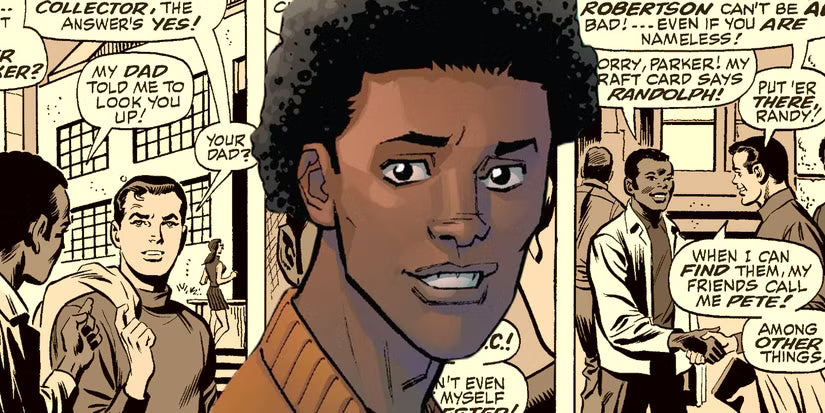
A student activist who grew into a clear-eyed adult, Randy Robertson embodies courage without a costume: he takes on the social injustices of New York where the web-slinger is powerless. Peter's flatmate and later his confidant at Empire State University, he senses his secret but chooses not to dig. His full story below.
A quiet but essential figure in the web-slinger's circle
Among the many friends and confidants of Peter Parker, Randy Robertson holds a unique place. The son of Robbie Robertson, a respected editor at the Daily Bugle, Randy grew up in the shadow of newsroom battles between truth, justice and the media manipulation orchestrated by J. Jonah Jameson. But unlike his father, Randy was never content simply to watch — he chose to act, often at the risk of his own safety.
First appearing in The Amazing Spider-Man #67 in 1968, he embodies a **younger, more militant generation**, shaped by the racial and social struggles of the United States at the time. His early appearances tie directly into powerful themes: segregation, police brutality, and the gulf between the classes in New York. Randy becomes the voice of change in a world where Spider-Man, for all his powers, cannot fix everything.

Between conviction and friendship: a solid bond with Peter Parker
Randy and Peter meet at Empire State University, where they become flatmates. That friendship, built on respect and openness, survives the revelations and the tensions of the era. Randy is one of the few characters to have sensed Peter's double life — a shy young man, often absent, yet driven by an almost superhuman sense of duty. Without ever knowing the identity of Spider-Man, Randy senses he leads a far more complicated life than he lets on.
Their closeness stands out for its **deep humanity**. When Peter doubts himself, Randy reminds him that heroes are not only the ones who wear a mask. That dynamic gives rise to several touching scenes, particularly in Spider-Man: The College Years, where Randy helps Peter juggle studies, work and personal commitment.
To revisit the student world of Peter and his friends, explore our Spider-Man clothing collection inspired by New York campuses, or discover our Spider-Man figures featuring his most iconic allies.
Randy Robertson, the voice of a committed generation
From his earliest comics appearances, Randy Robertson stands out for his protest energy. Where Peter Parker lives in guilt and discretion, Randy is his exact opposite: he acts in the open, leading **student movements and social protests** against corruption, racism and inequality in New York. He is a figure deeply rooted in the social reality of the 1970s — something rare in the comics of the period.
His first major involvement comes during the 'Crisis on Campus' storyline, where he opposes the university's budget cuts and police brutality. Peter, as Spider-Man, witnesses these tensions without being able to step in directly. It creates a poignant contrast between **the masked hero** and **the activist without a costume**, two forms of courage that coexist but do not always understand each other.
A fight rooted in the reality of New York
Randy does not fight super-villains: he fights injustices that are far more human. He calls out the gentrification of neighbourhoods, racial discrimination and the media manipulation of the Daily Bugle — the very paper where his father works. The opposition between the journalist father and the activist son becomes a powerful metaphor: **truth against the system**, **words against action**.

In several later arcs, particularly in Peter Parker: The Spectacular Spider-Man, Randy grows closer to other activist figures such as Glory Grant or Tombstone (in a tragic opposition between good and evil). He comes to understand that the line between social justice and violence is thin, and that some battles can only be won through dialogue.

The evolution of an idealist facing disillusion
Over time, Randy changes. He matures, he doubts. The ideals of youth collide with the complexity of the real world. But even if he is no longer as loud as he once was, he stays true to his sense of justice. Later on we find him as **moral support for Peter and MJ**, a clear-eyed adult who has kept his faith in human values.
In some modern arcs, notably Friendly Neighborhood Spider-Man, Randy returns as an **emotional anchor**, symbolising the continuity between generations of characters. It is this narrative consistency that makes him a quiet but essential pillar of the web-slinger's world.
You can also rediscover this historic period through our Spider-Man poster collection inspired by vintage comics, or dive back into those urban struggles with our classic masks drawn from Marvel's early decades.
Randy Robertson's relationships: loyalty, love and tragedy
An unshakeable friendship with Peter Parker
Ever since their university years, Randy Robertson has been one of the few friends of Peter's to bring emotional stability to the constant turmoil of his life. While many drift away because of the secrets or the dangers surrounding Spider-Man, Randy remains a solid anchor. He does not judge, he supports. He is one of those who remind Peter that he does not need a costume to be a hero.
In several recent arcs such as Friendly Neighborhood Spider-Man, we find this adult friendship again, sincere and settled. Randy no longer ignores the fact that Peter is hiding something enormous, but he chooses not to dig — proof of a rare trust in a world where masks are everywhere.
This bond also recalls other human friendships of the web-slinger, such as the one with Harry Osborn or Flash Thompson, but with a maturity those two often lost. Randy is the friend who does not try to understand Spider-Man — he simply loves Peter Parker.

Glory Grant: the activist ally and confidante
Randy also shares a deep bond with Glory Grant, another figure from the Daily Bugle. Their relationship develops against a backdrop of social struggle and the fight for justice. Both believe in a better world and embody a plural, aware and progressive New York. Even if their romance was never fully explored, their duo remains emblematic of a more human era of Spider-Man comics: the one where personal commitment replaced super-powers.

Their relationship echoes the evolution of Peter and Mary Jane: two couples grounded in reality, reminding us that the world of Spider-Man is not only made of battles, but also of feelings and everyday solidarity.
Janice Lincoln: the impossible love
But it is with Janice Lincoln, the daughter of Tombstone, that Randy's life takes a tragic turn. Their relationship is a clash of worlds: him, the son of a humanist journalist; her, the daughter of a notorious criminal who became the super-villain Beetle. This unlikely couple embodies the tension between love and legacy, between light and darkness.
Despite their differences, Randy sees in Janice what no one else ever has: a woman looking for redemption, tired of crime and of the weight of her name. But their story ends up breaking under the pressure of their respective pasts. It is one of the most beautiful and most painful secondary romances in the whole Spider-Man universe, recalling the tragedies of Gwen Stacy or Felicia Hardy.
This relationship gives Randy a more complex, melancholy dimension, proving that even without a cape or powers he carries a dramatic depth that is rare among the supporting cast of the Marvel universe.
For fans of these tender yet tragic romances, discover our Spider-Man phone cases inspired by the most iconic duos, or explore the fancy dress collection dedicated to his allies and to Spider-Man himself.
Randy Robertson's legacy: humanity before powers
A symbol of balance in a universe of chaos
In a world dominated by super-villains, symbiotes and cosmic threats, Randy Robertson embodies something precious: normality. He is one of the few characters to remind us that behind every heroic fight there is a society to save — not just lives. He stands for the idea that justice does not come through force alone, but also through words, empathy and persistence.
Randy, with no costume and no mask, succeeds where many heroes fail: he keeps his faith in humanity. And that is exactly what Peter Parker admires in him. As Uncle Ben put it so well: 'With great power comes great responsibility.' Randy proves that even without great power, responsibility remains — the responsibility not to look away.
An heir to Robbie Robertson's values
Throughout the saga, Randy stays in the shadow of an exceptional father, Robbie Robertson. But rather than being crushed by it, he becomes its natural continuation. Where Robbie defends the truth through the press, Randy defends direct action, the ground, the concrete reality of injustice. Their father-and-son duo embodies two approaches to the same battle: the one against corruption and indifference.
In some modern versions, Randy even appears as a transitional figure, working in turn for the Daily Bugle or getting involved in community programmes in Harlem. That evolution makes him a bridge between eras, linking the classic values of the early comics of Peter Parker to the social issues of the 21st century.

The character's future: potential still untapped
Despite his narrative richness, Randy remains surprisingly underused in screen adaptations. While his father Robbie appears in the trilogy by Sam Raimi and in the Spider-Verse, Randy has never had his own interpretation on screen. Yet he would offer a rare emotional depth: a human friend in a universe of superhumans, a symbol of grounding against the temptation of power.

Some fans are hoping to see him turn up in future Spider-Verse films or in the MCU, alongside characters such as Miles Morales. Such an appearance would reinforce the idea that heroism can also come from those with no web and no costume, just an enormous heart.
Randy Robertson: the thread of a persistent humanity
Randy does not fight to be recognised. He fights so that others can exist with dignity. It is this deeply human dimension that makes him a cult character — quiet, but indispensable to the philosophy of Spider-Man. He, like Robbie, reminds us that Peter Parker is not only a hero: he is also a young man shaped by the ordinary people who, in the shadows, hold the world up.

