
14-Day Money-Back Guarantee
0
The short answer
Under contract with Beyond Corporation, Ben Reilly swaps the vigilante's improvisation for hard targets, cutting-edge kit and a chain of command. The experiment is short-lived: his memories have been tampered with, and the collapse that follows will lead him to the identity of Chasm. We look back at that slide below.
In this article
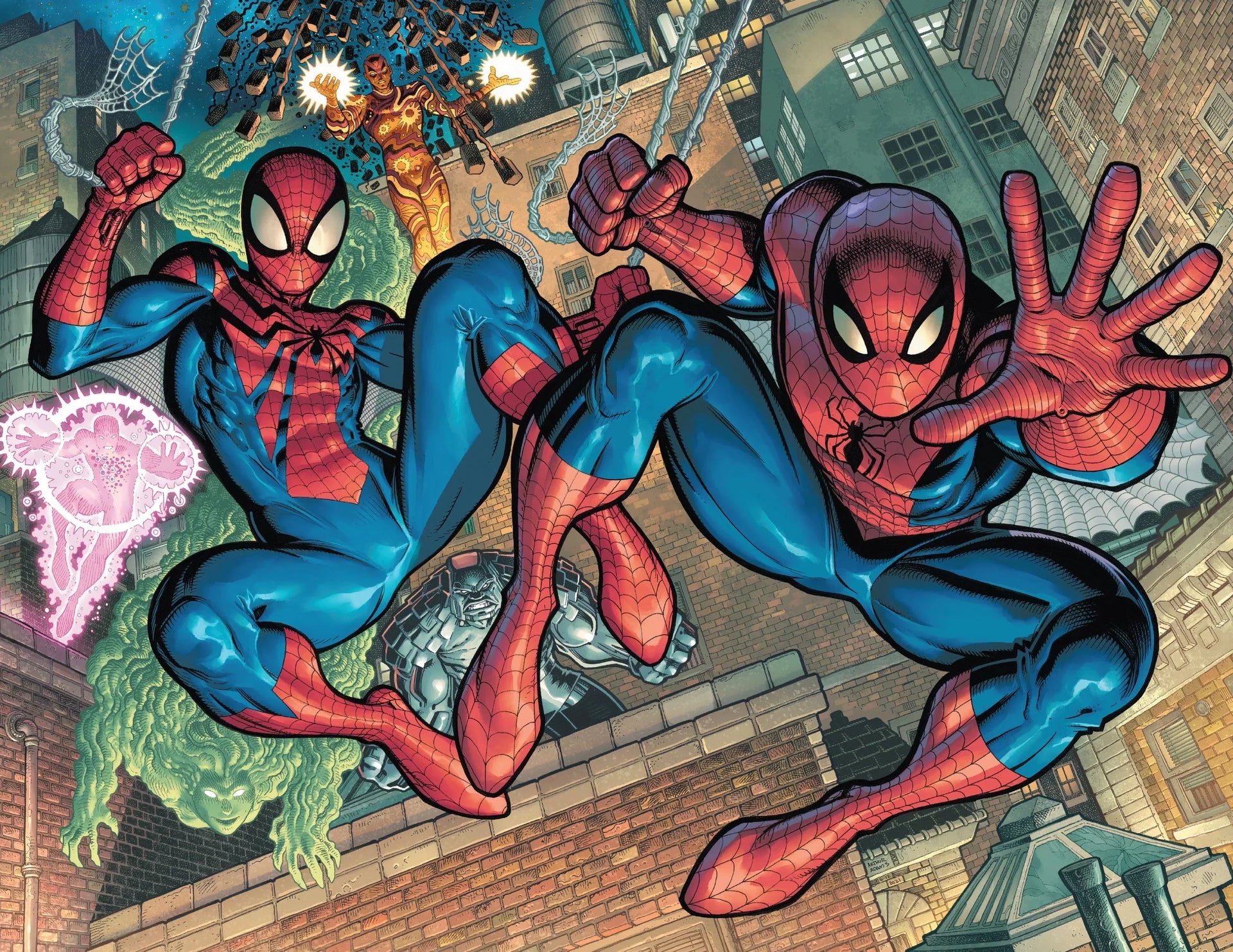
In launching the Beyond arc in Amazing Spider-Man #75 to #93, Marvel decided to shake up the rulebook. Temporarily written out: Peter Parker. From now on it is Ben Reilly, his clone and DNA brother, who pulls on the web-slinger's costume. But this time Ben does not come back alone: he is backed by Beyond Corporation, a mysterious company that intends to turn Spider-Man into... a registered trademark.
The very concept of Spider-Man is called into question. Can you buy a hero's image? Can you hand your values over to a private company? Marvel's answer is crystal clear: this experiment is going to blow apart everything that defines the role of Spider-Man.
Beyond Corporation's ambition is to professionalise Spider-Man: high-tech equipment, a secret base, optimised costumes, but also contracts, obligations and KPIs. Everything is designed to turn Ben into a corporate superhero… even if it means drifting away from the very heart of the character.
This arc opens on a gripping tension: can Spider-Man survive without Peter Parker? To dig into that question, we also recommend reading our page devoted to Peter Parker, or our article on Superior Spider-Man, where another ‘stand-in’ runs into the very same identity problem.
🕷️ For Ben Reilly fans, his ultra-stylish Beyond costume is also available in our Spider-Man figurine collection, perfect for completing your collection of multiverse variants!
Ben Reilly: a Spider-Man torn between past and future
Ben Reilly is not just a clone of Peter Parker. He is his memory, his pain, his values... but also his flaws. By agreeing to work for Beyond Corporation, Ben believes he can give his life meaning again, while offering an ‘optimised’ version of Spider-Man. Yet very quickly, the gap between the hero's ideals and the company's cold targets becomes unbridgeable.

Ben means well. He wants to prove he is worthy of the costume. But every mission pushes him closer to an existential crisis. Is he a hero, or an employee? Is he free, or simply a product? That tension reaches its peak when he discovers that Beyond Corporation is manipulating his memories, distorting his perception of reality and erasing what made him a full human being.
This question of identity points straight back to The Clone Conspiracy, another key moment where the figure of the clone sits at the centre of the drama. But here Ben's suffering takes on an even more tragic dimension, because it is inflicted by an organisation he believed was on his side.
The reader is torn too. We understand Ben. We feel for him. And we wonder, along with him, whether you can still believe in heroism in a world run by logos. That very modern theme makes the Beyond arc both a piece of storytelling and a comment on society.
🧠 To take that reflection further, we recommend our article devoted to Peter B. Parker, another version of a web-slinger battered by life, but still standing.

Hero or product?
Ben Reilly discovers that Beyond Corporation is manipulating his memories and distorting his perception of reality, to the point of erasing his humanity.
Peter Parker sidelined, but never erased
For much of the Beyond arc, Peter Parker is put on the bench. Poisoned after an intense fight with the U-Foe, he is hospitalised and physically weakened. But Marvel does not push him aside for all that: Peter keeps weighing on the story through his memories, his advice and, above all, the moral shadow he casts over Ben Reilly.
Every decision Ben makes is haunted by a single question: what would Peter have done? The absence of the classic Peter makes his symbolic power easier to see. Even out of the costume, he remains the ethical compass of the Spider-Man universe. It is also a rare chance for readers to see other characters – notably May and Mary Jane – take a more active role in the narrative.
Peter is not replaced: he is the bedrock. And it is precisely that stability which lets Ben realise that what he is looking for cannot be supplied by a company, only found within himself.
🕷️ Want to carry on Peter's legacy? Discover our Spider-Man mask collection or pull on one of our iconic costumes and live the web-slinger experience to the full.
The ethical compass
Poisoned after a fight with the U-Foe, Peter is hospitalised, but every decision Ben makes stays haunted by one question: what would Peter have done?
The fall of Beyond Corporation – and the return of the real Spider-Man
The further the plot goes, the more Ben Reilly realises he is being manipulated. Beyond Corporation's cracks become obvious: erased memories, orders given without scruple, and a cold determination to control Spider-Man's public image. When Ben discovers the scale of the mental conditioning he has been put through, he goes to open war against his creators. The final battle is both spectacular and tragic.
Stripped of his original memories, Ben Reilly loses all mental stability and becomes a ravaged, drifting, unstable Spider-Man. He will later take on a darker new identity: that of Chasm. For his part, Peter Parker, barely back on his feet, has to put the costume back on and tend the wounds left by this war of image and memory.

So Beyond ends on a double note: the failure of a ‘corporate’ Spider-Man model, and the reaffirmation of Peter as the one and only legitimate web-slinger. That tension between legacy and modernity, essence and artifice, sits at the heart of the arc.
🎬 To understand where this arc sits in continuity, you can explore every Spider-Man film adaptation or revisit our page devoted to all the merchandise.
🕸️ On the merchandise side, discover our Spider-Man slippers for hero-level comfort even at home, or pick a backpack in the web-slinger's colours to take on your day.
1
The manipulation revealed Ben discovers the mental conditioning he has been put through.
2
Open war He goes to war against his creators.
3
The turn into Chasm Stripped of his memories, he takes on a darker identity.
4
Peter's return Barely recovered, Peter puts his costume back on.

