
14-Day Money-Back Guarantee
0
The short answer
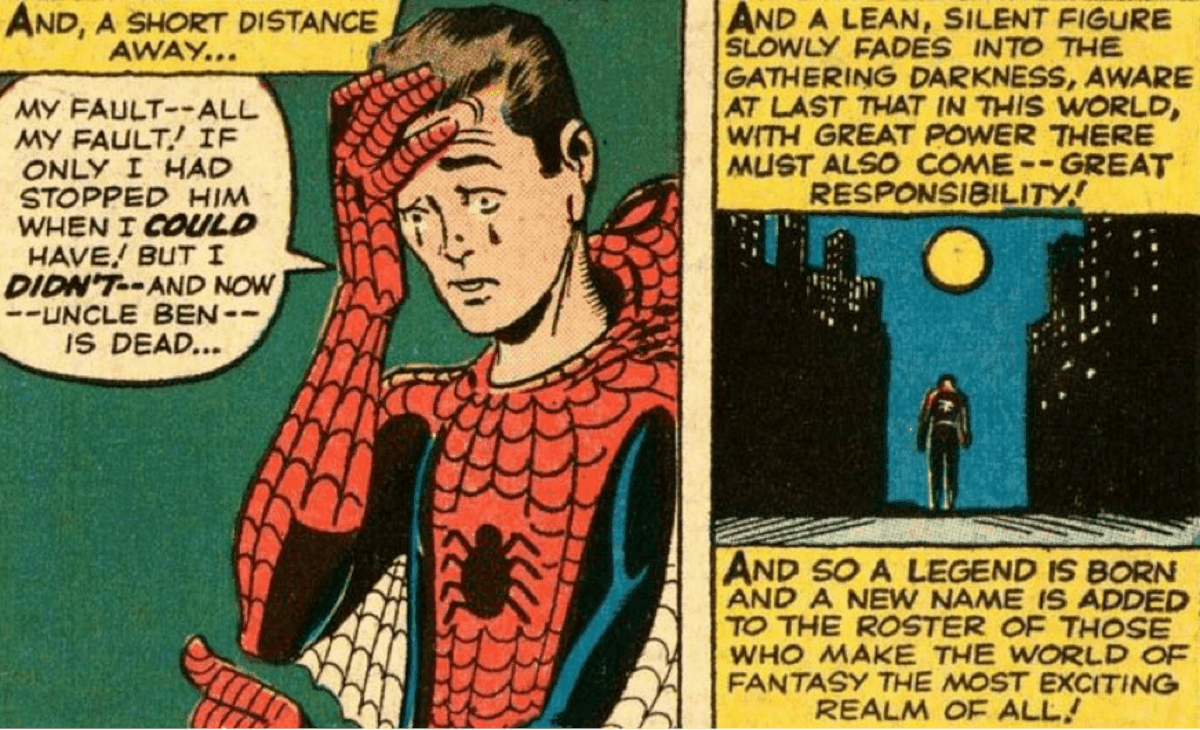
The line turns up as early as Amazing Fantasy #15, in 1962, at the end of the founding tragedy: a burglar allowed to walk away, then a family loss that can never be undone. From one trilogy to the next, spelled out or left unspoken, it explains why the hero acts out of guilt as much as out of idealism. Full breakdown below.
‘With great power comes great responsibility.’ This iconic line, first spoken by Uncle Ben, is far more than a throwaway piece of dialogue: it is the moral backbone of the entire Spider-Man universe. Behind the mask, Peter Parker is not a god, nor some untouchable symbol. He is a teenager, a student, a friend… and it is precisely this lesson that pushes him to become a true hero.
Where the quote comes from
The line first appears in Amazing Fantasy #15 (1962), the founding issue in which Spider-Man is born. After letting a burglar walk away out of sheer indifference, Peter discovers that that same man has killed his Uncle Ben .

That brutal emotional shock marks a point of no return. Peter understands that his powers are not a game, nor a personal privilege. They are a moral responsibility. It is at that exact moment that Spider-Man’s core philosophy is born, the one that will guide him for the rest of his life, far beyond the fights and the costumes.
A line echoed in every film
Whether in the films starring Tobey Maguire, Andrew Garfield or Tom Holland, the line is always there — sometimes spoken outright, sometimes buried in the emotional subtext. It travels across the generations and embodies the very soul of the character.

Every adaptation reminds us that Spider-Man is not defined by his strength, but by the way he chooses to use it. To explore these different incarnations in detail, have a look at our complete guide to the Spider-Man films .
A symbol of maturity and sacrifice
Very early on, Peter Parker learns that every action has a price. He could use his powers to make money, chase fame or simply buy himself some peace and quiet… but he chooses the opposite. He chooses to put himself on the line, to fight, to lose, sometimes even to suffer.
Because he knows that he is often the only one able to act. That tragic maturity, explored in many major story arcs such as Kraven’s Last Hunt or Dying Wish , makes Spider-Man one of the most human heroes in the Marvel universe.
A universal message
This line does not only apply to superheroes. It reminds us that the skills, the privileges and the opportunities we hold come with a responsibility towards other people. It is this deeply human dimension that explains why Spider-Man reaches far beyond the pages of a comic.
He is not a role model because he is powerful, but because he chooses to do what is right, even when nobody is watching.
Wear his values with pride
If this philosophy speaks to you, you can bring it into your everyday life too. Have a look at our Spider-Man T-shirt collection inspired by the films and the comics, or browse our collector figures to keep a symbol of courage, responsibility and commitment close to you.
Peter Parker: the human being behind the hero
To understand just how much this quote has shaped Spider-Man’s destiny, you have to dive into the personal story of Peter Parker . His choices, his failures and his sacrifices all prove that this line is not just a heroic slogan. It is his code to live by.
Every time Peter hesitates, every time he doubts himself or suffers, this maxim comes back like an inner voice. It explains why he keeps going despite the exhaustion, the losses and everything he gives up in his own life. Spider-Man is not a hero by vocation: he is one out of moral responsibility.
A motto echoed by other Marvel heroes
The power of this line is such that it has spread far beyond Spider-Man. You can hear its echo in other figures from the Marvel universe, such as Captain America or even Iron Man .
And yet, with Peter Parker, it takes on a unique dimension. Where some heroes act out of duty or out of a collective ideal, Peter acts because he learned this lesson through pain. It is a philosophy of life forged by loss, not a simple heroic maxim.
A lesson passed down from generation to generation
This message travels across the ages, the universes and the adaptations. In the comics, the films and the animated series, the same central idea always comes back: personal responsibility.
Even more recent heroes such as Miles Morales or Spider-Gwen , in the Spider-Verse , build this idea into the very heart of their journey.

This is precisely the principle that ties every Spider-hero together, despite their different worlds, cultures and destinies. The web that unites them is not only physical: it is moral.
Spider-Man: a role model for fans
What makes this line so powerful is that it resonates far beyond the pages of a comic. Whole generations of fans have grown up with this idea, taken it into their daily lives, sometimes even used it as a genuine personal reference point.
It teaches humility, courage and above all the importance of acting when you have the means to do so. That is also why Spider-Man is seen as one of the most universal heroes ever created, able to speak to children and adults alike.
Spider-Man’s moral power in popular culture
Over the decades, this quote has left the world of fiction to anchor itself deep in global popular culture. It is quoted in speeches, printed on posters, used in education, and sometimes even tattooed by fans.
It embodies a deeply human idea: everyone has a part to play as soon as they hold knowledge, influence, a skill or some particular ability.
The key moments where this line changes everything
In every major Spider-Man saga, this line turns up at decisive moments. In Sam Raimi’s trilogy, it marks the turning point after Uncle Ben’s death. In the MCU, it is Aunt May who says it, adding an even more intimate and devastating dimension to this handing down of values.

In Spider-Man: No Way Home , it becomes the true moral thread running through a Peter Parker confronted with loss, isolation and, above all, the crushing weight of his own decisions.
These scenes stay with audiences because they capture a universal tension: the one between what we could do… and what we must do. It is precisely in that space of doubt that Spider-Man becomes a powerful mirror of our own choices.
Passing Spidey’s values on to the youngest fans
Plenty of parents and teachers now see Spider-Man as a genuine vehicle for moral education. Giving a Spider-Man soft toy , a decorative piece for a bedroom , or even a pair of pyjamas with his logo on , is never just a purchase.
Sometimes it is a gentle, almost unconscious way of passing on the spirit of that founding line: do good around you when you have the ability to do so.
Spider-Man is not only a hero who takes on supervillains. He embodies the deeply reassuring idea that even a young lad from Queens, with no fortune and no privileges, can become a role model… simply because he makes the right choices, even when they cost him.
A quote with philosophical roots
Although this line is now inseparable from Spider-Man, its roots reach far beyond the world of comics. Thinkers such as Voltaire, Theodore Roosevelt and Winston Churchill expressed similar ideas long before Peter Parker was created.
But it was Marvel that pulled off a unique feat: turning a complex philosophical reflection into a popular maxim, accessible to everyone, embodied by an ordinary teenager faced with extraordinary choices.
That shift from philosophical thought to pop culture is one of the reasons Spider-Man has become such a timeless, profound and universal character.
An invisible force in every decision Peter makes
What makes this motto so powerful is that it does not need to be repeated in every scene to guide Peter Parker’s actions. It is always there, just below the surface.
When he chooses to spare an enemy, to save someone despite the hatred aimed at him, or to sacrifice himself to protect a loved one, it is that moral compass pushing him to act. It shapes his decisions far more than his powers or his costume.
And that is precisely what sets him apart from other superheroes. Where some are driven by revenge, anger or an abstract sense of duty, Peter acts out of personal responsibility. A responsibility that never switches off, even when he is exhausted, injured or completely alone in the face of danger.
From Peter to Miles: a generational handover
In the Spider-Verse , this philosophy is not limited to Peter Parker. It is passed on to Miles Morales , who also has to face impossible choices, in a world that will not wait for him to be ready.
But Miles does not copy Peter. He learns to carve out his own path, to adapt this quote to his own convictions, his culture and his sensibility. That evolution shows that this line is not set in stone.
It is both a guide… and a burden. Every Spider-hero has to learn to carry it in their own way, with their own strengths and their own flaws. That invisible bond is what unites every Spider-Man, despite their differences.
Conclusion
With Spider-Man, real strength does not lie only in his powers, but in what he chooses to do with them. ‘With great power comes great responsibility’ is not just a heroic motto.
It is a philosophy of life, a moral compass, a constant reminder that every action counts. And that is precisely why Spider-Man has been inspiring millions of fans around the world for more than sixty years.

