
14-Day Money-Back Guarantee
0
The short answer
The film reads through two wounds: Max Dillon wants to exist, Harry Osborn wants to survive. Gwen Stacy’s fall, modelled on the arc The Night Gwen Stacy Died, tips Peter into adulthood, while the extended universe promised around Oscorp never got beyond the planning stage. We break it all down below.
Released in 2014, The Amazing Spider-Man 2: Rise of Electro is probably one of the most controversial Spider-Man films of all.
More spectacular, more crowded with villains, more emotional too, this second instalment led by Andrew Garfield set out to lay the foundations of an extended universe around Oscorp.
But is the film really a failure? Or has it become, in hindsight, one of the most tragic chapters in the Spider-Man myth?
In this full analysis, we break down:
- ⚡ Electro and the theme of invisibility
- 🧬 Harry Osborn and the birth of the Green Goblin
- ❤️ The Peter / Gwen Stacy relationship
- 🎭 The extended universe ambitions
- 🕷️ The film’s impact on the multiverse
To place this film in the wider chronology, have a look at the pillar page as well: Spider-Man films: order, versions, costumes and universes.
A more confident Spider-Man… but a more fragile one inside
In this second film, Peter seems far more at ease in his role as a hero.
The action scenes are smoother, more acrobatic, more ‘comic accurate’. The suit was widely praised, too, for its return to larger eyes and a design far closer to the comics.
If this visual version particularly speaks to you, you can find some inspiration in the Spider-Man film figures collection or through some of our Amazing Spider-Man posters.
But behind that outward ease, Peter is eaten up by the promise he made to Captain Stacy: never to put Gwen in danger.
That moral tension deepens the human dimension explored on the pillar page: Peter Parker: the real face of Spider-Man.
Electro: the villain of invisibility and the need to exist
In The Amazing Spider-Man 2, the main antagonist is not merely an electric man. He is an invisible man.
Max Dillon is ignored, looked down on, erased. Nobody remembers his name. His obsession with Spider-Man does not come from hatred, but from the need to be seen.
That transformation into Electro embodies a central theme of the film: the quest for recognition.

Unlike purely ideological antagonists such as the Lizard, Electro has no scientific or political plan. He simply wants to exist.
A spectacular but symbolic look
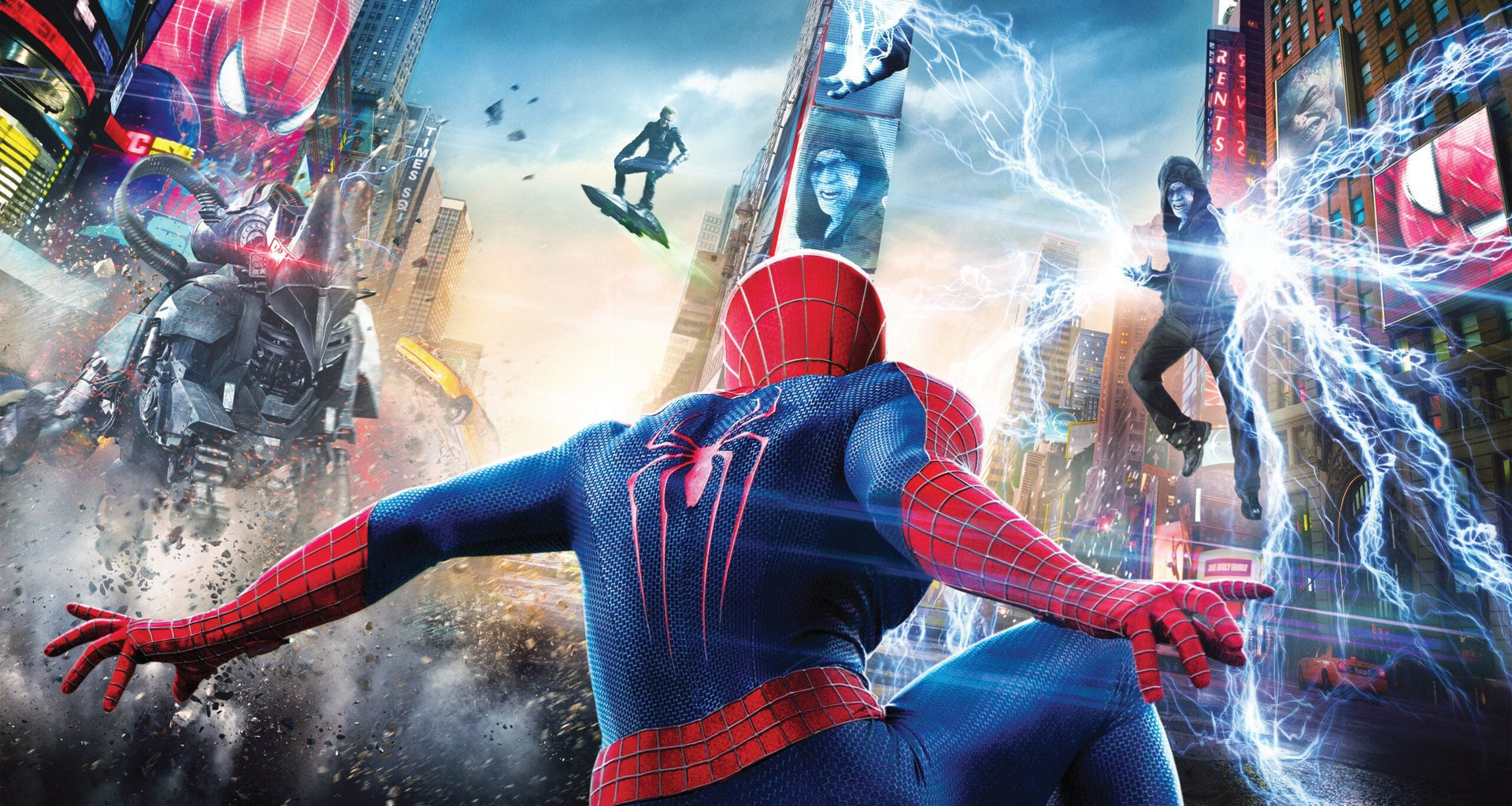
Visually, the Times Square confrontation scenes are among the most impressive in the whole saga.
But the electricity is not just a visual effect: it stands for Max’s emotional overload.
Every discharge is a scream.
If you want to dig deeper into the psychology of Spider-Man’s antagonists, have a look at this as well: Spider-Man’s enemies: origins and analysis.
Does the film criticise modern society?
Electro embodies a man driven mad by:
- Social indifference
- Media overexposure
- The culture of image
If Electro is one of the characters who stayed with you, you can find:

Electro is not a cartoonish villain. He is the reflection of a society that manufactures its own monsters.
Harry Osborn, the Green Goblin… and Gwen Stacy’s fall
If Electro embodies social loneliness, Harry Osborn embodies the fear of death.
In The Amazing Spider-Man 2, Harry comes back into Peter’s life as a broken childhood friend, condemned by a genetic illness inherited from his father.

His arc rests on a single obsession: surviving. And to survive, he is ready to do anything.
That dynamic echoes the themes already explored in the article devoted to Norman Osborn and the Green Goblin, where the hunger for power and the fear of decline lead to monstrosity.
A rushed… but symbolic transformation
Harry’s mutation into the Green Goblin is often criticised for how quickly it happens.
But in narrative terms, it embodies a key point: the film is about destiny.
Peter wants to believe he can control his life. Harry proves that some paths are inevitable.
That idea of fate connects directly to the logic developed on the pillar page: The Web of Destiny and the Spider-Totems.
Gwen Stacy’s death: the most striking moment in the film
Then comes the scene.

The fall.
The slow motion.
The web reaching out like a hand… but too late.

The death of Gwen Stacy is one of the moments most faithful to the comics, in particular to the legendary arc The Night Gwen Stacy Died.
Unlike many modern adaptations that shy away from emotional risk, this film dares.
It reminds us that Spider-Man is not only a spectacular hero. He is a tragic one.
That scene completely redefines Peter:
- He understands that he cannot save everyone
- He discovers the real weight of his choices
- He becomes an adult through pain

If you want to explore the character’s moral dimension further, the analysis Spider-Man’s impossible choice echoes this founding loss.
And if this version particularly struck you, you can carry on exploring its world through:
Gwen’s death is not a cheap shock. It is the moment Peter definitively becomes Spider-Man.
Extended universe ambitions: the abandoned Sinister Six project
Beyond its main plot, The Amazing Spider-Man 2 had a clear mission: to lay the foundations of an extended universe around Oscorp.
The laboratory scene, where you glimpse equipment belonging to the Vulture and the Rhino, along with the clues pointing to the Sinister Six, promised an ambitious future.
Sony wanted to build its own shared universe, before the concept even became standard practice.
If you want to understand how villain teams work in the web-slinger’s world, explore this too: The Sinister Six: origins and members.
But the film suffers precisely from that ambition:
- Too many threads left open
- Several secondary antagonists
- A sometimes unbalanced structure

In hindsight, the film looks less incoherent than simply… in far too much of a hurry.
Find out why The Amazing Spider-Man 3 never saw the light of day…
Rehabilitated by the multiverse
Then came Spider-Man: No Way Home.
Andrew Garfield’s return completely changed how audiences saw him.

His Spider-Man appears there as:
- More mature
- More marked by loss
- More introspective
His rescue scene echoes Gwen’s death directly. It is a redemption.
To place all this in the bigger picture, have a look at the pillar page: Understanding the Spider-Verse.
The Amazing Spider-Man 2: commercial failure… emotional success?
Yes, the film divided people.
Yes, it hastened the Sony / Marvel deal.
But it also gave us:
- One of the most believable romances in the saga
- The most tragic scene in the Spider-Man films
- A suit that became iconic
- A deeply human version of the hero
Today it holds a special place in the web-slinger’s mythology.
If this incarnation stayed with you, you can carry the experience on with:
- Spider-Man film figures
- Amazing Spider-Man posters
- Fancy dress inspired by the films
- Spider-Man jumpers & sweatshirts
🕷️ The Amazing Spider-Man 2 is not simply a flawed blockbuster. It is a tragic chapter that redefined Spider-Man’s emotional maturity on screen.

