
14-Day Money-Back Guarantee
0
The short answer
The Iron Spider first appears in Amazing Spider-Man #529 in 2006, designed by Stark during Civil War, with three articulated back-mounted appendages called waldoes. On screen it is offered and then turned down in Homecoming, before being deployed against Thanos. Origins, powers and versions are detailed below.
There is one precise moment in Spider-Man's history that changed everything for the character — a moment when Peter Parker stopped being the lone hero in red and blue tights and became something radically different. That moment is when Tony Stark handed him a blazing red and gold suit, packed with nanotechnology, fitted with mechanical back legs and built to survive cosmic threats that plain spandex could never absorb. The Iron Spider armour is not just another costume among the dozens Spider-Man has worn over the decades — it is a narrative turning point, a symbol of the bond between a billionaire mentor and a teenager from Queens, and above all proof that the web-slinger can play in the Avengers' league without giving up what makes him a unique hero. And yet, despite being everywhere in the Marvel films and hugely popular with fans, the full story of this armour remains surprisingly unknown. From the pages of essential starter comics to the MCU by way of the video games, here is everything you need to know about the most advanced suit ever worn by Spider-Man.
Born in the Comics: When Tony Stark Armed Spider-Man for the Civil War
The Iron Spider was not born on screen. It was born in the pages of Amazing Spider-Man #529, in 2006, in the middle of a major crisis for the Marvel universe: Civil War. To understand why Tony Stark created this armour, you need to understand the political stakes that were tearing the superhero community apart. The Superhuman Registration Act required every individual with powers to reveal their identity to the government — a demand that ran against everything Spider-Man had always protected : the secret of his identity, the safety of those close to him, his freedom to act according to his conscience. Stark, a firm believer in regulation, needed a symbolic ally to win over the undecided. And what better symbol than a Spider-Man kitted out in Iron Man's colours, publicly proving that technology and transparency could coexist with heroism?

The original comics armour was a masterpiece of fictional engineering. Made from a liquid-to-solid phase-changing material, it hugged Peter's body like a second skin while offering impact resistance comparable to a lightweight Iron Man suit. Its three articulated back legs — the waldoes — could pierce steel, act as extra arms in combat, or fold away invisibly behind his back. The armour also packed an environmental scanner, an optical camouflage system able to render Peter invisible, an audio filter for listening in on police frequencies and, of course, a direct link to Stark Industries systems. It was the first time in comics history that Spider-Man wore a costume that genuinely increased his abilities instead of simply dressing them up. And it was this suit that led Peter Parker to do the unthinkable: during a live televised press conference, he pulled off his mask in front of the entire world and declared that he was Spider-Man.
That decision had catastrophic consequences. Aunt May was seriously wounded by a gunman, Mary Jane had to flee, and Peter eventually realised he had let himself be manipulated by Stark. He tore off the Iron Spider, joined Captain America's side, and the armour became the symbol of his greatest error of judgement. In the comics, then, the Iron Spider is a story of betrayal as much as of technology — a reminder that even Tony Stark's best intentions often hide an agenda of control.
What became of the armour after Peter Parker
After Peter abandoned the costume, the Iron Spider did not disappear. Stark took it back and handed it in turn to three secondary characters — the MVPs, clones of the soldier Michael Van Patrick — who formed a short-lived team, each wearing a variant of the armour. Later, as part of the Spider-Verse, other alternate versions of Spider-Man wore Iron Spider variants, proving that the concept had outgrown its original creator to become a recurring archetype of the arachnid universe. Even Miles Morales briefly wore a modified version in some alternate arcs, showing the versatility of a design that adapts to every Spider-person while keeping its distinctive visual DNA: the red and gold, and the back legs.
The Iron Spider in the MCU: From Refused Gift to Cosmic Baptism
The Iron Spider's path through the Marvel Cinematic Universe is very different from the comics one and, in many ways, more moving. The armour appears for the first time at the end of Spider-Man: Homecoming in 2017, when Tony Stark presents it to Peter as part of his official induction into the Avengers. And Peter says no. That refusal is fundamental to understanding the character: despite the temptation of overpowered technology and Avenger prestige, Peter chooses to stay the neighbourhood hero, the kid in the homemade suit who helps ordinary people. That refusal establishes that the relationship between Peter and Tony is not that of a boss and an employee, but that of a surrogate father and a son who wants to prove he deserves his place by his own means.

The armour returns spectacularly in Avengers: Infinity War. When Thanos's ship appears above New York and Peter clings to its hull in the middle of the stratosphere, Stark sends the Iron Spider out by drone to save his protégé from suffocation. The mid-air suit-up — the nanites covering Peter layer by layer, the back legs unfolding for the first time — has become one of the most iconic moments in the MCU. From that instant on, Spider-Man stops being an earthbound hero and becomes a cosmic fighter. The Iron Spider goes with him to Titan, against Thanos, in one of the most desperate battles in Marvel history. And it is in this armour that Peter delivers the most heartbreaking line in the MCU: 'Mr Stark, I don't feel so good', before crumbling to dust in front of his mentor.
From Endgame to No Way Home: the armour that survived death
When Peter comes back in Endgame thanks to Hulk's reversed snap, he still materialises in the Iron Spider. The armour crossed five years of nothingness with him, intact — technically debatable, but narratively powerful. During the final battle against Thanos, Peter uses the back legs to carve a path through the army of Outriders, protects the Infinity Gauntlet and interacts with heroes he had never met (Captain Marvel, Valkyrie). The Iron Spider works as a visual passport here: it tells viewers immediately that this Spider-Man is no longer a beginner, that he belongs on this battlefield alongside gods and superhuman soldiers.
In Far From Home, Peter packs the Iron Spider away in his suitcase and prefers his classic costume, a symbolic act of mourning after Tony's death. The armour comes back briefly in No Way Home, notably in the opening scene where Peter is unmasked by Mysterio, and during the fights against the multiverse villains. But the high point is the moment when Peter, at the end of the film, loses everything — his friends, his life, Stark's legacy — and stitches himself a new costume by hand. The circle closes: the Iron Spider stood for the era when Peter had a mentor, a family, a technological safety net. Giving it up marks the beginning of a truly independent Spider-Man, back to the fundamentals of personal responsibility.

Anatomy of the Armour: The Powers That Make the Iron Spider a War Machine
What makes the Iron Spider fascinating is not just its look — it is the range of abilities it gives a hero whose natural powers are already superhuman. In the comics, the original 2006 armour had three mechanical back legs (the 'waldoes', named in tribute to Robert Heinlein's novella), each able to lift several tonnes, to anchor into concrete to steady Peter in a fight, and to operate semi-autonomously thanks to an onboard AI. The optical camouflage made Peter completely invisible — a tactical advantage he had never had before, and one that radically changed his approach to combat. The glide system allowed limited gliding flight, the breathing mesh filtered toxins and gases, and the Stark link gave real-time access to colossal databases.
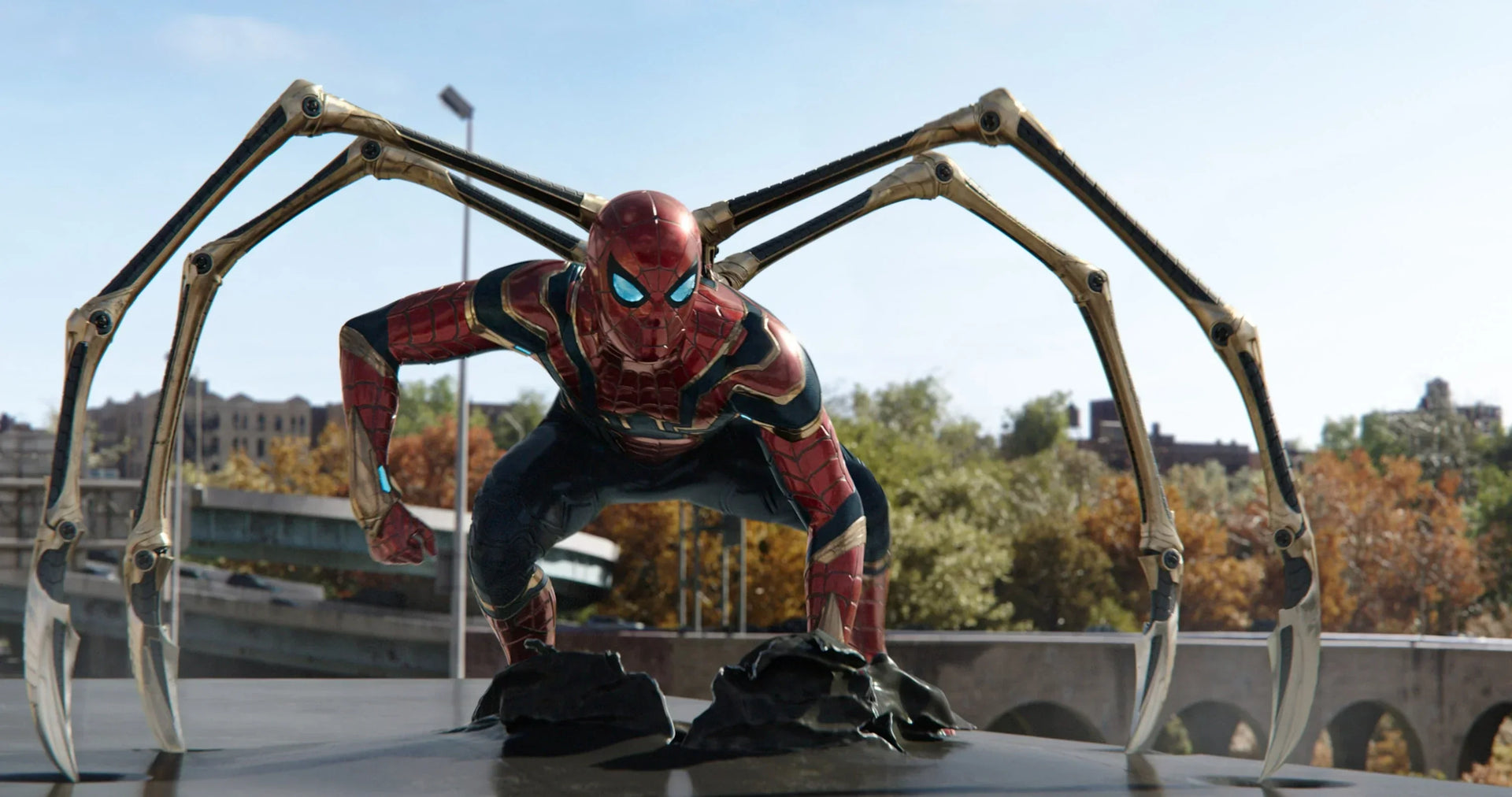
In the MCU, those abilities were reinterpreted through the lens of nanotechnology. Tom Holland's armour is made entirely of nanites — billions of micro-robots that reconfigured themselves instantly as needed. Need a shield? The nanites form a hard surface. Need back legs? They assemble behind him. Need to patch a breach? The nanites fill the hole in milliseconds. That flexibility made the armour theoretically immune to wear — as long as the nanite reserve was not exhausted. The onboard system also included the parachute (which had saved Peter in Homecoming in another form), built-in heating for high-altitude fights and, above all, the four back legs that became the suit's visual signature. It is the whole evolution of the entire history of Spider-Man costumes concentrated into a single design.
The back legs: why they change everything in a fight
The waldoes deserve a paragraph of their own, because they fundamentally transform the way Spider-Man fights. Without them, Peter is an agile fighter who dodges, strikes and fires webs — a style built on mobility and reflexes. With the legs, he becomes a multi-axis fighter able to strike from four extra directions at once while keeping his hands free to shoot webs or shield a civilian. In the battle of Titan against Thanos, the legs let Peter anchor himself to the ground while the Mad Titan drags him in — without them, he would have been torn away in a second. In Endgame, they act as a rapid means of movement when Peter runs across the battlefield with the Gauntlet, skewering Chitauri along the way like a mechanised arachnid. That combat versatility is the main reason the Iron Spider remains, in fan rankings, the most powerful costume Spider-Man has ever worn — ahead even of the black symbiote which, for all its raw power, had no comparable extra weaponry.
The Iron Spider in Video Games: A Playable Legend
The cultural impact of the Iron Spider is not limited to comics and films. In Marvel's Spider-Man on PS5, the Iron Spider suit is one of the most coveted by players — and with good reason. Unlocking the Iron Spider in the Insomniac Games title gives you a unique special power: the back legs that deal massive damage to surrounding enemies. Visually, the real-time nanite rendering, the red and gold reflections under the New York lights and the fluid animation of the mechanical legs make it one of the most spectacular suits in the game. In Spider-Man 2 on PS5, the armour is even more detailed, with textures that react dynamically to damage and dedicated combat animations that use the legs as primary weapons. The Spider-Man PS5 cases even let you extend the Iron Spider experience onto the console itself — a detail that gamers who are fans of the web-slinger particularly appreciate.

Beyond the Insomniac games, the Iron Spider turns up in Marvel's Avengers, in Marvel Ultimate Alliance 3 and in plenty of mobile games such as Marvel Contest of Champions or Marvel Future Fight. Its systematic presence shows its status as the 'premium' suit in the collective imagination — the one developers know players want to unlock, wear and show off. It has become a must-have for any self-respecting Spider-Man game, in the same way as the black symbiote costume or the classic red and blue suit.
Why the Iron Spider Divides Fans (and Why That Debate Matters)
Despite its popularity, the Iron Spider is the subject of passionate debate in the fan community, and that debate goes to the very heart of what being Spider-Man means. On one side, supporters of the armour see in it the character's natural evolution — a Peter Parker who grows up, who accepts help from his mentors, who uses technology to save more lives. On the other, purists feel the Iron Spider betrays the hero's very essence. Spider-Man, as originally conceived by Stan Lee and Steve Ditko, is the hero who succeeds with very little. He is the kid who sews his own costume, who builds his web-shooters in his bedroom, who fights opponents more powerful than himself with nothing but his intelligence and his determination. Giving him a Stark Industries suit erases what sets him apart from the wealthy, over-armed Avengers.
That debate took on a new dimension with Spider-Man in Civil War on screen, where the character was introduced as Stark's protégé before he had even had time to exist on his own. Some long-time fans criticise the MCU for turning Peter Parker into an 'Iron Man Junior' rather than an autonomous hero. The ending of No Way Home corrects that imbalance by taking Peter back to zero — no money, no technology, no safety net. But the Iron Spider has left its mark on how the character is seen by a whole generation of new fans who discovered Spider-Man through Tom Holland. For them, the Iron Spider is not a betrayal: it is the Spider-Man they know, the one who fought Thanos, the one who travelled through space, the one for whom science and technology are weapons as natural as his webs.
The Iron Spider as a mirror of Peter Parker's evolution
Deep down, the real narrative function of the Iron Spider is neither to make Peter stronger nor to turn him into Iron Man. It is to measure how far he has come. When Peter is given the armour in Homecoming, he is not ready — and he knows it. When he wears it in Infinity War, he has earned it through his actions but does not yet fully control it. When he masters it in Endgame, he has been through death and grief. And when he gives it up in No Way Home, he has understood that real strength comes not from a suit but from a moral choice. The Iron Spider is a narrative thermometer: at every moment it shows where Peter stands on his hero's journey. That is what makes it far more than a gadget — it is a storytelling tool as powerful as the spider-sense itself.

The Future of the Iron Spider: Doomsday, Secret Wars and Beyond
With Spider-Man 4 confirmed and Avengers: Doomsday and Secret Wars on the horizon, the question every fan is asking is this: will we see the Iron Spider again? The most likely answer is no — at least not in its original form. The ending of No Way Home made it clear that the post-Stark Peter Parker builds his own equipment, and bringing the Stark armour back would be a narrative step backwards. But the Iron Spider concept could be reborn in a different form. In recent comics, Peter has designed his own upgraded armours without Stark's help, proving that the character's scientific genius can rival Tony's when the situation demands it. An Iron Spider 2.0 designed by Peter himself — without the Stark colours, without the technological dependence, but with the back legs that have become his signature — would be the perfect synthesis between the two camps of fans.
As part of Secret Wars, where the multiverse will converge in a collision of realities, it is also possible that Iron Spider variants from other universes will appear. Imagine an Iron Spider worn by Spider-Man 2099, whose futuristic technology would amplify the armour's capabilities tenfold. Or a symbiotic Iron Spider, a nightmarish fusion of Stark nanotechnology and the black symbiote. The possibilities are endless, and it is precisely that adaptability which guarantees the Iron Spider will stay relevant for decades to come — it is not tied to a single wearer or a single timeline, it is a concept that reinvents itself with every new era of Spider-Man.
Collecting the Iron Spider: The Fans' Holy Grail
The Iron Spider holds a place of its own in the world of Spider-Man collecting. Its distinctive design — the metallic red and gold, the back legs, the silhouette halfway between spider and machine — makes it one of the most sought-after costumes in figures, in posters, and in collector replicas. Iron Spider figures are consistently among the first to sell out when new releases land, because they offer something classic figures do not: the visual complexity of articulated legs that give the piece a spectacular three-dimensional presence in a display case.
Beyond figures, the Iron Spider inspires a full range of products for fans who want to wear or display their favourite version of the web-slinger. Iron Spider fancy dress costumes have become one of the most popular choices for conventions and cosplay, with versions ranging from a simple children's costume to adult replicas with mechanised legs. The Iron Spider t-shirts and the hoodies allow more discreet everyday wear, while the collector masks are the most impressive pieces for serious display cabinets. The ecosystem of Spider-Man merchandise around the Iron Spider is one of the richest in the whole Marvel universe, because the design lends itself as readily to premium products as to everyday items — from an Iron Spider rug in an office to wall decoration in a living room.
If you are just starting your collection, the best advice is to begin with a centrepiece — a figure or a framed poster that will act as a focal point — then build around it with more discreet accessories that reinforce the theme without overloading it. A Marvel collecting starter guide can help you avoid the classic beginner's mistakes, but the golden rule stays the same as for any passion: choose with your heart first, and your head second.

The Iron Spider is far more than a costume in the Spider-Man universe — it is a whole chapter of the character's mythology, a symbol of his complex relationship with technology and power, and a design that has won over millions of fans around the world. From the pages of Civil War to Thanos's snap, from PS5 screens to collectors' cabinets, this armour embodies the fundamental question Spider-Man has been asking himself since 1962: how far can you go when you have great power? The Iron Spider's answer is a bold one — to the stars, to the far edges of the multiverse, to the ultimate sacrifice. But Peter Parker's answer, the one he has always ended up giving, is more beautiful still: as far as your conscience lets you, with or without armour. And it is that tension between technological power and moral simplicity which guarantees the Iron Spider will keep fascinating fans for decades to come.

