
14-Day Money-Back Guarantee
0
The short answer
Go Down Swinging is Dan Slott's final arc, published in Amazing Spider-Man #797 to #800 between March and May 2018. Norman Osborn bonds with the Carnage symbiote and becomes the Red Goblin, a fusion of Spider-Man's worst enemy and the most violent of the symbiotes. Flash Thompson, alias Anti-Venom, dies in Spider-Man's arms after healing the other heroes.
Pairing the Green Goblin with Carnage was one of those ideas readers had been floating for years without believing an editor would ever sign it off. It stacks two already maximal threats: the man who knows Peter Parker's identity and knows exactly where to strike, and the symbiote whose only guiding principle is to kill. In 2018, Dan Slott built the conclusion of his ten years on the series on that idea, and the result remains one of the character's deadliest confrontations — literally, since it costs a long-standing ally his life.
Go Down Swinging: what the arc is about
The story runs across Amazing Spider-Man #797 to #800, published between March and May 2018, and closes on issue 800, released as an anniversary issue. It is the last arc Dan Slott wrote on the series, after a decade of work: the structure of the story is therefore as much a confrontation as a settling of accounts with everything the author had put in place.
The starting point is simple and brutal. Norman Osborn, stripped of his abilities for some time, is looking for a way to become a threat again. He finds it by bonding with the Carnage symbiote, the very one that had made Cletus Kasady a superpowered serial killer. The result, the Red Goblin, combines Osborn's cunning with the symbiote's savagery — and above all, he no longer has any reason to hold back.
Osborn goes straight for Peter Parker's circle rather than for Spider-Man. That is the choice which sets this arc apart from most confrontations in the series: the villain is not looking to win a fight, he is looking to demolish a life. The logic is the same as that of the historic Green Goblin, pushed one notch further. To place this episode among the character's great moments, the page devoted to the story arcs sets out the reading order.
The Red Goblin: how a fused villain works
You have to be precise about what this creature is, because quick summaries often present it as 'Osborn in red'. The Red Goblin is a symbiote host in the strict sense: Carnage has a host, and that host is no longer Kasady but Osborn. The symbiote brings the mass, the regeneration, the slicing appendages and the aggression; Osborn brings the strategy, the intimate knowledge of his target and a set of Goblin equipment concealed beneath the living matter.
This last point is decisive for what follows, and it is a fine piece of writing: nobody thinks to look for technology underneath a symbiote. The general mechanics of symbiotes are set out in the complete history of Venom and on the page devoted to the symbiotes — knowing how the host-symbiote bond works completely changes how you read this arc.
The Red Goblin holds a particular place in the symbiote family. He is not an offspring like Toxin, nor a separate symbiote like those of the Life Foundation: he is the Carnage symbiote itself, transferred. The great crises of the genre — Maximum Carnage, then Absolute Carnage — bracket this episode chronologically, and it is a tighter variation on a single host. That is also what makes it the best entry point for anyone who finds the big crossovers unreadable. The Venom, Carnage and symbiote figures cover most of that gallery, as it happens.
COLLECTABLE FIGURES

Spider-Man Figurine - Cletus Kasady as Carnage
Before it moved on to Osborn, the symbiote in this arc belonged to someone else. This piece captures the original host in his most recognisable form, with the veined red and the open jaw that make up the character's whole visual identity.
99.90 €
Discover →The death of Flash Thompson
This is the event that got this arc talked about well beyond its usual readership. Flash Thompson is one of the most transformed characters in the series: first the bully who torments Peter at secondary school, then an amputee veteran, then a symbiote-carrying hero. At the time of Go Down Swinging, he wears Anti-Venom, the white symbiote whose particularity is that it heals.
After a confrontation with the Red Goblin, several heroes are seriously injured. Flash uses his healing abilities to put them back on their feet — and that use weakens him considerably. He nonetheless chooses to take the fight to Osborn. The fight seems to be going his way, until the Goblin triggers the electrical equipment hidden beneath the symbiote. The wounds are fatal and Flash Thompson dies in Spider-Man's arms.
The editorial anecdote is worth knowing, because it says what the team was after: Dan Slott had initially left an ambiguity that allowed for his survival, and that ambiguity was removed at the editorial team's request, on the grounds that it weakened the sacrifice. In a genre where deaths are reputed to be reversible, that is a rare decision and it changes the weight of the issue.
This death closes a trajectory of more than fifty years. The character introduced in 1963 as a school rival ends up a hero, healing the others first. It is the kind of conclusion that makes an arc memorable beyond its plot, and it is also why the Red Goblin has become a sought-after motif on Spider-Man t-shirts and Spider-Man posters with a comics feel.
Where this arc sits in Norman Osborn's career
Norman Osborn is the only villain in the series to have held so many successive statuses: respected industrialist, masked terrorist, officially dead, resurrected, then head of a national security agency during Dark Reign. Go Down Swinging comes after a phase in which he had lost almost everything that made him dangerous, and it is his most spectacular comeback.
To understand what makes the character unsinkable, you have to go back to his real origin, that of the chemical he tested on himself — the authorship of which partly belongs to a forgotten collaborator, as the article on Mendel Stromm recounts. The overall portrait is developed in Norman Osborn, the man behind the mask, and his most recent developments in the state of play on his returns.
The family dimension is never absent. Harry Osborn remains the painful point of contact between the two men, and that is what stops this confrontation from being a simple duel of power. The page listing Spider-Man's villains places the whole Osborn family back in the wider ecosystem, alongside the Spider-Man masks and costumes from the universe the character has inspired.
PRINTS AND POSTERS

Spider-Man and the Green Goblin Poster
The clash between the web-slinger and the Goblin runs through sixty years of publication without ever wearing thin. This print sets the two silhouettes face to face in a graphic treatment that works just as well on its own as in a series with other pieces on the same wall.
22.90 €
Discover →Why this fusion had never been attempted before
The idea had been going around since the 1990s, roughly since Carnage came into existence. It had never come off, and for a structural reason: the two characters occupy the same narrative function. The Green Goblin is the ultimate threat because he knows Peter Parker's identity; Carnage is the ultimate threat because he kills without motive. Fusing them means giving up one of the two registers.
Slott solves the problem by giving Osborn the upper hand. The symbiote does not absorb the man, it equips him. That is the opposite of what happens to most hosts, including Peter Parker himself at the time of his own experience with the black suit, and that inversion is the real subject of the arc. It also explains why the Red Goblin speaks normally, plans and negotiates, where a standard Carnage host merely screams.
The other obstacle was editorial. A villain that overloaded burns through ammunition for years: once Osborn has been the worst enemy possible, it is hard to bring him back without disappointing. That is precisely why the arc comes at the end of a run — an author on his way out can afford to spend what his successor will have to rebuild, as had already happened with the conclusion of Superior Spider-Man. The silhouettes from this period feed heavily into the Spider-Man toys and the phone cases built around the villains.
Should you read Go Down Swinging, and when?
Yes, but not first. The arc assumes you know who Flash Thompson is, what makes the Anti-Venom special, and why Osborn is more than just another villain. Read cold, it looks like one long fight against a red monster; read after a few hundred issues, it is a conclusion.
The shortest reading path goes through The Alien Costume Saga for the origin of the symbiotes, through the relationship between Spider-Man and the symbiote for the link with the main character, then through Flash Thompson's journey. After that comes the arc itself. The reading guides gathered on the guides and advice page set out other possible entry points depending on how much time you want to give it.
A word on the editions. The arc is short — four issues — but issue 800 is a thick anniversary volume containing several additional stories. Collected editions do not always include them, and the breakdown varies from one publisher to the next: check the issues covered rather than the title of the collection. It is the same reflex to have as with the big symbiote crossovers, of which Planet of the Symbiotes is the most fragmented example.
What the arc left behind
Three things, concretely. One more villain in the gallery, since reused elsewhere. An empty panel where a character present since the series began used to be. And the end of one of the longest stretches of continuity handled by a single author on Amazing Spider-Man, which mechanically reshuffled the cards for his successors.
You also have to note what the arc did not do. It did not permanently change Norman Osborn's status; he has been through other transformations since. Nor did it settle the symbiote question, which the arrival of Knull relaunched on an entirely different scale of threat. It is a turning point for the characters, not for the universe — and that distinction is useful when you are choosing what to read.
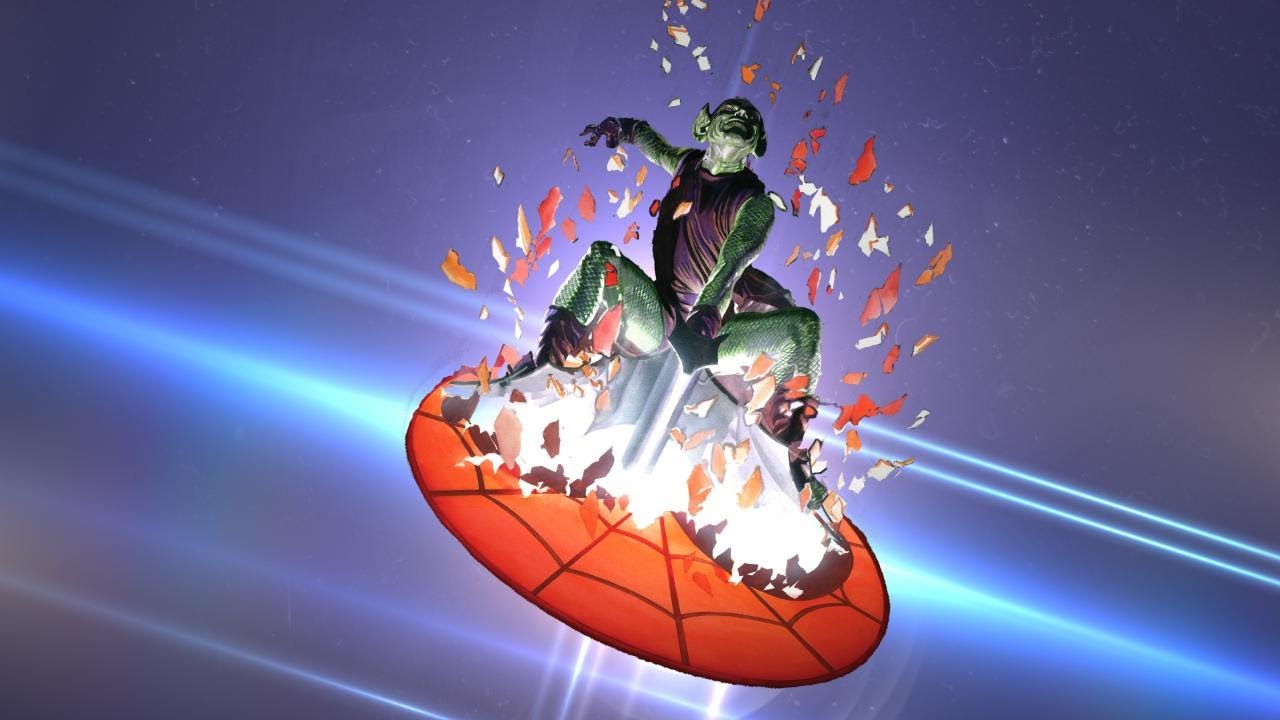
What remains is the image, which has outlived everything else. A Goblin silhouette in veined red, jaw open, hovering above a Spider-Man at the end of his tether: that is the panel readers remember, and it is the one you find on the Spider-Man stickers and Spider-Man mugs inspired by this period. The page listing the characters of the universe places each of the protagonists met along the way.
DISPLAY PIECES

Spider-Man Figurine - Green Goblin Pumpkin Bomb
The pumpkin bomb is the accessory that identifies the Goblin in a second, whichever version it is. This piece stages it in three dimensions, in a display format designed to catch the eye in the middle of an already crowded shelf.
139.90 €
Discover →The Red Goblin after 2018
The character did not disappear with the arc. The name has been picked up since, in different contexts and with other hosts, which fuels a frequent confusion among readers who discover the figure through recent stories. The rule to remember is simple: the original Red Goblin, the 2018 one, is Norman Osborn, and him alone.
This reuse is the usual fate of good visual ideas in comics. It has the advantage of keeping the concept alive, and the drawback of blurring the reference version — exactly what happened to the dozens of successive hosts of the Life Foundation symbiotes. To find your bearings, the page devoted to the symbiotes keeps track of who wears what, and in what order.
On the adaptation front, nothing has made it to the screen yet. The Red Goblin remains a comics motif, which is why you mostly find him on graphically inspired products — Spider-Man blankets or Spider-Man rugs with villain designs — rather than on the ranges that come out of the films. If an adaptation were ever to arrive, it would raise the same question as the arc itself: what do you do with a villain who already has everything?
Frequently asked questions
Who is the Red Goblin?
He is Norman Osborn bonded to the Carnage symbiote, in the Go Down Swinging arc published in 2018. He is neither a new character nor a new symbiote: he is the Carnage symbiote with another host. Osborn keeps his intelligence and his Goblin equipment, concealed beneath the symbiote's matter.
Is Flash Thompson really dead?
He dies in Amazing Spider-Man #800, killed by the electrical discharge from Goblin equipment hidden beneath Osborn's symbiote, after spending his healing abilities on other heroes. The ambiguity about a possible survival, present at first, was removed before publication.
Which issues should I read this arc in?
Amazing Spider-Man #797 to #800, published between March and May 2018. Four issues, the last of which is an anniversary volume noticeably thicker than the others. It is Dan Slott's final arc on the series.
Why does Osborn keep control of the symbiote?
Because the arc makes that its explicit subject. Where most hosts end up dominated by the creature, Osborn imposes his will and uses it as a tool. That is consistent with what the character has always been: someone who tests substances on himself and accepts the price. From his point of view, the symbiote is just one more upgrade.
Does this arc change anything for Spider-Man afterwards?
Less than you might think. The main character's status quo is largely preserved: he loses a friend, not his situation. The real effects are read in the cast — one ally fewer, one villain more — and in the creative team change that follows immediately. It is the conclusion of a run, not a reset of the series.
Is the Red Goblin more powerful than Carnage?
He is more dangerous, which is not the same thing. The raw power comes from the symbiote and stays comparable. The difference lies with the host: where the original host strikes at random, Osborn knows who matters to Peter Parker and strikes there. It is that clear-sightedness that makes the arc so costly for the characters.

