

14-Day Money-Back Guarantee
0
The short answer
Two forces explain the effect: Peter Parker starts out from a vulnerable position himself, which makes his progress imitable, and wearing a mask creates a protective distance that allows a child to try new behaviours without feeling judged. The mechanisms, and the practical ways to use them at home, are set out below.
How Spider-Man helps shy children assert themselves (the transformation will surprise you)
Your child hides behind your legs when an adult speaks to them. They refuse to put their hand up in class even when they know the answer. At break time, they stay on their own by the wall while the others play.
You have tried everything. Gentle encouragement. Small, progressive challenges. Conversations about self-confidence. Nothing seems to really work. The shyness stays there, like an invisible wall between your child and the world.
But one day, something changes. Your child puts on their Spider-Man costume for a birthday party. And suddenly, it is not the same child. They speak louder. They start games. They dare.
This is no accident. It is pure psychology.
Child development researchers have discovered something fascinating: shy children who identify with superheroes like Spider-Man develop significantly greater self-confidence than others. The phenomenon even has a scientific name: 'the superhero costume effect'.
But why does Spider-Man work better than other heroes for children who are shy? And above all, how can you use this discovery to help your child come out of their shell?
What you are about to discover in this article will change the way you see that 'simple Spider-Man phase' your child is going through.
Why shy children identify so strongly with Spider-Man
Here is what most parents do not realise: Peter Parker, before he became Spider-Man, was the very archetype of the shy, self-effacing child.
He was intimidated at school. Ignored by his classmates. Unable to talk to the girl he liked. He looked at the floor when someone shoved him in the corridor. Exactly like your child.
This deep identification is crucial. Unlike Superman (an invincible alien) or Wonder Woman (a warrior princess), Spider-Man starts out as an ordinary, vulnerable child. Shy children recognise themselves in him straight away.
A Stanford University study showed that shy children remember stories about initially weak characters who become strong better than stories about characters born powerful. Why? Because they see a possible path for themselves.
When your shy child watches Spider-Man: Into the Spider-Verse and sees Miles Morales - an awkward, anxious teenager - become a hero, they are not just watching a film. They are seeing proof that transformation is possible.

The mask effect: why hiding lets you reveal yourself
Here is something paradoxical that psychologists have discovered: when a shy child wears a mask, they paradoxically become more authentic and more courageous.
It sounds counter-intuitive. We generally associate masks with concealment. But for shy children, the mask works differently. It creates what psychologists call 'a protective distance' that frees the child from their social anxiety.
When your child wears their Spider-Man mask, they are no longer 'the shy child who might get it wrong and be judged'. They temporarily become Spider-Man - a character who is, by definition, brave. That borrowed identity gives them psychological permission to try new behaviours without any risk to their 'real' self.
Play therapy studies show that shy children are up to three times more likely to start social interactions when they are wearing a superhero costume. This is not simple distraction - it is a powerful therapeutic tool.
The costume's invisible power: one mother's story
'My son Lucas was 6 and was paralysed by shyness. He never spoke in class, not even to ask to go to the toilet. One day, I bought him a complete Spider-Man costume for his birthday.

The transformation was immediate. With the costume on, he spontaneously went over to talk to children he did not know. He organised games. He laughed out loud. I cried watching him.
So I did something many people would find strange: I let him wear his Spider-Man costume at home every evening for three months. Not all the time - just for an hour before dinner. His "courage hour", as he called it.
Gradually, the costume's courage transferred to his everyday life. Six months later, he was putting his hand up in class. A year later, he had friends. Today, at 9, he no longer needs the costume. But he keeps his Spider-Man figure on his desk, as a reminder that he can be brave.'
This account illustrates a key principle that therapists use: a borrowed identity can act as a bridge towards the real one. The costume is not a crutch - it is a tool for psychological transition.
What Spider-Man teaches shy children specifically
Spider-Man carries messages that are particularly powerful for children who struggle with shyness:
'Even heroes are afraid, but they act anyway'
In almost all the Spider-Man films, we see Peter being afraid before he acts. He doubts. He hesitates. Then he goes anyway. That fear to courage sequence is exactly what shy children need to learn.
Unlike fearless heroes, Spider-Man models the idea that courage is not the absence of fear, but action in spite of fear. A liberating message for shy children who believe they must stop being afraid before they can act.
'You do not have to be perfect to be useful'
Shy children are often perfectionists. They do not take part for fear of getting it wrong. Spider-Man gets it wrong constantly. He fails. He makes mistakes. And yet he is still a hero.
That lesson - that imperfection is compatible with personal worth - is therapeutic for children who avoid social situations for fear of making a mistake.
'Ordinary people can do extraordinary things'
The line 'with great power comes great responsibility' takes on a particular meaning for shy children. It tells them: even you, even if you feel small and weak, have power. And that power calls you to act.

It is a direct antidote to the sense of powerlessness shy children so often feel.
The 'little Spider-Man' strategy: how to use it at home
Psychologists have developed what they call 'superhero therapy' to help shy children. Here is how to apply it in practice with Spider-Man:
1. Create a 'Spider-Man courage zone' at home
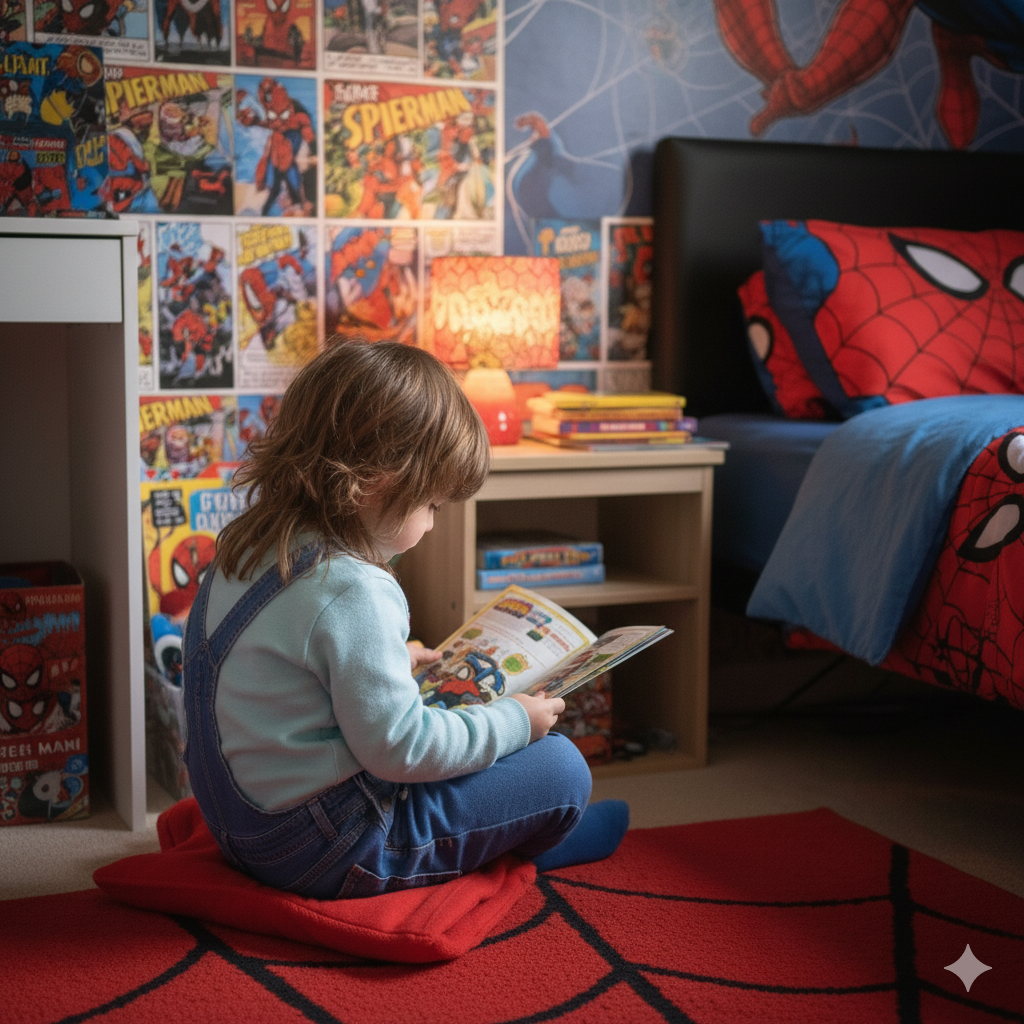
Set aside a space in your child's bedroom as their 'superhero zone'. When they are in that zone with their costume on, or surrounded by their Spider-Man posters, they practise brave behaviours.

Example: 'Before your birthday party, we are going to practise saying hello loudly in your Spider-Man zone.' The child gradually associates the Spider-Man identity with courage, then transfers that association to real life.
2. Use 'Spider-Man role play' before stressful situations
Before an anxiety-inducing social situation (first day at school, a birthday party, a trip to the doctor), act the scene out in Spider-Man mode.
'How would Spider-Man say hello to the new teacher? Show me in your Spider-Man voice!' The child practises the desired behaviour in a safe, playful setting, with Spider-Man's protective identity.
3. The 'Spider-Man courage pyjamas' ritual
Set up an evening ritual where your child puts on their Spider-Man pyjamas and tells you 'one brave thing I did today, even though I was scared'.
This ritual links Spider-Man to everyday courage and helps the child recognise their own acts of bravery, however small. Consciously acknowledging courage reinforces the behaviour.
4. The 'courage super-objects' collection
Build a collection of Spider-Man items with your child that they can wear or take with them into anxious situations: a Spider-Man watch, a small keyring, some shoes.
These objects become 'courage anchors' - physical reminders that the child can draw on Spider-Man's brave identity even without the full costume.
The decisive moment: when should you drop the 'Spider-Man crutch'?
Many parents worry: 'Is my child not becoming dependent on Spider-Man for courage? Shouldn't they learn to be brave on their own?'

Psychologists are clear on this point: 'dependence' on the superhero is a natural, healthy, transitional phase. It usually lasts only 6 to 18 months.
Here is what happens neurologically: at first, the child literally borrows Spider-Man's identity to reach their courage. But with every positive experience (talking to a classmate, answering in class, playing with others), their brain gradually associates those behaviours with their own identity, not only with Spider-Man.
Little by little, the child internalises it: 'I can be brave without a costume. Spider-Man showed me it was in me all along.'
The costume becomes less necessary. Then it disappears completely. But the lesson stays.
You will know the transition is complete when your child keeps their figure or their Spider-Man soft toy not as a tool they need any more, but as a fond symbol of a period of personal growth.

The common mistakes parents make (and how to avoid them)
Mistake #1: forcing your child to 'be brave without the costume'
'You do not need your Spider-Man costume to be brave! You can do it on your own!'
That well-meaning sentence invalidates the tool the child has found to manage their anxiety. It is like taking the stabilisers off a bike before the child is ready. The result: a relapse into shyness.
Better: 'Your Spider-Man costume helps you feel brave. That is great! One day you will discover the courage was in you from the start, but in the meantime, use what works.'
Mistake #2: playing down how important Spider-Man is
'He is only a cartoon character, it should not matter this much.'
For your child, Spider-Man is not 'just' a character. He is a psychological mentor, a model of courage, a bridge towards a better version of themselves. Playing Spider-Man down means playing down your child's growth.
Better: invest in that interest. A complete Spider-Man bedroom is not a waste - it is building an environment that supports the growth of self-confidence.
Mistake #3: comparing them with other children
'Look at your cousin, he does not need Spider-Man to talk to people.'
Every child has their own path to confidence. Comparing them only adds shame to the anxiety already there.
Better: 'I can see Spider-Man helps you be braver. It is clever of you to have found what works for you.'
The signs it is working (what to look out for)
How do you know whether identifying with Spider-Man is really helping your child overcome their shyness? Here are the positive indicators:
Gradual transfer of courage: Your child starts doing things they used to avoid 'in Spider-Man mode'. Then, little by little, they do them without invoking Spider-Man at all.
Positive storytelling: Your child tells stories in which they are the hero, often in Spider-Man mode at first, then gradually as themselves.
Visible pride: After an act of courage (even a small one), you see genuine pride in their eyes. That pride reinforces itself.
Seeking out opportunities: Instead of avoiding social situations, your child starts looking for them, especially when they have their 'Spider-Man courage objects' with them.
Parents' stories: the real transformations
'My daughter Emma, 5, never spoke in class. After watching Into the Spider-Verse, she started wearing her Spider-Gwen t-shirt every day. She would say: "Gwen is shy but she jumps anyway." Six months later, Emma was putting her hand up in class.' - Sophie, 34
'My son Marcus, 7, had diagnosed social anxiety. His therapist suggested using Spider-Man as a "courage attachment figure". We built a whole routine around his Spider-Man toys. Today he has friends and goes to birthday parties without a panic attack.' - David, 41
'Clara, 6, would literally hide when someone spoke to her. Her Spider-Man costume became her "armour of courage". She wore it everywhere for a year. Today, at 8, she no longer needs it, but she keeps her Spider-Man soft toy on her bed "just in case".' - Amélie, 37
The scientific truth nobody tells you
Here is what developmental psychology studies show again and again: children who use superhero figures to manage their social anxiety build more solid, lasting self-confidence than those who are forced to 'face their fears' without psychological support.
Why? Because confidence is built on experiences of success, not on brutal exposure to anxiety. The superhero provides psychological scaffolding that lets the child have those experiences of success.
It is like learning to swim with armbands before swimming alone. Nobody would say a child becomes 'dependent' on armbands - we understand it is a necessary transitional stage. The same should go for Spider-Man.
What you should do right now
If your child is shy and shows an interest in Spider-Man, here are the practical steps psychologists recommend:
Invest in meaningful Spider-Man items - not random merchandise, but things your child can wear or carry: a costume, a backpack, a watch, everyday clothing.


Create Spider-Man rituals around courage - bedtime stories about Spider-Man overcoming his fear, role play, conversations about 'what would Spider-Man do in this situation'.
Treat using Spider-Man as completely normal - never treat turning to Spider-Man as a weakness. It is a smart coping strategy.
Record the progress - note the small wins. 'Today, wearing his Spider-Man t-shirt, he said hello to the neighbour.' Those moments become tangible proof of growth.
Be patient with the transition phase - the dependence will fade naturally. Do not force the process.
The long-term legacy: what becomes of the shy child who found courage?
Longitudinal studies (which follow children over many years) show something remarkable: children who used superheroes like Spider-Man to overcome their shyness develop not only normal social confidence, but also greater resilience in the face of future challenges.
Why? Because they learned young that they can change, evolve, overcome their limitations. They have internalised Spider-Man's central message: transformation is possible.
Those children often become adults who are not afraid to step outside their comfort zone, because they lived through that experience of personal transformation in childhood.
Your shy child, hiding today behind their Spider-Man mask, is learning a lesson that will serve them for life: you are not a prisoner of who you are today. You can become whoever you want to be.
Conclusion: Spider-Man's invisible gift
The next time your shy child puts on their Spider-Man costume and suddenly becomes braver, do not see a child hiding behind a fictional character.
See a child who has found a powerful psychological tool to reach a part of themselves that already existed but that they did not dare show. Spider-Man does not give your child courage - he gives them permission to express it.
That 'Spider-Man obsession' you may have found excessive? That is your child building a bridge towards a more confident version of themselves. And it is absolutely wonderful.
To learn more about how Spider-Man positively influences your child's development, explore our in-depth articles. To find out how to create a Spider-Man environment that supports this growth, have a look at our complete guides.
And to equip your child with the Spider-Man tools that build their confidence, discover our collections of costumes, clothing, and all our Spider-Man merchandise.
In the end, as Peter Parker discovered, the real power was inside him from the start. The costume just helped him realise it. And that is exactly what Spider-Man does for your shy child: it reveals the courage that was there all along.

