

14-Day Money-Back Guarantee
0
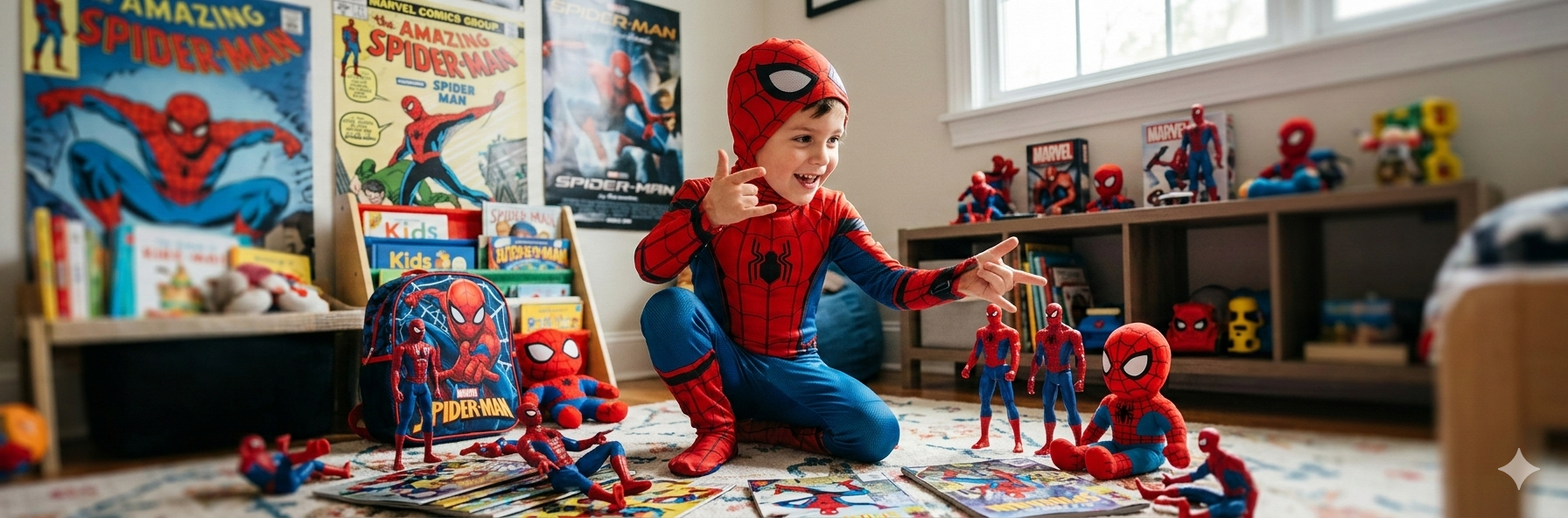
The short answer
This all-consuming passion is a healthy developmental stage, common between the ages of 3 and 12: it helps your child build their identity, tame their fears and absorb a sense of right and wrong. The character works as a reassuring landmark rather than a marketing fad. The five psychological drivers are detailed below.
Your child only ever talks about Spider-Man? You're not alone
Spider-Man at breakfast. Spider-Man at school. Spider-Man at bedtime. If you're the parent of a young fan of the web-slinger, you know the feeling: your child is quite literally obsessed with Spider-Man. Every conversation comes back to the wall-crawler, every drawing is full of spider webs, every clothing choice has to include the red and blue logo. To go further on this subject, see also Interactive and high-tech Spider-Man toys: the 2026 guide to connected toys.
That intensity can be worrying at times. Is it normal? Shouldn't they be interested in something else? Will this fixation pass? And above all: is it healthy for their development?
The short answer: yes, it's perfectly normal. And not only is it healthy, it's actually beneficial.
Contrary to what you might think, a child's obsession with Spider-Man isn't just a marketing whim. It's the result of a deep psychological connection with a character who answers essential developmental needs. Spider-Man isn't a hero like the others: he's an ordinary teenager juggling homework, responsibilities and everyday difficulties.
That human dimension explains why millions of children around the world form such a strong attachment to the character, as we explore in the full story of Peter Parker.
Why Spider-Man and not another superhero?
That's THE question every parent asks. Why does Spider-Man in particular spark such passion in children? Why not Batman, Superman or Iron Man?
The answer comes down to several precise psychological factors:
- Peter Parker is a child/teenager: unlike the other, adult heroes, Peter is roughly the same age as your child. That generational closeness creates instant identification.
- He lives with his aunt: no castle, no fortune, no alien technology. Peter lives an ordinary life in a modest flat, exactly like most children.
- He goes to school: Spider-Man does his homework, stresses about his exams and lives with the same constraints as any school-age child.
- He makes mistakes: Spider-Man gets things wrong, fails, doubts himself. That fallibility makes him relatable, unlike perfect, invincible heroes.
This humanity makes Spider-Man the hero psychologically closest to a child. He doesn't represent a distant ideal, but a better, braver version of themselves.
Obsession as a normal developmental phase
In child psychology, these passing 'obsessions' are not only normal, they're essential. Between the ages of 3 and 12, a child builds their identity by exploring specific interests intensely.
This focus allows them to:
- build in-depth knowledge on a subject,
- create stable landmarks in a changing world,
- assert a personality distinct from their parents',
- belong to a community (that of Spider-Man fans).
Far from being worrying, this intense passion is the sign of healthy cognitive and emotional development.
In the rest of this article, we'll explore the precise psychological reasons behind this attachment, then look at how this passion concretely contributes to your child's development.
The 5 psychological reasons behind the Spider-Man obsession
Behind your child's passion for Spider-Man lie precise psychological mechanisms. Understanding these drivers not only reassures parents, it also helps you support this passion constructively.
1. The need for a protective hero in the face of fear
Between the ages of 3 and 8, children develop all sorts of fears: fear of the dark, of monsters, of abandonment, of failure. Spider-Man embodies the protective figure who fights off those threats.

When a child falls asleep in Spider-Man pyjamas or sleeps under a Spider-Man duvet cover, they symbolically surround themselves with that protection. This isn't simple merchandising: it's a transitional object in the same way as a comfort blanket, something that reassures and secures.
That protective dimension explains why so many children want Spider-Man objects in their bedroom, turning their personal space into a safe zone, as we explain in our guide to creating a Spider-Man bedroom.
2. Identifying with the ordinary boy turned extraordinary
Every child secretly dreams of discovering they have hidden powers. Peter Parker's story embodies that fantasy perfectly: an unremarkable boy, often picked on, who suddenly discovers extraordinary abilities.
That transformation answers a deep psychological need: the hope that I, too, could become someone important. It's particularly powerful for shy or introverted children, or for those who feel different at school. Worth reading next: The villains of Spidey and His Amazing Friends: who are they?.
When a child puts on a Spider-Man costume, they aren't 'pretending': they're experiencing that transformation, testing out that better version of themselves. It's an extremely healthy exercise in identity-building.
3. The need for justice and a moral compass
Between the ages of 5 and 12, children develop their moral sense. They become hypersensitive to ideas of justice, fairness, right and wrong. Spider-Man embodies those values perfectly.
The famous line 'With great power comes great responsibility' resonates deeply with this developmental period. Your child learns that:

- actions have consequences,
- you should help others even when it's hard,
- doing the right thing takes courage,
- you can get it wrong and make amends.
That moral dimension makes Spider-Man an ethical role model far more than simple entertainment. The values he carries travel across generations, as explored in our article on why Spider-Man remains the best-loved Marvel hero.
4. The need to belong to a community
Being a Spider-Man fan means belonging to a worldwide community. At school, in the playground, at birthday parties: Spider-Man fans recognise each other, swap stories and share.
That sense of belonging fills a fundamental social need. Wearing a Spider-Man backpack or a Spider-Man jumper is a way of displaying an identity, of signalling to others 'I'm part of this tribe'.
For children who struggle to make friends, Spider-Man often becomes an easy conversation starter, an instant common ground with other children.
5. The need for control and autonomy
Children live in a world controlled by adults. Spider-Man represents total autonomy: he makes his own decisions, acts on his own judgement and solves his problems himself.
Playing with Spider-Man figures, making up scenarios, inventing stories: all these activities let a child exercise total creative control over their imaginary world.
This kind of free play is essential to developing autonomy, creativity and self-confidence.
In the next section, we'll look concretely at how this Spider-Man passion contributes to your child's overall development, beyond simple enjoyment.
The concrete benefits of a Spider-Man passion for your child
Beyond simple entertainment, the Spider-Man obsession actively contributes to your child's development. Far from being a waste of time, this passion stimulates plenty of essential skills.
Developing language and reading
A child who loves Spider-Man naturally wants to know more about their hero. That curiosity pushes them towards:
- reading Spider-Man books suited to their level,
- comics, which are excellent for developing visual literacy,
- conversations with other fans, which enrich their vocabulary,
- memorising complex names (characters, places, enemies).
Studies in child psychology show that children learn better when the subject fascinates them. A child who drags their feet over reading can devour a Spider-Man book without even noticing.
Stimulating imagination and creativity
Spider-Man is a wonderful catalyst for the imagination. Children:

- make up their own stories and scenarios,
- draw Spider-Man in every possible form,
- create elaborate role-playing games,
- imagine new powers or new enemies.

This narrative creativity is essential to cognitive development. It structures thinking, develops narrative logic (beginning-middle-end) and stimulates innovation.
The Spider-Man jigsaw puzzles and Spider-Man colouring books also feed this creative development while improving concentration and fine motor skills.
Learning positive moral values
Spider-Man carries strong values that leave a lasting mark on a child:
- Responsibility: 'With great power comes great responsibility'
- Perseverance: Spider-Man always gets back up after a defeat
- Altruism: helping others before yourself
- Courage: facing your fears despite the difficulty
- Humility: staying modest despite the powers
These values, absorbed through play and stories, have a positive influence on a child's behaviour in real life.
Developing motor skills and coordination
The Spider-Man universe encourages physical movement. Children:
- copy the hero's acrobatics (gross motor development),
- handle figures (fine motor skills),
- use web-shooters (hand-eye coordination),
- play actively rather than passively in front of a screen.
This physical dimension matters especially at a time when childhood inactivity worries health professionals more and more.
Building self-confidence
Identifying with Spider-Man allows a child to:
- face their fears by imagining they have the hero's powers,
- dare to assert themselves in the playground,
- develop their problem-solving skills,
- feel capable of great things.
For a shy or anxious child, putting on a Spider-Man costume can literally transform their behaviour, giving them courage they don't naturally have.
A healthy emotional outlet
Children experience intense emotions they can't always put into words. Spider-Man becomes a channel to:
- express anger (by play-fighting the villains),
- handle sadness (Spider-Man goes through hard times too),
- channel overflowing energy,
- find comfort in stressful moments.
That's exactly why so many children ask to sleep surrounded by Spider-Man things: it reassures them emotionally.
In the final section, we'll look at how to support this passion intelligently and get the most out of it.
How to support your child's Spider-Man passion intelligently
Now that you understand the psychological drivers and the benefits of this passion, the question becomes: how do you support it constructively? How do you maximise the benefits while avoiding the excesses?
Creating a Spider-Man environment that gives structure
Rather than piling up Spider-Man objects at random, create a coherent environment that supports your child's routines:
- In the bedroom: bedding, wall stickers, a bedside lamp to create a reassuring space.
- For school: a backpack, a pencil case, a water bottle that turn the new term into a positive moment.
- For quiet moments: Pixel art sets, jigsaw puzzles, colouring books that encourage concentration.
This approach structures the day around familiar landmarks that make a child feel safe.

Using Spider-Man as an educational lever
Your child's passion can become a wonderful teaching tool:
- Reading: 'Finish this chapter and we'll read a Spider-Man comic together'
- Maths: 'Spider-Man has to travel 500m using webs that are 50m long - how many swings does he need?'
- Science: 'How does a real spider make its web?'
- Writing: 'Write your own Spider-Man adventure'
Turning learning into a Spider-Man game makes it instantly more motivating for a child.
Sharing the passion as a family
Rather than putting up with the Spider-Man obsession, get involved:
- Organise a Spider-Man film night with the family
- Dress up together for Halloween or a fancy-dress party
- Visit Spider-Man exhibitions or events
- Play together with the figures and invent stories
These shared moments strengthen family bonds while validating your child's passion.
Encouraging creativity around Spider-Man
Don't limit yourself to merchandise. Encourage your child to:
- draw their own versions of Spider-Man,
- invent new characters in the Spider-Man universe,
- make Spider-Man decorations for their bedroom,
- write original stories.
This active creativity is far more beneficial than passive consumption.
Setting healthy limits
Supporting the passion doesn't mean giving in to every whim. A few simple rules:

- Limited screen time: even for Spider-Man cartoons
- A set budget: not every toy, choices have to be made
- Balance: encourage other activities too (sport, music, the outdoors)
- Tidying up: Spider-Man things need to be put away, not scattered everywhere
Those limits teach exactly the responsibility Spider-Man embodies.
Knowing when to worry (really)
In the vast majority of cases, a Spider-Man passion is perfectly healthy. A few signals do deserve attention, though:
- The child refuses ANY other activity or topic of conversation
- The obsession interferes with schoolwork or social relationships
- The child confuses reality and fiction (genuinely believes they have powers)
- Aggressive behaviour appears
In those rare cases, a conversation with a professional (a psychologist or paediatrician) can help. But let's say it again: these situations are exceptional.
Conclusion: an obsession that builds rather than destroys
Your child's obsession with Spider-Man isn't a problem to solve, it's an opportunity to seize. This intense passion reveals healthy developmental needs: the need for a protective hero, for identification, for moral values, for belonging, for autonomy.
Far from harming their development, this fixation stimulates their language, their creativity, their motor skills, their moral sense and their self-confidence. It gives them a safe framework in which to explore their emotions, face their fears and build their identity.
By supporting this passion intelligently - with objects that give structure, creative activities, shared moments and healthy limits - you turn a simple obsession into a genuine educational lever.
And who knows? In a few years, once your child has moved past this phase, they'll look back fondly on the time when Spider-Man was their best friend. Those memories will be part of their personal story, one of those magical childhood moments when everything seemed possible.
Because deep down, Spider-Man reminds us of an essential truth: we all have the power to become someone good. And for a child still finding their feet, that's exactly the message they need.
To explore the Spider-Man universe in more depth and understand why this character crosses generations, take a look at our complete guide to Spider-Man merchandise.

