
14-Day Money-Back Guarantee
0
The short answer
Spider-Man has no single kryptonite. His strength tops out at around ten tonnes while his durability stays almost human, his spider-sense can be overloaded, switched off or bypassed, and ethyl chloride strips his powers away. But his decisive weakness lies elsewhere: the people he loves. We unpack each of these flaws below.
A reader discovering the Marvel universe naturally looks for the equivalent of kryptonite. A green rock, a cursed colour, a magic word. With the web-slinger, that search stalls quickly: no single object brings him to his knees. What makes the character so compelling is precisely that his weak points are scattered, contradictory and, for the most part, perfectly human. Some are biological, others chemical, and the most painful belong to his private life. Almost every one of them has been identified, mapped and then exploited by an enemy who took the time to study him.
The wrong question: looking for kryptonite where there is none
Superman was built around a single, spectacular, instantly readable weakness. Peter Parker was designed the other way round: Stan Lee and Steve Ditko wanted a hero whose problems looked like the reader's own. As a result, his flaws are not a plot device sitting next to the character, they are the character. A teenager who wakes up with powers does not become invulnerable: he becomes a teenager with powers, with the same rent to pay, the same exams to revise for and the same fear of losing the people he loves.
That architecture explains why the web-slinger's best villains are never the most powerful ones. Juggernaut is physically unbeatable and remains a second-tier opponent; Green Goblin, a man with no super-strength, is his worst nightmare. The difference comes down to one detail: one hits the costume, the other hits the man underneath. The full overview of Spider-Man's enemies actually reads very well through that lens: every memorable villain found a different flaw.
A body that takes punishment, but still a body
Real strength, but a clearly defined ceiling
Official Marvel files put his peak strength at around ten tonnes. That is colossal on a human scale and trivial in a room containing Hulk, Thor or The Thing. The web-slinger almost never wins on raw power: he wins through reaction speed, agility and a knack for improvisation that his opponents systematically underestimate. The moment a fight turns into a pure contest of strength, he loses. That is exactly the logic we explore in our comparison of the most powerful versions of Spider-Man, and it is also what makes the question of whether he could lift Mjolnir so revealing: the hammer does not judge strength, it judges worth — and on that ground, Peter does considerably better.
Durability that remains very human indeed
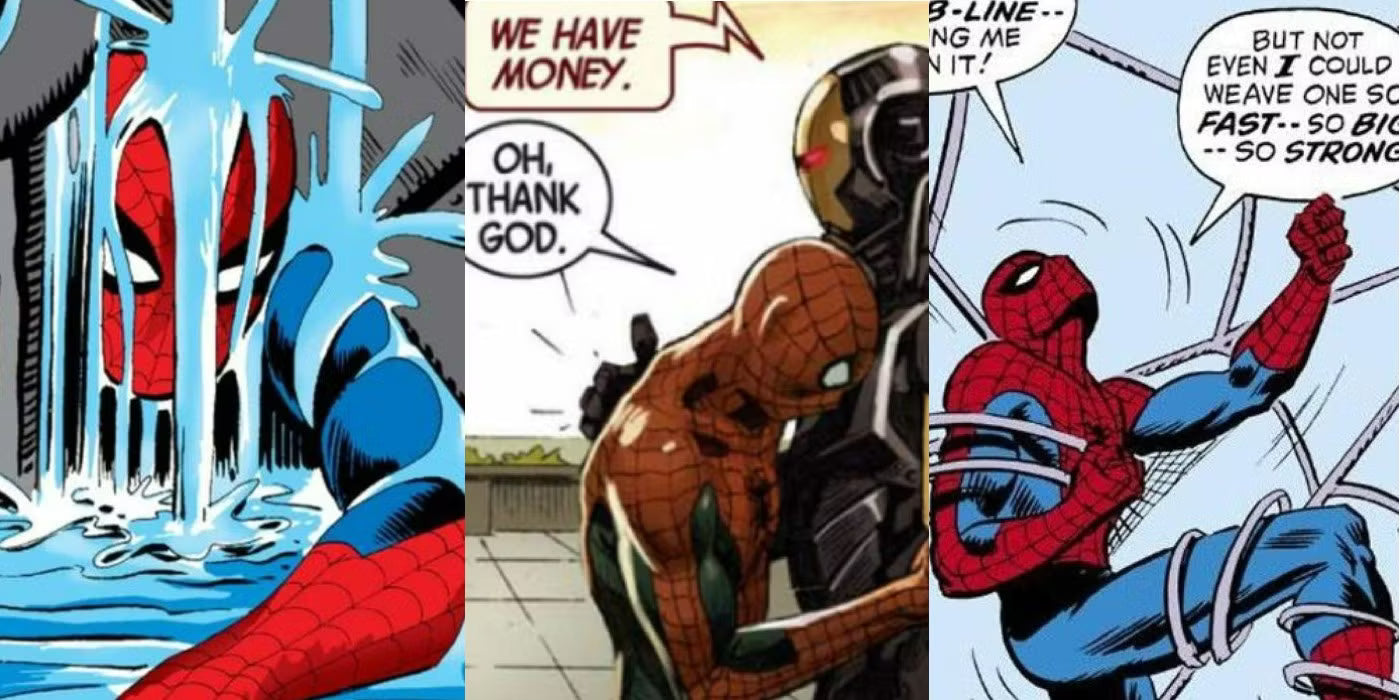
This is the most constant and least discussed weakness. Spider-Man bleeds. He breaks ribs, takes bullets that do not bounce off his skin, and goes home with stitches to put in himself. His healing is faster than average, not miraculous. A long fight drains him, and several of his most memorable defeats come not from a decisive blow but from accumulation: too many sleepless nights, too many patrols, too little sleep. Sometimes the most effective enemy against him only needs to be patient.
Spider-sense: a radar, not a shield
His famous spider-sense is taken for his unbeatable asset. That reading is flattering but wrong: it is a warning system, not a protection. It flags a threat, it does not neutralise it, and above all it has three failure modes that his cleverest enemies have learned to trigger.
Overload
When dangers pile up at the same moment, the alarm becomes a continuous noise that no longer points anywhere. Against an organised team the advantage flips: the radar screams, but it screams in every direction at once. That is exactly the principle behind villain coalitions, where numbers serve less to hit hard than to make the signal unreadable.
Illusion
Spider-sense reacts to real danger. A threat that does not exist never sets it off — and a real threat dressed up as an ordinary scene slips under the radar. That is the whole craft of Mysterio, who never tries to be faster than Peter, only to make him look in the wrong place. Chameleon exploits the opposite blind spot: nothing in Peter's power warns him that a familiar face is an impostor, as told in The Chameleon Conspiracy.
Shutdown
This is the rarest and most terrifying case: an opponent who has worked out how to cut the signal at source, chemically or because he has learned never to trigger it at all. The two canonical examples in this category are called Venom and Kraven, and each deserves its own section.
Venom: the blind spot walking beside him
The most elegant weakness in the whole canon comes from a decision Peter made himself. By wearing the symbiote for months, he taught it his body, his reflexes and his powers. When the creature bonded with Eddie Brock, it took that knowledge with it. The result: Venom can stand right behind him without a single alarm going off. The radar does not see him because, somewhere, it still counts him as part of the household.
That is what makes Venom an opponent of an entirely different nature. He is not just stronger and tougher than Peter: he is the only one who cancels the advantage that usually makes up for every one of his shortfalls. The full story of the symbiote and the black suit era show just how much this flaw is a debt Peter ran up himself. Anyone who wants to explore the whole gallery of parasites will find the detail in the complete guide to the symbiotes, while the Venom, Carnage and symbiote figurine collection brings together the pieces that put this rivalry on display.

The flaw on display
Spider-Man and Symbiote Collector's Figurine
The exact moment the costume stops being a garment and becomes an opponent. A piece that captures the founding scene of the only weakness Peter inflicted on himself.
View the product — €99.90Ethyl chloride: the weakness Marvel chose to shelve
There is, after all, one substance that plays something close to kryptonite's role in the comics: ethyl chloride, a compound found in certain pesticides aimed at spiders and insects. Exposed to a large enough dose, the web-slinger sees his abilities collapse; prolonged exposure becomes life-threatening. The logic is cruel and perfectly consistent with his origin: the man who owes his powers to a spider also inherits what kills spiders.
Spencer Smythe, father of the Spider-Slayers, made it the centrepiece of his hunting machines, and that is what made those robots genuinely dangerous rather than merely cumbersome. The problem, for the writers, was that the weapon worked too well: it turned every confrontation into a formality for anyone carrying a canister. The solution was to phase it out of the scenery. So this weakness remains canon while becoming vanishingly rare, which makes it the favourite curiosity of long-time readers.
Kraven: the enemy who turned weaknesses into a method
Sergei Kravinoff has no armour, no symbiote, no doctorate. He has something far more dangerous: the patience of a professional hunter and the habit of studying his prey before tracking it. Where others improvise, he prepares. He knows that spider-sense warns of danger, so he uses a tranquilliser dart rather than a fist. He knows that Peter stays on his feet through sheer willpower, so he attacks the mind before the body.
This is the blueprint of Kraven's Last Hunt, where he brings Peter down with a tranquilliser shot, buries him alive for two weeks and takes his place under the mask. No super-strength features in that victory: only a methodical reading of vulnerabilities. Thirty years later, Hunted replays the same idea on an industrial scale. The full portrait of the hunter sets out why this approach remains the most effective ever used against the web-slinger, and his bloodline continues with Ana Kravinoff. Anyone drawn to the hunter's style will find his emblem on the Spider-Man t-shirts and his full look in the fancy dress and costumes.

Wear the hunter's colours
Spider-Man T-Shirt — Kraven
For those who find the hunter more fascinating than the prey. An understated design, wearable every day, that speaks instantly to anyone who has read Last Hunt.
View the product — €29.90The real flaw: the people he loves
Every weakness mentioned so far can be treated, sidestepped or compensated for. This one, never. Peter Parker is vulnerable through the people close to him, and that vulnerability grows with every person he lets into his life. The mask does not exist to protect him: it exists to protect everyone else, as our analysis of his secret identity explains in depth.
Norman Osborn was the first to understand this all the way through. Discovering the face under the mask did not help him win a fight, but it told him where to strike. Gwen Stacy's fall from the top of a bridge, told in the arc that changed Spider-Man forever, remains the most brutal demonstration of the principle: the hero arrives in time, catches the person he loves, and loses her anyway. Green Goblin remains his worst nightmare for exactly that reason, not because he hits hard. The same mechanism plays out again in Back in Black, when a bullet meant for Peter hits Aunt May. The masks section and the feature on the man behind the costume take on a particular resonance once you understand what that piece of fabric really protects.

The face of the real weakness
Spider-Man Mask — Green Goblin
The one who worked out that you do not bring the web-slinger down by hitting him, but by aiming at what he loves. A characterful piece for a memorable cosplay or a villains display.
View the product — €59.90Doctor Octopus: the weakness nobody saw coming
Otto Octavius brought a variation the web-slinger had never considered: what if the attack targeted neither the body nor his loved ones, but his identity itself? In the arc Dying Wish, he swaps minds with Peter and takes over his entire life — his body, his costume, his reputation, his relationships. The sequel, Superior Spider-Man, shows a web-slinger who is technically more effective and humanly unrecognisable.
That story reveals an uncomfortable truth: Peter's powers are not what makes Spider-Man. They are transferable, as the genius with the mechanical arms proved. What is not transferable is the moral compass — and that is precisely what the stolen body will end up unable to bear.
The weaknesses nobody fights for him
There remains the category that character profiles never list, and which nonetheless explains half his defeats. Money, first: Peter funds his own equipment, his web fluid and his repairs while struggling to pay the rent. Then fatigue, piling up over years of sacrificed nights. And finally isolation, imposed by the secret that forces him to lie to everyone who matters.
To that must be added a flaw he has no wish to be rid of: his refusal to kill. That rule systematically denies him the definitive solution, which guarantees that every villain comes back. Green Goblin, Octavius and Vulture are all opponents that any more ruthless vigilante would have removed from the equation long ago. His enemies know it perfectly well and play on it: they take risks they would never take against a hero willing to go all the way. The constraint is real, measurable in the number of escapes, and yet Peter keeps it — a chosen weakness, the only one on the list.
And above all, guilt. Uncle Ben's death installed an inner rule that no opponent needs to activate: every person he fails to save becomes his fault. His sharpest enemies do not create that pressure, they simply lean on it. It is also what gives the character his depth, and what you find again in the retrospective of his major story arcs.
Why these flaws make him the best-loved hero
A character without weakness has no story, only fights. By giving the web-slinger a limited body, a fallible radar, an empty bank account and a heart left too exposed, Marvel created a hero whose every victory costs something. That is why an eight-year-old and a fifty-year-old reader both see themselves in him for different reasons: the first sees someone who always gets back up, the second sees someone who pays the price.
So the answer to the opening question comes down to one sentence: Spider-Man's greatest weakness is having stayed Peter Parker. No enemy has ever managed to take that away from him, and that is precisely what makes him beatable — and unforgettable. To take the exploration further, the Spider-Man figurines and posters cover most of the scenes mentioned here, and the Guides & Advice hub brings together all the shop's in-depth features.
Frequently asked questions about Spider-Man's weaknesses
Does Spider-Man have a kryptonite?
Not strictly speaking, but ethyl chloride comes close: this compound, found in certain pesticides, neutralises his powers and becomes lethal at a high dose. The writers deliberately set it aside because it made the character too easy to beat.
Why doesn't his spider-sense detect Venom?
Because the symbiote lived on Peter before joining Eddie Brock. It learned how he works, including his warning system, and knows how not to set it off. It is a weakness Peter created for himself by wearing the black suit.
Is he vulnerable to ultrasound and fire like Venom?
No, those two vulnerabilities belong to the symbiotes, not to Peter. Quite the opposite: they are the weapons he uses against them. Confusing the two means crediting the hero with his opponent's weak points.
Which enemy exploited his weaknesses best?
Two names stand out. Kraven, for method: he studies him, sedates him and buries him without ever resorting to brute force. And Norman Osborn, for target: by discovering his identity, he understood that he had to aim at the people close to him rather than at the hero.

