

14-Day Money-Back Guarantee
0
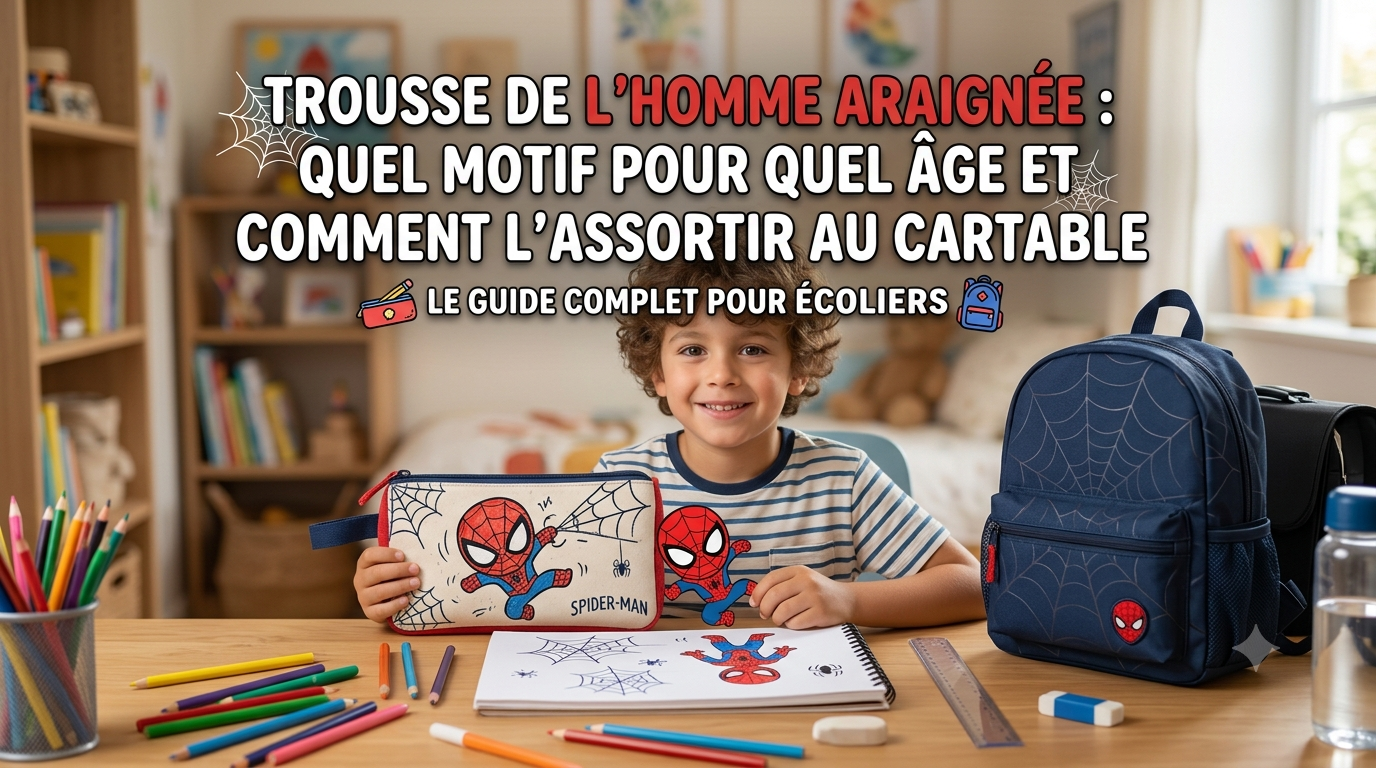
The essentials before you choose
The design matters more than the size: Spidey and His Amazing Friends for nursery, the logo or the mask from Year 3 onwards, Miles Morales and the darker versions for pre-teens who refuse anything too childish. Then check the zip, the lining and how it works with the school bag. Every criterion is covered below.
It's the one piece of school kit a child opens and closes twenty times a day, the one they put on the desk in front of everyone else, and yet the one that gets the least thought at the moment of buying. The school bag is chosen carefully, water bottles are compared, then the first pencil case with the web-slinger on it gets grabbed at the till. The result: a pencil case that matches nothing, or worse, a design your child will find babyish by January. This guide takes the problem from the other end, starting with the only criterion that really decides how long the thing lasts: the design, and the age it suits.
Why the design matters more than anything else
On this kind of accessory, the technical specs barely vary from one model to the next: the same roughly twenty-centimetre size, the same wipe-clean coated fabric, the same price bracket. The difference you can actually see, the one that decides whether a pencil case is adopted or abandoned at the bottom of the bag, comes down to the illustration printed on it.
And that illustration has a use-by date. A four-year-old asks for the round, smiling characters; the same child at nine will flatly refuse to take them out in front of their classmates. That is why a badly judged purchase never lasts a full school year, whereas a design chosen one notch above your child's actual age often lasts two back-to-school seasons. The reasoning is the same one we set out in our guide to backpacks by age and use, with the difference that a pencil case, being smaller and cheaper, is easier to replace.
Ages 3 to 6: round, reassuring characters
In nursery and the first years of primary school, a child cannot yet read fluently: they recognise shapes and colours. The cartoon-style versions, with rounded lines and bold colours, are the ones they instantly identify as theirs. It is also the age where the object works as an emotional anchor: finding the same character on the pencil case, the bag and the water bottle is reassuring at drop-off in the morning.
In practice, go for the versions taken from the programmes aimed at younger children, along with cartoon-style designs. Avoid dark visuals and close-ups of masked characters, which some children of this age find intimidating. We took this mechanism of attachment apart in our analysis of why children are fascinated by Spider-Man.

The nursery pick
Spider-Man Pencil Case — Spidey and His Amazing Friends
Rounded lines, bright colours, characters they recognise instantly: the design that reassures 3-6 year olds and that they can spot before they can read.
View product — 22,90 €Ages 7 to 10: the logo, the mask, the suit
This is the pivotal age. Your child still wants their hero, but they are starting to notice what others think and reject anything that looks babyish. Graphic designs answer exactly that need: the stylised spider, a close-up of the mask or the texture of the suit all signal allegiance without going anywhere near cartoon territory.
It is also the age bracket where the logo design becomes the safest bet. Pared back, almost abstract to an adult eye, it stays readable to every child in the playground and ages remarkably well: it is often the only pencil case that survives two school years without your child asking to change it. The same principle explains the lasting success of graphic prints on clothing, as our guide to backpacks by style and design shows. The full range is gathered in the Spider-Man pencil case collection.
From age 10: the darker, alternative versions
At secondary school, the classic red and blue design becomes a social risk. Your child has not stopped loving the character, they have stopped accepting the childish version of him. The answer comes down to one thing: the alternative takes. Miles Morales and his flat black and red, the street-styled versions, the darker graphic treatments all let them keep the universe while changing the visual register completely.
It is the best investment on this list, because it is the only design that does not date downwards: a pre-teen who drops red and blue never goes back, whereas a dark version can stay with them right through sixth form. The same logic applies to every everyday accessory, from the keyring clipped to the school bag to clothing.

The secondary school pick
Spider-Man Pencil Case — Miles Morales
Black and red, street register: the universe stays, the childish side disappears. The design that survives the move up to Year 7 instead of being shoved to the bottom of the bag.
View product — 22,90 €The four things to check before you commit
The zip
It is the part that fails first, almost always before the fabric wears out. A slider that catches in the shop will not get any better after three months of daily handling by eight-year-old hands. Run the zip all the way along, twice, in both directions: if it sticks at one particular point, put it back.
The inside lining
A school pencil case will sooner or later take a leaking biro or an uncapped felt tip. A smooth, lightly coated lining wipes clean with a sponge; raw fabric takes the stain for good. It is a detail you cannot see in a photo, and it is the one that decides what the thing looks like by March.
The volume you will actually use
The instinct is to go big to be on the safe side. That is a mistake at primary level: an oversized pencil case no longer fits the front pocket of the school bag and ends up crushed in the main compartment against the exercise books. The right size is the one that holds the school's equipment list, not the one that holds the whole stationery aisle.
A name label that stays readable
Pencil cases get lost, mixed up, and turn up in someone else's bag. Plan for a smooth spot, inside or under the zip, where the first name can be written in permanent marker. On very busy designs, that detail turns out to be surprisingly hard to find after the event.
Matching it to the school bag without going full matching set
The classic mistake is choosing exactly the same visual on the bag, the pencil case, the water bottle and the lunch bag. The effect is that of an advertising uniform, and above all it dooms the whole lot: the day your child tires of the design, they reject all four items at once.
The right method is to let a single piece carry the strong design and keep the others in the same colour register. An illustrated backpack calls for a graphic pencil case; conversely, a plain bag allows a more attention-grabbing one. The water bottle and the lunch bag then act as the link by simply picking up the red and the blue. The full reasoning on kitting them out is in our back-to-school guide and in the feature on the insulated lunch bag, while the back-to-school selection brings all the pieces together.

The fail-safe option
Complete Spider-Man Backpack Set
The set already coordinated for you, designed to work together with no styling effort. The shortcut for parents who want the new school year sorted in one go.
View product — 64,90 €Filled or empty: what it really changes
Pre-filled pencil cases are reassuring because they give the impression that everything has been sorted in one go. In practice, the school issues a precise equipment list, often with set brands or sizes, and the generic contents of a filled pencil case almost never match that list. You end up buying the items asked for anyway, having already paid for the ones you will not use.
An empty pencil case, chosen for its design and its build quality and then filled with the class's actual list, therefore works out cheaper and lasts longer. The simple rule: the pencil case is a container you keep for several years, the contents are consumables you replace every term. The two do not have to be bought together.
What it should hold, year by year
In Years 1 and 2, the contents stay deliberately minimal because the teacher often provides the essentials and your child is still learning to look after their own kit. Two pencils, a rubber, a sharpener with a shavings compartment, a pair of round-ended scissors, a glue stick and a few colouring pencils are enough. Anything beyond that basic set ends up lost, broken or swapped in the playground before the October half-term. It is also why a compact pencil case is better at this age: it sets the limit for you.
From Year 3 to Year 6, things change. The four-colour biro appears, whiteboard pens become a daily item, and the flat twenty-centimetre ruler has to go in without being forced. That is exactly when the pencil case bought back in nursery becomes too small, and when a lot of parents discover the ruler does not fit. Measuring the inside diagonal before buying avoids that great classic of the second week of September.
At secondary school, the kit becomes specialised and spreads out across subjects. Highlighters, an eraser pen, correction fluid, a calculator for some year groups, not counting the compass and set square that no soft pencil case takes properly any more. That is where the two-pencil-case approach makes its own case, and where the size matters more than the design. A teenager who has to rummage for thirty seconds to find a highlighter mid-lesson changes pencil case before the end of term, whatever character is printed on it.
The real sum: purchase price against annual cost
A budget pencil case picked up in a supermarket costs a few euros and feels like a bargain. The problem shows up in January: the zip gives way, the lining is stained, the print is flaking, and you have to buy again. Over one school year, two or three purchases like that come to more than a decent model bought once, not counting the mornings lost finding a replacement in a hurry.
The useful calculation, then, is not the price on the label but the cost per school year actually covered. A pencil case at around twenty euros that lasts two back-to-school seasons works out at around ten euros a year, with the kit intact and your child happy. The same budget spent on three throwaway pencil cases leaves them with a battered object at the moment they need it most, right in the middle of assessments.
That sum also explains why the choice of design carries financial weight. A pencil case in perfect condition that your child is embarrassed by is exactly as wasted as a broken one: either way, you have to buy again. That is why aiming one notch above their actual age, as explained above, is not a cosmetic detail but the decision that sets the real cost of the kit. The same arithmetic applies to the whole outfit, from the back-to-school bag to the clothes your child will wear in class.
How many pencil cases do you actually need?
One is enough up to Year 2. From Year 3, and above all at secondary school, two pencil cases become a genuine comfort: one for everyday writing, which stays light and travels every day, and a second for drawing and geometry kit, which only comes out on the relevant days. That split avoids the single overloaded pencil case that warps the school bag and takes thirty seconds to get a pencil out of.
It is also an elegant way to solve the design problem: the everyday pencil case carries the discreet visual your child is happy with in front of their classmates, while the second one can keep a bolder design. For families putting together a complete back-to-school gift, the gift selection makes it possible to pair the set with a surprise, an approach set out in our article on why parents stay loyal to this universe.
Making it last the whole year
Three habits are enough. Empty the pencil case completely once a month, which is how you find the lost sharpeners and clear out the shavings that eventually jam the zip. Clean the inside with a damp sponge without soaking the fabric, never in the machine on coated models. And replace a leaking pen straight away, before the ink migrates into the lining.
The same habits apply to the whole kit, as set out in our guide to looking after a backpack. A properly looked-after pencil case gets through two school years without trouble, which changes the real cost calculation completely. More practical features are gathered on the Guides & Advice hub and in the merchandise guide.
Frequently asked questions
Which design should I choose if my child changes school mid-year?
Go for a graphic visual rather than an identifiable character. The spider logo is socially neutral: it works in every playground, whatever the group's level of attachment to the Marvel universe.
Is a Spider-Man pencil case suitable for a girl?
Without the slightest difficulty, and the designs featuring Spider-Gwen or the colourful takes answer that directly. The character cuts right across among children, and the question has already stopped being asked in the playground.
Can it go in the washing machine?
It is not advisable on coated or printed models: washing gradually lifts the print and warps the zip. Cleaning with a damp sponge, inside included, gives a better result and preserves the design.
Should I buy it at the same time as the school bag?
Ideally yes, so you can check that it fits the front pocket and that the two visuals work together. If the bag has already been bought, measure the pocket before ordering: it is the constraint that rules out the most models.
My child loses everything: what can I do?
Two measures genuinely work. Write the first name inside AND outside, because a pencil case found in a corridor only gets handed back if the name is visible without opening it. And choose a distinctive design rather than the year's best seller: in a class where six children have the same pencil case, mix-ups stop being a matter of luck and become a matter of statistics.
When should I buy it to avoid it selling out?
The most sought-after designs go first and restock badly in the middle of the season. The comfortable window runs to mid-August; after that date, the choice narrows to whatever references are left and your child ends up with the design nobody wanted. Ordering early costs the same and leaves the whole range open.
Is a design from a recent film a good choice?
It is the riskiest bet over time. A visual tied to one specific film makes an immediate impression at the start of term, then dates fast as soon as the news moves on. Timeless designs — logo, mask, classic suit — get through the seasons without ever looking dated, and that is what makes them better value over two years.

