
14-Day Money-Back Guarantee
0
The short answer
Unable to die since his resurrection, Sergei Kravinoff stages this vast hunt to prove that he is the ultimate predator before finally finding rest. The web-slinger, trapped inside the park, chooses to protect his worst enemies rather than abandon them. Analysis and ending below.
Picture Central Park, that green lung at the heart of Manhattan, turned into a sealed hunting reserve where dozens of animal-themed criminals are released like game. Picture an army of clones, all identical, tracking that prey for the morbid entertainment of a handful of thrill-hungry billionaires. And at the centre of this nightmare, a man who is no longer chasing victory, but death. That is the setting of 'Hunted', the masterful arc written by Nick Spencer for the Amazing Spider-Man series in 2019, one of the darkest and most ambitious stories ever devoted to the twisted relationship between the wall-crawler and his most obsessive hunter. This is not simply an action story: it is a chilling meditation on mortality, legacy and what it really means to hunt a prey. Let's dive behind the scenes of a hunt that will remain etched into Spider-Man's legend.
Kraven the Hunter: a man worn down by the boredom of immortality
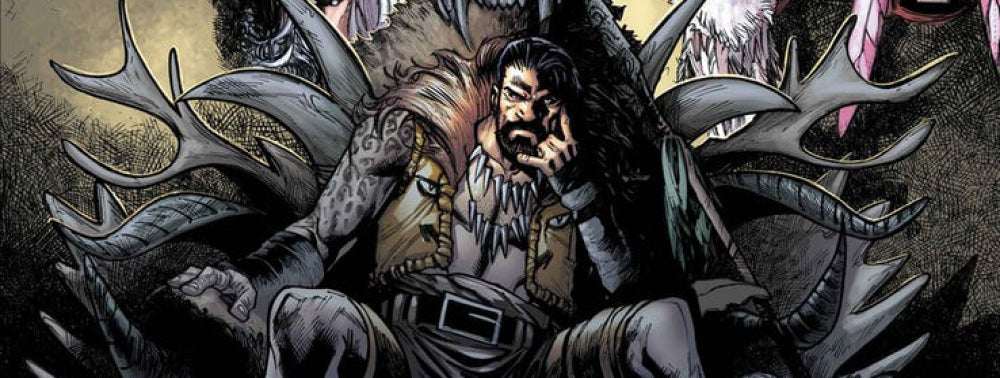
To understand 'Hunted', you first have to understand the state of mind Sergei Kravinoff is in as the arc begins. Kraven the Hunter is no ordinary villain. Where most of the wall-crawler's enemies want money, power or revenge, Kraven pursues one thing only: the perfect hunt, the ultimate confrontation with a prey worthy of him. And since his resurrection, that quest has become a curse.
For Sergei came back from the dead. After the events of 'Grim Hunt', his family brought him back to life through a bloody ritual, but this new existence brought him no peace. On the contrary, he discovers to his horror that he can no longer die a natural death, condemned to wander in an immortality he never wanted. For a man whose entire philosophy rests on the thrill of mortal danger, living without being able to die is the worst of tortures. The hunt, now far too easy, has lost all its flavour. Every prey brought down only deepens his disgust.
It is from this existential despair that the most ambitious and most terrible plan of his whole career is born. Kraven no longer simply wants to hunt: he wants to prove, once and for all, that he is the ultimate hunter, and then finally find the rest of death. This obsession with mortality runs through every page of the arc and gives it a tragic depth that reaches far beyond a straightforward superhero story.
The great hunt: Central Park turned into a deadly reserve
The heart of the scheme Kraven devises is machiavellian in its cruelty. He has dozens of criminals and animal-themed individuals from Spider-Man's world captured: Vulture, Scorpion, Rhino, the Lizard and many more besides. All these enemies, whom the wall-crawler has fought separately over the years, suddenly find themselves gathered together not as allies, but as prey.
Central Park is sealed off and turned into an enormous closed hunting reserve. The captured villains are released inside, forced to run for their lives. But they are not hunted by Kraven alone. The hunter has spawned an army of clones of himself, dozens of perfect copies, who roam the park to bring down the game. The macabre spectacle is broadcast live to wealthy clients, rich hunters who pay colossal sums to watch this organised carnage from the safety of their boxes. The hunt becomes entertainment, an urban safari where human beings stand in for wild beasts.

This reversal is one of the arc's most striking ideas. Criminals the reader was used to fearing or despising suddenly become victims, hunted down and terrified. The line between predator and prey, between monster and innocent, blurs dizzyingly. And in the middle of this chaos, Spider-Man is about to be trapped.

The prey turned hunter
Detective Spider-Man Figure
Trapped in Kraven's hunt, Spider-Man has to use his wits to survive. A figure in a dark detective style that captures all his intensity.
79,90 €View product
Spider-Man trapped: the hero facing the horror
When Peter Parker works out what is going on in Central Park, he has no intention of standing by and watching. But Kraven has anticipated it. The wall-crawler too is caught in the net of the hunt, becoming both prey and protector. For unlike the clones, who have only one goal, to kill, Spider-Man sets himself the diametrically opposite mission: to save as many lives as possible.
This is where the arc reaches its most powerful moral dimension. These villains Spider-Man has been chasing for years, these men who have wanted him dead countless times, he nevertheless chooses to protect. For Peter Parker, it does not matter who they are or what they have done: no life deserves to be sacrificed for the perverse pleasure of a few billionaires. That conviction is the very heart of what makes him a hero.
The story shows an exhausted, overwhelmed Spider-Man, running from one threat to the next in a park turned into a slaughterhouse. He cannot be everywhere at once. He watches, powerless, deaths he would have wanted to prevent. That powerlessness eats away at him and gives the arc an almost unbearable tension. You find in it the essence of the character's great tragedies, those moments when the weight of responsibility becomes crushing, as in some of the greatest defeats of Spider-Man.
Refusing to kill: the line Spider-Man will never cross
Beyond the spectacular action, 'Hunted' is above all an exploration of Spider-Man's moral code. The whole machinery of Kraven's hunt rests on killing. The clones kill, the hunters applaud, blood flows. In this environment where lethal violence is the norm, Spider-Man opposes an absolute refusal: he will not kill, and he will do everything he can to make sure the others survive.
This refusal to kill is not a weakness, it is the very definition of the character. Where Kraven sees death as the logical outcome of any hunt, Spider-Man sees a line that no circumstance justifies crossing. This philosophical opposition structures the entire arc. The hunter embodies a view of the world in which a being's worth is measured by its ability to survive the chase; the hero embodies the idea that every life has an intrinsic, unconditional value.
Nick Spencer pushes this tension to breaking point. Spider-Man is tempted, driven into a corner, faced with situations where the simplest solution would be to let someone die, or even to kill. But he holds firm. And that is precisely what exasperates and fascinates Kraven: the hunter cannot understand how a prey can refuse to become a predator in order to survive. This mutual incomprehension is the emotional engine of the story.

In full flight
Spider-Man Figure with Stand
Capture the web-slinger mid-acrobatics, just as he escapes Kraven's clones. A dynamic figure at a small price for every fan.
26,90 €View product
The clone army and the last son: Kraven's legacy
Kraven's real plan is more devious than simply staging a hunt. The clones he has spawned are not mere disposable soldiers. They stand for a deep obsession: transmission, legacy, the perpetuation of the self beyond death. Kraven, who can no longer die naturally and who despises offspring he judges unworthy, has decided to recreate himself.
Among this multitude of copies, one being stands out: the 'last son', a clone meant to embody the perfect culmination of everything Kraven represents. This last son is not conceived as a slave, but as an heir, the one who must take up the mantle of the ultimate hunter. The whole staging of the great hunt is in fact designed to forge and test this heir, to confront him with the most merciless of trials.
This theme of filiation and legacy haunts the whole arc and echoes the hunter's entire family history. Kraven has already had children who left their mark on the wall-crawler's world, such as Ana Kravinoff or Alyosha Kravinoff, each having tried in their own way to carry on or betray the Kravinoff name. But with his army of clones, Sergei goes further: he refuses to entrust his legacy to the accident of birth and chooses to manufacture it from scratch.
The ending: Kraven finally gets what he wants
The ending of 'Hunted' is as unexpected as it is moving. The whole great hunt, all this excess of violence and clones, had only one secret purpose: to let Kraven finally die, but with a death that meant something in his eyes. The hunter could not take his own life, a gesture unworthy of his philosophy. He had to be defeated, hunted in his turn by a prey that had become his equal.
And it is his own clone-son who carries out that destiny. The last son, forged to become the ultimate hunter, turns his weapons on his creator and kills him. Dying at the hands of his own creation, Kraven fulfils his deepest wish: he proves that he has fathered a hunter capable of surpassing him, and in that final defeat he finds the death he had been desperately seeking. The predator becomes prey, the master is overtaken by the pupil, and the cycle of the hunt closes in a tragic vertigo.
This conclusion gives the arc an almost mythological resonance. Kraven does not die defeated by Spider-Man, as you might have expected, but by the fruit of his own obsession. It is an ending of relentless coherence, one that perfectly rounds off the portrait of a man imprisoned by his own quest for perfection.

The hero who refuses to kill
Tom Holland Spider-Man Figure
At the heart of the hunt, Spider-Man stays true to his code: never kill. A collector's figure of the web-slinger played by Tom Holland.
79,90 €View product
Mortality, legacy and the hunt: the arc's great themes
If 'Hunted' leaves such a mark on readers, it is because it goes beyond a simple clash between a hero and a villain to tackle universal questions. Mortality first: Kraven embodies the anguish of the man who can no longer die, for whom life without the prospect of an end loses all meaning. This inversion of the usual human desire, where it is death and not life that becomes the object of the quest, gives the character a rare philosophical depth.
Legacy next: through the clone army and the last son, the arc questions what we leave behind us and the way we seek to extend ourselves beyond our own existence. Kraven wants to control his own succession down to the smallest detail, refusing to let chance decide who will carry his name and his philosophy. This will to absolute control over his posterity is both fascinating and deeply futile.
The nature of the hunt last of all: what separates the predator from the prey? The whole arc plays on that shifting line. The villains become game, the hunter becomes the target, and Spider-Man refuses to play the predator's game. By setting the hero's moral code against the implacable logic of the hunt, Nick Spencer delivers a subtle reflection on violence, dignity and the value of life. To better grasp Kraven's place in the wall-crawler's gallery of adversaries, you can situate him among the most powerful enemies of Spider-Man.
An echo of the great hunts of the past
'Hunted' does not come out of nowhere. The arc belongs to a long tradition of stories in which Kraven and Spider-Man clash in duels of exceptional psychological intensity. The most famous of them remains, of course, Kraven's Last Hunt, that 1980s masterpiece in which the hunter, after capturing and burying the wall-crawler alive, put on his costume to prove that he could surpass him, before taking his own life. Even then, death and the obsession with perfection were at the heart of the character.
'Hunted' also enters into close dialogue with Grim Hunt, the arc that orchestrated Kraven's return from the dead through his family's ritual. It is precisely this forced resurrection, this immortality he never asked for, that drives the entire great hunt of 2019. Without 'Grim Hunt', 'Hunted' would simply not exist. Nick Spencer builds his story as the culmination of a saga decades in the making, weaving in constant references to past confrontations.
This continuity gives the arc a particular richness for long-standing readers. Every detail resonates with the character's history, every theme extends and deepens what had been sown years earlier. 'Hunted' reads less like an isolated story than like the final movement of a tragic symphony devoted to the figure of the hunter. To explore this gallery of adversaries more widely, the guide to Spider-Man's enemies offers a complete overview.
The legacy of 'Hunted' in the Spider-Man universe
The impact of 'Hunted' did not stop at the arc's final page. Kraven's death, the surviving clones and the upheavals caused by this hunt left lasting traces in the wall-crawler's world. The consequences of the hunt went on being felt in the stories that followed, feeding new plots and new conflicts. Kraven's clones, in particular, became recurring elements, prolonging the hunter's shadow long after his passing.
The arc also helped revive interest in the great collective confrontations between Spider-Man and his enemies. By bringing so many villains together in a single set-up, 'Hunted' paved the way for other ensemble stories in which the wall-crawler faces entire galleries of adversaries, such as the devastating war told in Sinister War. The 'all against one' logic and the psychological exploration of the villains, pushed to their extreme in 'Hunted', fed a whole creative period of the series.
Critically, the arc is today regarded as one of the high points of Nick Spencer's run on Amazing Spider-Man, praised for its narrative ambition, its thematic richness and its courage in plunging the character into a darkness rarely reached. It gave Kraven the Hunter back his full stature as a great tragic adversary, worthy of the legacy left by 'Kraven's Last Hunt'. A special mention too for the monstrous creature Gog, whose presence in Kraven's mythology shows the sheer breadth of the universe woven around the hunter over the decades.
Why 'Hunted' is an essential arc
At the end of this deep dive, one thing is obvious: 'Hunted' is not just another action arc, but a major work that condenses everything that makes Spider-Man stories great. The moral tension is constant, the emotional stakes permanent, and the philosophical reflection unusually deep for a mainstream superhero story. By setting the wall-crawler's absolute refusal to kill against the hunter's deathly obsession, Nick Spencer delivers one of the most accomplished ideological confrontations in Spider-Man's mythology.
The arc also works because it takes its characters seriously. Kraven is not reduced to a cardboard villain here, but treated as a tragic figure worthy of the great classical tragedies, a prisoner of a curse he called down on himself. Spider-Man, for his part, embodies with dazzling clarity the values that have made him a beloved hero for generations: sacrifice, compassion, and that unshakeable conviction that every life deserves to be protected.
For any comics lover, whether a long-standing reader or a newcomer drawn in by the wall-crawler's world, 'Hunted' is essential reading. It offers an ideal way into the character's great themes while rewarding those who know his history. And to carry the passion beyond the page, there is nothing like surrounding yourself with your favourite heroes and villains through a fine collection of Spider-Man figures that bring these legendary clashes back to life.
Frequently asked questions about the 'Hunted' arc
Who wrote the 'Hunted' arc and when was it published?
'Hunted' was written by Nick Spencer and published in 2019 in the Amazing Spider-Man series. The arc belongs to the run Spencer devoted to the character and stands as one of its high points, both for its narrative ambition and for the darkness of its themes. It marks a major moment in the confrontation between Spider-Man and Kraven the Hunter, extending and concluding a saga begun decades earlier with stories such as 'Kraven's Last Hunt' and 'Grim Hunt'.
Why does Kraven organise this gigantic hunt?
Kraven organises this hunt because he is eaten up by his obsession with mortality and by disgust at a hunt that has become far too easy since his resurrection. Unable to die naturally, he wants to achieve one last feat proving that he is the ultimate hunter, and then finally find the rest of death. Capturing the animal-themed villains and creating an army of clones serve that twin aim: to demonstrate his supremacy and to forge the heir who will be able to kill him and carry on his legacy.
How does Kraven die at the end of the arc?
Kraven dies at the hands of his own clone-son, the 'last son' he had conceived to embody the ultimate hunter. By turning his weapons on his creator, this heir fulfils Kraven's deepest wish: to be defeated by a prey that has become his equal, and so to find the death he had been desperately seeking. It is a deeply tragic and coherent ending, in which the predator becomes prey and the hunter's obsession finally consumes him.
Should you read 'Kraven's Last Hunt' and 'Grim Hunt' before 'Hunted'?
It is not strictly necessary, as 'Hunted' can be followed without difficulty, but reading those two arcs first enriches the experience considerably. 'Grim Hunt' explains Kraven's resurrection and the immortality forced upon him, which drive the entire great hunt of 'Hunted'. As for 'Kraven's Last Hunt', it lays the foundations of the hunter's obsession with death and perfection, themes that 'Hunted' takes up and deepens. Together, these stories form a genuine thematic trilogy around the figure of Kraven the Hunter.

