
14-Day Money-Back Guarantee
0
The short answer
In this 2013 run written by Dan Slott, Otto Octavius pilots Peter Parker's body across thirty-three issues: optimised patrols, a network of spy robots, the execution of a villain as early as the fifth issue, a doctorate earned and a company founded. He fails on a single front, the one that eventually pushes him to erase himself in the face of Norman Osborn. The whole run is unpacked below.
In January 2013, Marvel did something no publisher does willingly: pull its most profitable character out of his own series and replace him with his worst enemy. For eighteen months the cover still showed a red and blue spider, but the man under the mask was Otto Octavius. Readers howled, sales climbed, and the experiment produced one of the most debated runs in the wall-crawler's history. Here is what actually happens in it, issue by issue, and why the ending is far subtler than the provocation it started with.
The starting point: a stolen body, not a disguise
The swap itself does not happen in this series. It closes the previous arc, in which a dying Octavius transfers his mind into Peter Parker's body and leaves the hero to fade away in a broken shell. The details of that manoeuvre, its immediate consequences and Peter's final gesture are told in Dying Wish, which remains the compulsory way in.
What matters for the rest holds in one decisive nuance: Otto does not steal an identity, he inherits a memory. As he dies, Peter forces him to relive every one of his memories, including Uncle Ben's death. The man who gets back up is therefore not a cynical impostor but a scientist convinced he has understood the lesson better than the one who learnt it. The whole series flows from that conviction. To place Octavius before his transformation, his full profile and the outsized operation of Ends of the Earth show the scale of the ego at play.
What an engineer changes when you hand him Spider-Man
The first issues are an almost comic demonstration of efficiency. Where Peter patrolled at random hoping to stumble on a crime, Otto deploys a network of spy robots above New York and moves only where the system flags an intervention. He turns down pointless fights, standardises his web-shooters, upgrades the suit's armour and hires staff. Within a few weeks, crime falls for good.
That is the trap laid for the reader, and it works perfectly: on results alone, Otto is a better Spider-Man. He works less in a panic, sleeps more, no longer misses his appointments. The series spends its first five issues making that observation uncomfortable, before blowing it apart.

Massacre: the scene that tips the whole run
In the fifth issue, Otto faces Massacre, a mass killer stripped of empathy by a brain injury. Peter would have tried to save him. Otto neutralises him, then executes him coldly in front of a television camera, before explaining live on air that the city no longer has to worry about seeing him come back.
Why this scene is the real beginning of the story
Because it settles the debate the series had just set up. Otto gets superior results because he allows himself what Peter forbids himself. Efficiency was not a better method, it was the abandoning of a constraint. From there, every improvement Otto brings reads differently: the surveillance network becomes a control tool, the henchmen the beginnings of a militia, and the silence of the police an embarrassed complicity.

The silhouette of the run
Spider-Man Figure — Superior Spider-Man
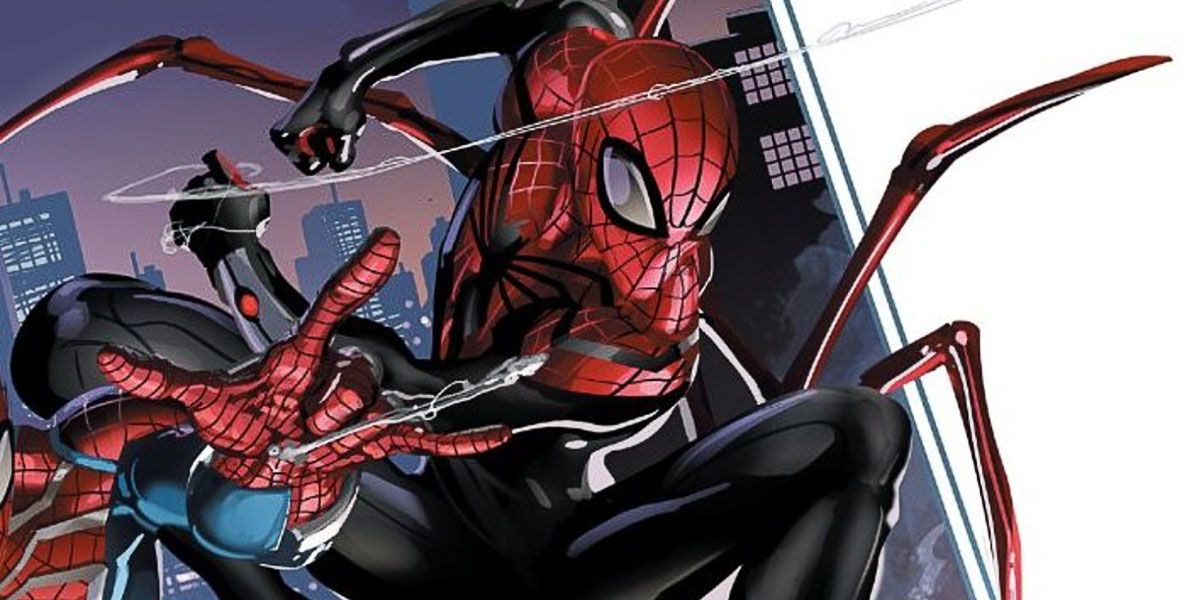
The red and black suit, the claws and the narrowed eyes: the character's whole message sits in this design. The piece missing from any display case devoted to the landmark arcs.
View the product — 109,90 €The ghost in the machine: Peter is not quite dead
The real narrative engine arrives next. Part of Peter's consciousness survived the transfer and watches, trapped, unable to act other than by quietly nudging Otto's decisions. It is that residue which stops the new web-slinger from crossing certain lines, and which explains the hesitations the reader took for leftover humanity.
Otto eventually finds out. His reaction is the most chilling gesture of the run: he hunts that residual consciousness down inside his own mind and erases it methodically, memory after memory. The reader then witnesses a second death of Peter Parker, more intimate than the first, and is left alone with Otto for some twenty issues. The series dares something rare: it deprives its audience of the character they came for, and gives them exactly enough time to measure what is missing. That question of 'who is really under the mask' runs through the character's entire mythology, as shown by the analysis of his dual identity.
Anna Maria Marconi: the relationship nobody saw coming
Introduced in that same fifth issue, Anna Maria Marconi is the most unexpected find of the series. A brilliant doctoral student of short stature, she first becomes the tutor of an Otto who has to catch up on Peter's university course, then his partner. The paradox is complete: it is by inhabiting another man that Octavius experiences the first sincere relationship of his life.
This romantic thread is not decorative. It sets up the only thing Otto really has to lose, and the series will use it when the time comes to conclude. It also allows a cruel contrast with the emotional life Peter had built: on taking over his existence, Otto ends his relationship with Mary Jane, judged too dangerous and too time-consuming for a rational Spider-Man.
A doctorate and Parker Industries: Otto succeeds where Peter gave up
The civilian half of the run is as enjoyable as the masked half. Otto lands the doctorate Peter had been dragging out for years, publishes, impresses his examiners and promptly founds his own company, Parker Industries. Within a few months, the Parker name stops belonging to a broke photographer and becomes a respected technology brand.
That is where the run touches its real subject. Peter was not failing for lack of talent: he was failing because he systematically sacrificed his career to his mission. Otto refuses that sacrifice, and his professional success measures exactly what heroism was costing Peter. Readers who want to place this period within the character's long trajectory will find the full thread in the panorama of all the major story arcs, alongside comparable turning points such as One More Day or The Other.

Octavius's camp
Spider-Man T-Shirt — Doctor Octopus
The four mechanical arms as a signature. An understated look to wear day to day, for those who find the doctor more interesting than the hero.
View the product — 29,90 €The world around him: the allies Otto loses one by one
One of the run's great successes is that it does not play out in a vacuum. Every supporting character reacts to this Spider-Man who has become unrecognisable, and those reactions form a countdown. The Avengers are the first to worry: they note a change in behaviour, run tests, find nothing conclusive and end up expelling him for want of trust. Otto takes the snub with lordly contempt, convinced they simply do not understand the superiority of his method.
On the civilian side, the movement runs the other way and is far more unsettling. J. Jonah Jameson, who has spent his career denouncing the web-slinger, becomes his best institutional supporter: this Spider-Man gets results, respects authority and does not do sentiment. The mayor of New York applauds exactly what the reader finds worrying, and that complicity will collapse brutally when Jameson measures how far the method goes.
That leaves those closest to him. Mary Jane is pushed away by calculation, Aunt May kept at a distance, Carlie Cooper shown the door for asking the right questions. By the end of the series, Otto has built a technology empire and methodically destroyed the circle that kept Peter standing. When the decisive attack comes, he will literally have nobody to call — and it is that emptiness, more than Osborn's power, that decides the outcome.
Superior Venom: when arrogance meets the symbiote
Towards the end of the run, Otto makes the mistake Peter took years to understand: he seizes the Venom symbiote, convinced he can dominate it by mental strength alone. The result is a black web-slinger, more powerful, more violent, and quickly uncontrollable — the Avengers have to step in to separate them.
The episode is an exact mirror of Peter's first experience with the black suit, told in our feature on his relationship with the symbiote, and the full history of Venom shows just how far this creature exploits the pride of its hosts. Otto repeats the same mistake with the certainty of being immune: proof that his intelligence protects him from nothing. The Venom and symbiotes figures collection and the complete guide to the symbiotes carry this part of the story further.

The mistake Otto repeats
Premium Venom Bust Statue
The creature that brought down two different Spider-Men, frozen in a premium-finish bust. The ideal display piece for a shelf devoted to the dark side.
View the product — 89,90 €Goblin Nation: the one thing Otto cannot do
While Otto optimises the city, Norman Osborn has patiently built an underground army. When the Goblin King strikes, he does not go after the web-slinger: he methodically destroys everything Otto has built, reduces Parker Industries to ashes, turns his surveillance network against him and finally kidnaps Anna Maria to force him out.
Osborn's superiority comes down to one thing Otto never had: he knows Peter Parker. He attacks human bonds, not systems. Faced with an opponent who strikes at the emotions, the engineer finds himself without a procedure. That is exactly the mechanism described in our analysis of the Green Goblin as Peter's worst nightmare, and a variant of the strategy deployed in Dark Reign. Those discovering the character can start with his full profile or with the portrait of the man behind the mask.
The final sacrifice: Otto erases himself
The conclusion is what saves the whole run. Cornered, Otto realises he does not have the means to win and, above all, he admits it. He finds within his own memory the recollections of Peter he thought he had destroyed, lets them reassemble, then erases his own consciousness to give the body back to its owner. His final message holds in a single line: the one who deserves the title of Superior Spider-Man is Peter.
The gesture is all the stronger for being voluntary. Otto does not lose a fight, he acknowledges an inferiority and draws the consequences — which, coming from the proudest character in the catalogue, amounts to the only genuinely heroic act of his career. Peter gets back a body in better shape, a doctorate, a company and a repaired reputation: the run ends on a poisoned gift whose consequences will occupy the years that follow.
Why this run divided readers so much
The criticism aimed at the series when it came out was simple: Peter Parker had been pulled from his own title without warning, and for a long time. Part of the readership experienced every issue as a hostage situation, all the more so as Marvel kept the real length of the experiment unclear. The commercial paradox became famous: the angrier the comment threads grew, the higher the sales figures climbed. Many readers bought the series precisely to check whether the publisher would dare see it through, which gave Dan Slott a freedom few writers get on a character of this stature.
With hindsight, the series reads quite differently. It is the most rigorous demonstration ever written of what Spider-Man is not: not the powers, not the suit, not even the effectiveness in a fight. By letting another man do the job better than him for thirty-three issues, Marvel proved by absence that the character rests entirely on his moral compass. Few stories manage to define a hero by taking him off the stage.
The legacy: what Superior left behind
The last two issues serve as a prelude to the multiversal event that follows, detailed in our Spider-Verse feature: the Superior version teams up with the other web-slingers of the multiverse, where his brutal pragmatism becomes a collective asset. The red and black suit has since become a safe bet in merchandising and video games, and the character has had several returns in limited series.
Parker Industries, for its part, outlived its founder and provided the backdrop for several years of stories. As for the central idea — a villain sincerely trying to be a hero and failing for good reasons — it has spread well beyond Spider-Man. To explore the other figures in this catalogue, the complete guide to the villains and the portrait of Stunner, Octavius's most intimate creation, extend the reading naturally. On the shop side, the Spider-Man figures, the t-shirts, the posters and the fancy dress and costumes take the red and black design in every direction, and the Guides & Advice hub brings together the shop's in-depth features.
Frequently asked questions about Superior Spider-Man
How many issues does the series run to?
Thirty-three, published between January 2013 and 2014, written by Dan Slott. The first thirty-one form the main story, from the takeover through to Goblin Nation; the last two serve as a prelude to Spider-Verse.
Is Peter Parker really dead for the whole run?
Not entirely. Part of his consciousness survives inside his own body and quietly influences Otto through the first half of the series, before being erased. It is his preserved memories that allow him to be pieced back together at the end.
Do you need to read Dying Wish first?
Yes — it is the arc that sets up the mind swap and gives the opening scene all its weight. Without it, the run starts from a situation already in place whose cost and cruelty you cannot gauge.
Did Otto Octavius become a hero in the end?
For the space of one gesture, yes. Acknowledging his inferiority and stepping aside voluntarily so that Peter can return remains the noblest act of his journey. His later appearances show, however, that the lesson did not last.

