
14-Day Money-Back Guarantee
0
The short answer
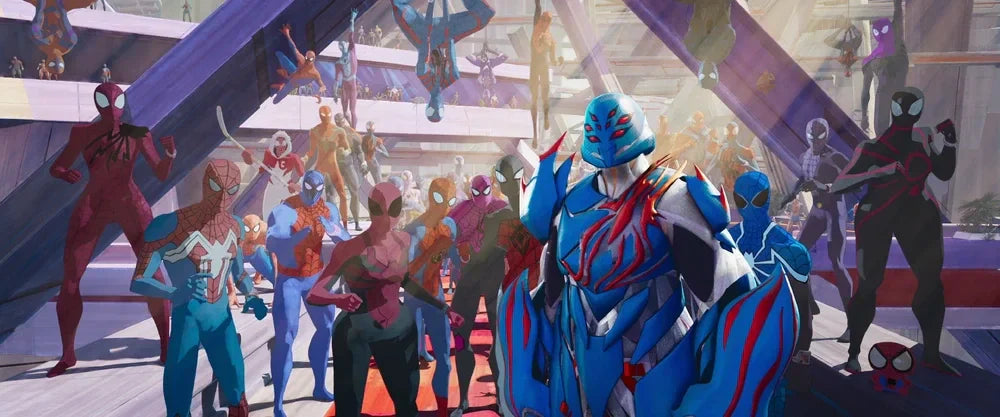
The Spider Society gathers variants of the web-slinger from different dimensions, united to watch over the stability of the realities and stop a single anomaly from bringing the whole web down. Miguel O'Hara enforces a strict doctrine around Canon Events, and it splits his members in two. Origins, branches and internal fractures just below.
An ancient order born of the spider totems
In the chaotic vastness of the Spider-Verse, beyond the familiar versions of Spider-Man covered on our pillar page Spider-Verse: Every Version of the Web-Slinger, lies a mystical organisation whose true scale very few people grasp: the Spider Society. Made famous by the film Across the Spider-Verse and deeply rooted in the totemic mythology explored in our article on the Spider-Totems, this secret society is no ordinary group of heroes. It is a sacred order, a thousand-year-old network charged with preserving the balance of the spider multiverse.

The idea behind the Spider Society is simple and terrifying: every Spider-Man, Spider-Woman or spider variant is part of a fragile cosmic fabric. A web. And that web has to be protected, watched over and mended whenever anomalies – or disasters such as Canon Events – threaten to tear it apart.
The concept has its roots in arcs readers already know well: the role of Ezekiel, totemic forces such as Morlun, the hunt led by the Inheritors… All of it points towards a need for organisation, a sacred union of the totems against threats capable of wiping out entire realities.

The Spider Society is often pictured as a place where the mystical meets the technological. You come across iconic versions of the web-slinger there – whether it is Spider-Man 2099, Peni Parker, or darker iterations – all bound by the same duty. Their mission? To watch over the multiverse, prevent realities from collapsing and protect the web of spider destiny.
The Spider Society's appearance in recent works has inspired a wave of merchandise: multiverse figurines, stylised posters, or even Spider-Verse costumes that take up the designs of the key members.
In this first part, we trace the origins of the Spider Society, its reason for being and its link to the deeper mythology of the web-slinger. The next section looks at how it works internally, at its leaders and at the way it handles multiversal crises.
A structured order built to hold the multiverse together
The Spider Society is not simply a team of interdimensional vigilantes. It is a hierarchical order, with strict rules, invisible protocols and a mission far bigger than any individual battle. It brings to mind the great organisations of the Marvel universe such as S.H.I.E.L.D., examined in our article on Spider-Man and S.H.I.E.L.D., but on a cosmic scale.
At the top of this structure sits one central figure: Miguel O'Hara (Spider-Man 2099), already explored in our detailed article on the Spider-Man of the future. In modern stories he acts as the inflexible guardian of time, of stability and of the 'narrative nodes' of the multiverse. His pragmatic – sometimes brutal – outlook sets him apart from more empathetic versions such as Peter B. Parker or Gwen Stacy.

Under his authority, the Spider Society splits into several branches:

- The multiverse patrollers: responsible for monitoring dimensional anomalies and stepping in whenever realities rupture.
- The Canon analysts: tasked with studying Canon Events and understanding the narrative ramifications specific to each Spider-Man.
- The web menders: a mystical unit devoted to restoring broken threads, heir to the totemic teachings found in the Spider-Totems.
This organisation reveals a truth that is rarely spelled out: every Spider-Man is not just an isolated hero, but an essential player in a complex cosmic symphony. This theme runs through our pillar page The Story of Peter Parker, which shows how even the smallest decisions send huge ripples across the multiversal web.
The Spider Society also runs on interdimensional sanctuaries, teleportation platforms and mystical tools combined with advanced technology – a perfect blend of the esoteric and science fiction. That side of things has inspired several flagship pieces of merchandise: Spider-Verse soft toys, articulated multiverse figurines and Spider-Man variant masks that take up the designs of the society's members.
In the next part, we will explore the internal conflicts, the ethical limits and the ideological fractures that threaten the Spider Society – and that reveal why its ideal is as fragile as the reality it protects.
When the web-slinger's values collide with the logic of the multiverse
The Spider Society may look like a force for stability, but its foundations rest on a deep tension: the eternal conflict between destiny and free will. Where Peter Parker embodies the idea that a hero is forged by his choices – the central theme of our pillar page Peter Parker – the Spider Society defends the opposite, rigid view: certain events have to happen, even when they bring suffering or death.
That tension comes to a head in the debates around Canon Events. Should a Captain Stacy really be left to die in every reality? Should an Uncle Ben perish so that destiny runs its course? For some members, the answer is yes. For others – Gwen Stacy, Miles Morales and Peter B. Parker among them – it is an unbearable moral dilemma.

These ideological fractures recall landmark arcs such as Kraven's Last Hunt or One More Day, where the link between destiny and responsibility sits at the heart of the drama. Here the Spider Society stops being a team… and becomes an almost military structure in which everyone has to accept a place in a web far bigger than themselves.

Miguel O'Hara faces the rebellion
Miguel O'Hara is essential to understanding this tension. Having already lived through the catastrophic consequences of a broken Canon Event, he takes an almost doctrinaire stance. His discipline recalls certain antagonists whose motives are 'understandable but terrifying', such as Morlun or even the authoritarian leaders of Sinister War.
But his intransigence sparks an internal resistance led by iconic figures of the modern Spider-Verse. Miles Morales comes to mind first, and his journey is explored in our article Who is Miles Morales?: a hero who refuses to let destiny dictate the rules.
This divide turns the Spider Society into an ideological arena, where what clashes is not fists and webs… but world views. And that fracture, far from being merely dramatic, raises an essential question: what is a Spider-Man, if not someone who refuses to give up?
An inevitable split
The internal rifts run so deep that the Spider Society eventually wavers. As in the tragic moments of End of the Spider-Verse or in Spider-Geddon, spider unity is pushed to its limits. And once again it is Miles who becomes the symbol: a Spider-Man who believes that every life counts, and that the web does not need to be perfect to be strong.
That fragility has inspired plenty of objects born of Spider-Verse culture: multiverse posters, Spider-Man 2099 T-shirts or Spider-Gwen jumpers, all visual heirs of the group's ideological clashes.
In the next part, we will look at what the Spider Society really stands for in the mythology of the web-slinger – and why it is as symbolic as it is narrative.
The Spider Society as a metaphor for the web of destiny
If the Spider Society fascinates so many people, it is because it crystallises an idea at the very heart of Spider-Man mythology: no one is ever alone. Every spider hero, from the oldest like Spider-Man Noir to the most modern like Peni Parker, is only one thread in an immense web. The society is the purest embodiment of that: a network where every Spider-Man exists with the others, never outside them.
It is also a way for writers to pay tribute to the longevity of the myth. Since his first appearance in 1962 – a story retraced on our pillar page Films – Spider-Man has never stopped spawning variants, legacies, stand-ins and alternative worlds. The Spider Society becomes the logical conclusion: an institution devoted to protecting that colossal narrative heritage.
Between individual responsibility and collective destiny
The great strength of this order is that it brings together two seemingly opposing philosophies: the personal responsibility so dear to Peter Parker, and the cosmic responsibility that belongs to the multiverse. Where Peter has to save his neighbourhood, the Spider Society protects the entire fabric of reality – a dizzying scale you also find in major arcs such as Spider-Geddon or The Other.


That said, this collective responsibility never erases individuality: every member brings their own strengths, flaws and doubts. Gwen brings her resilience, Miles brings his humanity and Miguel brings his strategic vision. The trio sums up the tensions within the order perfectly, and reminds us that even in the most powerful organisations it is individuals who define the value of the system.
Why the Spider Society became a cult favourite
The society's explosive popularity after Across the Spider-Verse rests on several things:
- a unique visual design blending futuristic technology and totemic symbolism;
- gripping moral conflicts around destiny and free will;
- a richer mythology that expands and complicates the very concept of the web-slinger.
Conclusion: the invisible order that keeps the web alive
The Spider Society is far more than a group of heroes. It is the backbone of the Spider-Verse, the structure that lets realities exist without collapsing under the weight of their own contradictions. It embodies the fragility of the web, but also its strength: a set of threads that hold only because they are many, connected and bound together.
In that sense, it captures the heart of Spider-Man mythology perfectly: no one can carry everything alone. Not even the web-slinger. And in a universe where every thread can snap, the Spider Society watches, mends and protects… so that every Spider-Man can carry on being a hero, whether he comes from New York, from Earth-928 or from a dimension nobody has seen yet.
To carry on exploring the spider multiverse, have a look at our full analysis of the animated films with Into the Spider-Verse and Across the Spider-Verse, two essential works for understanding the role and narrative reach of the Spider Society.

