

14-Day Money-Back Guarantee
0
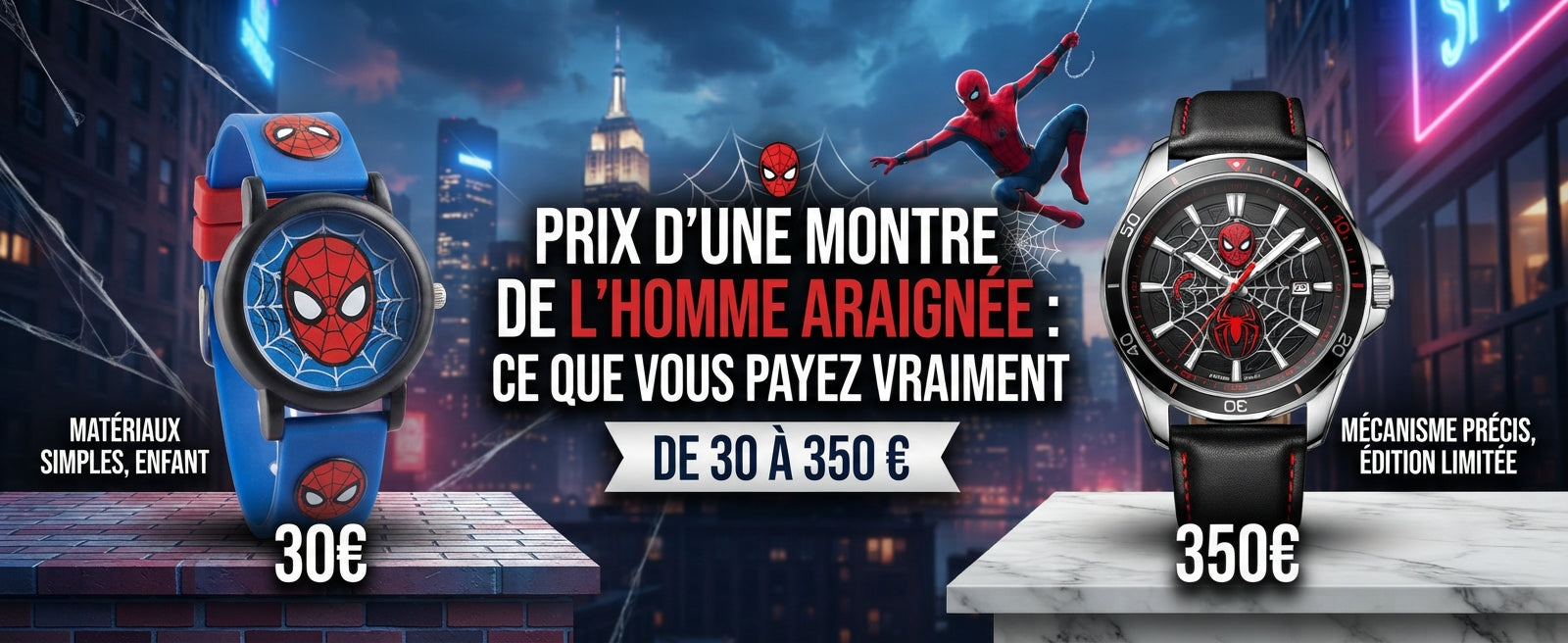
The short answer
A Spider-Man watch costs roughly between 30 and 350 euros. Under 40 euros, you are paying for a plastic case and a simple quartz movement. Between 40 and 70 euros, you gain a leather strap or a backlit display. Above 100 euros, the difference is about finish and presentation, not timekeeping accuracy, which is the same across the board.
It is the question you ask first and the one guides answer last: how much should you actually spend? The price gap across this range reaches a factor of twelve between the most affordable model and the showpiece, which is considerable for objects that perform the same basic function. This article takes the problem from the wallet rather than from age or style: what you really get at each tier, what justifies a step up, and what does not.
The price landscape at a glance
In the Spider-Man watch collection, prices run from around thirty euros to three hundred and fifty. In between, the spread is not even: most models cluster between thirty-five and sixty euros, which matches the budget most buyers set for themselves without thinking about it.
Three tiers genuinely structure this range. Below forty euros, you are buying a functional officially licensed watch. From forty to seventy, you are buying an extra material or an extra function. Above one hundred, you are buying a display piece, and the equation changes. These three tiers do not correspond to three levels of watchmaking quality: they correspond to three different buying intentions.
One thing often comes as a surprise: timekeeping accuracy does not vary from one tier to the next. All these models run on quartz, whose drift is measured in seconds per month whatever the price. Paying more never buys you a more accurate time — that is the first misconception to clear away before comparing anything at all.
Under 40 €: what you really get
At this level you find the digital and cartoon models aimed at children. The case is plastic, the strap silicone or soft plastic, the display digital or simply analogue. The watch tells the time, survives everyday knocks, and can be replaced without drama if it vanishes in a school playground.
That is precisely the main argument for this tier, and it is underrated: a child's first watch has a short life expectancy. It gets lost, it gets knocked about, it goes in the swimming pool. Putting sixty euros on a six-year-old's first wrist is often a miscalculation rather than generosity. Choosing by age group is covered in the guide to the Spider-Man watch by age.
What you will not find at this price: real leather, elaborate backlighting, a metal case, boxed presentation. What you do find, and what matters most for a child, is legibility and lightness. Spider-Man alarm clocks sit in the same price bracket, and answer the same everyday-use logic.
ENTRY PRICE

Spider-Man Digital Watch for Children
The entry point to the range, designed for a first wrist: a digital display that is readable with no learning curve, a soft strap and a light case that takes playground life in its stride. The model you replace without regret if it disappears.
29.90 €
Discover →Between 40 and 70 €: the sweet spot
This is where most considered purchases happen, and for good reason: every extra euro buys something visible. The strap moves to leather. The display gains a backlight. The case gains finish. The watch stops being a disposable accessory and becomes an object you keep.
Two sub-families share this bracket. Children's models moved upmarket, aimed at an eight- to twelve-year-old wearer able to look after them, with leather or a light-up function. And classic quartz models, more understated, that a teenager or an adult can wear without the licence dominating the wrist. The full typology is set out in the guide by type and use.
The practical advice at this tier: favour the strap over the electronics. A well-finished leather strap gets noticed every day; a light-up function gets used for two weeks then forgotten. The strap is also what decides whether the watch will still be worn in two years' time, and replacing it is covered in the care and repair guide. If you are putting together a complete set, you will find the Spider-Man bracelets and the Spider-Man accessories in the same vein.
Above 100 €: what premium really buys
The top of this collection goes beyond three hundred euros, which puts the piece in a different purchase category. Let us be direct: at this level you are no longer buying a watch, you are buying a wearable collector's item. The timekeeping function is identical to that of a model eight times cheaper.
What the price actually covers: the quality of the case and strap materials, the care taken over the finish, the presentation — box, documentation, sometimes numbering — and the fact that the object stands up to being displayed as much as worn. It is the same buying logic as for the high-end pieces among the Spider-Man figures: you are paying for the presence of the object, not its function.
Is it worth it? The honest answer depends on a single question: is this a gift meant to make an impression, or a watch meant to be used? To mark an occasion — a milestone birthday, a graduation — the premium piece plays a role a forty-euro model never will. For everyday use, it is overkill. Other gift ideas are gathered in the selection of gift ideas for fans of all ages and in the Spider-Man gift section.
SHOWPIECE

Spider-Man Premium Deluxe Watch
The top of the range, designed to be displayed as much as worn: careful finish, presentation to match the price, and the kind of piece you give to mark a date rather than to kit out a wrist for daily use.
349.90 €
Discover →What actually pushes the price up
Four factors, in order of their real weight. The strap material comes first: moving from silicone to real leather costs more than any electronic function. The case finish comes next: moulded plastic, treated plastic, or metal — every step up is paid for.
The official licence is the third factor, and the least visible. A licensed product pays royalties to the rights holder of the character, which feeds mechanically into the retail price. It is also what guarantees the image is used legally and that the manufacturer is accountable — a subject that deserves its own discussion, given how many abnormally low prices stem from it.
The fourth is the presentation: box, instructions, warranty. It weighs little on entry-level models and a lot on premium pieces, where it sometimes accounts for a third of the perceived value. Which explains why the same watch, sold bare or boxed, does not sit in the same place among the Spider-Man watches in the catalogue.
What does not justify paying more
Accuracy, as we have said: it is identical everywhere. Then battery life — a button cell lasts one to two years whatever the watch costs, and replacing it costs a few euros. A seller pitching you battery life on a quartz watch is selling you hot air.
Water resistance deserves nuance rather than dismissal. It does improve with price, but far more slowly than people think, and above all it is almost always misunderstood: most of these watches resist splashes, very few resist swimming. Paying more in the hope of the swimming pool is the best way to lose on both counts. The subject is covered in detail in the care guide.
A final point, specific to buying for a child: moving upmarket does not reduce the risk of losing it. A sixty-euro watch gets lost exactly as easily as a thirty-euro one. The only parameter that counts then is the age of the wearer, not the budget — the same logic as for choosing a Spider-Man backpack or the rest of the backpacks and keyrings of the school day.
The real cost over three years
The advertised price is not the price you pay. Over three years of use, expect at least one battery change, often two, and frequently a strap replacement on models worn every day. These two items add up to a few tens of euros, and they apply whatever your starting tier.
That calculation changes the trade-off at the first tier. A thirty-euro watch whose battery is replaced twice ends up, over three years, in the same zone as a better-finished forty-five-euro watch that would have lasted as long. That is why the mid-range is almost always the most rational buy — except for a first wrist, where loss is the dominant factor.
The third item, rarely anticipated, is outright replacement. For a wearer under eight, you should statistically plan to buy again before the watch wears out. Factoring that in from the start avoids disappointment, and naturally points towards the entry level for the youngest. The same cost-over-time logic applies to Spider-Man toys and to the whole of the toy catalogue.
THE RIGHT COMPROMISE

Spider-Man Quartz Watch
The model that concentrates the essentials of what you pay for in this range: a reliable quartz movement, an understated and legible finish, wearable by a teenager or an adult without the licence taking over the whole wrist.
39.90 €
Discover →Compare with the rest of the range before deciding
A watch is never bought in a vacuum: within the same budget, it competes with everything else that could please the same person. At forty euros, you are up against a decent figure, a good-quality t-shirt or a full backpack. Framing that comparison honestly avoids buying by default.
What the watch has going for it, with no equivalent in the rest of the catalogue, is frequency of use. An object worn on the wrist is seen by its owner fifty times a day, every day, for years. No other piece of merchandise reaches that level of presence — the comparison is developed on the page devoted to Spider-Man merchandise, which puts each family of objects back into its real use.
What it has against it: it forgives neither a sizing mistake nor a mistake of taste. An oversized t-shirt still gets worn; an overly bulky watch ends up in a drawer. That is why price should never be the first criterion but the second, once the format has been settled. The other buying guides in the shop are gathered on the guides and advice page, and the buying guide by budget and profile applies the same reasoning across the whole catalogue, from t-shirts to caps.
Which budget for which situation
For a first wrist, between five and eight years old: thirty to forty euros, digital or very legible analogue, and no more. For an eight- to twelve-year-old who already looks after their things: forty to sixty euros, with a proper strap. For a teenage or adult fan: fifty to seventy euros, aiming for understatement rather than function.
For a gift meant to make an impression, whoever the wearer: above one hundred euros, accepting that the object will be looked at as much as worn. And for a supporting purchase — completing a set, marking a birthday without being the main gift — the entry level does the job very well, like the rest of the small items in the accessories range.
In every case, the most effective starting point is still to browse all the Spider-Man watches available and filter by price before filtering by style. The reverse — falling in love with a model then discovering its price — reliably produces bad decisions.
Frequently asked questions
How much does a Spider-Man watch cost?
Around thirty euros for children's digital models, forty to seventy euros for most of the range, and up to three hundred and fifty euros for the showpiece. The heart of the offering sits between thirty-five and sixty euros.
Does a more expensive watch keep better time?
No. All these models run on quartz, whose accuracy is equivalent whatever the price, with a drift of a few seconds per month. The price buys materials, a finish and a presentation, never better accuracy.
What budget for a child's first watch?
Thirty to forty euros is plenty. At that age the watch gets lost, gets knocked about and sometimes goes in the water: spending more increases the regret without increasing the lifespan. Budget becomes a real question from eight years old, when a child looks after their things.
Is premium worth it?
To mark an occasion, yes: the presentation and the finish play a role an entry-level model will not. For everyday use, no: the function is identical and the risk of a scratch or a loss weighs far more heavily on a three-hundred-euro piece.
Is it better to buy a Spider-Man watch or an alarm clock?
The two answer different needs. The alarm clock stays in the bedroom and structures getting up; the watch follows the wearer all day and teaches independence. For a child who cannot tell the time yet, the alarm clock is often the first sensible purchase, and the guide to the Spider-Man alarm clock for children goes through that choice. The budgets are comparable, around thirty to fifty euros for either.
Do you need to budget for costs after the purchase?
Yes, two mainly. The battery change, once or twice over three years, for a few euros. And replacing the strap on watches worn daily. These costs apply at every price tier and bring the entry level closer to the mid-range over time.

