
14-Day Money-Back Guarantee
0
The short answer
Spider-Man's death unfolds in Ultimate Comics Spider-Man #156 to #160, published in 2011 by Brian Michael Bendis and Mark Bagley. The Ultimate universe's Peter Parker, weakened by a bullet fired by Frank Castle and meant for Captain America, faces the Green Goblin outside his own home and dies in Aunt May's arms. Miles Morales takes over from him in Ultimate Fallout #4, in August 2011.
Killing Spider-Man off for good, with no resurrection in the next issue, no clone, no multiverse comeback: that is what Marvel did in 2011, and the publisher's history holds few examples this clear-cut. The move was only possible because it happened in a parallel universe built for it, the Ultimate universe — a separate continuity where characters could genuinely be damaged. That death produced the most popular character Marvel has created in twenty years, and practically everything the wider public now associates with Miles Morales flows from it.
The Ultimate universe, a laboratory built for taking risks
In 2000, Marvel launched a separate continuity aimed at new readers, free of forty years of accumulated backstory. Ultimate Spider-Man, written by Brian Michael Bendis and drawn by Mark Bagley, was its founding and longest-running title: the series ran for 160 issues. Peter Parker is a secondary school pupil again, Uncle Ben dies again, but the supporting cast follow arcs that never reset.
The difference comes down to one simple editorial rule: in this universe, what breaks stays broken. A character who is killed does not come back six months later on the pretext of a clone or a bit of time travel — a device the main universe has leaned on heavily, as the story of the Clone Saga reminds us. That rule is what makes the 2011 death credible, and it is also why it was announced in the mainstream press rather than in the specialist press alone.
You need to keep that framework in mind so as not to confuse the two Peter Parkers. The one who dies in 2011 is not the one from the main series, who carries on his career without interruption. Readers who discover the universe through the films often conflate the two lines, and the page explaining the Spider-Man multiverse exists precisely to untangle that kind of knot. The Spider-Man posters that reproduce the covers from this period remain perfectly recognisable, though: the Ultimate suit has a finer web pattern and a darker red.
COLLECTOR FIGURES

Spider-Man Miles Morales Collector Figure
The character born of this story has become the most recognisable face of Spider-Man for an entire generation. This collector's piece captures the silhouette and the black-and-red suit that made his name, in a format that sits on a shelf without dominating everything around it.
79.90 €
Discover →What happens in Ultimate Comics Spider-Man #156-160
The arc was published in 2011. It opens on a clash between the Ultimates and the New Ultimates, in which Peter steps in. He takes a bullet fired by Frank Castle and meant for Captain America. The wound is serious and it does not close: the whole rest of the story plays out with a Spider-Man who is bleeding out, which is a far harsher writing choice than a standard fight.
Norman Osborn escapes and finds out where Peter Parker lives. The final confrontation happens outside the house, in broad daylight, mask torn off. Peter faces not only the Green Goblin but a group of villains freed alongside him — the Ultimate equivalent of the line-up known from the Sinister Six. He wins: he ends up crushing Osborn under a lorry. Then the lorry explodes and the blast carries him away.
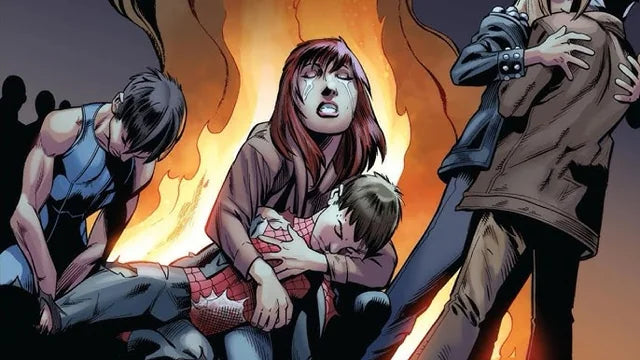
He dies on his own lawn, in Aunt May's arms, surrounded by those closest to him, with a smile. It is the point summaries skip most often, and yet it is the one that gives the arc its meaning: he does not die beaten, he dies having held the line. The contrast with Uncle Ben's death, suffered and unintended, is the dramatic engine of the whole story — the loop opened in the first issue closes in the one hundred and sixtieth.
One note on the numbering, because it throws a lot of readers. The series changed its title along the way and then reclaimed its original numbering: you will therefore find the arc referenced sometimes as Ultimate Spider-Man #156-160, sometimes as Ultimate Comics Spider-Man #156-160. They are the same issues. To place this arc among the character's other major moments, the page listing all the great story arcs gives the full reading order.
The Ultimate Green Goblin is not the one you know
The villain of this arc is worth pausing on, because he has almost nothing in common with the version the cinema made famous. In this continuity, Norman Osborn wears no mask and rides no glider: the formula he tests on himself physically turns him into a massive, burning creature, incapable of passing for a respectable businessman. Where the classic version rests on a double identity — the pillar of society by day, the monster by night — this one has lost the civilian half of the equation.
The change is not cosmetic. It strips the confrontation of its social-duel dimension, the thing that gives the Green Goblin of the main continuity his bite, and replaces it with a purely physical threat. That is consistent with what the arc is about: Peter is not being manipulated, he is being hunted. The comparison between the two versions is developed in the profile of Norman Osborn, the man behind the mask, and the character in all his forms remains one of the most requested motifs among the fancy dress and costumes of the universe as well as the Spider-Man masks.
A second difference that matters for the reading: this particular Goblin has known Peter's identity for a long time, and knows where he lives. The final confrontation outside the family home is therefore not a plot convenience, it is the payoff of a threat set up dozens of issues earlier. Stories where the villain knows exactly where to strike are rare in Spider-Man, and they are consistently the harshest — the same mechanism runs through The Death of Jean DeWolff.
Ultimate Fallout: the mourning, then the succession
Marvel does not restart straight away. The Ultimate Fallout mini-series fills the space left empty and devotes itself to grief: the universe's characters react to the absence, each in their own way. It is an unusual editorial decision — normally the successor turns up in the very next issue. Here, the emptiness is allowed to settle.
Miles Morales appears for the first time in Ultimate Fallout #4, in August 2011, created by Brian Michael Bendis and Sara Pichelli. He does not take up the costume out of ambition: he takes it up because he feels responsible. An Afro-Latino teenager from Brooklyn, bitten by a spider from the same experiments as the one that bit Peter, he has extra abilities — camouflage and a bioelectric blast — that the original character never had. His full profile is developed in the article devoted to him.
The success was immediate, then lasting. Fifteen years on, this character has his own video game, his own animated trilogy and a central place in the brand's imagery, to the point that Spider-Man figures and Spider-Man t-shirts show him almost as often as Peter Parker. His family's part in that success is set out in the article on Jefferson Davis and Rio Morales, and his circle's in the profile of Ganke Lee.
PRINTS AND POSTERS

Spider-Man Into The Spider Verse Poster
The whole visual language of the Spider-Verse on screen goes back to this handover. This poster picks up its saturated palette and cut-out graphics, in a format that works just as well in a teenager's bedroom as in an office.
22.90 €
Discover →Why this death worked where others failed
Superhero deaths are usually commercial operations with a built-in expiry date. This one held, for three identifiable reasons. First, it was prepared: Bendis had been writing the series for eleven years, the supporting cast had real depth, and the loss affects them for good. Second, it was followed by a deliberate emptiness, which rules out reading it as 'one product being swapped for another'. Third, the successor was built as a character, not as a costume to be reassigned.
Compare that with standard practice in the main continuity. Superior Spider-Man replaces Peter Parker with Doctor Octopus's mind, but everyone knows from the outset that the situation is reversible. Ben Reilly held the role for years before the status quo returned. The difference is not moral, it is structural: in a separate universe, going back has no commercial upside.
One point does need to be precise, though: the Ultimate universe itself did not survive. It was destroyed in a major editorial event, and Marvel then launched a new Ultimate line in 2024, distinct from the previous one. Miles Morales, for his part, was transferred into the main continuity and stayed there. In other words, the universe vanished and the character it produced survived — which is the best possible summary of the 2011 operation.
2011: the day the mainstream press announced Spider-Man's death
The release of issue 160 produced something rare for a comic: media coverage well outside the specialist field. American general-interest newsrooms ran headlines on the death of Spider-Man, without always making clear that this was a parallel continuity. The shortcut sowed a lasting confusion, still visible today in searches from readers convinced the main character died in 2011.
That frenzy had a useful side effect. It made an alternative universe known to an audience that had no idea it existed, and paved the way for everything that followed: the multiverse stories, then their adaptation into animated film. A good part of the current popularity of the Spider-Verse concept was won right there, in an editorial news story from the summer of 2011.
Some perspective is still in order. The arc did not turn the Ultimate universe into a lasting commercial success, and the line was shut down a few years later. What lasted was the character. Today, the imagery born of that succession turns up everywhere, from Spider-Man stickers to Spider-Man backpacks, and the black-and-red suit has become a motif as recognisable as the original red and blue.
Where to read this arc, and in what order
The clearest order starts upstream. The arc's five issues assume you know the characters: read the early volumes of the series first, or at the very least the beginning, to grasp what the death breaks. Then comes #156-160, then Ultimate Fallout in full — issue 4 being the tipping point — then the series devoted to the new Spider-Man.
Two bookshop traps. First, several French editions gather the arc under different titles, which makes it tedious to track down: look for the issue numbers rather than the titles. Second, a reader who starts with Miles Morales's recent stories in the main continuity will not understand where the character comes from, since that origin took place elsewhere. The guides collected on the guides and advice page cover this kind of reading path. You will find the same thread in Gang War: the event that turned the New York underworld upside down for Spider-Man.
For anyone wanting to go further, the logical next step is the meeting between the two Spider-Men, published the following year, then the big multiverse stories. The page devoted to the characters of the Spider-Man universe lists the figures you cross paths with along the way, and the Spider-Man phone cases as well as the Spider-Man mugs happily pick up the motifs of this graphic period.
ARTICULATED FIGURES

Articulated Spider-Man Figure - Miles Morales
For anyone who would rather pose their characters than leave them fixed, this articulated version lets you replay the poses of the black-and-red suit. The joints hold their position, which is not a given with every figure in this format.
59.90 €
Discover →Frequently asked questions
Did Peter Parker really die in the comics?
The Ultimate universe's Peter Parker dies in 2011 and has not returned in that continuity. The Peter Parker of the main continuity, the one from the Amazing Spider-Man series, is not dead and carries on his adventures without interruption. The two characters share a name but belong to two separate lines.
Who killed Spider-Man in this arc?
No single person. Peter is first hit by a bullet fired by Frank Castle and meant for Captain America, which weakens him lastingly. He then dies from the after-effects of his fight with the Green Goblin, whose final explosion finishes him off. He wins the fight before he succumbs.
Do you need to have read the whole series to follow it?
No, but the arc loses a great deal without context. The five issues rest entirely on eleven years of built-up attachment: read on their own, they look like one long fight. Reading at least the early volumes of the series, or a serious summary of the starting situation, changes the experience completely.
Did this arc inspire the animated films?
Indirectly, but clearly. The animated features take up the central motif — a teenager who inherits the role after a Peter Parker dies — and transpose it into a multiverse plot of their own invention. The sequence of events is not the one from the comics, the supporting characters differ, and the death does not carry the same weight there. But without the succession organised in 2011, the central character of these films would not exist. The relationship between the two media is set out in the overview of the Spider-Man films.
Where does this arc sit in relation to the other major stories?
It is an endpoint story, to be read late rather than early. It takes as read everything the other arcs set up: the weight of responsibility, the role of family, the Osborn threat. A reader starting out will do better to begin with the founding stories of the main continuity, then come here to see what happens when a writer is given permission to finish. The everyday items that go with these re-reads, from Spider-Man blankets to Spider-Man rugs, are listed by theme across the shop.
Does Miles Morales replace Peter Parker?
In the Ultimate universe, yes, he takes over after his death. In the main continuity, no: the two characters coexist, each with his own series and his own neighbourhood. The costume has not changed owner, it has been worn by two people in two different realities.

