

14-Day Money-Back Guarantee
0
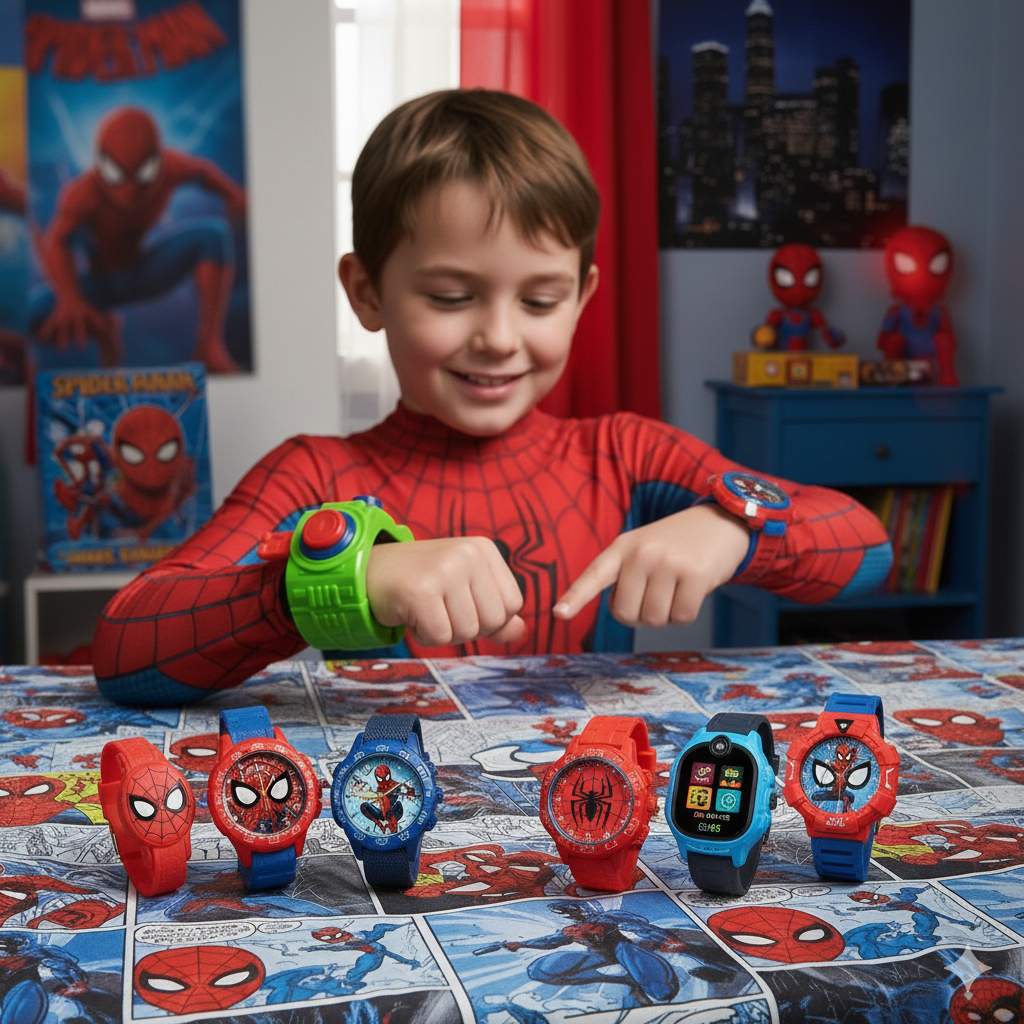
The essentials before you choose
Three markers are enough. Before the age of 7, a highly legible dial and a soft strap matter more than the features. Between 7 and 9, the hands become a learning tool, so go for an analogue watch with clearly marked minutes. After 10, your child wants independence: digital, backlight, shock resistance.
Choosing a child's watch works the opposite way round to what you'd think. The look decides the excitement of day one, but it's the legibility of the dial and the comfort of the strap that decide whether it's still on their wrist three months later.
This guide starts from age, because that's the only criterion that genuinely changes the answer. A five-year-old and an eleven-year-old don't have the same relationship with time, and a watch that suits one will put the other off.
Why a watch makes a good gift at this age
Unlike most licensed items, a watch has a purpose. It supports real learning — telling the time — and it gives a child a little independence: knowing when break ends, when to head home, how long is left.
It's also one of the few accessories a child wears every day and doesn't lose at the bottom of a bag. It's on them, they see it, they show it off. The emotional pull of the character works especially well on something this personal.
A child's watch isn't a grown-up watch in miniature
This is the most common design mistake. A watch genuinely made for a child stands out by four things: an uncluttered dial where the numbers have room to breathe, a light case, a soft strap that doesn't pinch, and a fastening the child can manage alone.
That last point is decisive and almost never mentioned. A buckle that's too stiff to close means an adult has to step in every morning. Two weeks later, the watch stays in the drawer. If you're looking for yourself, the logic is different and we cover it in our guide to watches by type and use.

Spider-Man Digital Watch for Children
A very legible digital display and a light case: the format that reassures children who can't yet read the hands. The full range is in our Spider-Man watches.
View product — €29.90Choosing by your child's age
Here's the only breakdown that really counts, with what changes at each stage.
Ages 4 to 6: enjoyment before timekeeping
At this age, a child can't yet tell the time and that isn't the point. The watch is an object of pride and a first sense of time: they learn that the hands move, that time is measured, that 'in ten minutes' means something.
So look for a very simple dial, large well-spaced numbers, a soft strap and an instantly recognisable image of the character. Extra functions add nothing and only complicate things.
Weight matters more than you'd think: a heavy case on a slim wrist quickly becomes annoying, and your child will slip it off without saying a word.
Ages 7 to 9: the watch becomes a learning tool
This is the age when telling the time is taught at school, and when a watch can genuinely help — provided you choose one suited to that goal.
Go for analogue at this stage, even if digital seems simpler. A digital display gives the answer effortlessly and short-circuits the learning. Hands force a child to reason, and that's exactly what you want.
The detail that makes the difference: the minutes must be visibly marked around the edge of the dial. An analogue watch without minute markers makes learning harder, not easier.
As for straps, silicone and synthetic leather hold up far better than fabric at this age, when the watch faces the playground, water and sand.
Ages 10 to 12: independence, style and toughness
Telling the time is sorted and the priorities shift. Your child wants a watch that's useful and doesn't look too childish, because what their classmates think starts to matter.
Digital takes the lead again: precise display, a backlight for the evening, sometimes a stopwatch and alarm. These are features genuinely used at this age, for sport as much as for organisation.
Durability also becomes a serious criterion. At ten, a watch gets dropped, knocked about and taken underwater. A reinforced case and a stated water resistance make a clear difference to how long it lasts.

Spider-Man Leather Watch for Children
A smarter strap for children who find silicone too childish, with a dial that stays perfectly legible. Pair it with our Spider-Man gift ideas.
View product — €44.90Analogue, digital or light-up: which to choose
The three families answer different needs, and the right choice depends above all on the learning stage.
Analogue: learning the time gently
It's the most instructive format, and visually the most timeless. It suits ages five to nine particularly well, the period when reading the time is being built.
Its drawback is how slow it is to read at first: a child takes several seconds to work it out, which can be frustrating. That effort is precisely what makes them progress, and the frustration disappears within a few weeks.
Digital: precision and simplicity
Instant reading, no ambiguity, and often useful extra functions. It's the most practical format at school and for sport, and the best suited from ten upwards.
Many digital models are also more shock-resistant, which counts for intensive daily wear. The downside is still the learning: giving a digital watch to a seven-year-old delays their mastery of the hands.
Light-up and electronic models: the fun factor
A backlit dial, animations, sometimes projections. These are the watches that spark instant excitement, and they have a real use: reading the time in the dark, first thing in the morning or on a winter evening.
Two caveats. The backlight draws power, so the battery runs down faster. And on the most animated models, the novelty wears off within a few weeks — it's a bonus, rarely the main criterion.
The mistakes that come up most
Choosing a model that's too complex for the age. A watch with multiple functions puts a six-year-old off. They don't use it, so they don't wear it.
Overlooking the strap. A stiff strap, too long or hard to buckle, kills a watch far more surely than any styling flaw. Check that your child can open and close it alone, three times in a row, before you commit.
Buying on looks alone. Attachment to the character sparks the desire, legibility keeps it in use. Both are needed, in that order of priority.
Going too big 'so it lasts'. An oversized case swivels round the wrist and gets in the way of writing. Unlike clothes, a watch isn't worn while you wait to grow into it.
Forgetting the battery. Many children's models arrive with a demonstration battery. Planning a replacement within the year avoids the disappointment of a watch that stops without warning.
Safety, durability and everyday use
Three points deserve a check before you buy, and they're rarely highlighted on product pages.
The stated water resistance. A 'splash-resistant' watch doesn't go in the shower or the pool. If your child swims, you need genuinely suitable resistance, otherwise the watch will give up at the first dip.
How tough the glass is. It's the part that breaks first. Mineral glass scratches less than acrylic plastic, but acrylic absorbs knocks better — for a young child, the latter is often the better compromise.
The fastening. A classic pin buckle is the easiest to manage alone. Deployant clasps look smarter but call for a dexterity the youngest don't have yet.

Spider-Man Flash Light Watch for Children
A dial that lights up at the press of a button, so they can read the time in the evening without switching the light on. The argument that wins children over, with legibility intact. Have a look alongside our Spider-Man toys.
View product — €44.90Making the watch stick beyond day one
Initial excitement guarantees nothing. Three habits make the difference between a watch that's worn and a watch that's forgotten.
Let them choose. Shortlist two or three models that meet the criteria for their age, then let your child decide. Something they picked becomes theirs, and that's the first condition for them wearing it.
Give them a reason to look at it. A watch earns its place when it answers a real question: how long before we leave, what time the cartoon finishes. Asking your child those questions rather than answering them turns the object into a tool.
Give it a fixed home. A watch that has its own spot — on the bedside table, next to the alarm clock — goes back on in the morning without a thought. It's the same logic we describe for the Spider-Man alarm clock and the morning routine.
Learning to tell the time with a watch: what works
A watch isn't enough on its own to teach the time, but it speeds things up a lot when it's used in the right order.
Start with whole hours
The first step isn't reading the exact time but recognising o'clock positions. 'The big hand on the twelve' becomes a simple marker, and your child can already place the moments of their day: break, lunch, home time.
This is also where an analogue watch shows its teaching advantage: the position of the hands is a picture, and children remember pictures far better than numbers.
Then half past and quarters
Next comes dividing up the dial. Half past makes visual sense — the hand is straight opposite — and the quarters follow naturally. This stage often takes several months, and that's normal: it calls for an abstraction that children don't all reach at the same pace.
Avoid correcting them by giving the answer. Asking 'where is the big hand?' moves things along far faster than 'it's quarter past three'.
And finally the exact minutes
Reading minute by minute means counting in fives, so mastering that times table. That's why it rarely arrives before eight, and why the minute markers printed around the dial matter so much.
A watch with no markings around the edge forces a child to guess, which sets in approximations that are hard to correct later.
Classic watch or smartwatch?
The question comes up without fail from about eight onwards, and it deserves a straight answer rather than a list of arguments.
What a smartwatch really brings
Location tracking, calls to one or two numbers, sometimes messaging. For a parent, the location argument is a strong one, especially when a child starts coming home alone or taking public transport.
You do need to weigh up what it involves, though: a subscription, a SIM card, charging almost daily, and a noticeably heavier object on the wrist. It's no longer a watch, it's a small phone that tells the time.
What a classic watch keeps
A battery watch runs for one to two years without a second thought. It doesn't need charging, doesn't update, doesn't go off in class and doesn't attract envy. Many schools have strict rules on connected devices anyway, which sometimes settles the question for you.
On the learning side, the classic watch stays superior: it does one thing, and that thing is exactly what you want your child to master. A smartwatch shows the time in digits among ten other pieces of information, and the child stops looking at it for the time.
Our position, if you're torn: a classic watch before ten, and the smartwatch question only when a real need for location tracking appears. Buying a smartwatch at seven means skipping the learning stage for a need that doesn't exist yet.
Care and lifespan
A child's watch leads a hard life, but a few habits noticeably extend it.
Rinse the strap in clean water when your child has been playing in sand or has got hot and sweaty: silicone holds on to salt and residue, which ends up irritating the skin. A soft cloth is enough for the glass, avoiding any household cleaner that would attack the markings on the dial.
Keep an eye on the battery rather than waiting for it to stop. A watch that gradually runs slow is announcing a battery near the end of its life, and a quick replacement stops it leaking inside the case, which would finish off the movement.
Finally, take the watch off before the pool if its water resistance isn't explicitly rated for swimming. It's the number one cause of terminal failure on children's models, and it's entirely avoidable.
Which model for which child
For a child of four to six, aim for absolute simplicity: an uncluttered dial, a soft strap, a bold character image, no superfluous functions.
For a child of seven to nine, an analogue watch with graduated minutes is the best teaching investment, with a silicone or synthetic leather strap.
For a pre-teen of ten to twelve, go for a digital model with a backlight and a tough case, in a less childish design.
And if the watch is meant as a gift, it works very well alongside something else rather than as the main present. Our selections of small gifts under €20 and gifts for children give combinations that work, as does our guide to toys by age. For a coherent back-to-school set, see our backpack guide, the one on pencil cases by age and our advice on dressing your child for the new school year. The rest of the kit is in our backpacks and our children's T-shirts. The subject is covered in more detail in Spider-Man watch prices: what you're really paying for, from €30 to €350.
The right moment for a first watch
There's no official age, but two signals are worth more than a date. The first: your child starts asking questions about time — how much longer, when are we leaving. The second: they move into a setting where the time has a concrete consequence, typically starting primary school.
Giving the watch before those signals still works, but it stays a decorative accessory for a few months. That's not a problem: attachment to the object often comes before its use, and it makes the learning easier when it arrives.
The occasions that work best are the ones that mark a transition: a new school year, a milestone birthday, the start of an activity they do on their own. The watch then takes on a symbolic 'you're growing up' value that children read very clearly, and it's worn with pride rather than put away.
What to remember
Age dictates the format: enjoyment and legibility before seven, analogue for learning between seven and nine, digital and toughness after ten.
And one check is worth all the technical arguments: ask your child to open and close the strap on their own. If they can't, no other quality will make up for it.

