

14-Day Money-Back Guarantee
0
The essentials before you choose
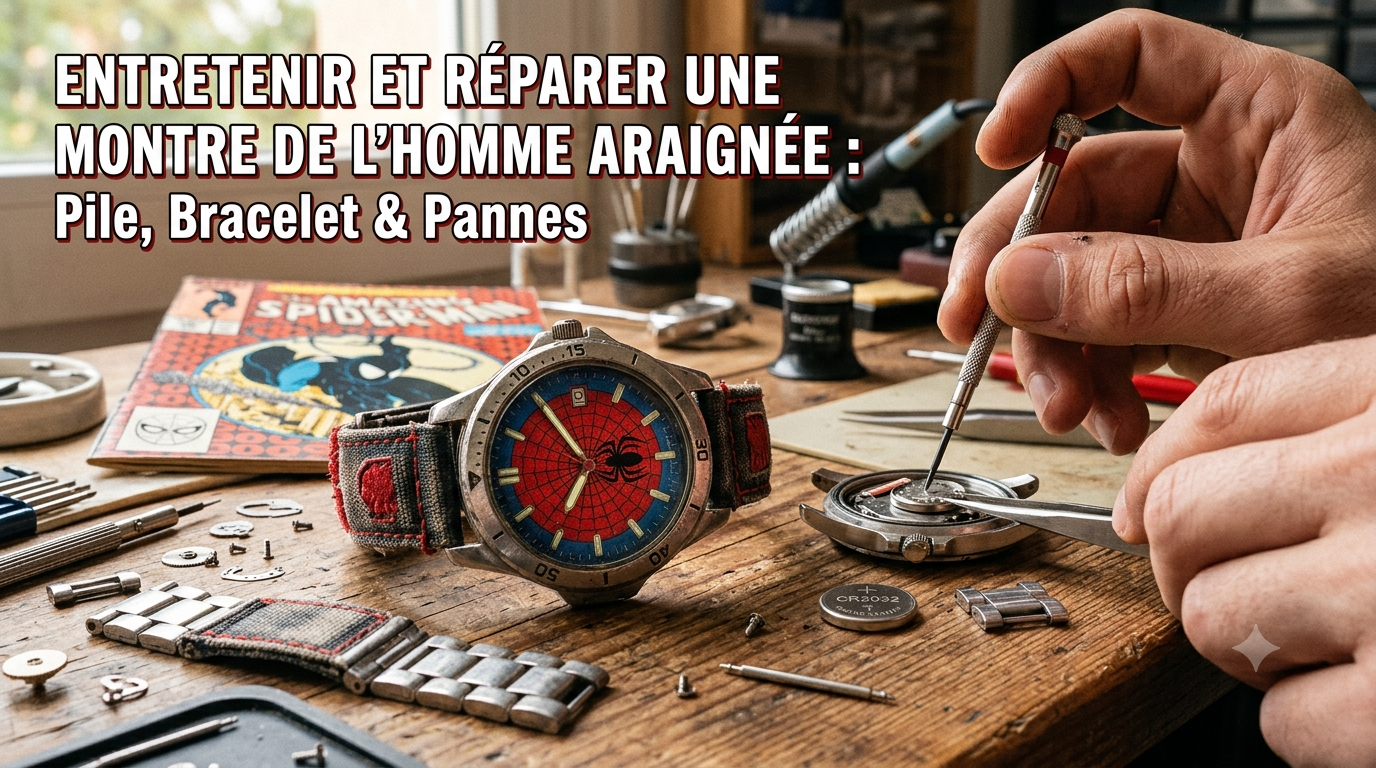
Three habits cover 90% of cases. The strap is adjusted by removing links or by punching a clean extra hole, never with a knife. The battery takes five minutes to change if the case back clips off, and belongs with a watchmaker if it is screwed down or water-resistant. And misting under the glass means opening it straight away: it is the one symptom that gets worse with every hour you wait.
You have chosen the watch, it is on the wrist, and that is when the real questions start. The strap is loose. It runs slow. The display fades. Misting has appeared after the swimming pool.
This guide covers what happens after the purchase. If you are still choosing the model, our guide to children's watches by age and our guide by type and use cover that step.
Adjusting the strap: the very first thing to do
It is the most useful step and the one most often rushed. A badly adjusted strap is not merely uncomfortable: it is the number one reason a child stops wearing a watch.
Getting it right comes down to one rule: you should be able to slide one finger between the strap and the wrist, not two. Any looser and the watch swivels, leaving the dial under the wrist. Any tighter and it marks the skin, and the child takes it off.
Silicone or plastic strap with a pin buckle
The simplest of all. You just move to another notch. If no existing hole fits and the strap is too long, the excess length can be cut off - but only on models designed for it, with cutting marks on the underside.
To add a hole, use a heated point or a leather punch, never the tip of a knife or a pair of scissors. A ragged cut creates a weak point, and the strap tears there within weeks.
Leather or synthetic strap
Same principle, but the material is less forgiving. An extra hole punched carelessly in leather widens and becomes unusable. If you do need to add one, use a proper punch and line it up exactly with the others.
Worth knowing: a leather strap naturally relaxes over the first few weeks. Do not punch it on day one; give it ten days to take its shape.
Metal link bracelet
This is the only one that calls for genuinely removing material. The removable links are marked by small arrows engraved on the underside, showing which way the pins come out.
Links are removed symmetrically, as many on one side of the clasp as the other, otherwise the clasp shifts round and the watch sits at an angle. A pin pusher costing a few euros is enough; failing that, a jeweller will do it in two minutes, often free of charge when you buy.

Spider-Man Quartz Watch
A classic quartz movement, easy to look after and with a battery that is simple to replace. Find it in our Spider-Man watches.
View the product - 39.90 EURChanging the battery
A quartz watch stops after one to two years on average. That is not a fault, it is routine maintenance.
Spotting a battery at the end of its life
The most reliable sign is not the watch stopping but the gradual loss of time: the watch loses a few minutes a week, then a few a day. On a digital model, the display fades and the backlight weakens before anything else.
Some movements signal the end of life by making the second hand jump in four-second steps instead of advancing every second. If you see that, the battery has a few weeks left, no more.
Do not leave a dead battery in the case. That is the most important advice in this section: a flat battery eventually leaks, and the electrolyte destroys the movement for good. A watch that has been stopped for a year is often a watch that is lost.
The three types of case back
The clip-on back lifts off with a flat tool slipped into the notch provided. This is the most common type on children's watches, and the only one really suited to doing it at home.
The screw-down back, with its notches, needs a specific wrench. Forcing it with pliers scratches the case and damages the thread. For a few euros at a watchmaker's, it is generally not worth the risk.
The multi-screw back comes apart with a small screwdriver, but you have to note the order of the screws, which are not always identical.
The battery format
It is almost always printed on the battery itself, in tiny characters. The common formats on these models are SR or CR button cells. Photograph the reference before you take it out rather than trying to read it once it is in your hand.
Handle the new battery with a cloth or plastic tweezers. Finger grease on the contacts creates resistance that shortens its life.
When not to do it yourself
Three cases: a screw-down back, a watch advertised as water-resistant, and a watch still under guarantee. In the first two, opening it breaks the seal and the water resistance is gone, even if you close it up properly. In the third, you lose the guarantee to save the cost of a service.
Common faults, and what they mean
Misting under the glass
The most urgent symptom. Water has got in, and for as long as it stays there it attacks the movement and oxidises the contacts.
The right reflex: open the case as quickly as possible, take out the battery, and let it dry in the open air for forty-eight hours somewhere dry and warm. Not on a radiator: direct heat warps the seals and the plastic.
A watch dried within hours often starts again. The same watch left misted up for three days is usually beyond saving.
It runs slow without stopping
Nine times out of ten, it is the battery. The other possible causes are a knock that has shifted the movement, or a magnetic field - rarer on these models than on a mechanical watch.
The digital display fades or flickers
A weak battery in the vast majority of cases. If replacing it changes nothing, the contacts between the screen and the circuit have oxidised, and the repair costs more than the watch.
The backlight has stopped working
On light-up models, the backlight draws a lot of power and gives up before the display does. If the time still shows but the light is dead, change the battery first. If the problem persists, it is the LED, and it cannot be replaced on these cases.
The glass is scratched
On acrylic glass, surface scratches fade with a plastic polishing paste and a microfibre cloth, using light circular movements. On mineral glass it does not work: the scratch is in the material and only replacing the glass removes it.

Spider-Man Digital Watch
A clear digital display, a format that is rarely repaired but can be replaced without breaking the bank. The full range is in our Spider-Man watches, and the rest of the kit in our Spider-Man accessories.
View the product - 37.90 EURUnderstanding water resistance before you wreck anything
This is where the most watches die, and where the markings are most misunderstood. What is printed on the dial does not mean what people think it means.
What the markings really mean
A watch marked 3 ATM or 30 metres does not go three metres underwater. That figure comes from a static pressure test in a laboratory, not from real use. In practice it copes with rain and washing your hands, nothing more.
You need 5 ATM for the occasional shower and 10 ATM for swimming. Most licensed children's watches sit below that, often with no marking at all - which means they are not designed for water.
The reason for the gap is simple: underwater, one movement of the arm multiplies the instantaneous pressure far beyond the actual depth. A dive into a one-metre pool goes well past what a 3 ATM case can take.
Water resistance is not permanent
Something almost nobody knows: it relies on rubber seals that age. A watch that is water-resistant when you buy it is not necessarily still water-resistant three years later, even if it has never been opened.
And as soon as the case is opened to change a battery, the seal has to go back perfectly, or be replaced. That is exactly why a watch advertised as water-resistant is better off going to a watchmaker than onto the kitchen table.
Everyday care, in three habits
A child's watch has a hard life, but it lasts a great deal longer with very little effort.
Rinse it after the pool and the beach. Chlorine attacks the seals, salt crystallises in the gaps of the strap, and sand acts as an abrasive between the case and the skin. Ten seconds under clean water, then dry it with a cloth.
Clean the strap, not just the dial. That is where sweat and dust build up, and that is what causes irritation. A damp cloth is enough on silicone; on leather, use a dry cloth only, as water stiffens it.
Store it flat, never with the strap buckled. A strap left fastened for weeks keeps a permanent curve, especially in leather. The same rule applies to all the everyday accessories, as we point out in our guide to children's alarm clocks.
What kills a child's watch
In order of how often it really happens, and every one of these causes is avoidable.
The shower and the pool on a model never built for it. 'Splash resistant' does not mean waterproof when submerged. This is the number one cause, by a long way.
The forgotten flat battery. The second cause, purely administrative: nobody thinks to change it, it leaks, and the movement is ruined.
Prolonged sunlight. A watch left on a windowsill over the summer ends up with a hardened strap and yellowed acrylic glass.
The drawer. Less obvious: a watch put away for months with the battery inside is exactly the leak scenario. If you are setting a watch aside, take the battery out.
Setting a watch to the right time without getting it wrong
An everyday action, two classic traps, and one of the two can damage the movement.
On an analogue watch, the crown pulls out one notch for the time. If your model shows a date, an intermediate notch sets it - and you should avoid changing the date between 9pm and 3am. At that point the date change mechanism is engaged, and forcing it breaks a part that nobody will replace on a watch at this price.
Second trap: once you have set it, always push the crown fully back in. A crown left pulled out leaves the movement stopped and opens a way in for moisture and dust. It is a common fault, and completely invisible.
On a digital model, setting it means a button combination specific to each watch. The useful habit is to photograph the instructions on the day of purchase: they always get lost, and finding the sequence again two years later is detective work.
The minimum kit, and what is not worth having
You can do the essentials with very little, as long as you pick the right tool.
What genuinely helps
A microfibre cloth for everything else - cleaning, drying, handling the battery without leaving grease on the contacts.
A small flat screwdriver, the sort used for glasses, which opens clip-on backs and takes apart screw backs. It is the best value tool on the list.
A pin pusher if the watch has a metal bracelet. A few euros, and it saves a trip to the jeweller every time the wrist size changes.
What you can do without
The complete kits sold with twenty accessories are overkill for home use: the case press, the water resistance tester and the sets of pliers will never be needed on a child's watch.
And above all, a word on what you should not use: the kitchen knife to open a case back, pliers to unscrew, alcohol to clean a printed dial. Those three moves cause more damage than the faults they claim to fix.
Teaching your child to look after it
The best maintenance is the maintenance you never have to do, and a seven-year-old is perfectly capable of taking on three simple rules.
Take the watch off before water, unless it is made for it. It is the rule with the best return, and it lands better framed as a responsibility than as a ban: it is their watch, and it is up to them to protect it.
Give it a fixed place. A watch that has its own spot in the evening - on the bedside table, next to the alarm clock - is a watch nobody hunts for in the morning and nobody loses.
Say something when it runs slow. A child who understands that losing time means a tired battery speaks up before it stops, which is precisely what prevents the electrolyte leak. It is also a roundabout way of getting them to check the time, and so to firm up their clock reading.
Repair or replace?
The question comes up quickly on affordable watches, and the answer is simpler than people think.
It is worth repairing when it is a battery, a strap, a link or a scratched acrylic glass. Those are jobs costing a few euros on a watch that will run for years more.
It is not worth it when the movement has taken in water, when the digital display is dead after a battery change, or when the backlight LED has gone. The workshop cost then comes to more than a new one.
And there is the particular case of the child who has grown up. A perfectly working watch that has become too small or too babyish is not repaired, it is handed on. Our gift ideas for children and our guide to toys by age help you choose a replacement suited to the new age, and our Spider-Man gift ideas cover every budget.

Spider-Man Logo Watch
An understated logo dial, with a strap that adjusts without tools and cleans with a wipe of a cloth. The format that ages best, to be seen in our Spider-Man watches.
View the product - 49.90 EURWhat to remember
Adjust the strap on day one, with one finger of play. Change the battery as soon as the watch starts losing time, and never leave a dead one in the case. And if misting appears, open it straight away - it is the one symptom where every hour counts.
Those three habits extend a watch's life far more reliably than any buying criterion. To round out the everyday kit, our small gifts under 20 euros and our ideas for setting up a bedroom take the universe beyond the wrist, along with our Spider-Man toys and our children's t-shirts. The subject is covered in more detail in Spider-Man watch prices: what you are really paying, from 30 to 350 EUR.

