
14-Day Money-Back Guarantee
0
The short answer
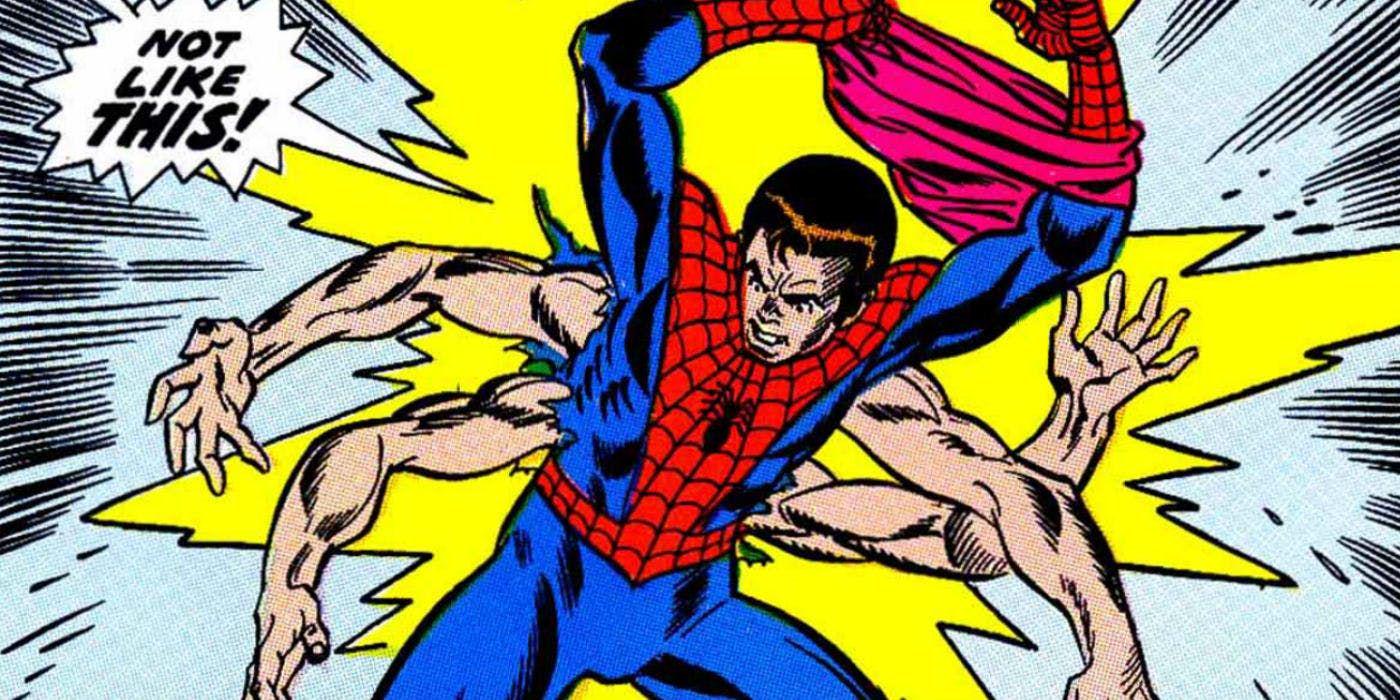
Trying to strip away his powers so he could live a normal life with Gwen Stacy, Peter Parker swallowed a home-made cure and woke up with four extra limbs - six arms in all. Stan Lee and Gil Kane turned a botched mutation into one of the most talked-about stories in the character's history. Here is that experiment and everything it cost, below.
September 1971. A corner newsstand in a New York neighbourhood takes delivery of issue 100 of Amazing Spider-Man. The cover, drawn by Gil Kane, promises a celebration: eight anniversaries gathered around the web-slinger's face. Children buy it for the commemorative portrait. Nobody expects that inside, Peter Parker will spend the most nightmarish night of his entire career locked in his laboratory, drinking a serum that is about to disfigure him. This arc, stretched across three issues (#100, #101, #102), remains one of the most unsettling dives ever written into the web-slinger's true identity. It is the night the hero tried to erase his powers, and woke up with four extra arms.
1971: why Peter Parker wanted to throw his powers away
To understand this arc, you have to get inside the head of the Peter Parker of 1971. At this point in the comics he is twenty-two, he is studying at Empire State University, he barely scrapes together enough to pay Aunt May's rent by selling photos to the Daily Bugle run by J. Jonah Jameson, and his love life amounts to a string of broken promises to Gwen Stacy. The hero has just come through two gruelling years of comics: the tragic death of Captain Stacy still haunts him, and he knows he bears part of the blame for the collapse of his relationship with Stacy's daughter. For the first time since the radioactive bite, he asks out loud whether the costume gives him more than it takes.
This questioning is nothing new in the character's mythology. Stan Lee had already staged it in the famous Spider-Man No More! of 1967, where Peter dumped his costume in a bin down a New York alleyway. But in 1967 the doubt came from social disgust: Peter hated being branded a public menace. In 1971 the doubt is intimate, almost romantic. Peter no longer wants the hero because he wants Gwen, completely, with no lies, no nights spent pacing the rooftops, no alibis to invent. He wants a normal life. He wants to be the Peter Parker who existed before the double life.
That emotional context is what turns the episode into classic tragedy. When a hero tries to run from his destiny, the myth always punishes him. The night of the serum is the moment the story applies that rule to the letter, with a brutality nobody saw coming.
Amazing Spider-Man #100: a gift-wrapped cover hiding the most disturbing arc of all
Issue 100 arrives carrying enormous symbolic weight. Marvel wants to mark the occasion. Gil Kane, who took up the brushes after Steve Ditko's historic departure and John Romita Sr.'s run, composes a mosaic cover in which Peter Parker faces the ghosts of all his enemies: the Green Goblin, Doctor Octopus, the Vulture, the Lizard, and even the dead Captain Stacy. The visual promise is clear: this will be a stocktaking issue, a tribute, perhaps a cycle closing.
And yet, inside, Stan Lee delivers an intimate, almost claustrophobic story. No mass battle. No cataclysm. Just a young man alone in a laboratory in Forest Hills, carefully weighing chemical components on a precision balance, trying to reverse a genetic mutation that has been eating away at him for eight years of Marvel time. The gap between the cover's promise and the actual contents remains one of the great editorial shocks of the Bronze Age. Readers were expecting a party. They got a tense scientific thriller.
The night in the lab: 24 hours, six vials, one home-made serum
The narrative sequencing of #100 is almost theatrical. Peter Parker runs test after test. He combines spider venom extracts taken from live specimens bought at a pet shop, a biological serum base synthesised at home, and a catalyst derived from a chemistry thesis he skimmed at Empire State. He takes pencil notes in a notebook open on the bench. He does not sleep. He does not ring Gwen. He does not warn Mary Jane, whose hold on his life is nevertheless enormous at this point, as set out in this look at Mary Jane Watson's influence. He does not ask Robbie Robertson for advice, the moral conscience of the Daily Bugle. He is alone, and he has made his choice.
Into that sleepless night Stan Lee slips hallucinatory flashes. Peter daydreams. The ghosts of the key characters file past: the burglar who killed Uncle Ben, a frail Aunt May in her hospital bed, Gwen Stacy smiling in a park, the Green Goblin cackling in the shadows. The panel where he swallows the first vial is deliberately silent. No sound effect. No thought bubble. Just a taut face and a tightening neck. That moment of silence is one of the most powerful of the writer's career, and it is a reminder of why the story of Stan Lee is inseparable from the story of the web-slinger.
Peter collapses a few minutes after the last dose. He has no idea how long he lies unconscious on the laboratory floor. The next panel is black. Then he wakes.
Waking up: four extra arms, an irreversible nightmare
The opening double-page spread of Amazing Spider-Man #101 has gone down in the history of the medium. Peter Parker pulls himself up, dazed, in front of a cracked laboratory mirror. Four extra arms are growing out of his torso. Not symbolic growths. Not a hallucination. Four jointed, muscular, fully working arms, perfectly matched to the original two. The serum has not erased his powers. It has amplified them in the opposite direction to his prayers. Peter is now more spider than ever.
The hero's immediate reaction is visceral. He is sick. He tries to tear the arms off. He collapses. Gil Kane draws these pages in an almost gothic darkness, with heavy black contrasts, close to a scene from Back in Black thirty-five years before that arc existed. The web-slinger cannot go out. He cannot see Gwen. He cannot even pull on his costume, which of course has only two sleeves. The metaphor is transparent: by trying so hard to escape the spider identity and become a man again, Peter has become more spider than man. Science has punished his hubris, exactly as in a Greek tragedy relocated to Queens.
The treatment of the body in this arc is unusually violent for a mainstream comic in 1971. The Comics Code, still very strict, in principle forbids that kind of graphic depiction. Lee and Kane get round it by working through suggestion: no blood, no mutilation, but an inner ugliness that shows through in every panel. It is that restraint that makes the sequence so powerful. The reader feels the horror without seeing it head-on.
COLLECTION - Six-Armed Figure

Collector Figure - Web-Slinger & Symbiote
99,90 €
For when your shelf deserves the most iconic version of an arachnid transformation. Dynamic pose, commanding presence, a direct nod to the great mutations of comics lore.
Discover →Curt Connors steps in: a desperate call to the one scientist he trusts
The mutated Peter Parker does not stay slumped for long. His scientific rationality takes over. He knows he can trust no one but Doctor Curt Connors, a Florida biochemist and, incidentally, the man behind the transformation into the Lizard. It is paradoxical and it is deliberate: Stan Lee has Peter ring a scientist who lost control of his own genetic mutation. Connors understands what the hero is going through better than anyone, because he has lived it from the inside.
The phone call is staged like a medical emergency. Peter, draped in a long coat that barely hides the six arms, shuts himself in a phone box on the East Side. Connors picks up in Miami. The conversation is short, dense, urgent. Peter wants a plane, a laboratory, absolute discretion. Connors agrees without asking a single question. It is one of the finest moments of scientific brotherhood in 1970s Marvel comics, and it is also proof that across his first eight years in print the web-slinger had woven a network of quiet allies far richer than he himself realises.
Morbius, an industrial accident: how this arc created a cult character
It is on the flight to Florida that the second disaster strikes. Connors, in his Miami laboratory, has started analysing biological samples brought back from another project. A certain Michael Morbius, a Nobel Prize-winning biochemist, had tried a few weeks earlier to cure himself of a rare blood disease by injecting himself with a serum derived from vampire bats. The result is that he became the Living Vampire, a humanoid creature that feeds on human blood to survive. Morbius is prowling the Miami area at the moment Peter lands.
The encounter is titanic. The six-armed web-slinger takes on Morbius in Connors' laboratory. Both characters are mistakes of chemistry. Both desperately want to be human again. And each one carries, in his blood or in his cells, the key that could save the other. Stan Lee builds a powerful metaphor here about science going off the rails, one that has had a lasting influence on later arcs dealing with science in the web-slinger's world. Morbius was never meant to be a recurring character. He was supposed to die at the end of #102. The readers' letters page decided otherwise. Fifty years on, Morbius has his own film, his own series, his own collectable figures.
Stan Lee, Gil Kane, John Romita Sr: a trio that pushed the Comics Code
This arc is also a turning point in the studio's editorial dynamic. Stan Lee, at 49, senses the series needs fresh air. He hands most of #100 to Gil Kane, whose nervous, heavily anatomical line contrasts with the rounder style of John Romita Sr., who oversees the covers. The result is a hybrid. The interior pages have an almost expressionist energy, with plunging perspectives and framing that borders on film noir. It is that aesthetic which, by osmosis, would go on to inspire the work of whole generations, and which still echoes in the graphic evolution traced in the genealogy of the spider myth.
The Comics Code Authority, the censorship body still very powerful in 1971, baulks. Several panels are retouched before printing. A scene in which Peter is sick at the sight of his arms is partly repainted. But Marvel gets the final sign-off, largely because Stan Lee argues the moral dimension: Peter Parker is punished for trying to run from his responsibility, which fits perfectly with the educational agenda the Code wants to promote. The writer had already used that argument earlier in that same year of 1971, to publish the anti-drug trilogy without Code approval, in Amazing Spider-Man #96-98. The method works again. The six-armed arc goes through.
CLOTHING - Bronze Age Tribute

Web-Slinger Logo T-Shirt
29,90 €
The stripped-back symbol that has survived every era, from the 1971 newsstand to IMAX screens. Straight cut, crew-neck cotton, made to be worn over a shirt for the full Empire State student Peter Parker effect.
Discover →Morbius' blood: a last-chance serum
The resolution of the arc takes up the final pages of #102. Connors manages to isolate an agent in Morbius' blood that inhibits accelerated cellular mutation. He synthesises a counter-serum and injects it into Peter while Morbius is subdued. The transformation reverses within a few hours. Peter gets his human shape back, his two arms, his face. But Morbius stays a vampire. He slips out of the laboratory during the night, condemned to wander on the edges of the world, and he will become one of the most tragic characters in the 1970s Marvel galaxy.
That ending is deliberately bitter. Peter is saved, but at what cost. A good man, a brilliant scientist, is now tied to a supernatural condition he never chose. The web-slinger goes home to New York knowing that he has indirectly helped create a new enemy. The mirror is unforgiving. Wanting to erase his powers cost another man his sanity and his body. The moral lesson is every bit as harsh as the one in the Gauntlet arc, written a full forty years later.
Why this arc is still a Bronze Age high point
Three things make #100-102 an absolute reference for Bronze Age fans. First, narrative nerve. Stan Lee agrees to disfigure his lead character for three issues. That is rare. Most arcs of the period protect the heroic image. Here Peter spends forty-five pages in monstrous form, and the reader has to become as attached to that six-armed creature as to the usual boyish face.
Then, thematic coherence. The arc is about running away, about hubris, and about the price to be paid. It sits naturally in the lineage of the web-slinger's great identity crises, alongside Spider-Man No More, Identity Crisis, and the reflection on the moments when Peter Parker nearly gave up the role. All these stories ask the same question: can you choose to stop being what you have become?
Finally, editorial fertility. The arc produced Morbius, a creature who then spread into Spider-Man, Adventure into Fear, his own series, and eventually the MCU. Without Peter Parker's serum there would be no hunt for symbiotes, no recurring mystical antagonist, none of the horror dimension that sets the web-slinger apart from Marvel's other heroes. The six-armed arc is, structurally, one of the great hidden ancestors of the modern catalogue.
The legacy: What If, the Iron Spider and modern tributes
The six-armed version of the hero is rarely brought back head-on. Marvel kept it up its sleeve for a long time, like a visual wild card. It appears briefly in What If? #42, an alternative story in which Peter Parker never finds the counter-serum and stays mutated for life. In that version he becomes an icon of Manhattan's undocumented, a marginalised hero no longer accepted by society. The political metaphor is transparent.
The arc also influences modern designers. The Iron Spider Armour designed by Tony Stark, seen in Civil War and then in Avengers: Infinity War, has four extra appendages that fold away into the back. It is a discreet but acknowledged tribute to the 1971 silhouette, and several designer interviews have confirmed the direct inspiration. The six-arm motif also comes back in the costume of Cindy Moon, known as Silk, and in several alternative versions explored through the Spider-Verse. Every time writers want to recall the web-slinger's latent monstrous side, they summon the eight-limbed silhouette.
More subtly, the arc talks to the mythology of the Spider-Totems introduced by J. Michael Straczynski in the 2000s. The six-armed form retroactively becomes proof that Peter Parker is connected to an animal totemic dimension, and that the serum merely revealed a biological truth already written into his cells. That retro-continuity reading enriches the original arc without betraying it.
EXCEPTIONAL PIECE - Resin Collection

Collector Resin Web-Slinger Figure
999,90 €
The piece that anyone who has actually read issues 100-102 deserves on their shelves. Museum-level presence, a finish taken down to the smallest anatomical detail, a perfect tribute to a Bronze Age legend.
Discover →How to collect this arc in 2026: editions, value and where to find it
For French-language collectors, the #100-102 arc is available in several translations. The most accessible version is the Panini Comics edition in the Marvel Origins collection, which gathers the three issues in one reasonably priced hardback. Purists hunt down the original 1970s Lug edition, published in the magazine Strange, where copies in good condition now fetch several hundred euros on specialist platforms. The Omnibus hardcover, published by Marvel in 2010, remains the definitive reference for bibliophiles, in the original English.
The value of the original #100 has climbed a great deal since Morbius reached cinemas in 2022. A CGC 9.6 copy now goes beyond 800 dollars on the American auction platforms. Issues 101 and 102, which contain Morbius' first canonical appearance, are even more sought after, and their value sometimes reaches double that for high-grade copies. Those figures put the six-armed arc in the same bracket as the great first appearances of the 1970s, alongside Ghost Rider's Marvel Spotlight #5 and Blade's Tomb of Dracula #10.
Beyond physical collecting, the arc is available digitally through Marvel Unlimited, the studio's comics streaming service, which offers the three issues with built-in panel-by-panel zoom. For a first read that is probably the gentlest route, and the one that lets you compare Gil Kane's original artwork straight away with the tributes drawn later.
More than a transformation: a psychological mirror of Peter Parker
Fifty years after publication, the six-armed arc is still being pulled apart by critics. It is regularly listed among the ten best web-slinger stories, and it holds a special place because it is, arguably, the story in which Peter Parker appears at his most vulnerable, his most human and, paradoxically, his most monstrous. The lesson Stan Lee hammers home, and which still rings true in every modern iteration of the character, is that the weight the hero carries is not the costume, or the powers, or even the enemies. It is the impossibility of going back.
Peter Parker tried, one night in September 1971, in the laboratory of his Forest Hills home. He failed. And it is that failure that made him, lastingly, the most mortal of Marvel's great heroes. The six-armed arc is not an odd aside in comics chronology. It is one of the founding moments where the myth sets, where responsibility becomes irrevocable, and where the face reappearing in the mirror, in the final panel of #102, is no longer that of a shy teenager but that of a man who has chosen.
To go further into this mythology, dive into the full portrait of the web-slinger, into the complete guide to his enemies, or explore the full collectable figure range, the iconic logo T-shirts, the wall posters of every era, the jumpers and hoodies, the cosplay masks, and the LEGO sets inspired by the multiverse.

