
14-Day Money-Back Guarantee
0
The short answer
It's the company that repairs the damage after super-hero battles. Born in 1988 as an office comedy owned in equal shares by Tony Stark and the Kingpin, it became a government surveillance agency on screen. And it is the agency that created the Vulture back in 2017. Its full history is traced below.
There's a question nobody was asking in the comics of the 1980s, and yet it's the most logical one in the world: when two superhumans destroy an office block while fighting, who comes to sweep up? Who redoes the facade, who compensates the tenants, who clears away the alien debris left on the pavement? Marvel eventually answered, and that answer is called Damage Control. Almost forty years later, the little clean-up company has become one of the most unsettling institutions in its universe.
An idea born from a five-page joke
Damage Control was born in June 1988 in Marvel Age Annual number 4, in the form of a five-page short story titled 'The Sales Pitch', written by Dwayne McDuffie and drawn by Ernie Colón. The concept went down well enough for a series to be devoted to it the following year, in 1989, with Bob Wiacek on inks.

The distinction between the two dates matters, because both circulate interchangeably as 'the origin' of the concept. The first appearance dates from 1988, the first series from 1989. Three mini-series appeared at the time, between 1989 and 1991, before a 2022 relaunch in the form of a five-issue mini-series written by Adam F. Goldberg, Hans Rodionoff and Charlotte Fullerton.
McDuffie had conceived the idea as a sitcom set in the Marvel universe, and you can hear it in the tone: we follow employees grumbling about deadlines, negotiating quotes and handling impossible clients, while gods fight above their heads. It's a fairly rare reversal of perspective in the genre, and it's what makes the contrast with its modern version so striking.
The most improbable shareholding in the Marvel universe
Here's the detail every reader remembers once they've read it. In the comics, Damage Control is a private company, founded and run by Anne Marie Hoag, whose capital is held in equal shares by two shareholders: Tony Stark and Wilson Fisk. The philanthropist billionaire and the boss of organised crime, fifty-fifty partners in the same building firm.
The logic is impeccably cynical: nobody profits more from urban destruction than the person who controls the rebuilding, and nobody has more interest in the city staying standing than the person who rules it. Stark eventually sold his shares, uneasy at the idea of being associated with the Kingpin — whose rise is told in our portrait of the crime king of New York.
The head office is in the Flatiron Building, and the recurring team includes characters such as John Porter, Robin Chapel, Albert Cleary and Bart Rozum — not forgetting Trull the Unhuman, whose mere presence sums up the spirit of the series. When Hoag leaves for a government post, it's Robin Chapel she names as her successor.

The villain the agency created
Spider-Man Figure — The Vulture
Adrian Toomes would never have strapped on those wings if Damage Control hadn't taken his contract away. The piece that embodies that turning point.
See the product — €329.90On screen, the same name for a reversed mission
This is where the two versions diverge radically, and it's the point most overviews skate over. In the cinematic universe, the Department of Damage Control is no longer a private company but a government agency, born of a joint venture between Stark Industries and the American state after the 2012 Battle of New York.
The shift is considerable. We go from a slightly venal building firm, played for comedy, to an administrative machine tasked with collecting, classifying and controlling everything superhuman. The debris is no longer rubble to be cleared but strategic material. And an institution that decides what is dangerous always ends up deciding who is dangerous.
It was Damage Control that created the Vulture
The most important fact in this whole file for a Spider-Man reader is also the quietest. On its first screen appearance in 2017, the agency, then headed by Anne Marie Hoag, strips Adrian Toomes's salvage company of the Chitauri debris clean-up contract he had just won. Ruined overnight by an administrative decision, Toomes keeps the alien technology and becomes the Vulture.
In other words, one of the franchise's most human antagonists is the direct product of this agency. This isn't a continuity footnote: the film itself builds its villain out of an economic injustice committed by Damage Control. Our portrait of the Vulture and our file on Homecoming set out this mechanism, which gives the film its social depth.
The full timeline of its screen appearances
2017, the agency that takes a contract away
First appearance, with Anne Marie Hoag at its head, played by Tyne Daly. The agency is presented there as a legitimate and slightly bureaucratic body, whose real power nobody has yet measured.
2021, the agency that arrests a family
After the reveal orchestrated by Mysterio, it's Damage Control that carries out the arrest of Peter Parker, Michelle Jones, Ned Leeds and May Parker. Agent P. Cleary, played by Arian Moayed, leads the interrogation. The change of tone is clear: we're no longer in clean-up, we're in policing. The circumstances of that sequence are described in our analysis of No Way Home, and the wider context of Peter's successive unmaskings in our round-up of every time he has been unmasked.
2022, the agency that hunts a teenager
In the series devoted to Kamala Khan, Damage Control pursues a secondary school pupil. Agent Cleary returns, joined by Sadie Deever, played by Alysia Reiner, who oversteps her orders by launching a raid on a school and is relieved of her duties. The same year, another series reveals that the agency runs a high-security prison for superhumans.
2023 and 2026, the agency that becomes the problem
A Damage Control depot is the target of an alien infiltration operation in 2023. Then, in January 2026, the agency crosses a line: it becomes the main antagonist of an entire series, with Agent Cleary investigating an individual with powers. It's the first time an entity glimpsed across several films has become the central villain of a story in its own right — a sign that the studio has understood what it has on its hands.

Where it all began
Spider-Man Poster — Homecoming
The film that introduced the agency on screen, and that turned an administrative decision into the starting point of one of the saga's best villains.
See the product — €22.90Its role in Brand New Day
The studio's fourth Spider-Man film, released on 29/07/2026 in France, puts the agency at the centre of everything. According to the early reviews, the plot is set off by a series of attacks on its New York facilities, and the agency reverse-engineers the technology confiscated from the opponents the web-slinger has taken down.
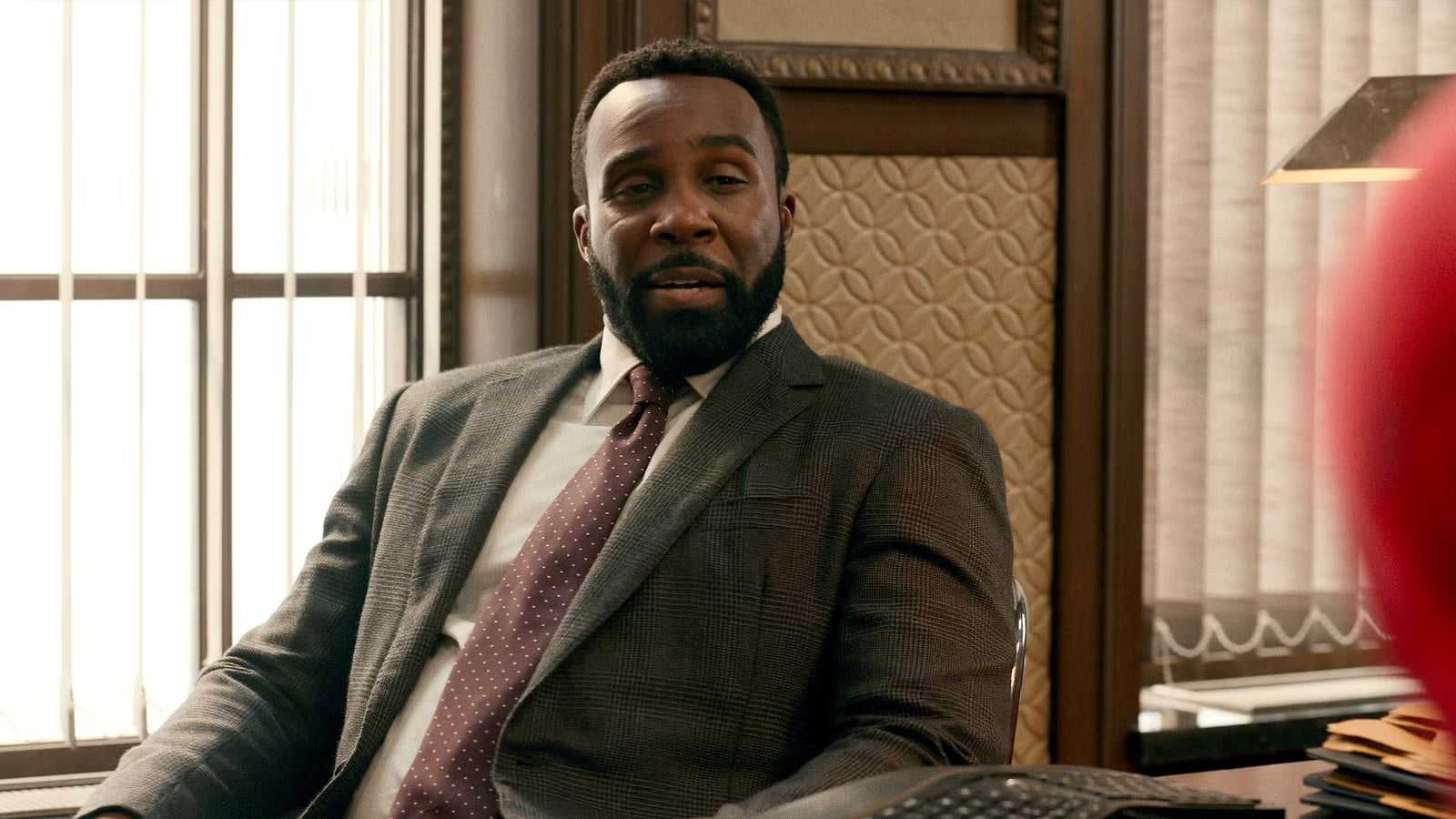
The portrait that emerges, again according to those reports, is of a morally murky institution, geared towards surveillance and the control of individuals with powers, with which Spider-Man starts out collaborating before the relationship sours. The agency is headed there by William Metzger, played by Tramell Tillman: our file devoted to the character sets out his background and his motives.
The film fits into a fairly coherent continuity: from 2017 to 2026, the agency has never stopped gaining power and ambiguity, without ever changing its name. To place this chapter within the whole, our guide to what you should have watched first and our summary of the critical reception complete the picture.
Anne Marie Hoag, the only thread linking the two versions
One character connects the page version and the screen version, and it's the one everyone systematically forgets: Anne Marie Hoag. In the comics, she founds and runs the company, negotiates with its two antagonistic shareholders, and ends up leaving for a government post, handing the reins to Robin Chapel. On screen, it's she who appears in 2017 to take Adrian Toomes's contract away, played by Tyne Daly.
Carrying the same character from one medium to the other is no small thing. It shows that the adaptation didn't simply borrow a catchy name: it drew on the source material, while reversing the nature of the organisation. Hoag is the point of contact between the office comedy of 1988 and the administrative machine of 2026, and that's probably why we've never seen her return since. Her departure marks the moment the concept tips over for good.
The detail is also telling about Marvel's method: take a minor idea, keep it in reserve for thirty years, then bring it back at the moment it serves a bigger point. That's exactly what happened with figures like the Vulture, Mysterio or the Green Goblin, whose original concepts were far lighter than their modern versions.
What we don't know, and are better off admitting
One continuity point remains entirely open, and plenty of sites fill it in wrongly: nobody knows who ran the agency between Anne Marie Hoag and William Metzger. Agent Cleary is there throughout, but he is never identified as director. There's a gap of almost ten years in the succession that nothing on screen has filled.
In the same way, you sometimes read that the agency has existed since 2008 as a sub-division of another organisation, or that it appears in this or that recent series: those claims rest on sources too thin to be repeated. On a subject as documented as the Marvel universe, knowing how to say what you don't know is worth more than plugging the gaps.
The series that never existed
A little-known anecdote deserves digging out. In October 2015, the ABC network ordered a pilot for a half-hour comedy series adapted from Damage Control, overseen by showrunner Ben Karlin and Marvel's television arm. The script was delivered in January 2016. The series never saw the light of day.
With hindsight, that aborted project says something: at the time, Damage Control was still seen as comedy material, faithful to its 1988 DNA. Ten years later, the same entity serves as an authoritarian threat in a blockbuster. Few Marvel concepts have taken such a complete turn — a move comparable to the one made by Alchemax, the other great multinational in the web-slinger's universe.
Why this idea works so well
Damage Control answers a narrative need that super-hero stories carefully avoid: consequences. A spectacular fight leaves a city in ruins, residents without homes and a bill nobody ever shows you. By creating a company responsible for that work, Marvel made its universe more liveable and, paradoxically, more credible.
That's also what explains its transformation. Once you accept that somebody picks up the debris, the next question comes by itself: what does he do with what he picks up? Who decides? In whose name? The move from office comedy to surveillance agency isn't a betrayal of the concept, it's its logical conclusion. The question of control runs through the whole of the web-slinger's trajectory, from his involvement in Civil War to his ambiguous relationship with Tony Stark.
To take your exploration of this universe further, the Spider-Man figures cover most of the characters mentioned here, the Brand New Day selection brings together the pieces tied to the film, and the posters, t-shirts and masks cover the whole franchise. The complete guide to the web-slinger's enemies finally places the agency within his gallery of adversaries.

The other shareholder
Spider-Man Figure — Iron
Without Tony Stark, neither the agency nor Peter's armour would have existed. A piece for the display shelf of those who follow that particular thread.
See the product — €119.90Frequently asked questions
Is Damage Control a government agency?
It depends on the version. In the comics, no: it's a private company owned by Tony Stark and Wilson Fisk. On screen, yes: it's a government department born of a joint venture with Stark Industries. That's the main difference between the two, and the source of most of the confusion.
Is it an evil organisation?
Not originally. It slides gradually from service company towards control apparatus across its appearances, until it becomes the central antagonist of a story in 2026. Its dramatic power comes precisely from that ambiguity: it never needed to declare itself hostile in order to become so.
What exactly is its link with Spider-Man?
It's closer than with any other hero. The agency unintentionally created the Vulture in 2017, arrested Peter and his loved ones in 2021, and holds a central place in the 2026 film. No other Marvel character has been affected by it as much.
Who runs Damage Control today?
On screen, William Metzger. But the line of succession between Anne Marie Hoag, seen in 2017, and him has never been established: it's a gap of almost ten years that nothing has come to fill. Agent Cleary, present throughout, is never presented as director.
Why do we never see the agency in recent comics?
It remains a peripheral concept, brought out occasionally rather than settled into the main continuity. The five-issue relaunch of 2022 is the most recent attempt. Its current profile comes almost entirely from the films, which is rare enough to be worth noting.
Does Damage Control really exist in real life?
No, it's a pure Marvel invention. The idea does draw on a very real trade, though, that of the firms handling decontamination and rebuilding after a disaster, which partly explains why the concept rings so true. It's precisely that administrative plausibility that makes it work in fiction.
Do you need to read the comics to understand?
No, the two versions are independent and the films assume no prior knowledge. Reading the original version mainly offers the pleasure of contrast: discovering that this unsettling administration started life as an office comedy completely changes how you look at it.

