

14-Day Money-Back Guarantee
0
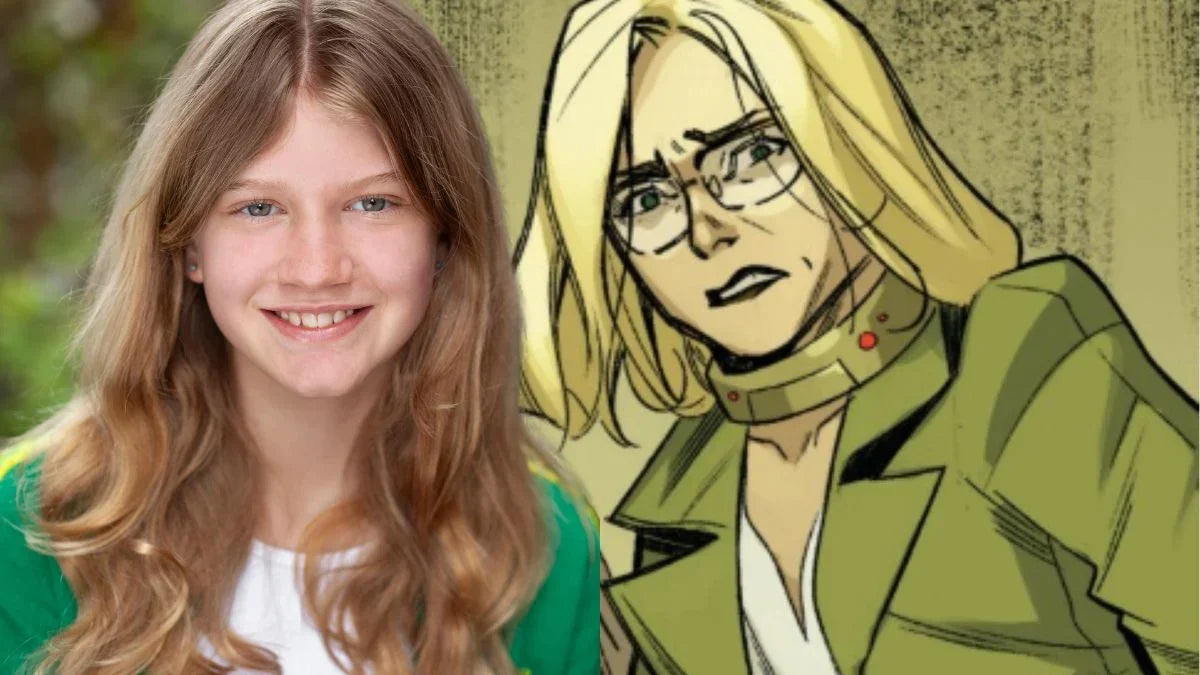
The short answer
Yes, Sara Grey has existed in the comics since 1966: Jean's biological elder sister, married, mother of twins. But the film invents the essentials — in the canon, she has strictly no powers at all. She is the only human in the family, and her fate on the page is even crueller than on screen. We untangle it all below.
It's the question a lot of viewers ask as they leave the cinema: this sister everyone talks about throughout the film, does she come from the comics or did the screenwriters invent her for the occasion? The answer is yes, she exists — and her real story is at once more obscure, sadder and more interesting than what the film shows. Here is what forty-five years of publishing actually say about Sara Grey, and what the film chose to rewrite.
She has existed since 1966 — but she has never had a single power
Her full name is Sara Grey-Bailey: Grey by birth, Bailey by marriage. She is the daughter of John and Elaine Grey, of Annandale-on-Hudson in New York State, and Jean's elder sister — not younger, contrary to what several online profiles claim. She is also her biological sister, with no ambiguity.
And here is the fact that overturns everything: in the comics, Sara Grey is an ordinary human. No powers, no mutation, no psychic ability. Marvel's reference profiles explicitly class her as human, with the powers section left empty. She is the one ordinary member of a family whose bloodline will nonetheless be hunted across the galaxy for its cosmic potential.
It is the exact opposite of the version brought to the screen. This contamination from the film back into the comics will spread over the coming weeks, carried by hastily written articles: better to state the fact clearly right now. On what the film says on its own account, our feature on the character played by Sadie Sink sorts it out.
Named in 1966, shown only in 1980
The distinction matters and almost nobody gets it right. Sara is mentioned as early as July 1966, in an issue where Jean plans to go and visit her sister. But she is only drawn for the first time in August 1980, pencilled by John Byrne and written by Chris Claremont, in the thick of the Dark Phoenix Saga.
Fourteen years therefore separate the mention from the appearance. Profiles that give 1966 as her first appearance conflate the two, and that is the most widespread error about this character. The right formula is simple: named in 1966, shown in 1980.
The night she discovers who her sister really is
Her first scene is striking. Sara is staying at their parents' house when Jean, now Dark Phoenix, returns to the family home at night. Sara knows nothing of her sister's double life: in a single second she discovers that this woman is a superhero, and an unstable cosmic power.
Jean, a telepath, then reads a very specific fear in her sister's mind, one that will become the central irony of the whole character: Sara dreads that her own children might be mutants. A few issues later, she attends Jean's funeral. This motif of a family struck again and again runs through the whole of the web-slinger's universe, as shown by the arc that changed Spider-Man for ever.

The era we're talking about
Spider-Man Comics Battle Poster
The style of the panels from the Claremont-Byrne period, the one in which Sara Grey first appeared. A piece of the golden age to hang on your wall.
View the product — €19.90The only time she had powers — and it was against her will
One exception exists, and it is chilling. In 1981, in a story by Claremont and John Buscema, the two sisters are abducted by Attuma, the Atlantean warlord, who wants to make them wives capable of producing a hybrid bloodline. He genetically modifies Sara so that she can breathe underwater.
Jean, then Phoenix, restores her — then wipes her memory of the episode. So Sara forgets both her transformation and what she had just learnt. It is the only time the character has possessed an ability out of the ordinary, and it had been forced on her by a kidnapper before being erased by her own sister. It would be hard to find a crueller summary of an entire life spent on the margins of other people's powers.
A campaigner, then vanished
After Jean's death, the mental blocks fade and Sara recovers her memories at her sister's grave. She then makes a decision that defines her: becoming a public spokeswoman for mutant rights. No costume, no powers, no protection. Just a woman speaking out.
In January 1987, she goes on national television to defend that cause. Jean and Scott Summers then call at her home: the house has been emptied, then destroyed. Sara and her husband are nowhere to be found. The story stops there — and the thread will be left hanging for seven years.
A death that cannot even be dated
The answer comes in September 1994, in the course of a major crossover devoted to the Phalanx, a techno-organic entity that absorbs its victims. We learn that Sara has been assimilated by this entity, and that her residual consciousness begs for her sister to be protected. She is dead.
Two versions coexist in the reference encyclopaedias, and honesty requires saying so: according to one, she was murdered by anti-mutant fanatics before her body was absorbed; according to the other, she was absorbed alive and died when the collective was destroyed. In both cases, her death is never shown. It is even impossible to date it precisely: the texts themselves contradict one another about when it happens.
As for her husband, Paul Bailey, he never received a conclusion. He disappears from the story in 1987 and is never found. Claiming that he died or that he survived is pure speculation: Marvel has never settled it.
Her children: the bitterest irony of the Grey family
Sara had two children, twins: Gailyn and Joseph, known as Joey. And here is the loop closing back on that 1980 scene — both of them are mutants. What Sara dreaded so deeply that her telepathic sister read it in her mind came true.
After their parents vanished, the twins are abducted and conditioned by two superhuman child-snatchers, before being recovered by the family's allies and entrusted to their grandparents. Their exact power is never revealed: their mutation stays latent to the very end.
To the very end, literally. In 2006, a story arc sees alien commandos wipe out almost the entire Grey family, judged to carry a genetic heritage predisposed to hosting a cosmic force. Gailyn and Joey are killed with the rest. Sara's line therefore dies out after her — a useful clarification, since you sometimes read that Sara herself died in that arc: she had already been dead for twelve years.

For the women who read the comics
Spider-Man Marvel T-Shirt for Women
A cut made to be worn, not put away. The logo that runs through every editorial era mentioned here.
View the product — €29.90The character who could have replaced Jean Grey
This is the most fascinating part of her story, and it never happened. In the mid-1980s, Chris Claremont, forced by editorial to kill Jean off, put forward a solution: making Sara the fifth member of the new team that was about to form, in place of her resurrected sister.

In this plan, Sara would have been a mutant, with a power as elegant as it was symbolic: the ability to trigger other people's latent powers. The ordinary sister in a family of superhumans became the one who reveals what others carry without knowing it. The editor-in-chief of the time, Jim Shooter, refused and imposed Jean's return.
Claremont would reuse the idea much later for another character. But the missed opportunity remains one of the great 'what ifs' of the period: Sara Grey was never wasted for lack of interest, she was set aside by a management decision. This kind of editorial call has shaped a good part of the Marvel universe, as our feature on the crossovers between Spider-Man and the X-Men points out.
The 2025 return isn't one
A wave of headlines announced in 2025 that Marvel was finally resurrecting Jean Grey's sister. That is inaccurate, and the nuance is a big one. A Sara does reappear in a recent series, at the head of a refuge city, endowed with precisely the power to unlock other people's latent potential — a transparent nod to Claremont's abandoned plan.
But the story quickly reveals that this is not a resurrection: the character was created unintentionally by Jean herself, out of energy released during a confrontation. The reference profiles even give her a separate entry, explicitly identified as a simulacrum. The real Sara Grey remains dead. The simulacrum, for its part, ends up becoming a cosmic entity charged with reminding the gods of compassion.
What the film invents, what it keeps
What is invented for the screen
The powers, first of all, and that is the major gap: the film's Sara has psychic abilities comparable to her sister's, where the canon makes her an ordinary human. Then her mentor role — on screen, she is the one who teaches Jean her technique; in the comics, that function belongs to Charles Xavier. And finally the involvement of the Department of Damage Control, which has strictly no role in her story on the page: no abduction, no experiments, no detention. The circumstances of her death are therefore entirely rewritten, as set out in our feature on Damage Control and its boss.
What the film leaves out
Sara's whole family disappears from the adaptation: no husband, no twins. And above all, her activism is erased. The comics character is first and foremost a public voice, killed for having spoken out; the film turns her into a captured victim. We go from a woman who acts to a woman things are done to, which is not the same story.
What it keeps faithfully
The name, her status as biological elder sister, and above all the narrative function. In the comics as on screen, Sara Grey dies outside the main story, and that death drives her sister. She is a structuring absence far more than a present character — and that is perhaps the adaptation's deepest fidelity, even if unintentional.
Don't get them mixed up: a guide to the Greys
The Grey family is a nest of confusions, and several errors circulate widely. Madelyne Pryor is not Jean's sister: she is a clone, created by Mister Sinister, and Scott Summers's wife. Rachel Summers is neither Jean's sister nor Sara's daughter: she is Jean's daughter, come from an alternative reality.
As for Cable, he is the son of Scott Summers and Madelyne Pryor — so Sara's nephew by marriage, and certainly not Jean's son. Nor should he be confused with Nate Grey, another character again. Remembering the simple rule is enough: Sara is Jean's only real sister, and the only human of the lot.

For the reading corner
Spider-Man Neon Lamp
Untangling forty-five years of continuity deserves decent lighting. A mood lamp for long evenings of re-reading.
View the product — €99.90A family designed to be destroyed
Step back and Sara Grey's trajectory sheds light on a writing principle Marvel has applied for sixty years: around a hero, the supporting cast is the raw material of drama. With Jean, that machinery reaches a rare intensity — sister absorbed, brother-in-law vanished, nephew and niece exterminated, parents killed, an entire line wiped out in the name of a coveted genetic heritage.
Spider-Man readers will recognise the device. Peter Parker loses an uncle, a girlfriend, friends, and sees his aunt threatened again and again. The difference lies in the position: with the web-slinger, those close to him die because he is a hero; with the Greys, they die because they share a bloodline. Peter's family origins, told in our feature on his parents, stem from the same logic of inherited secrets.
It also explains why the adaptation worked with audiences. By reducing Sara's story to an abducted sister whose disappearance haunts the survivor, the film kept the essence of the motif while setting aside forty-five years of continuity impossible to summarise. The rest of the film's narrative machinery is unpicked in our portrait of its Peter Parker.
Why this character deserves better
Seven appearances in forty-five years. That is all Marvel will have granted Sara Grey. She will have served to humanise her sister in 1980, to supply a victim in 1987, to resolve a forgotten thread in 1994, then to inspire an oblique tribute in 2025. Never once will she have been the subject of her own story.
That is precisely what makes her presence on screen remarkable: a character the comics never knew how to use becomes the emotional engine of a blockbuster, forty-six years after her first panel. That the film had to invent powers for her to get there says a lot about how hard it is to stage an ordinary woman in a universe of superhumans. To explore the rest of the gallery, the shop's figures, posters and T-shirts cover most of the characters mentioned here, while the Brand New Day selection and the lamps extend the world of the film.
To carry on with the film itself, our analysis of the post-credits scene and our round-up of the critical reception complete the picture, and our portrait of Firestar is a reminder that mutants have been crossing the web-slinger's universe for a long time. The character panorama brings it all together.
Frequently asked questions
Does Sara Grey have powers in the comics?
No, none at all. She is an ordinary human, the only one in the family. Latent mental abilities have been hinted at twice by other characters, but they never manifested. The film gives her some: that is an invention.
Is she older or younger than Jean?
Older. She is the elder sister, and this appears both in the reference profiles and in the stories. The mention of a 'younger sister' found on some pages comes from a contributor's error copied ever since.
How does she die in the comics?
Absorbed by a techno-organic entity, after disappearing from her home seven years earlier. Her death is never shown on the page and two versions of the circumstances coexist. No precise date is established, something the encyclopaedias flag themselves.
Are there any descendants of Sara left?
No. Her two twins, both mutants, were killed in 2006 along with almost the whole Grey family. Her husband's fate has never been revealed: he simply disappeared from the story in 1987.

