

14-Day Money-Back Guarantee
0
The short answer
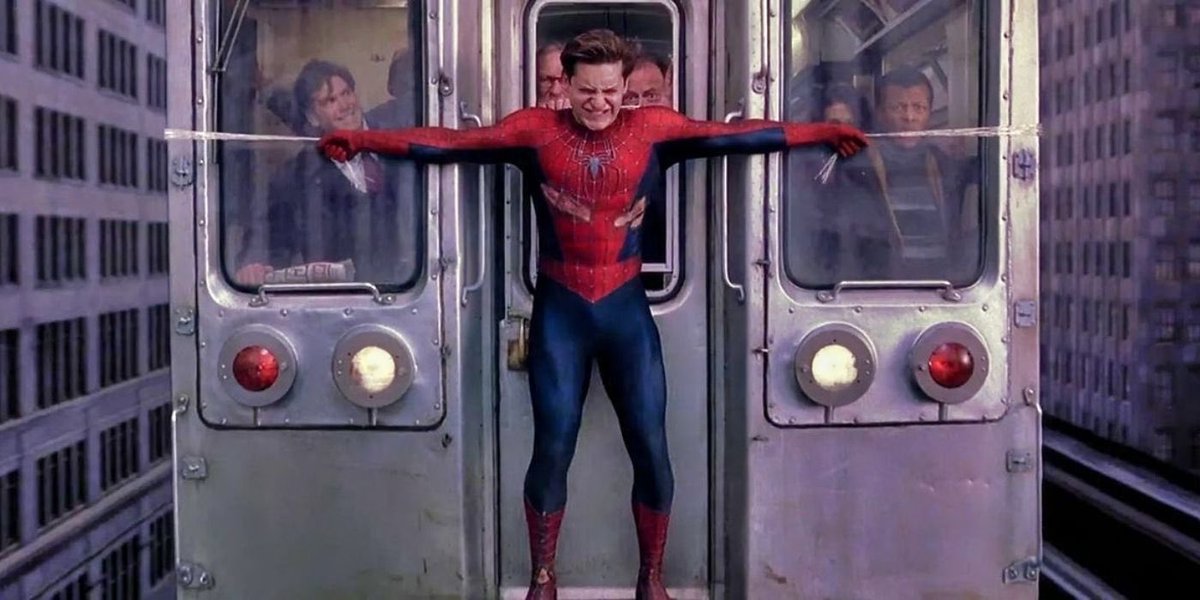
Its legendary status comes down to one directorial choice: Peter brakes a runaway carriage with his body alone, exhausted and without armour, in front of passengers he has never met. The clarity of every shot and the intimate stakes behind the feat explain the rest — we break down the mechanics below.
The train scene in Spider-Man 2: the peak of the superhero film
Twenty years after its 2004 release, the train scene in Sam Raimi's Spider-Man 2 remains etched in our collective memory as one of the most perfectly crafted sequences ever filmed in a superhero movie.
This seven-minute scene distils everything that makes the genre great: spectacular action, dramatic tension, heroic sacrifice and, above all, a deep humanity that transcends the special effects. It is the moment when Peter Parker stops being merely Spider-Man and becomes a universal symbol of selfless sacrifice.
So what makes this scene so legendary? Why is it still held up as the absolute benchmark, even after the hundreds of superhero films released since?
The answer lies in a rare convergence of elements: impeccable direction, emotional stakes at their highest, choreography you can follow perfectly and, above all, a profoundly human message about courage and self-denial.
A scene that defines the essence of Spider-Man
Unlike other superheroes, Spider-Man is not a god, a billionaire or an elite-trained soldier. He is an ordinary young man who makes extraordinary choices. The train scene crystallises that essence better than any other in the character's screen history.
When Peter stops the elevated train hurtling along at full speed by using his own body as an anchor point, he is not relying on invincible armour or limitless powers. He is relying on sheer will, his refusal to give up and his determination to save innocent people whatever the cost.

This sacrificial dimension echoes the line that defines Spider-Man — with great power comes great responsibility. Peter does not take the easy path, he takes the right one, even when it means destroying himself physically.
The lasting influence on superhero films
This scene set a standard that every superhero film since has tried to reach, often without success. It proves that a great action scene does not need mass destruction or wall-to-wall digital effects, but genuine emotional tension and clear personal stakes.
In our article on which is the best Spider-Man film, this scene is systematically cited as the major argument in favour of Spider-Man 2. It represents the absolute high point of the Spider-Man cinematic universe.
In this article, we will unpack why this scene works so perfectly, analyse its technical and emotional components, and explore its lasting impact on popular culture and the superhero genre.
The narrative context: when everything converges on this moment
To understand why the train scene hits so hard emotionally, you need to grasp the narrative context leading up to it. This is not a gratuitous action scene: it is the culmination of a carefully built dramatic arc.
Peter Parker at rock bottom
By the time this scene arrives, Peter is going through the worst period of his life. He has given up being Spider-Man, abandoning his responsibilities as a hero to try to live a normal life. His powers have become unstable, his self-confidence is shattered, and he doubts his ability to be the man New York deserves.

This identity crisis, explored in our analysis of Peter Parker's double identity, reaches its peak just before the confrontation with Doctor Octopus. Peter has to choose: stay in the comfort of anonymity or become the hero the city needs once again.
Mary Jane's kidnapping and the showdown with Doctor Octopus
When Doctor Octopus abducts Mary Jane to force Peter to hand over the tritium his experiment needs, Peter has no choice left. He has to put the suit back on, face his doubts and become Spider-Man again — not out of obligation, but out of love and a sense of duty.
The complex relationship between Peter and Mary Jane adds a further emotional layer: Peter is fighting not only to save innocent people, but also to protect the woman he loves, even though their relationship seems impossible.
The fight on the train: the stakes at their highest
The confrontation between Spider-Man and Doctor Octopus moves onto an elevated train racing at full speed across New York. In an act of calculated cruelty, Doctor Octopus sabotages the brakes and leaps off the train, leaving Spider-Man facing a deadly dilemma.
The stakes are perfectly clear and visceral:
- Save the passengers — dozens of innocent people will die if the train does not stop
- Face his physical limits — Peter has just been in a fight and is already exhausted
- Take on the impossible — stopping a train weighing several tonnes with his strength alone
- Accept the ultimate sacrifice — Peter knows he could die trying
This pile-up of obstacles creates maximum dramatic tension and sets up the heroic resolution to come perfectly.
In the next section, we will analyse how Sam Raimi films this sequence to maximise its emotional and visual impact.
Technical excellence: direction, effects and choreography
What sets the train scene apart from so many other action sequences is Sam Raimi's absolute technical mastery. Every directorial decision serves the emotion and the narrative clarity.
A visual geography you can read perfectly
One recurring flaw of modern action films is the chaotic editing that makes the action impossible to read. The train scene is the exact opposite: at every moment you understand perfectly where the characters are, which way the train is going and what the immediate dangers are.
Sam Raimi uses wide shots that clearly establish the geography of the action:

- The train races above the New York neighbourhoods
- The passengers panic inside
- Peter moves along the roof and the sides
- The end of the line is closing in inexorably
This visual clarity lets you feel the tension without ever being confused. You understand viscerally that time is running out and that every second counts.
The subtle blend of practical and digital effects
In 2004, digital effects were less refined than they are today, but Raimi compensates brilliantly with a clever balance of CGI and practical effects. The real stunts performed by Tobey Maguire and his stunt double give the movements a physical weight that all-digital work could never reproduce.
The webs Spider-Man fires to anchor himself to the buildings, the visible strain in his body as he holds the train back, the gradual tearing of his suit — every one of these details creates a physical authenticity that makes the sequence believable despite being physically impossible.
The gradual build-up
The sequence does not open at maximum effort. It builds the tension step by step:
Phase 1 - Realising the danger:
- Peter works out that the brakes have been sabotaged
- He tries several solutions (getting into the cab, slowing the train by friction)
- Nothing works — the despair builds
Phase 2 - The desperate attempt:
- Peter fires webs at the buildings on either side
- He uses his body as the central anchor point
- The physical strain becomes unbearable
Phase 3 - The absolute sacrifice:
- The webs stretch to their limit
- Peter's body is pulled apart by the strain
- His mask starts to tear
- The train slows... and finally stops
This progression creates an emotional build-up that peaks in the moment of victory, made even more powerful by Peter's total exhaustion as he collapses, unconscious.
Danny Elfman's score
Danny Elfman's music accompanies every phase of the scene perfectly, alternating between orchestral tension and moments of heroic grace. The Spider-Man theme swells at the crucial moment when Peter refuses to give up, reinforcing the emotional impact.
This technical excellence turns what could have been a simple action scene into a moment of pure cinema that transcends the genre. The details of the Spider-Man suit tearing apart piece by piece visually symbolise Peter's physical sacrifice.

In the next part, we will look at the emotional and symbolic dimension that makes this scene far more than a simple slice of spectacular action.
The emotional dimension: sacrifice, humanity and revelation
What turns the train scene into a legendary moment is not the technical feat or the special effects. It is what happens immediately afterwards: the moment of pure humanity that reveals the character's soul and moves audiences everywhere.

Total exhaustion: when the hero becomes vulnerable
Having stopped the train at the cost of a superhuman effort, Peter collapses, unconscious. His body has given everything. He has nothing left to offer. This extreme vulnerability is rare in superhero films, where heroes usually rack up feats without ever showing real fatigue.
Here, Peter is physically broken. The train passengers catch him before he falls, holding him carefully like a precious relic. That reversal — the hero saved by the very people he has just saved — creates a moment of tenderness that is rare in the genre.
This vulnerability chimes with the very essence of Peter Parker — an ordinary young man who pushes himself beyond what is bearable out of a pure sense of duty.
The identity reveal: a moment of communion
While Peter is unconscious, his mask partly comes away, revealing his face to the passengers. This moment could have been played as a disaster — the secret identity exposed. Instead, Sam Raimi turns it into a moment of deep human communion.
The passengers, seeing that their saviour is just a young man barely out of his teens, react with respect and protectiveness. One of them says something simple but powerful: 'He's just a kid... no older than my son.'
That realisation turns Spider-Man from a mythical figure into a tangible human being. The passengers no longer see a distant superhero, but a young man who risked his life for strangers. The response is unanimous: they gently put his mask back on, protecting his secret.
The symbol of collective sacrifice
When Doctor Octopus comes back to seize the exhausted Peter, the passengers form a human wall to protect him. Ordinary New Yorkers, with no powers at all, stand up to a supervillain to defend the man who has just saved them.
This scene illustrates perfectly why Spider-Man is one of the most loved heroes in the world — he is not above the people he protects. He is one of them. His vulnerability and his humanity create an emotional connection that invincible heroes can never reach.
Of course, the passengers cannot really stop Doctor Octopus — but their symbolic gesture is immense. They show that Spider-Man's heroism has inspired courage of their own. Sacrifice breeds sacrifice. Heroism is contagious.
The contrast with modern films
This train scene contrasts radically with the climaxes of many modern superhero films, where heroes take on entire armies and level whole cities without ever showing real vulnerability.
Here, saving a few dozen people on a train is enough. No need for a cosmic threat or planetary destruction. The stakes are human, tangible, understandable. It is precisely that human scale that makes the scene so powerful.
This more intimate approach to heroism defines the spirit of Sam Raimi's Spider-Man trilogy and explains why it remains a timeless benchmark.

In the final part, we will explore the lasting cultural impact of this scene and how it still influences superhero films two decades on.
The cultural legacy: influence, references and iconic status
Twenty years after its release, the train scene in Spider-Man 2 is still quoted, referenced, parodied and analysed. Its influence on the superhero genre and on popular culture remains profound.
The gold standard of heroic sacrifice
This scene set a standard that every superhero film since has tried to match. When directors want to show a hero truly giving everything, they try to recreate the emotional impact of this sequence.
Films such as Spider-Man: Homecoming with its rubble scene, or No Way Home with its final sacrifice, consciously try to capture that same raw emotion.
Tobey Maguire's return in No Way Home revived the nostalgia for this scene, reminding new generations why the Raimi trilogy remains an absolute benchmark.
In meme and internet culture
The train scene has become an inexhaustible source of memes and internet references. Images of Spider-Man stretched between the buildings, of the mask coming away, or of the passengers forming a human wall are constantly reused to illustrate extreme effort, sacrifice or solidarity.
This cultural dimension is part of the wider phenomenon of how Spider-Man wins over Gen Z, where the iconic scenes of the Raimi trilogy are constantly revisited and celebrated.
The influence on the comics and on animation
The train scene even influenced the Spider-Man comics that followed. Writers have tried to recreate that emotional intensity in their own stories, proving that a film adaptation can sometimes enrich its source material.
In Spider-Man: Into the Spider-Verse, several moments echo this scene, especially when Miles has to take his own 'leap of faith' — another moment of sacrifice where the young hero must choose between safety and responsibility.
Why this scene still resonates today
In a world saturated with invincible superheroes and cosmic battles, the train scene reminds us that true heroism lies in the conscious choice to sacrifice yourself for others, even when it is hard, painful and dangerous.
It is that timeless message that explains why parents keep buying Spider-Man figures, fancy dress costumes and posters featuring this hero: Spider-Man embodies positive values of courage, sacrifice and humanity.
The train scene crystallises these values perfectly in a moment of pure cinema that transcends the genre and touches something universal in human experience.

The lessons for future films
This scene teaches several essential lessons to superhero film directors:
- Human stakes hit harder than abstract cosmic threats
- Vulnerability creates the emotional connection with the audience
- Visual clarity lets the viewer live the action fully
- Personal sacrifice resonates more than an easy victory
- The quiet moments after the action matter as much as the action itself
These principles still hold two decades later and continue to inspire the best moments in the genre.
The impact on generations of fans
For a whole generation that grew up with the Raimi trilogy, the train scene remains THE definitive Spider-Man moment. It is the scene they show their own children to explain why Spider-Man is special.
That generational hand-down explains why Spider-Man clothing, toys and all the Spider-Man merchandise keep selling in huge numbers — each generation rediscovers the character and his values.
Conclusion: a scene that defines a genre
The train scene in Spider-Man 2 is not simply a great action scene. It is the moment that proves a superhero film can reach the emotional and artistic greatness of the very best cinema.
It combines technical excellence, dramatic tension, genuine sacrifice and deep humanity to create a perfect moment that still resonates twenty years on. It is the gold standard every superhero film is measured against — and that few manage to match.
To explore further why Spider-Man 2 remains an absolute benchmark, read our full analysis of which is the best Spider-Man film of all time. To understand the trilogy's overall cultural impact, read our article on why the Raimi trilogy became a cult classic.
And to discover how all the Spider-Man films fit into the character's evolution on screen, explore our guides & advice section which covers every aspect of the web-slinger's universe.
Because in the end, as this scene proves masterfully, Spider-Man is not great because he is invincible. He is great because he chooses to fight even when it is impossible, to sacrifice himself even when it hurts, and to protect others even at the cost of his own destruction.
And it is precisely that universal message that explains why, twenty years on, the train scene remains etched in our memories as the definitive moment of the best Spider-Man ever brought to the screen.

