

14-Day Money-Back Guarantee
0
The short answer
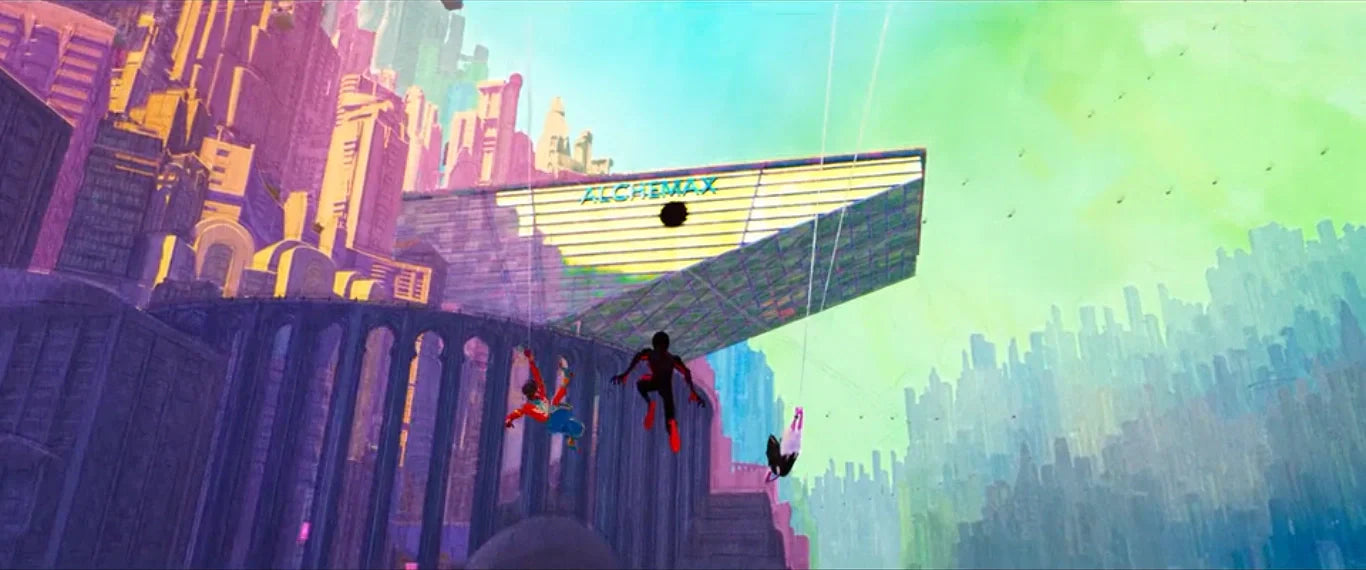
Alchemax is the all-powerful conglomerate of the New York of 2099: born out of genetic research, it extends its grip over the police, the media and the government. It is inside its walls that Miguel O’Hara, a rebellious geneticist, becomes the spider of the future. We unpack its story below.
Contents
A shadow company born of scientific greed
In the world of Spider-Man, danger does not come only from costumed supervillains. It also comes from laboratories, multinationals and economic powers ready to do anything to push back the limits of science. And among them, one stands out for its sheer ambition: Alchemax.
Created in the Spider-Man 2099 comics by Peter David and Rick Leonardi, Alchemax is the great corporation of the dystopian future of Miguel O’Hara. It controls society, manipulates science and exploits humanity in the name of profit. Behind its technological, progressive façade hides an economic monster: an empire that embodies the fusion of political, scientific and military power.
Origins rooted in genetic manipulation
Alchemax built its fortune on genetic research, biological weapons and forbidden experiments. It was in its laboratories that Spider-Man 2099 was born, the result of a genetic accident during a DNA-rewriting test. But instead of creating a hero, Alchemax was trying to manufacture a product: a patented version of the superman, marketable as a weapon or a soldier under contract.
This scientific cynicism recalls other excesses running through the classic Spider-Man arcs: the experiments of Doctor Octopus, the mutations of Curt Connors (the Lizard) or the mad schemes of Oscorp. But Alchemax goes further: it does not merely seek to create monsters, it wants to own science itself.
Its influence reaches every level: police, media, government, and even religion. In this dystopian future, New York belongs to Alchemax — and Miguel O’Hara becomes its symbol of resistance.
To dive into this futuristic world, browse our Spider-Man 2099 figures or our futuristic Spider-Man masks, inspired by the cyberpunk aesthetic of the Spider-Verse.
An empire built on genetics
Alchemax made its fortune through genetic research, biological weapons and forbidden experiments; Spider-Man 2099 was born in its laboratories.
Alchemax’s expansion across the Spider-Verse
While Alchemax was born in the future of Spider-Man 2099, it has not stayed confined to that era. Marvel’s writers very quickly wove links between this company and other timelines, until it became an omnipresent force in the Spider-Verse.
In certain story arcs, Alchemax already exists in the present, founded by figures well known to Peter Parker. Norman Osborn and Kingpin have invested in it, seeking to merge their criminal ambitions with the science of tomorrow. This is how the company becomes a genuine bridge between eras: the past of Oscorp’s experiments and the industrial future of Spider-Man 2099.
When corporate power threatens the multiverse
In the Spider-Verse crossover, some versions of Peter Parker and Miguel O’Hara discover that Alchemax is manipulating interdimensional technology to control parallel realities. The company has learnt to reproduce the power of the Spider-Totem, seeking to sell it as a commercial product or a biological weapon. Once again, science without ethics becomes a universal threat.

This theme echoes other major Spider-Verse arcs, notably Spider-Island or the Clone Saga, where genetic manipulation and scientific excess sit at the heart of the story. Alchemax is therefore not merely an economic adversary: it is the natural evolution of the scientific corruption Peter Parker has been fighting since the very beginning.
Ramifications reaching Venom and the symbiotes
Alchemax also plays a key role in certain symbiote arcs. In Venom 2099, the company experiments on the symbiote’s DNA to create a ‘stabilised’ version its security forces can use. Those trials lead to fresh horrors, turning soldiers into half-organic, half-technological creatures — hybrids reminiscent of the original Carnage.
This parallel between biotechnology and economic domination underlines one truth: Alchemax is not a simple villain. It is a **system**, a metaphor for the modern world where science, in the wrong hands, becomes the instrument of absolute power.
For anyone passionate about Spider-Man’s future, explore our collection of Spider-Man 2099 costumes and our futuristic Spider-Man posters inspired by the cyberpunk comics. These products celebrate the dark, technological world where Alchemax reigns unchallenged.
In the present day
Norman Osborn and Kingpin invest in the company to merge their criminal ambitions with the science of tomorrow.
In the Spider-Verse crossover
Alchemax manipulates interdimensional technology and reproduces the power of the Spider-Totem in order to sell it.
In Venom 2099
The company experiments on the symbiote’s DNA to create a stabilised version intended for its security forces.
Miguel O’Hara against Alchemax: the rebellion of a disillusioned scientist
At the heart of the Alchemax story stands Miguel O’Hara, a brilliant geneticist working for the firm in the New York of 2099. Ambitious and idealistic, Miguel dreamt of perfecting the legacy of the original Spider-Man by creating a new model of superhero. But he very quickly discovers that Alchemax’s leadership — corrupt, manipulative and obsessed with profit — is diverting his research towards military and commercial projects.

When he tries to resign, the company imprisons him inside his own DNA: to stop him leaving, a superior traps him with an addictive substance, Rapture, synthesised only by Alchemax. To free himself, Miguel rewrites his genetic code, accidentally splicing his DNA with that of a spider. That is how he becomes the **Spider-Man of the future**, the web-slinger 2.0 born in spite of himself out of Alchemax’s scientific excesses.
A hero born of a moral failure
Unlike Norman Osborn or Doctor Octopus, Miguel never sought power. His power is a curse, the result of a fight against a system he had helped to build. His story illustrates the corruption of science by the logic of profit — a recurring theme in the Spider-Man universe, where every great discovery ends up turning against its creator.
In the future Alchemax dominates, humanity lives under the yoke of multinationals, and heroes have become forgotten myths. Miguel O’Hara embodies the rebirth of responsibility: a scientist who decides to give science back its first role — to protect, not to dominate.
Between resistance and the web-slinger’s legacy
Alchemax sees Spider-Man 2099 as a threat to its supremacy. Its executives send cybernetic mercenaries and clones to hunt him down, recalling the worst hours of the twentieth-century cloning experiments. But Miguel draws on the legends of the past and takes up Peter Parker’s torch, becoming living proof that ethics can triumph over greed, even in a world where everything is bought or sold.
The fight between Spider-Man 2099 and Alchemax then becomes a metaphor for our own era: one where technological innovation collides with human morality. And in that duel, Miguel represents more than a hero: he symbolises the hope of a rehabilitated science.
1
Geneticist at Alchemax In the New York of 2099, Miguel wants to perfect the legacy of the original Spider-Man.
2
The corruption revealed Management diverts his research towards military and commercial projects.
3
Trapped by Rapture When he wants to resign, a superior makes him dependent on a substance synthesised only by Alchemax.
4
His DNA rewritten To free himself, he accidentally splices his DNA with that of a spider and becomes Spider-Man 2099.
5
Hunted by the company Alchemax sends cybernetic mercenaries and clones after him.
Alchemax, a mirror of the modern world: science between progress and excess
Beyond the fiction, Alchemax embodies a powerful critique of contemporary society. In the Marvel universe, this multinational symbolises the culmination of a world dominated by technology, finance and the pursuit of power. But above all it echoes our own reality — that of pharmaceutical giants, biotech companies and large-scale data manipulation.
Through Alchemax, Marvel’s writers pose an essential question: how far can you go in the name of progress? The line between innovation and immorality becomes blurred, and Spider-Man — whether Peter Parker, Miguel O’Hara or another variant — always ends up defending that fine line between useful science and destructive science.
An ideological legacy across the whole Spider-Verse
It is no accident that Alchemax appears in several arcs and parallel universes of the Spider-Verse. Researchers from this company are responsible for experiments that echo all the way into timelines inhabited by Spider-Gwen, Miles Morales or even Jessica Drew (Spider-Woman). In some versions, Jessica has even infiltrated Alchemax on behalf of S.H.I.E.L.D., in order to expose its secret projects.
This multiplicity of stories makes Alchemax a cross-cutting pillar of the Spider-Man myth: every version of the hero ends up facing a form of systemic oppression, whether embodied by an individual or an organisation. It is that consistency which strengthens the web-slinger’s identity across the ages: a hero who fights not only crime, but the corruption of knowledge.

Alchemax’s impact on pop culture
Thanks to Spider-Man: Across the Spider-Verse and the growing popularity of Spider-Man 2099, Alchemax has regained major visibility with the general public. Its laboratories, its futuristic architecture and its inhuman experiments feed a cyberpunk imagery that fascinates fans. It has become a company almost as mythical as Oscorp or Stark Industries, but on the dark side of science fiction.
And it is also a **bottomless narrative seam**: modern writers find in it a space to question the relationship between artificial intelligence, transhumanism and human exploitation — all highly topical themes.
If you want to bring a little of this dystopian world home, explore our futuristic Spider-Man figures or our Spider-Man lamps inspired by the neon lights of Nueva York. Every piece captures the essence of the fight between humanity and technology, an eternal symbol of the struggle against Alchemax.
Conclusion: Alchemax, the web-slinger’s industrial nightmare
In Spider-Man mythology, Alchemax is not just a company: it is an ideology. It personifies the fear of the future, scientific arrogance and the dehumanisation of an overly rational world. And faced with this faceless monster, one simple man — or rather one spider — keeps reminding us that morality, empathy and responsibility are the only weapons capable of saving the future.
An ideology more than a company
Alchemax personifies the fear of the future, scientific arrogance and dehumanisation; against it, morality, empathy and responsibility remain the only weapons.

