
14-Day Money-Back Guarantee
0
The short answer
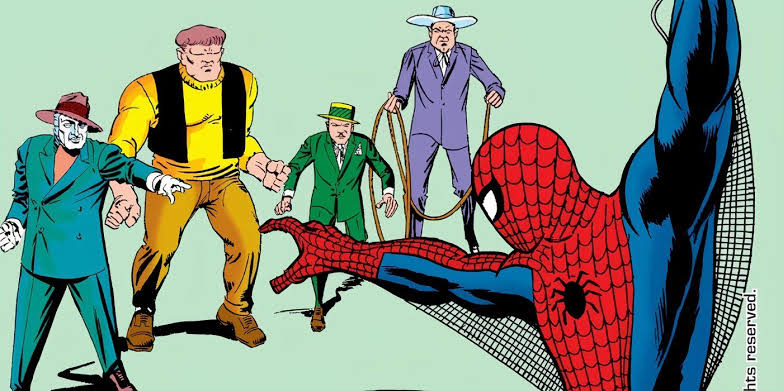
The Enforcers are the first organised gang that Spider-Man faces, back in 1964. Three men without a single power: Fancy Dan, a small-framed close-combat expert; Montana, a virtuoso with a lasso; and Ox, a mountain of muscle. They work for the Big Man, and they beat Spider-Man at their very first meeting.
We remember the villains with powers - the Goblin, Octopus, Venom. We forget that Spider-Man's most interesting early opponents were three men in street suits, without the slightest superhuman ability.
Here is who they are, why they still work sixty years on, and what a recent film borrowed from them without saying so.
Who the Enforcers are
Three men, three specialities, no superpowers. That is the whole concept.
Fancy Dan
The smallest of the three, and the most dangerous up close. A martial arts expert, he makes up for his size with a speed and a technique that let him floor opponents twice his weight.
His nickname comes from his sharp dress sense and his way of fighting - economical, precise, almost choreographed. He is the tactical brain of the trio.
Montana
The lasso specialist. A weapon that looks ridiculous on paper, and turns out to be formidable against an opponent whose whole strategy rests on movement.
He is the only member of the group able to neutralise Spider-Man's main asset directly: he does not try to hit him, he tries to pin him down. His civilian name, Jackson Brice, would have an unexpected afterlife on screen.
Ox
Brute force. Raymond Bloch is a giant who needs no technique at all, and his job in the group is simple: soak up the hits and throw them while the other two manoeuvre.
He represents what Spider-Man ought to beat without trouble - and that is exactly why the writers use him, by combining him with the other two.

Spider-Man Figurine
The character in his classic version, the one from the first years of publication. The full range is in our figurines.
View the product - 69.90 EURTheir first appearance, and Spider-Man's defeat
The trio debut in March 1964, in the tenth issue of the series, written by Stan Lee and drawn by Steve Ditko.
The context
At the time, the New York underworld is run by a masked figure called the Big Man, whose identity nobody knows. The Enforcers are his armed wing.
The final reveal - the Big Man is in fact a Daily Bugle journalist, a colleague of Peter Parker - is one of the first great twists in the series. We go into it in our article on the Crime Master and the Big Man's succession, and into the paper itself in the Daily Bugle.
What makes the fight memorable
Spider-Man loses. Three ordinary men rout an opponent able to lift several tonnes, because they do not take him head-on: they come at him from three different angles, in coordination.
It is a lesson in writing. A hero who is too powerful becomes boring the moment you answer him with force. He becomes interesting again the moment you answer him with method.
The return
The trio come back several times in the early years, notably in issues 14, 18 and 19. They are one of the most frequent recurring threats of the early days, long before the catalogue of powered villains filled up.
Why they work without powers
That is the interesting question, and the answer explains why the concept has survived.
They exploit a structural flaw
Spider-Man's spider-sense warns him of a threat and of the direction it comes from. Against a single opponent, that is decisive. Against three simultaneous attacks from three sides, the signal becomes unreadable.
Without knowing it, the Enforcers are the first demonstration of a limit in the character that would be used again for sixty years - including by far more powerful groups such as the Sinister Six.
They anchor the story in the real world
A hero who only fights monsters ends up floating outside the world. The Enforcers remind us that Peter Parker lives in a city where crime is first of all a matter of gangsters, protection rackets and scores being settled.
It is that register that the great figures of organised crime would later take up, from Kingpin to Tombstone by way of Hammerhead.
They cannot win, and they come back anyway
None of the three has any ambition of conquest or personal revenge. They are employees. They take the hits, they lose, they change boss and they start again.
That total absence of grandeur is precisely what makes them believable - and lasting.

Vintage Spider-Man Poster
The look of the first years of publication, the era of the Enforcers. Find it among our posters and our t-shirts.
View the product - 17.90 EURFrom boss to boss
Their career reads like a history of New York organised crime seen from the bottom.
They start out working for the Big Man. After his fall, they pass from one employer to the next as the underworld reshuffles, and end up notably working for Kingpin when he takes control of the city.
The line-up changes too: Ox dies and is replaced, new members are added depending on the era, and the name itself is taken up by different teams. The original trio remains the definitive version.
That longevity through subordination is a singular thing. Most villains in this universe want to become the boss; these three are content to change bosses, and that is what lets them cross the decades. The full picture is in our guide to Spider-Man's enemies.
The Big Man, or the best twist of the early days
It is impossible to talk about the Enforcers without coming back to the man who hired them, because he is what gives the episode its full weight.
A boss nobody sees
The Big Man runs the New York underworld from behind a mask, with neither the police nor the press knowing who he is. He gives his orders to the Enforcers, takes the money, and stays invisible throughout the episode.
The reveal
He is a Daily Bugle journalist - a colleague Peter Parker passes every day in the newsroom corridors. The most wanted criminal in the city works three metres from Spider-Man without him ever suspecting it.
It is the first major use of a principle that would become a signature of the series: the threat does not come from elsewhere, it comes from the hero's immediate circle. You find it again with Harry Osborn, with Norman, with half the catalogue.
What that changes for the Enforcers
That reveal shifts them from being simple thugs to being parts of a machine. They are not the enemy: they are the screen that stops you seeing the enemy.
Their whole narrative usefulness lies there. They keep the hero busy while the real story plays out elsewhere - and that is a role no powered villain can fill, because a powered villain inevitably becomes the subject.
The trio today
What is left of them in contemporary stories?
The name resurfaces regularly, applied to reshuffled teams that have little to do with the original. It has become a generic label for a squad of heavies working for a crime boss.
The original trio, for their part, belong to a precise era - the one where Spider-Man was a secondary school pupil taking on armed robbers before he took on gods. Reading them again today means finding a character on the scale of his own neighbourhood, something our feature on Peter Parker puts back into the whole of his journey.
It is also why they interest adaptations. A writer looking to anchor a young Spider-Man in a real city does not need a cosmic god: he needs three men who know how to fight and who take orders from someone.
The legacy on screen
The detail almost nobody picks up on.
In the 2017 film devoted to the character's MCU debut, one of the antagonist's henchmen is called Jackson Brice. That is Montana's civilian name, and the character briefly handles the equipment that makes him the first Shocker of the film before he is eliminated.
The film never presents him as an Enforcer and never says the name of the group. But the borrowing is obvious to anyone who knows the comics - and it shows how adaptations dig into the second-string characters of the 1960s to populate their universe.
We come back to that film in our article on Homecoming, and to the character it made popular in our profile of Shocker.
What the Enforcers started
Three things, all taken up since.
First, the coordinated group as an answer to a hero who is too fast. It is the template for every villain team that followed.
Then the opponent without powers who stays believable. Without them, there would probably be no room in this universe for the purely criminal figures that make urban stories what they are today.
Finally, the hidden paymaster. The Enforcers are never the real threat: they point to someone else, in the shadows. That structure - beat the muscle to work your way up to the boss - has become the default narrative pattern for a whole part of the series.
How you beat three ordinary men
The way Spider-Man eventually defeats them is as instructive as his initial defeat.
Separate them
As long as the three stay together, they cover every angle and the spider-sense no longer points to anything usable. Isolated, each one becomes what he is again: a man without powers facing someone able to lift a car.
It is the only strategy that works, and it rests on the terrain rather than on strength - using corridors, rooftops and blind spots so as never to face all three at once.
Never hit hard
A point rarely made: against human opponents, Spider-Man has to measure every blow with extreme precision. A badly judged impact does not knock them out, it kills them.
These fights are therefore paradoxically harder for him than those against armoured opponents, where he can hit without thinking. It is a constraint you find in all his clashes with organised crime.
Work your way up the chain
And above all: beating them settles nothing. They are replaceable, and whoever hired them will recruit three more men the following week. The victory only means something if it leads to the boss - which turns the episode into an investigation rather than a fight.
Three archetypes that set the pattern
The make-up of the trio is not arbitrary. It is a formula, and it has been copied countless times since.
The technician
Small, quick, precise. He makes up for the lack of power with mastery. He is the archetype that makes the group unpredictable, because he is the only one who can surprise someone stronger than himself.
The specialist
The one with a unique weapon or skill, designed to neutralise one precise advantage of the opponent. He is not trying to win on his own: he creates the opening the others exploit.
The wall
The bulk. He does not think, he absorbs. His job is to take up the hero's attention while the other two work - and he is almost always the first to go down.
Technician, specialist, wall: that division turns up in almost every second-string team in this universe, right up to the big line-ups such as the return of the Sinister Six.
Why we forgot them
A group this structural ought to be famous. Three reasons explain why it is not.
First, the competition. The same years see the arrival of the Green Goblin, Doctor Octopus, Vulture, Electro and Kraven. Three men in street suits stand no chance of staying in the memory against that.
Then the lack of a visual identity. A cowboy hat, a tailored suit and a big lad: nothing that makes a memorable silhouette, at a time when that is exactly what sells a cover.
Finally, the lack of motivation. The villains we remember have an obsession - a revenge, a theory, a madness. The Enforcers have a wage. That is what makes them realistic, and it is also what makes them forgettable.
Which takes nothing away from their role: they set up a mechanic that the most famous villains still reuse.
The questions people ask
Do the Enforcers have powers?
None. That is their very definition. Martial skills, mastery of the lasso and exceptional but human physical strength - nothing more.
Have they ever beaten Spider-Man?
Yes, on their very first appearance. It is the whole point of their debut episode, and the reason they made an impression on readers at the time.
How many of them are there?
Three originally. The line-up has varied over the decades, with replacements and new recruits, but the initial trio remains the reference formation.
Are they linked to the Sinister Six?
No, they are two opposite logics. The Sinister Six bring together powered villains who each have their own agenda, which makes the group unstable. The Enforcers are coordinated employees, which makes them far more effective tactically - and far less spectacular.
Do they appear in the video games?
Recent adaptations favour the figures of New York organised crime as a whole rather than this trio in particular. Their influence is felt; their name much less so.
Where should you read them?
In the very first issues of the series, available in the collections devoted to the early days of the character. Our guide to the comics to start with sets out the most accessible editions.

The Amazing Spider-Man Mug
The logo of the first years of publication, the ones when the Enforcers were at large. Find it among our mugs and our gift ideas.
View the product - 24.90 EURWhat to take away
Three men without powers, one speciality each, and one method: attack from several sides at once to overload Spider-Man's spider-sense. They beat him in 1964 and the principle still works.
And if you only remember one thing: they were designed as extras, and they ended up defining the way a villain team is written.
They have no ambition, no tragedy, no destiny. That is exactly what makes them useful: they remind us that the real backdrop for this character is not a laboratory or another dimension, but a city where men in suits get paid to break legs.

