

14-Day Money-Back Guarantee
0
The short answer
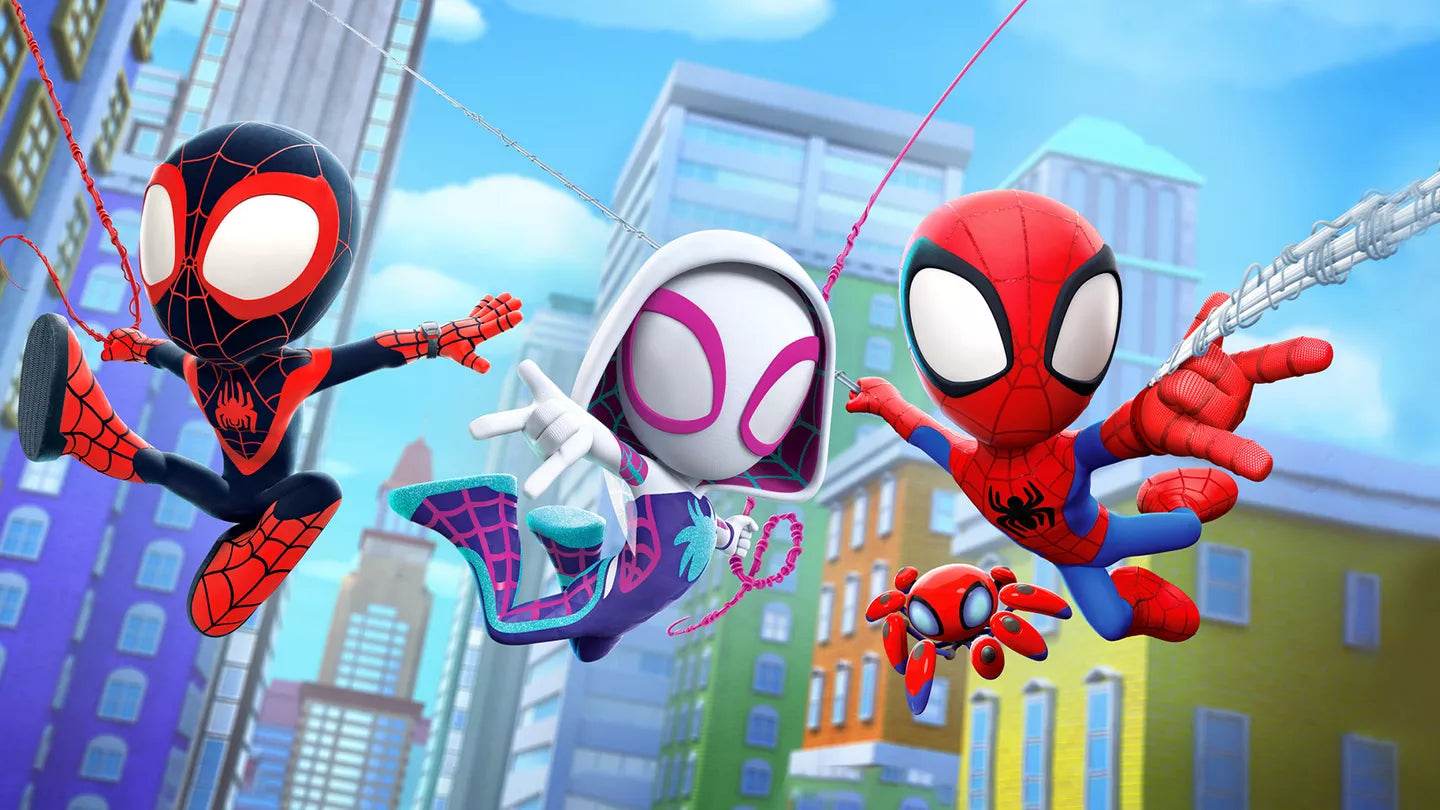
This preschool production, available on Disney+, brings together three spider-powered heroes — Spidey, Spin and Ghost-Spider — in short episodes where every mission is settled through teamwork. The tone stays bright, with no violence and no complex moral dilemmas, which explains why it works so well with the very young. Below we break down the characters and the values the show passes on.
When people talk about the great animated Spider-Man adaptations, the mind rushes straight to the cult series of the 1990s, to The Spectacular Spider-Man from 2008, or to the more recent Spider-Verse animated films. Yet in the shadow of those productions aimed at teenagers and adults, there is one series that has probably turned more young children into future Marvel fans than any other adaptation: Spidey and His Amazing Friends. Streaming on Disney+ since 2021, this series aimed at 3 to 7-year-olds pulled off the feat of adapting the Spider-Man universe for the very young without betraying its essence — exactly the gamble nobody had seriously dared to take before. The subject is covered in more depth in The villains of Spidey and His Amazing Friends: who are they?.
This series is far more than a simple children's programme. It is a strategic gateway into the Marvel universe for the new generation, built with remarkable educational intelligence and a warmth of storytelling that contrasts sharply with the growing darkness of Marvel's output for adults. This article breaks down why Spidey and His Amazing Friends works so well with young children, how Marvel managed this delicate adaptation, and why the show is probably one of the finest successes of the whole Disney+ strategy since the platform launched.
The Bold Gamble: Adapting Spider-Man For The Very Young
Adapting a superhero universe for 3 to 7-year-olds is an extremely difficult exercise that many studios have attempted without success. Child versions of adult characters usually fail because of two opposite pitfalls: either they infantilise the character so much that all substance disappears, or they keep a level of violence or narrative complexity unsuited to the target audience. Spidey and His Amazing Friends brilliantly avoids both traps by completely rethinking the narrative formula for very young viewers.
The core cast is deliberately reduced to three child characters — Peter Parker in child form, Miles Morales as Spin, and Gwen Stacy as Ghost-Spider. That reduction allows immediate identification for the children watching — each character embodies a distinct personality type (Peter the leader, Miles the cool one, Gwen the creative one) that young children can easily latch onto. The absence of adult characters at the heart of the action reinforces that identification: children watch children living adventures, with no parental interference to dilute the power of identification.
The overall tone of the series is deliberately kind, colourful, optimistic — the exact opposite of the growing darkness of the Spider-Man films for adults. No complex moral drama, no traumatic deaths, no difficult philosophical dilemmas. Each episode offers a simple situation (an object to find, a friend to help, a small problem to solve), a clear mission, and a joyful resolution through cooperation. That formula, sometimes criticised by adult fans for its simplicity, is in fact perfectly suited to the cognitive psychology of 3 to 7-year-olds, who need predictable narrative structures to build their understanding of the world.
The Three Heroes: Identities, Personalities And Identification
At the heart of the series, the three protagonists are designed to offer young viewers three possible points of identification. Peter Parker, alias Spidey, is the natural leader of the group — the one who takes the initiative, suggests the plans, reassures his friends. His child version keeps the scientific intelligence of the Peter Parker of the comics, but in a form adapted to children's problems: he invents gadgets to help his mates, he uses his logic to solve everyday puzzles. For the children watching who like being responsible, organising and planning, Peter offers a rewarding role model.
Miles Morales, alias Spin, brings the cool, creative side of the trio. More laid-back, more artistic, more geared towards play and imagination, he embodies a different approach to being a superhero. His difference from Peter matters enormously in teaching terms — it shows children that you can be a hero in several ways, that there is no single heroic personality type. That diversity of role models is one of the show's finest ideas, and it prepares children to understand later the richness of the wider Spider-Man multiverse.
Gwen Stacy, alias Ghost-Spider, completes the trio with dynamic, creative energy. Her character is deliberately livelier, more spontaneous, more focused on immediate action than on planning. This third personality gives the young girls watching a heroine who looks like them — brave, energetic, creative, without falling into traditional feminine stereotypes. Gwen's presence in the core cast is essential to break the usual male monopoly of superhero shows for children, and to give little girls direct identification with a leading character.
The Educational Values: Cooperation, Diversity, Perseverance
Beyond simple entertainment, Spidey and His Amazing Friends actively passes on educational values that are fundamental to young children's development. Cooperation is probably the central value of the whole series: no episode is resolved by the solo action of a single hero, every mission needs the combined strengths of all three protagonists. That lesson in teamwork contrasts sharply with traditional heroic individualism and prepares children to understand the importance of working together in real life.
Diversity is the second fundamental value. Miles Morales is Afro-Latino, Peter Parker is white, Gwen Stacy is blonde — that obvious visual diversity comes with a subtler cultural diversity. The characters occasionally speak a few words in other languages, mention different family traditions, show varied musical and cultural tastes. This inclusive representation is designed to normalise diversity among young children at an age when they are building their cognitive categories about the world around them.
Perseverance is the third great value passed on. In almost every episode, the heroes fail at least once before they succeed. That deliberate narrative mechanic teaches children that failure is not an ending but a stage, that you can always try again after a disappointment, that real success often takes several attempts. This lesson in resilience is probably the show's deepest educational contribution, and it is praised by many child psychologists as a model of writing for a young audience.

Toddler Companion — Spider-Man Cuddly Toy

Spider-Man Soft Toy
24,90 €
The Spider-Man soft toy that becomes a bedroom companion for young Spidey fans — soft, reassuring, and it carries the world of the series right into the bedroom.
Adopt the Soft Toy →The Visual Style: Colours, Shapes And Emotional Safety
The visual side of Spidey and His Amazing Friends deserves an analysis of its own, so carefully is it built for the cognitive comfort of young children. The shapes are deliberately rounded, soft, never threatening. The dominant colours are saturated but cheerful — bright red, luminous blue, warm yellow. The lighting is always kind, with none of the dramatic shadows that might worry young viewers. This aesthetic approach contrasts radically with the Spider-Man adaptations for adults, which favour night-time urban moods, dramatic play of shadow, and more complex visual compositions.

This visual difference is not an impoverishment — it is an intelligent adaptation to the target audience. Children aged 3 to 7 do not have the emotional maturity to handle overly dark visual moods, and their developing brains prefer clear, readable compositions. Spidey and His Amazing Friends respects that psychology by offering a reassuring visual environment that lets children concentrate on the stories and the characters rather than being distracted by excessive visual stimulation.
The show's villains follow the same logic. Rather than the terrifying antagonists of the traditional Spider-Man comics (a bloodthirsty Green Goblin, a monstrous Venom, a psychopathic Carnage), the Spidey villains are softened versions, almost likeable in their clumsiness. Doctor Octopus becomes a mad scientist rather than a dangerous murderer. Green Goblin becomes an annoying prankster rather than a terrorist. That toning down preserves the narrative stakes (there is always someone to stop) without traumatising young viewers with wildly disproportionate existential threats.
Global Success: Why The Series Works So Well
Since its launch in 2021, Spidey and His Amazing Friends has become one of the most watched series on Disney+ in the children's category. Its success far exceeds initial expectations and speaks to a real need among modern families — Marvel programming suited to very young children. Parents who are Marvel fans themselves had long been looking for a way to share their passion with their youngest children, and the series offers exactly that family gateway.
The effect on merchandise is massive. Children watch the series, then ask to wear their heroes' costumes, to sleep with the soft toys, to eat off Spidey plates. That emotional continuity between the screen and everyday life is one of the main reasons for the franchise's commercial success. Spider-Man pyjamas have seen a particularly spectacular boom thanks to the series — every young fan wants to wear the web-slinger's costume to sleep like their favourite hero.
For parents, the series offers an often underestimated educational advantage: it is a gentle transition towards the other Marvel productions. Children who grow up with Spidey and His Amazing Friends at 4 or 5 can then discover Spider-Man: Homecoming at 8 or 9, then Into the Spider-Verse at 10 to 12, and finally the comics and the films for teenagers. That organic progression turns a simple children's programme into the first step of a fan journey that can last a lifetime. It is probably the most brilliant generational strategy Marvel has ever developed.
How To Keep The Magic Going At Home
For parents who want to extend the Spidey and His Amazing Friends experience beyond the screen, several ways to enrich it exist. The first, and the most obvious, is clothing — Spider-Man pyjamas, a T-shirt featuring the three heroes, a full costume for imaginative play. These clothes turn everyday life into a permanent adventure and let children keep playing their heroes long after the episode ends.
The second approach is bedroom decoration. A complete Spider-Man bedroom with a poster, a duvet cover, a lamp and a throw turns the child's own space into a genuine web-slinger's hideout. That environmental immersion strengthens their emotional attachment to the Spider-Man universe and creates lasting memories the child will keep for life. Parents who grew up with Marvel bedrooms themselves in the 1990s will instantly recognise the nostalgic power of this kind of decoration.
The third approach is structured play. Organising Spider-Man treasure hunts around the house, drawing sessions inspired by the series, reading moments where you tell simplified Spider-Man stories — all these activities enrich the experience of the show far beyond passive viewing. For a young fan's birthday, putting on a brilliant Spider-Man birthday party with decorations, cake and themed activities is probably the most memorable moment of their entire childhood.
Animated-Series Pyjamas — A Tribute

Spider-Man Animated Series Pyjama Set
34,90 €

The pyjamas that carry the animated Spider-Man world right into the bedroom — for young fans who want to sleep like real little web-slingers.
Discover the Pyjamas →The Future Of Marvel's Franchise For Children
Beyond its current success, Spidey and His Amazing Friends opens the way to a whole new category of Marvel productions aimed at young children. The formula works so well that Disney+ is actively developing other similar series based on other franchises. That strategy reflects a fundamental commercial reality — children who develop an affinity with a brand between the ages of 3 and 7 usually become loyal customers for life. Investing in children's content means building the Marvel market of the 2030s and 2040s.
For fans following the evolution of Spider-Man adaptations as a whole, Spidey and His Amazing Friends is a particularly interesting case study. The series proves that a complex universe can be adapted intelligently for different age groups without distorting it. That narrative flexibility is probably what sets Spider-Man apart from most other superheroes — the character can exist at the same time in productions for 3-year-olds (Spidey), 8-year-olds (the Tom Holland films), 14-year-olds (the PS5 games), 25-year-olds (complex comics) and 40-year-olds (in-depth critical analysis). That versatility is probably the secret of the web-slinger's exceptional longevity since 1962.
To go further into the world of animated Spider-Man adaptations, dive into our analyses of every animated Spider-Man since 1967 and of a possible return for Spectacular Spider-Man, or explore the Spider-Man toys collection which includes many items directly inspired by Spidey and His Amazing Friends. In just a few years this series has transformed the way an entire generation of young children discovers Spider-Man — and that is probably one of the finest legacies a Marvel production could leave to the global media landscape.

