
14-Day Money-Back Guarantee
0
The short answer
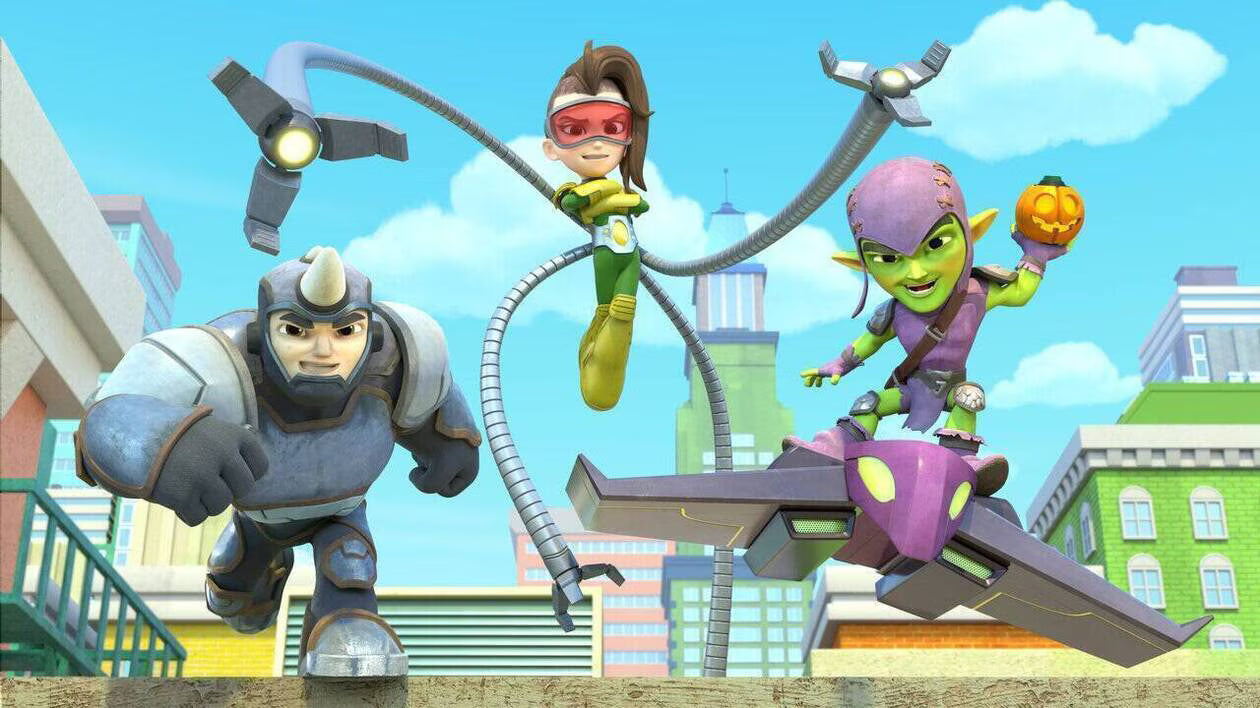
Six antagonists turn up again and again: the Green Goblin, Doc Ock, Rhino, Electro, Black Cat and Sandman. Two things take parents by surprise: the Doc Ock of the series is a woman, and none of these characters is truly a villain in the usual sense. They get up to mischief, they are stopped, and the episode often ends with everyone making up.
Your child keeps talking about ‘Doc Ock’ and you are trying to work out who that is. Or you are wondering whether the villains in this series might be too frightening for a four-year-old.
Here is who they are, how the series handles them, and why they look nothing like the villains you know from the films.
Villains who are not really villains
This is the thing to grasp before going through the characters one by one. The series does not build villains, it builds troublemakers.
None of them sets out to do any harm. They want an object, they are testing an invention, they are bored. The conflict comes from a whim or a blunder, never from any intention to hurt anyone, and nobody is ever injured.
That choice is deliberate: the series is aimed at 2 to 6-year-olds. At that age, an antagonist who wants to destroy something is distressing; an antagonist who does something very silly makes sense. It is the same teaching logic we set out in our introduction to the series and its values.
The resolution: you repair, you do not punish
Episodes almost always end the same way: the team puts a stop to the mischief, then helps repair the damage. The villain leaves free, sometimes apologising, sometimes promising to do it all again as a joke.
This absence of punishment sometimes throws parents. It is perfectly consistent with the target age, though: at four, a child takes in ‘we mend what we break’ far better than ‘villains go to prison’.

Spider-Man Stickers - Spidey and His Amazing Friends
Stickers in the series’ colours, perfect for a notebook or a bedroom. Find the whole universe in our Spider-Man gift ideas.
View the product — €26.90Doc Ock: the surprise that throws parents
She is the antagonist who appears most in the series, and the one that causes the most confusion at home.
She is a woman
The Doc Ock in Spidey and His Amazing Friends is a female character. If you are looking for Otto Octavius, the four-armed scientist from the films, you will not find him here.
The series keeps the concept — a scientist fitted with mechanical arms — but not the character. It is a reinvention rather than an adaptation, and that is why searching for ‘Doc Ock’ brings up images that do not match what your child is watching.
For the original version of the character, the one from the comics and the films, our profile of Doctor Octopus traces his full story.
What she does in the series
She turns up regularly with a new invention meant to serve some mischievous plan, which the team foils every time. Her mechanical arms are mostly used to grab things out of reach and to set up chases.
The tone stays light. She is annoyed when it goes wrong, never threatening, and her stubborn-scientist streak makes her funny rather than worrying.
The other recurring antagonists
The Green Goblin
The one an adult recognises most easily, and the one softened most for the occasion. Gone are the manic laugh and the pumpkin bombs: he becomes a flying prankster on his glider, whose bad turns mostly amount to stealing things and causing chaos.
It is probably the most radical transformation in the series. If your child later comes across the character in a film, the difference will be striking — we set out his real face in our article on the Green Goblin.
Rhino
Big, strong, heavy and not very bright. He is the physical antagonist par excellence: he charges, he breaks things by accident, he does not always understand what he is doing.
Young children adore him, precisely because he is more clumsy than wicked. He is also the character who makes up with the team most often.
Electro
He controls electricity, which gives the series a chance to cut the power, make the lights flicker and create visually spectacular situations without any violence at all.
His original version, in the comics and on the big screen, is far more dangerous. Our profile of Electro traces the character’s path as he exists for adult readers.
Black Cat
More thief than enemy. She covets shiny things, slips through, and gets caught. The series plays on her feline side — agility, curiosity, mischief — rather than on her ambiguous relationship with Spider-Man in the original publications.
She is the character closest to an antihero: she sometimes helps the team when it suits her.
Sandman
He turns into sand, scatters, and re-forms. The power is spectacular on screen and completely harmless: children love watching him fall apart and rebuild himself.
Like the others, he is driven by a simple urge rather than by any wish to do harm.

Spider-Man T-Shirt for Children - Spidey and His Amazing Friends
A t-shirt in the team’s colours, cut for the youngest fans. Worth a look alongside our children’s t-shirts and our children’s pyjamas.
View the product — €22.90What the series changes compared with the adult versions
Comparing the two versions helps you understand what the series is doing — and avoids nasty surprises as your child grows up.
The motive disappears, the power stays
In the original publications, every villain has a painful history: an accident, a betrayal, an ambition that turns sour. The series removes that layer entirely.
What is left is the visual ability: mechanical arms, electricity, sand, a glider. A four-year-old remembers a silhouette and a power, not a motivation. The choice is therefore perfectly suited to its audience.
Danger becomes a problem to solve
In a film, the villain puts lives at risk. In the series, he creates an awkward situation: a stolen object, a machine running wild, a blocked bridge. The episode becomes a little puzzle rather than a confrontation.
It is that shift that lets the child take part mentally — looking for the solution alongside the heroes instead of sitting through the tension.
Nobody really loses
One last difference, and the most important one for a parent: the series does not produce losers. The villain is neither humiliated, nor destroyed, nor locked away. He is stopped, then often brought into the ending.
That absence of humiliation is a strong teaching choice. It shows that you can thwart someone without rejecting them, which is exactly the kind of situation a child meets in a group setting.
Facing them: the team
The antagonists only work by contrast with the three heroes, and the series builds that contrast very carefully.
Spidey, that is Peter Parker: the organiser, the one who suggests a plan. Ghost-Spider, that is Gwen Stacy: the quick one, the one who acts first. Spin, that is Miles Morales: the inventive one, the one who finds the solution nobody else had seen.
Each episode shares out the roles, which lets every child identify with a different profile. We set out that mechanism in our article on the series and its three heroes.
And if your child takes a particular liking to Ghost-Spider, our guide to the Ghost-Spider costume for girls covers the sizes and the models.
The allies who lend a hand
The team is not alone against the troublemakers, and that is one of the series’ good ideas: it gradually widens the universe without making the episodes more complicated.
The guest heroes
Other Marvel figures show up as reinforcements across the seasons, in one-off roles. They make it possible to vary the powers on show without adding permanent characters to remember.
The principle is always the same: the guest brings an ability the team does not have, solves their part of the problem, then steps aside. The child discovers a new character without losing their bearings.
Aunt May, the anchor
Present in the background of many episodes, she stands for the world of caring adults. She does not fight, she reassures — and she gives the series its domestic anchor.
It is a quiet but structuring role: it is a reminder that the heroes have a home to go back to, which matters a great deal to a four-year-old viewer.
TRACE-E, the team’s robot
A robot companion, he serves as an assistant and as comic relief. His narrative job is to explain: he asks the questions the child is asking, and the team answers him, which clears up the plot without breaking the rhythm.
The questions parents ask
From what age?
The series is designed for 2 to 6-year-olds, and it keeps that promise. No blows landed, no character in real danger, no drawn-out tension. Episodes run about ten minutes, a format suited to the attention span of that age.
In practice it works from three years old. Before that, a child follows the colours and the songs more than the story, which is no bad thing.
Are the villains frightening?
Very rarely. The only moments that might startle a sensitive child are the sudden entrances and the loud noises — a gadget going off, a light going out. Nothing that amounts to a threat.
The Green Goblin is still the most striking visually because of his mask, but his prankster behaviour defuses the effect very quickly.
Will my child be disappointed by the films later on?
The question is a fair one, and the answer is rather reassuring. Children naturally tell the difference between versions of the same character, just as they do with fairy tales.
What you should not do, though, is put the films on thinking ‘it is the same Spider-Man’. The feature films are aimed at a much older audience, and the shift in tone is real.
How many villains do you need to know to follow it?
None at all. Every episode makes sense on its own, and the antagonists are introduced before they act. There is no overarching plot and no viewing order to respect, which makes it a particularly easy-going series for parents.
That is also why a child can watch it for two years without ever tiring of it: they are not following a story, they are meeting characters again.
Where can you watch it?
The series has been shown on Disney Junior since 2021 in France, where it was also picked up by Gulli. It is available to stream on Disney’s platform.

Spider-Man Nursery Backpack Spidey and His Amazing Friends
The nursery size in the team’s colours, scaled for small shoulders. Pair it with our Spider-Man backpacks and our pencil cases.
View the product — €39.90How to talk about it with your child
The antagonists of the series are an excellent way in to ideas that very young children are working on in a group setting. You just have to seize the moment.
Name the misbehaviour, not the person
The series hands you a ready-made vocabulary. Instead of ‘he is nasty’, the child learns ‘he did something silly’ — and the distinction is fundamental at that age, because it separates the act from the identity.
It transfers straight to home or to school: a classmate who pushes is not a villain, he behaved badly. Borrowing the vocabulary of the series to talk about a real argument works surprisingly well, because the child already has the frame in mind.
Asking the right question after the episode
An open question beats a summary. ‘Why do you think he did that?’ leads the child to look for an intention, which is exactly the exercise the series sets up by giving each troublemaker a simple, understandable motivation.
Avoid ‘who is the goodie and who is the baddie’, though. The series works precisely at blurring that line, and the question closes it again.
If a character frightens them
It happens, especially with the Green Goblin’s mask. The useful reflex is to show the character out of action — on a still image, in a book, on a sticker — so the child can look at him without the movement and the sound that create the surprise.
A character you can look at calmly very quickly stops being worrying. That is also why merchandise has a real use beyond the pleasure of it: it makes the universe something you can handle.
Extending the series at home
It is often the natural next step: the child watches, grows attached, and wants to find the characters somewhere other than in front of a screen.
The Spidey licence covers everyday kit of every kind, with one useful thing in common: the artwork is round, colourful and very legible, so it is recognised instantly by a child who cannot read yet. That is exactly what you want for a nursery school bag or a water bottle to pick out among twenty others.
To put together a coherent set, our guide to dressing your child and our gift selection by age give combinations that work, and our toy guide by age helps you aim right depending on how mature your child is.
The right order for discovering the universe
Here is a progression that works well, if your child takes to it and asks for more.
First the series, which installs the silhouettes and the names. Then everyday objects carrying their image, which extend the attachment away from the screen. Then, around six or seven, the animated series aimed at older children, which are far more story-driven.
The live-action films come last, and much later. The shift in tone is real: a child used to a prankster Green Goblin will discover a character with nothing funny about him at all. Nothing insurmountable, but better not to go straight from one to the other.
What to remember
Six recurring antagonists, all softened, none of them genuinely threatening. The Green Goblin has become a prankster, Rhino a clumsy soul, Black Cat a thief of shiny things. And the Doc Ock of the series is a woman, which explains the confusion when you look the character up online.
It is a way in, not a watered-down version made out of laziness. Your child learns the names, the silhouettes and the powers, and will meet these characters again later in their adult form — our profiles of the web-slinger’s most powerful enemies are there for that day.

