

14-Day Money-Back Guarantee
0
The short answer
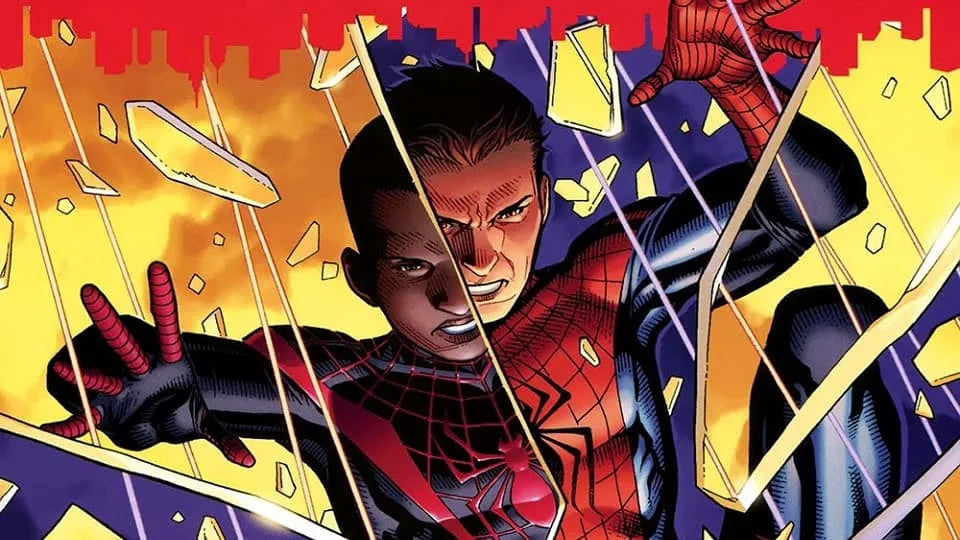
Spider-Men is a five-issue miniseries published in 2012, written by Brian Michael Bendis and drawn by Sara Pichelli. Mysterio opens a passage between two universes: the Peter Parker of the main continuity crosses into the Ultimate universe and meets Miles Morales there. It is the first time the two continuities intersect, thirteen years after the Ultimate line was created.
Two editorial lines kept watertight for more than a decade, then a bridge opened for the length of an anniversary: that was the gamble Marvel took in 2012. The no-contact rule protected the newer line from the complexity the other had accumulated, and breaking it meant having something to say. That something comes down to an image readers still quote: an adult watching a teenager wear his costume, in a city where he himself no longer exists.
Spider-Men: the editorial facts
Spider-Men is a five-issue miniseries published by Marvel in 2012, written by Brian Michael Bendis and drawn by Sara Pichelli — the same duo who had created Miles Morales the year before. The choice was no accident: handing the meeting to the creators of the new character rather than to an outside team guaranteed that he would be handled consistently.
The editorial context is explicit. The crossover comes thirteen years into the life of the Ultimate line, and it is presented as a celebration of Spider-Man's fiftieth anniversary. In other words, it is not a consequence of plot: it is an anniversary decision, owned as such, which explains the broadly warm tone of a story that could have been grim.
The narrative trigger is a first-generation villain. Mysterio builds a device that opens a passage between the two realities. The Peter Parker of the main continuity falls through it and finds himself in a world that looks like his own without being it. To place this miniseries among the other major storylines, the page listing the narrative arcs sets out where it sits chronologically.
What Peter finds when he arrives
The strength of the story rests on a detail of timing: Peter arrives in a world where the local Peter Parker has just died. He does not discover an exotic universe full of dinosaurs or galactic empires — he discovers his own city, his own loved ones, and his own absence. It is a variation on the ghost motif, applied to a living character.
His reaction to Miles Morales is the heart of the miniseries. He is neither hostile nor condescending: he is thrown, then attentive. The scene readers bring up most often is the one where he asks the teenager why he does this — and where the answer, responsibility, is exactly his own.
The encounters with the people around Miles are the other, more painful side. Running into versions of people who, back home, lead a different life produces short, effective scenes. Miles's family background, explored in the profile of Jefferson Davis and Rio Morales, and his close circle, covered in the one on Ganke Lee, give this part a depth a straight fight could never have had. The Spider-Man posters of that period start, tellingly, to show the two costumes side by side.
Collector figures

Spider-Man Peter B. Parker Figure
An older Peter Parker, a little worn down, facing a successor: that is exactly the silhouette this story made popular. The piece captures that grown-up version of the character in a display format that stands apart from the classic heroic poses.
89.90 €
Discover →The 2012 cliffhanger and its 2017 resolution
The miniseries ends on a question left unanswered: back home, Peter starts looking for a Miles Morales in his own reality. The final issue stops there. That kind of open ending is common, but this one stuck because it touched on the very status of the new character.
The answer took five years to arrive. Spider-Men II, published in 2017 by the same team, picks up precisely that thread and sets about finding Miles's counterpart in the main continuity. It is a sequel in the strict sense: it exists only to close what had been left open, which is rare in a medium where open endings are usually forgotten.
In between, the landscape had changed. The new Spider-Man had left his home universe to join the main continuity, and multiverse stories had become a genre in their own right. The rules governing these crossovers, as the comics gradually settled them, are set out in the invisible rules of the Spider-Verse and on the page devoted to the Spider-Man multiverse.
Two New Yorks, two Spider-Men: the work on the differences
A universe crossover succeeds or fails on the details, and Bendis had eleven years of history with that continuity behind him. The differences are not decorative: characters dead on one side are alive on the other, institutions do not share the same past, and the city's relationship with its heroes is not the same. Peter is not a tourist, then; he is permanently off his bearings.
Sara Pichelli's artwork does part of the job. The two costumes are treated differently — the historic red and blue against the successor's black and red — and the two silhouettes share neither the same build nor the same way of moving. It is a visual choice that makes the comparison legible without a single line of dialogue having to explain it, and it is what fixed the character's image for the decade that followed.
The balance of power is also written against the grain. The adult is not presented as superior: he is more experienced but less well equipped for that world, and the younger one's extra abilities — camouflage, bioelectric discharge — are entirely unknown to him. That even-handedness is what kept the story from sounding like a condescending blessing. The fancy dress and costumes from the universe now cover both outfits with the same eye for detail.
Why this meeting mattered more than the ones that followed
There have been dozens of arachnid crossovers since, some bringing together several hundred versions of the character. The 2012 one keeps a place of its own for a simple reason: it rests on no effect of sheer numbers. Two characters, five issues, one city. Everything at stake in it is legible without footnotes.
The major events that followed work differently. Morlun and his family threaten every version at once; End of the Spider-Verse pushes the logic to its conclusion. These stories have their qualities, but they ask the reader to follow dozens of protagonists — that is a different kind of pleasure.
Spider-Men also served as a full-scale test. It showed that readers accepted the new character alongside the original without seeing him as a replacement, which made his later move into the main continuity possible. Seen from today, where he has his own animated trilogy and his own range across the Spider-Man figures and the Spider-Man T-shirts, the question looks absurd. In 2012, it was not.
Posters and prints

Spider-Man Spiderverse Miles Morales and Gwen Poster
Prints bringing together several bearers of the costume were born out of this kind of meeting. This one stages two of the most popular versions in a bold graphic treatment that works just as well on its own as in a wall arrangement.
22.90 €
Discover →The legacy: from comic to screen
The motif launched here — a grown-up Peter Parker facing a young successor — has become one of the franchise's most profitable devices. Animated cinema took it up and amplified it in Into the Spider-Verse, then in Across the Spider-Verse, with a critical and commercial success that far outstripped that of the original comics.
The live-action films have mined the same seam, bringing together several actors who have played the role rather than several characters, as the article on the multiverse arriving in the MCU explains. The principle is still the one from 2012: the interest does not come from the crossover itself but from what the characters say to each other once they are together.
That lineage explains why the miniseries is still worth reading today. It contains, in minimal form, everything the later productions developed: the handing down, the successor's self-doubt, the elder's gaze. The figures who cross paths through these stories are catalogued on the page devoted to the characters of the Spider-Man universe, from the best known to Peni Parker or Miguel O'Hara. The Spider-Man phone cases and the Spider-Man stickers featuring several versions are direct descendants of that imagery.
What the miniseries changed for Marvel
The first effect is strategic: it proved that the two continuities could meet without one devouring the other. Until then, the argument against a crossover was that it would destroy the accessibility that made the newer line worthwhile in the first place. Five issues were enough to show that the fear was overblown, provided the story was kept small.
The second effect concerns the character himself. By putting him up against the original without diminishing him, the miniseries settled in advance the question that could have followed him for years. When he was later moved into the main continuity, the operation needed no justification: readers had already accepted him in the role.
The third is more diffuse but probably the most important. Spider-Men established the idea that a single costume could have several legitimate bearers at the same time, with no hierarchy. It is that idea everything produced since has drawn on, from comics series to video games, and it runs all the way down to the product ranges — the Spider-Man toys and the Spider-Man backpacks now offer several versions of the character side by side, which would have been unthinkable before.
Where to start, and what to know first
Five issues, a single miniseries: it is one of the most accessible stories in the franchise. The minimum prerequisite fits in one sentence — knowing that Miles Morales took over from a Peter Parker who died in another continuity. Without that information, half the scenes lose their emotional charge.
The recommended order is to read the new character's beginnings first, then Spider-Men, then Spider-Men II if you want the open thread resolved. You can then move on to the big multiverse stories, but there is no obligation: the miniseries stands on its own, which has become rare. The detailed reading paths are gathered on the guides and advice page.
One last marker to avoid a common mix-up. Spider-Men is not the Spider-Verse event, published later and far broader in scope, nor the animated film series with a similar name. Three different things, three different scales. Replacement stories within a single reality, such as Superior Spider-Man or the path taken by Ben Reilly, belong to yet another category.
Collector figures

Spider-Man Figure - Miles Morales
The character discovered in this story has become, in a decade, as recognisable as the original. This piece shows him in his black and red costume, in a size and finish suited to a display cabinet as much as to a desk shelf.
49.90 €
Discover →That leaves the question of tone, which explains a good deal of the story's longevity. Bendis could have written a tragedy: a man confronted with his own death, a child crushed by a legacy. He wrote something else — a story in which the two characters do each other good. The elder leaves reassured about what he is leaving behind; the younger leaves legitimised by the only opinion that mattered to him. It is a rare writing choice in a medium that generally prefers drama, and it is why you reread this miniseries for pleasure rather than out of duty. Anyone wanting to place each character in the wider picture will find the full map on the page devoted to the films and their versions of the character.
Frequently asked questions
How many issues does Spider-Men run to?
Five, published in 2012, written by Brian Michael Bendis and drawn by Sara Pichelli. A sequel, also five issues, Spider-Men II, came out in 2017 with the same creative team. The whole thing therefore reads in ten issues, or five if you stick to the original meeting.
Who causes the two universes to meet?
Mysterio, one of the character's oldest adversaries, whose device opens a passage between the two realities. It is a choice consistent with his speciality: this villain has always worked on perception and illusion, and moving from one world to another is the logical extension of that.
Do you need to know the Ultimate universe to read this miniseries?
You only need to know that it is a separate continuity, in which the local Peter Parker died and was replaced by a teenager. Everything else is explained as the pages go by. It is in fact one of the best entry points into that continuity for a reader who knows nothing about it.
Do the two Spider-Men fight each other?
Briefly, and out of a misunderstanding, as the convention of the genre demands: two heroes who cross paths almost always start by fighting before realising they are on the same side. The exchange is short and inconsequential. The bulk of the miniseries plays out afterwards, in conversations and shared scenes, not in combat.
What happens to Miles Morales after this meeting?
He carries on with his series in his home continuity, then joins the main continuity a few years later, where he has had his own series and his own patch of Brooklyn ever since. The two characters now coexist without either replacing the other, each with his own circle and his own adversaries.
Should you read Spider-Men II?
Only if the open ending of the first miniseries left you wanting more. The 2017 sequel exists to answer that specific question and brings little else. The 2012 meeting reads very well as a complete story, and plenty of readers stop there without missing anything essential. The items that go with these rereads, from Spider-Man mugs to Spider-Man blankets, are sorted by theme in the shop.
Does Spider-Men have anything to do with the animated films?
No direct adaptation link: the films tell a different story, with different supporting characters and a different plot. The connection is thematic — the meeting between a grown-up Peter Parker and a young successor, and the passing on that follows. It is that motif, launched in the comics in 2012, that cinema then developed in its own way.

