

14-Day Money-Back Guarantee
0
The short answer
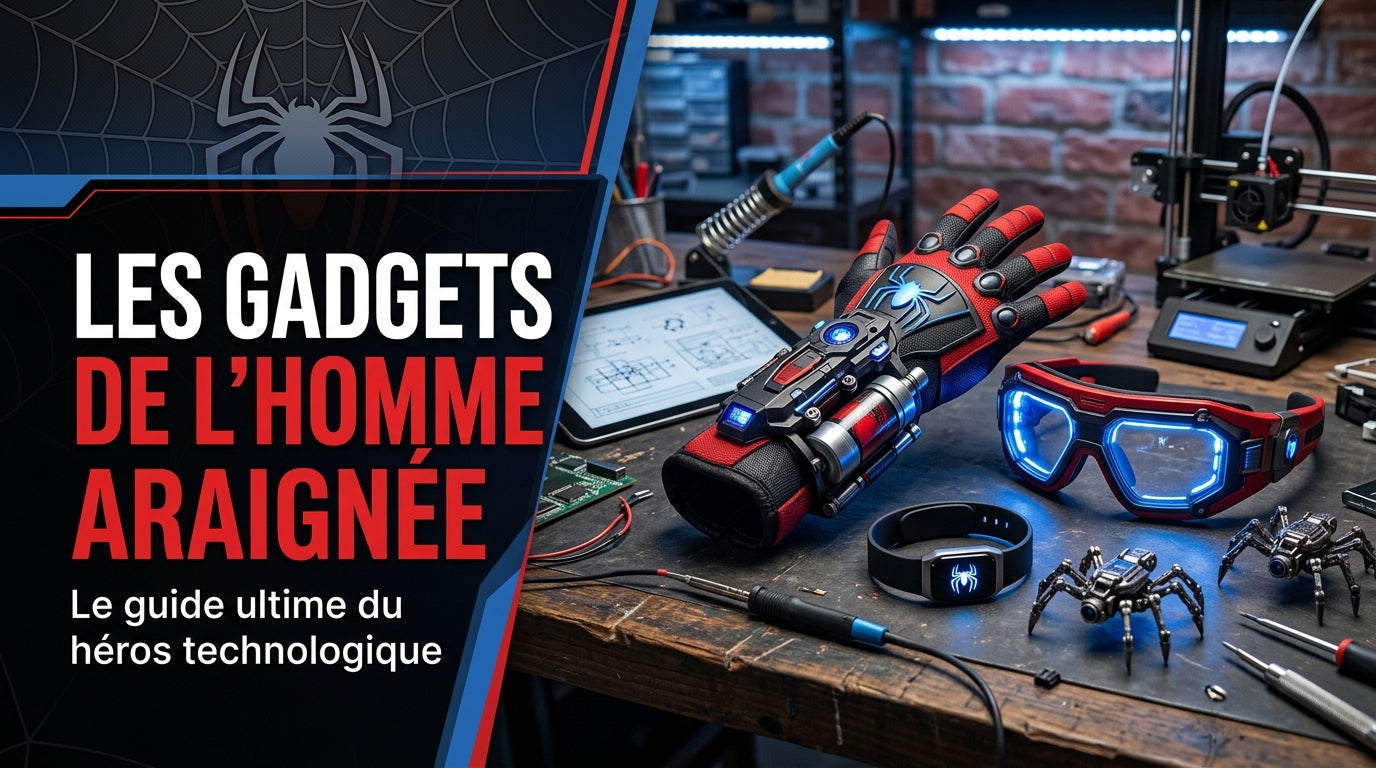
Beyond the web-shooters, Spider-Man has three accessories that adaptations have almost all dropped: the spider-tracer, a tiny spider-shaped bug; the spider-signal, a belt projector that casts his emblem; and the belt itself, which carries the web-fluid cartridges under the tunic. All of them date back to the earliest years.
Ask anyone about the web-slinger's kit: they will mention the web-shooters, then stop. Yet here is a hero who has been tinkering since 1962, and whose first decades overflow with inventions built out of next to nothing in a Queens bedroom. Almost all of them have left the screen, a few have even left the pages — and those departures say a great deal about how the myth has evolved.
The spider-tracer: the bug that never had a screen
It is the most iconic of the forgotten gadgets. A small spider-shaped object, which the character fires or sticks onto a target — a car, a piece of clothing, a fleeing opponent — and which then lets him find it again. The idea dates back to the earliest years of the series.
What makes it unique is the way it originally worked: the tracer was attuned to the character's own spider-sense. No screen, no receiver, no map: he feels the direction. It is a remarkable idea, because it turns a passive power — a warning signal — into an active investigative tool. The mechanics of the spider-sense are detailed in the article on his powers.
Later versions added electronic receivers, especially when the writers wanted other characters to be able to use them. It is a logical development and an impoverishment: as soon as a receiver exists, the object becomes an ordinary tracker. The most detailed Spider-Man figures sometimes reproduce these miniature accessories, often without the buyer knowing what they are.
The spider-signal: a projector on the belt
The second forgotten item is a light projector mounted on the belt, which casts the spider emblem onto a wall or onto an opponent. Its function is twofold: to light up a dark area, and above all to announce a presence — the projected silhouette arrives before the character does.
The inspiration is obvious and the writers never hid it: it is the equivalent of a signal projector, a device already well tested at the rival publisher. The difference is that this one is worn, not installed on a roof — which makes it a tool of individual intimidation rather than an institutional summons.
The accessory gradually disappeared, for a simple reason: it contradicts the character's identity. Spider-Man turns up by surprise, jokes, defuses. Announcing his arrival with a projector belongs to a theatrical register that does not suit him. The costume and its variants, on the other hand, have survived rather better — as shown by the round-up of the most legendary outfits and the range of fancy dress and costumes.
DETAILED FIGURES

Small Spider-Man Figure Spinning a Web
Small pieces are the ones that render the accessories best: belt, hand position, the tension of the web. This format stages the gesture rather than the musculature, and sits anywhere without demanding a display case.
34.90 €
Discover →The belt: the most useful object and the least shown
It is hidden under the tunic of the costume, which explains why it gets forgotten. Yet it carries the web-fluid cartridges, without which nothing works, along with the projector mentioned above. It is the true logistics centre of the kit.
Its discretion is a deliberate design choice. A hero covered in visible pouches would not have the same silhouette: the clean lines of the costume are part of his graphic identity, set from the very first pages by Steve Ditko. Everything functional therefore had to disappear under the fabric.
It is also what explains running dry as a narrative device: the reserves are limited by the space available on a belt, not by an arbitrary choice. The logistics of the fluid are covered in the article devoted to the web-shooter, and Spider-Man accessories such as keyrings are the direct descendants of this logic of the small functional object.
The camera: the most improbable accessory
This one is not a combat gadget, and that is exactly what makes it interesting. For years, the character carried a camera that he fixed to a wall before a fight, set to trigger on its own, so that he could then sell the shots to the newspaper that vilifies him.
The device is absurd if you take it seriously — the framing, the focus, the sheer luck required — and that is precisely what makes it delicious. It condenses the character's central irony into a single object: he funds his life by selling pictures of himself to the man who loathes him, a situation retraced in the profile of J. Jonah Jameson.
This accessory disappeared along with the job. When the character stopped being a freelance photographer to become a researcher and then a company boss, the camera no longer had any reason to exist — a shift retraced in the article on his successive jobs and in the profile of the Daily Bugle. The Spider-Man posters styled like a newspaper front page still recall that period.
VINTAGE OBJECTS

Vintage Comics Spider-Man Alarm Clock
The look of the early years is the one in which these gadgets still existed: visible halftone dots, bold colours, unapologetically functional objects. This alarm clock takes up that graphic register and earns its keep every morning.
29.90 €
Discover →The common thread: everything is hand-made
One point links these four objects and it is almost never pointed out: none of them was supplied by anyone. The tracer, the projector, the belt, the camera — everything comes out of the same bedroom, the same non-existent budget, the same teenager who repairs rather than buys.
This trait is structural and it sets the character apart from the vast majority of heroes of his era. The kitted-out billionaire, the agent equipped by an organisation, the mutant who needs nothing: three models that all exist at the same publisher. The skint tinkerer, on the other hand, barely existed before 1962, and that is what made him a hit with teenage readers.
It also explains why the disappearance of the gadgets went down badly with long-standing readers. It is not the loss of accessories that grates, it is the loss of what those accessories said. A hero equipped by a third party is no longer the same character, whatever his performance. The same tension runs through the history of the costume, retraced in the outfit round-up, and right into the Spider-Man toys that favour the high-tech versions over the home-made ones.
Why adaptations dropped them
Three reasons stack up. The first is screen time: every gadget requires a scene of explanation, and a two-hour film does not have that narrative budget. Whatever is not essential goes, and only the web-shooters are essential.
The second is technological. A spider-shaped bug was science fiction in 1963; in 2026, any phone does better. Some gadgets have been caught up with and then overtaken by reality, and showing them on screen would date the character instantly.
The third is aesthetic. Recent adaptations have concentrated the technology in the suit itself — sensors, assistance, drones — rather than in separate objects. The most fully realised example is detailed in the article on the Iron Spider armour, and this centralisation makes belt accessories redundant.
The gadgets he tried and then dropped
Beyond the main four, the series has seen any number of one-off inventions: anti-symbiote devices, kit tailored to one specific opponent, web-fluid variants designed for a single occasion. Almost none survived the issue that introduced it.
That abandonment rate is not a writing flaw, it is a feature of the character. He improvises under pressure, solves a problem with whatever is to hand, then moves on for lack of the time and money to scale it up. A hero who built on every invention would quickly become invincible, which would kill the series.
The rare exceptions correspond to periods when he had real resources — a laboratory, funding, a team. That is the case during his researcher and then executive phase, retraced in the article on his jobs, and it is also the period when his kit most resembles that of the technological heroes. The difference in resources leaps out on the page listing the characters of the universe.
What their disappearance cost
A whole register: that of investigation. The spider-tracer made possible plots of tailing, tracking and patience — a character who follows a lead for three issues rather than throwing a punch. Without it, the resolution almost always comes through direct confrontation.
The tinkering, too. These objects said that the character made his tools out of whatever he could find, with no budget and no backing. A suit supplied by a third party, however spectacular, tells the opposite story: that of a hero who is equipped rather than a hero who is resourceful.
That is the underlying debate in recent adaptations, and it goes well beyond the question of gadgets. The stories that return to tinkering are in fact the ones long-standing readers prefer, as shown by the selection gathered on the story arcs page and on the guides and advice page.
The gadgets that did survive
Two, essentially. The web-shooters, obviously, inseparable from the character. And the costume itself, treated as a piece of equipment in its own right — hand-sewn in the earliest versions, which makes it the first home-made object of the series.
A third category has emerged recently: specialised-function suit variants, designed for a specific opponent or environment. They replace separate gadgets to good effect, by concentrating the function in the garment. The full round-up appears in the article on the most legendary outfits.
For the collector, the consequence is clear: merchandise reproduces almost exclusively the costumes and the poses, very rarely the accessories. You will find a thousand versions of the suit on Spider-Man T-shirts and phone cases, and almost no depiction of a spider-tracer at all. The merchandise page confirms it category by category.
SMALL OBJECTS

Small Spider-Man Figure Keyring
The format closest to the spirit of the original gadgets: small, functional, carried everywhere. It slips onto a keyring or a bag and keeps the character present without taking up any space.
16.90 €
Discover →Will we ever see them again?
In the comics, they reappear intermittently, usually when a writer wants to reconnect with the tone of the early years. These are nods rather than lasting comebacks, but they show that the material is still available.
In adaptations, it is less likely. A production that reintroduces a home-made bug has to explain why the character does not simply use a phone, and that explanation costs more than it earns. The spider-signal suffers from the same problem, made worse by the inevitable comparison with another famous projector.
The one that could come back most easily is the camera, because it is tied to a job rather than to a technology. A story that brought the character back to journalism would bring it back automatically — and for many readers that would be a far better sign of a return to the roots than a new suit. The Spider-Man watches and alarm clocks are in fact the only items in the shop that carry on this idea of a functional rather than decorative accessory.
Finding them in the pages
The best hunting ground remains the early years of the series, where these objects appear naturally, with no scene introducing them: they are there because they are part of the kit, full stop. That absence of ceremony is what makes them believable, and it is also what makes them easy to miss on a quick read.
The stories from the journalism period offer the best concentration: the camera is constantly present, the belt is shown every time he reloads, and the tracer drives whole plots. The context of that period is described in the profile of the Daily Bugle.
For readers just starting out, one piece of advice: do not look for these objects in recent stories, where they are either absent or mentioned as nostalgic references. The original material is in the collected editions of the first two decades, whose look carries over onto Spider-Man posters and stickers with a vintage feel.
Frequently asked questions
What is a spider-tracer?
A small spider-shaped object that Spider-Man sticks or fires onto a target in order to follow it. Its original quirk: it was attuned to his spider-sense, with no screen and no receiver — he simply felt its direction. Later versions added an electronic receiver.
What was the spider-signal for?
It was a projector mounted on the belt, which cast the spider emblem onto a wall or an opponent. A twofold function: lighting a dark area and announcing a presence. It disappeared because announcing his arrival contradicts a character who turns up by surprise.
What does Spider-Man's belt contain?
The web-fluid cartridges, carried under the tunic of the costume, and the spider-signal projector in the versions where it exists. It is the logistics centre of the kit, deliberately invisible so as to preserve the clean lines of the silhouette.
Why did Peter Parker photograph himself?
To sell the shots to the newspaper that disparages him, and so fund his life. He would fix a camera to a wall before a fight, set to trigger on its own. The accessory disappeared when the character stopped being a freelance photographer.
Does the spider-tracer still work today?
It turns up intermittently in recent comics, usually when a writer wants to reconnect with the tone of the early days. These are nods rather than lasting comebacks: real technology has caught up with it, and a character who plants a home-made bug in 2026 has to justify why he is not using a phone.
Do these gadgets exist as merchandise?
Very few, and that is telling: the market reproduces the costumes and the poses, almost never the accessories. You will find countless versions of the suit on clothing and everyday objects, and almost no depiction of a spider-tracer. The full overview appears on the merchandise page, and the buying guides on the guides and advice page.
Will we see these gadgets on screen?
It is unlikely. A home-made bug forces you to explain why the character does not use a phone, and the projector suffers from the comparison with another famous signal. The only one that could come back is the camera, because it depends on a job and not on a technology.

