

14-Day Money-Back Guarantee
0
The short answer
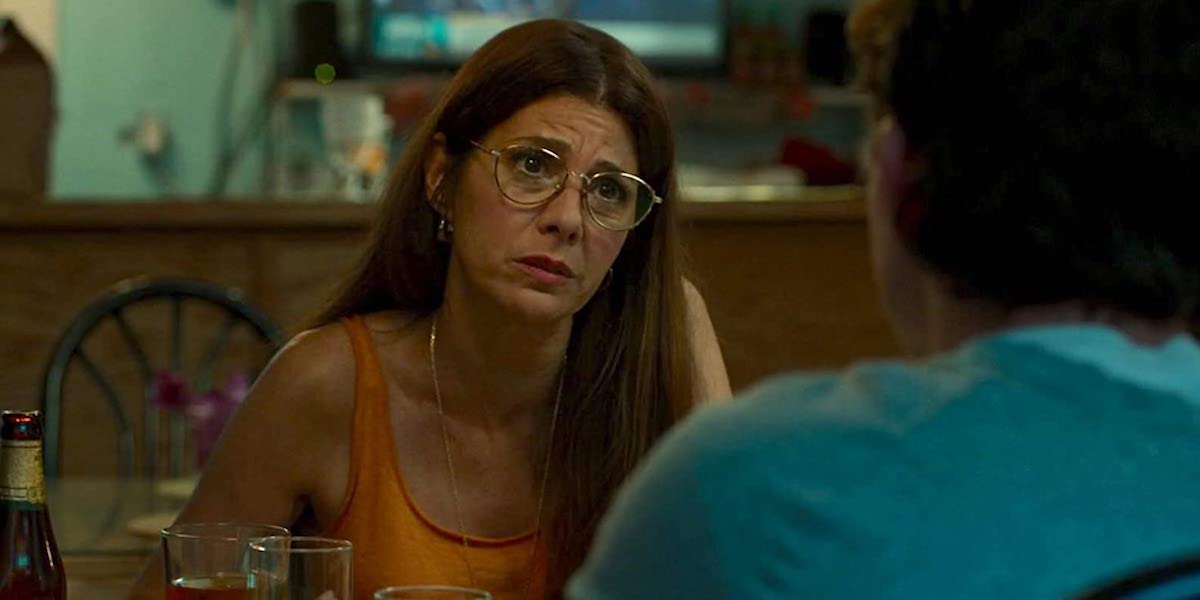
No, May hasn’t come back to life: she is still dead, and the film doesn’t cheat on that. Marisa Tomei appears in two scenes, both of them memories. The first is a brand-new sequence, shot for this film and not lifted from the earlier ones. The second is the pivot of the story: Jean Grey steps into that memory and takes Peter’s place.
It’s the appearance nobody saw coming, and it’s also the one that decides how the film ends. Marisa Tomei is back as Aunt May even though the character has been dead for two films.
Here’s how the film pulls it off, without resurrecting anyone and without recycling a single frame of archive footage.
Is May alive? The answer straight away
No. May Parker is dead, she stays dead, and the film offers no variant from another universe, no miraculous return and no revelation that would undo what happened.
That’s worth stating up front, because the multiverse has taught audiences that death is negotiable. Here, it isn’t. May appears in one form only: the memory Peter keeps of her.
And that’s precisely what gives these two scenes their power. They don’t give May back to Peter, they show what he has left of her. For the context of her death, our analysis of No Way Home and what it changed retraces the whole sequence of events.
The first scene: a memory shot for this film
It comes early in the story, in the form of a flashback.
What the scene shows
Peter is sitting on his bed, in costume, mask off. He is visibly overwhelmed and discouraged. May sits down beside him.
What she offers him is neither tactical advice nor heroic encouragement. She acknowledges what he is going through: the anxiety and the exhaustion that come with being Spider-Man. She validates how worn out he is instead of playing it down.
It is a scene of a few minutes, with no action stakes, and it is one of the most important in the film.
This isn’t archive footage
A detail many viewers wrongly assume: this sequence was not lifted from an earlier film. It is an entirely new scene, shot for Brand New Day with Marisa Tomei.
The difference isn’t a trivial one. A cut of archive footage would have been a nod to the fans. A brand-new scene means the film built this moment for itself, and that it needed it in order to work.

Spider-Man Tom Holland Figure
The Peter Parker of this period, the one who takes off his mask and sits down on his bed. The figure captures the silhouette of the web-slinger as played by Tom Holland, one to find among our Spider-Man figures.
View the product — €79.90The second scene: when Jean takes Peter’s place
This is where the film turns a memory into its resolution.
How we get there
In the final act, Peter realises he won’t win by force against Jean Grey. So he stops resisting and opens his mind to her.
What she finds there is neither a weapon, nor an argument, nor a strategy. It is that one precise memory: Peter slumped on his bed, and May sitting beside him.
The turning point
And the film then does something remarkable. Jean doesn’t watch the memory from the outside: she finds herself inside it, in Peter’s place. She is the one sitting on the bed, and it is her that May is speaking to.
What she receives is what Peter had received — a motherly presence, without judgement, asking nothing of her. The message comes down to one idea: you deserve to be loved for who you are, not for what you can do.
For a character whom Damage Control detained and exploited precisely for her abilities, that line is the exact opposite of everything she has lived through.
What it sets off
This is the moment that decides what follows. Jean was holding Bill Metzger’s life in her hands — the man responsible for what happened to her sister Sara. She lets him live.
So the film rests its resolution on a woman who has been dead for two films, inside a memory that wasn’t even hers. It is the boldest piece of writing in the whole feature. The full detail of the ending is in our analysis of the ending and the post-credits scene.

Retro Spider-Man Poster
An understated visual for those who prefer the character to the action. Our Spider-Man posters cover the whole range of styles, from retro to contemporary.
View the product — €16.90Why May is still the emotional backbone of this trilogy
Three films, three different functions, but always the same role: she is the one the emotion passes through.
No Way Home: the founding death
It is her death that tips Peter into adulthood and that makes the spell acceptable in his eyes. Without that loss, the solitude he chooses at the end would carry no weight.
The previous film made her the breaking point. This one makes her the point of support, which is an elegant inversion.
Brand New Day: memory as inheritance
Here, May no longer acts. She has no existence in the present of the story. What remains of her is what Peter has internalised — and it is solid enough to be passed on to someone else.
That is a very accurate definition of what an inheritance is: not what the person did, but what they left behind in the way the survivors carry themselves. The same mechanism runs through the character’s whole history, starting with Uncle Ben’s death that underpins everything else.
What these scenes say about Peter’s grief
The film never shows Peter openly grieving May. It shows something else, something truer.
The memory he keeps isn’t a happy one. It is a moment when he was struggling and she was there. What grief has held on to isn’t the joy, it is the comfort — and that is exactly what people really keep of those they have lost.
This treatment is consistent with the portrait of the Peter Parker of this film: a man the world has forgotten, standing up on what is left of him that nobody can see.
And it is what makes the final scene possible. Peter doesn’t share a pleasant memory with Jean: he shows her the moment when he was at his weakest. That is the very definition of the openness he had been refusing since the start of the film.
Why this writing choice is risky
Resting a resolution on a dead character isn’t a free move, and it could have gone very wrong. Three traps were waiting for the film.
The trap of the easy way out
Bringing back a beloved figure to trigger emotion is the most tempting shortcut in the genre. Plenty of films use it as a lever: you show the departed, the room is moved, the plot advances without having built anything.
What saves Brand New Day is that the memory isn’t decorative. It is the mechanism of the resolution: without it, Jean kills Metzger and the film ends differently. Something you cannot remove without breaking the story isn’t an easy way out, it is structure.
The fan-service trap
The second risk was to treat the return as an event: swelling music, a close-up on her face, a hush in the cinema. The film refuses all of that.
May turns up unannounced, in a domestic scene, and leaves without any flourish. That is what lets the sequence work as a memory rather than as an appearance.
The multiverse trap
Finally, the universe offered an easy way out: a May from elsewhere, a variant, an alternative version. The film ignores it completely, even though the main character has himself been through a multiversal event.
That refusal is consistent with what the film is saying. Peter spends two hours learning that you don’t get back what you have lost, you live with it. Giving him May back would have contradicted his own lesson.
Marisa Tomei, and what this role has become
Her performance divided opinion when she first arrived, essentially because it broke with the image of an elderly May inherited from the comics and the earlier adaptations.
Hindsight proves her right. A younger May allowed for a relationship between equals rather than one of guardianship, and it is precisely that closeness that makes the bedroom scene believable: this isn’t a grandmother comforting a child, it is one adult sitting down next to another.
Across two scenes and a few minutes of screen time, she carries the emotional turning point of the film. It is the same role she held in the previous film, except that here she is no longer alive.

Spider-Man T-Shirt
A web-slinger staple for wearing the character every day, among our Spider-Man t-shirts. The selection tied to the release is gathered in the Brand New Day merch collection.
View the product — €29.90May in the comics: what the film keeps and what it invents
The character has existed since the very first issues, and her treatment on screen departs from the source material on specific points.
In the comics, she survives for a long time
May Parker is a lasting figure there, present across decades of stories. She has had false deaths, retirements and returns — but she has never occupied the position of the permanently departed that structures the film trilogy.
So the film takes a considerable liberty, and it owns it: May’s death here is a point of no return, not a temporary twist.
What is faithful all the same
The function of the character, on the other hand, is respected perfectly. In the comics as on screen, May is Peter’s moral conscience: the one person he cannot lie to, and the one whose approval matters more than the public’s.
From that point of view the bedroom scene is very faithful to the spirit of the character: she doesn’t tell him what to do, she tells him he is allowed to be tired. That is exactly the register she has occupied for sixty years.
The lost-mentor motif
Spider-Man is the hero whose identity rests on the absent. Ben first, then May, and between the two a series of guiding figures who disappear. That isn’t a writing accident, it is the engine of the character: his guilt and his sense of duty are born, every single time, of a loss.
Brand New Day pushes that motif to its logical conclusion. The mentor is no longer merely absent, he has become a tool Peter can pass on to someone else. It is the first time the series does something useful with its dead instead of simply mourning them.
The questions you leave with
Why wasn’t she in the trailer?
Because the effect depended entirely on surprise. Announcing Marisa Tomei’s return would have turned every scene into a wait: you watch out for the appearance instead of receiving it.
It is the same reasoning that kept other appearances out of the marketing. The film chose to undersell its emotional content, even at the risk of looking thinner than it is in the promotional images.
The gamble is defensible, but it has a cost: part of the audience walked into the cinema expecting an action film and walked out with a film about grief and loneliness. That is one of the sources of the misunderstanding you find in the reactions.
Exactly how many scenes is May in?
Two. One early in the film, as a flashback, and one in the final act, inside Peter’s mind. No other appearance, and nothing after the credits.
Do you need to have seen No Way Home to follow it?
Strongly recommended. The film doesn’t explain how May died, it assumes you know. Without that context, the two scenes still work emotionally but lose half their charge. Our guide to what you need to have seen first sets out the bare essentials.
Could the character come back in a future film?
Nothing has been announced, and the logic of the film pushes the other way: it built its whole ending on the idea that May survives through what she passed on, not through her presence. Bringing her back would empty that ending of its meaning.
As always, what hasn’t been announced isn’t information. Be wary of articles that claim otherwise with confidence.
Do MJ and Ned remember her?
The film doesn’t address the question head-on, but the answer follows from the spell: they have forgotten Peter, and so everything that connected them to him. We set out the three states of memory that most summaries muddle up in our article on MJ’s memory.
Why the scene works even if you haven’t seen the earlier films
Because it doesn’t rest on any information. A woman sits down next to someone who is struggling and tells him it is all right to struggle. There is nothing you need to know to understand that.
That is also what explains why the scene works just as well on Jean, who has never met May and knows nothing about her. The memory doesn’t pass on knowledge to her, it passes on an experience.
Did Peter know that Jean would see this memory?
The film doesn’t say so explicitly, and that is deliberate. Peter opens his mind without choosing what she will find there: that is the whole principle of what he accepts. If he had picked the memory, the gesture would lose all its meaning — he wouldn’t have made himself vulnerable, he would have been making a case.
What Jean finds is what dominates Peter’s head. That it should be that moment rather than a victory or a happy memory says a great deal about what he has become.
What to take away
May is dead and stays dead. She appears in two memories, one of them a brand-new scene shot for this film. And the second of those memories serves as the resolution: Jean Grey takes Peter’s place in it and receives there what she needed in order not to kill.
A superhero film that settles its final act with a conversation between a dead woman and a stranger, inside a third character’s head, is unusual. It is also, in the view of a good part of the critics, what the film does best.

