

14-Day Money-Back Guarantee
0
The short answer
Published in six issues from February to July 1993, this mini-series is the first to hand the lead role to Eddie Brock. Settled in San Francisco, Venom protects a homeless community from a property developer, while the Life Foundation extracts a symbiote seed from him to spawn five more. This is the character's birth certificate as an antihero.
In February 1993, Marvel tried something the publisher had never done with this character: giving him his own series. Until then, Eddie Brock existed only as an antagonist in Spider-Man's titles — a threat that comes back, takes a beating, leaves again. Venom: Lethal Protector changes that place in six issues, and invents along the way a figure the cinema would take up twenty-five years later almost unchanged: the monster who protects.
Six issues to turn a villain into a lead character
The mini-series ran from February to July 1993. The script is signed David Michelinie, co-creator of the character — this is not a jobbing writer handed a commission, it is the man who brought him into the world. On art, Mark Bagley handles the first three issues, Ron Lim takes over the pencils on the last three.
The starting point assumes a deal already struck. Eddie Brock and Spider-Man have agreed a truce: Venom leaves Peter Parker alone, provided he is allowed to go. That truce is not formed in this series — it was sealed a few months earlier in the pages of Amazing Spider-Man, and the mini-series opens by taking it as read. It is a detail many summaries skip over, and it changes the reading: we are not watching a reconciliation, we are watching what a former enemy does with his freedom.
To understand where this relationship comes from, our article on his relationship with the symbiote goes back to the origin of the black suit, and the complete history of Venom retraces Eddie Brock's path before this series.
San Francisco, and a city beneath the city
Brock leaves New York for California. There he finds what the story calls the Underground: a homeless community settled in a slice of city swallowed up by an earthquake. People living beneath the streets, in buildings still standing but buried.
That setting is not decoration. It gives Venom exactly what he needed in order to stop being a villain: innocents nobody else defends. The character does not turn nice, he changes target. The whole story rests on that nuance — and it explains why the title speaks of a lethal protector and not a hero.
Roland Treece, the most ordinary enemy in the series
The threat comes not from a supervillain but from a property developer. Roland Treece, head of Treece International, wants to drive out the Underground under cover of a redevelopment scheme. The real motive is a stash of gold buried beneath the city. To dislodge the residents, he sends in the Diggers: men kitted out in drilling exoskeletons, armed among other things with sonic cannons.
The choice of weapon is clever. Sound is the symbiotes' historic weakness, and the story thereby gives itself an ordinary opponent, with no powers, able to put Venom in trouble using building-site kit.
A silhouette designed for San Francisco
The geographical move has a visual consequence rarely noticed. New York was Spider-Man's turf; by settling Venom on the west coast, the series gives him settings that belong to him alone — the fog, the slopes, the docks, the flooded basements. Bagley and then Lim draw pages very different from those of the New York titles, with a massive creature lost in white rather than cut out against building fronts.
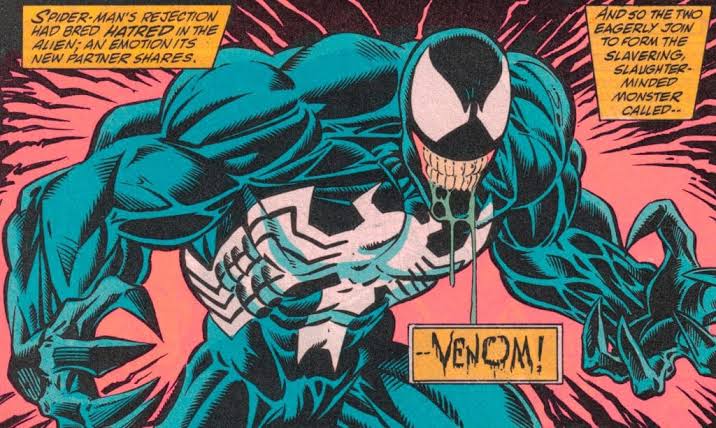
It is that silhouette, more than the one in earlier appearances, that took lasting hold: the thick build, the gaping mouth, the tongue. You find it unchanged on the symbiote figures as on the tapestries, thirty years later.
FIGURES & COLLECTION

Spider-Man Figure - Eddie Brock Transforming
Eddie Brock caught mid-transformation: the very image of what this series made of the character.
119.90 €
Discover →1993, or the exact moment the market tipped
This series did not come out of nowhere. The early 1990s were the most speculative period in the history of the comic book: gimmick covers, first issues bought in twos to be resold, print runs beyond anything the medium had known. The first issue of this mini-series sports a holographic cover — a costly process with only one aim, to make you buy the object rather than the story.
The character fits that era perfectly. Venom ticks every box the 1993 audience was asking for: massive silhouette, bared teeth, ambiguous morals, unapologetic violence. Where Spider-Man quips, Venom growls. That contrast explains the commercial success as much as the quality of the story — and it also explains why the imagery of that period remains, thirty years on, among the most reused on t-shirts and posters.
Our article on Torment describes exactly the same editorial mechanism three years earlier, with the same result: a collectable dressed up as a story.
The Jury: when a monster's victim becomes the hunter
A squad makes its debut in the second issue, and it is worth pausing on. The Jury is founded and funded by retired general Orwell Taylor. His motive is personal: his eldest son Hugh, a guard at the Vault prison, was suffocated by the symbiote during one of Venom's escapes.

It is the sharpest idea in the series. It takes seriously something superhero comics usually brush aside: the people monsters kill in passing have families. The Jury is not a gang of criminals, it is a father and his recruits carrying out a methodical revenge — and the reader, having just accepted Venom as the protagonist, ends up hoping he escapes people who have excellent reasons to hunt him.
That moral reversal runs through Spider-Man's whole rogues' gallery. Our page devoted to his iconic enemies shows how porous the line between vigilante and villain is there, and our article on the Punisher describes the most radical version of that logic.
The Life Foundation and the five offspring
The best-known part of the series is also the most poorly retold. The Life Foundation was not created for the occasion: this survivalist organisation led by Carlton Drake had appeared five years earlier, in March 1988, in the pages of Amazing Spider-Man — already written by Michelinie.
Drake captures Venom and holds him in a sonic containment sphere. He extracts a symbiote seed from him, brings it artificially to maturity, then spawns four more. All five are grafted onto the foundation's security staff. It is the first time the story shows that a symbiote can reproduce on demand — an idea that would feed thirty years of publications.
The trap of the five names
You read everywhere that the series introduces Riot, Lasher, Agony, Phage and Scream. That is wrong, and the mistake is instructive: none of the five is named in these six issues. They are symbiotes of different colours, worn by anonymous agents. The names appeared afterwards, first through a line of action figures in the mid-1990s, then made canon by later stories.
In other words, a good part of the mythology credited to this series was built after it, in hindsight. Our profiles of Riot and Shriek follow those characters to where they really take shape, and the page devoted to Venom and the symbiotes puts that lineage back in order. On the merchandise side, this family has its own range of symbiote figures, quite separate from the Spider-Man figures.
An ending Spider-Man disapproves of
The five offspring are not beaten in combat. In the laboratory Venom finds a metabolic accelerator, a ray that ages them brutally and reduces them to dust. Spider-Man objects to its use on moral grounds. Venom uses it anyway, killing the symbiotes and, to all appearances, their hosts.
The scene says everything about the character. He has just spent six issues protecting innocents, and he settles the problem with a mass execution that the hero at his side refuses. The contrast is deliberate, and it connects with the underlying question covered in our article on responsibility: what separates these two is not strength, it is the limit.
FIGURES & COLLECTION

Spider-Man Figure - Premium Venom Bust Statue
The bust that captures the jaw and the tongue, the two details McFarlane imposed and that this series settled for good.
89.90 €
Discover →The final issue: a fight in the fog, then a rescue
The sixth issue sets the two characters against each other one last time, in the San Francisco fog, before making them co-operate. Together, they stop Treece from blowing up the underground city.
Then comes the gesture that justifies the title of the series: Venom sends his symbiote into the flames to save the life of Treece, the man he had been hunting for six issues. He does not spare him out of pity — he saves him because letting someone die no longer falls within what he allows himself. The series closes on Venom being accepted as the appointed protector of the Underground, with one notable exception: Reverend Rakestraw, who cannot bring himself to it. Spider-Man, for his part, heads back to New York convinced that Brock will keep his word.
What this series set off
The commercial success has a direct, measurable consequence: between 1993 and the end of the 1990s, Marvel put out seventeen limited series devoted to Venom. The publisher preferred to multiply mini-series rather than grant the character an ongoing title — a strategy that says a good deal about the caution of the time towards a protagonist with no moral code.
The most visible legacy lies elsewhere. The 2018 film draws mainly on this mini-series and on Planet of the Symbiotes, taking up Carlton Drake, the Life Foundation and one of the five offspring — while removing Spider-Man from the equation. The title of the 2021 sequel even picks up the phrase lethal protector explicitly.
Watch out for a frequent confusion along the way: in the film, the symbiote Riot has Carlton Drake as its host. In the comics, Drake is never a host — he is the backer, the one who funds and who extracts. Our notes on continuity errors come back to that kind of gap between page and screen.
Why Eddie Brock works where others fail
Plenty of villains were given their own solo series in the 1990s. Almost none survived. This one held up because the character rests on a contradiction the reader grasps at once: Eddie Brock sincerely believes he is on the side of good. He does not think of himself as a monster, he thinks of himself as an avenger — and it is the symbiote, not him, that makes his methods indefensible.
That conviction changes everything. A villain who knows he is doing wrong is quickly read; a man convinced he is acting rightly while killing can be read for a long time. It is also what makes the double act with Spider-Man endlessly workable: they want the same thing and cannot work together. Our article on Eddie Brock and Peter Parker digs into that parallel, and the profile of Cletus Kasady shows what becomes of the formula once you remove the good faith.
An antihero before the word became a genre
The vocabulary has changed since. In 1993, a protagonist who kills his opponents is an editorial anomaly; today it is a standard. So this series reads as a tipping point: it bets that a reader can follow someone whose acts he disapproves of, and it wins that bet. The whole symbiote lineage, right up to the Carnage and Toxin figures, rests on that initial bet.
Should you read it today?
Yes, provided you know what you are looking for. It is not a masterpiece of writing: the dialogue is dated, the crooked developer is a caricature, and the pace drags in the third issue. But it is the founding document of a shift — the precise moment a B-list villain becomes a property in his own right.
It also reads as a 1990s time capsule: the holographic cover of the first issue, the graphic one-upmanship, the era's taste for antiheroes. Our article on Torment describes the same editorial mechanism three years earlier, and our selection for getting started points to the volume to approach this period with. The overview of the major arcs places it within the overall chronology.
For those who would rather display this era than read it, the black suit and its descendants hold a place apart on the posters and the t-shirts, and the tapestries let you cover a whole wall without any building work.
T-SHIRTS

Spider-Man Symbiote Logo T-Shirt
The spider logo in its symbiote version, the one that has survived every era since 1984.
39.90 €
Discover →Where it sits in the symbiote mythology
This mini-series occupies a pivotal position worth placing properly. Before it, the symbiote is an accident: an outfit brought back from elsewhere, rejected by Spider-Man, picked up by an angry journalist. After it, it is a species — able to reproduce, to colonise hosts in series, to have descendants and therefore a history.
Everything Marvel published on the subject afterwards flows from that shift. Planet of the Symbiotes turns the species into an invasion two years later, Maximum Carnage had already shown what an offspring with no restraint looks like, and Knull would end up inventing them a creator god. Without the 1993 demonstration — a symbiote can make others — none of those stories would have a foundation.
It is also why this branch now has its own shelf, separate from Spider-Man's. The page devoted to the symbiotes puts the whole family back in order, and the gift selection covers the safe bets for a reader who already knows the series.
The key points
Six issues, from February to July 1993, written by the character's co-creator. A homeless community to defend, a property developer for an enemy, a squad of avengers led by a grieving father, and five symbiotes the series never names. At the end, a monster who saves the man he was hunting.
It is not the best Venom story, but it is the one without which the others would not exist. For what comes next for the character, Eddie Brock's redemption as Anti-Venom carries that trajectory on exactly, and the story of Knull shows how far the publisher ended up pushing the mythology opened here.

