

14-Day Money-Back Guarantee
0
THE SHORT ANSWER
Frank Castle is a former special forces Marine turned vigilante after his wife and his two children were murdered in a mafia shooting in Central Park. Created in 1974 by Gerry Conway, Ross Andru and John Romita Sr., he guns his targets down rather than handing them over to the police. Details below.
Contents
Who is the Punisher? Frank Castle in a nutshellFrank Castle's origin: the day everything changedThe veteran: military training and wartime disciplineThe Punisher's arsenal: war without superpowersLethal methods: why the Punisher killsThe skull: anatomy of the character's most iconic symbolPunisher versus Spider-Man: two irreconcilable visions of justiceFrank Castle on screen: Jon Bernthal and the One Last Kill special
There is no superpower about the Punisher. No radioactive spider bite, no serum, no high-tech armour piloted by an artificial intelligence. Just a man, a rifle and a pain so total that it ended up replacing his personality. Frank Castle is perhaps the most disturbing character in the Marvel universe, because he asks for neither admiration nor forgiveness: he executes, and he starts again the next day. As we approach Spider-Man: Brand New Day, due in French cinemas on 29/07/2026, this white-skulled vigilante is walking into Peter Parker's life, and a full profile was long overdue to understand where this figure of absolute vengeance came from.
Because the Punisher is not a classic villain, nor quite a hero. He occupies that grey area Marvel has loved exploring since the 1970s, where justice stops being a noble idea and becomes a loaded weapon. In this article, we go back to the character's origin, detail his lethal methods, dissect the symbolism of his famous skull, and explain why his arrival alongside Spider-Man is anything but trivial. For the exact nature of their turbulent, mistrustful relationship, we point you to a dedicated feature further down: here, it really is Frank Castle himself we are putting in the spotlight.
Who is the Punisher? Frank Castle in a nutshell
The Punisher is an urban vigilante waging a personal, endless war on organised crime. Created by writer Gerry Conway, artist Ross Andru and the legendary John Romita Sr., he first appeared in the pages of The Amazing Spider-Man #129, published in 1974. A delicious and often forgotten detail: on his very first appearance, Frank Castle is not an ally of Spider-Man but an enemy. Manipulated by the Jackal, he hunts the web-slinger, who has been presented to him as a dangerous murderer. The Punisher was therefore literally born in Spider-Man's shadow, which makes their future collaboration all the more ironic.
Unlike almost every character who populates the gallery of heroes and villains of the Marvel universe, Frank Castle has no superhuman ability whatsoever. His only 'superpower' is exceptional military training, an iron will and an almost total indifference to his own survival. Where Peter Parker constantly wrestles with his conscience, refusing to kill even his worst adversaries, the Punisher settled that question long ago: for him, the only punishment that stops a criminal reoffending is death. That philosophical opposition is the very heart of what makes the character so compelling.
A vigilante with no superpower
Created in 1974 in The Amazing Spider-Man #129, Frank Castle is first an enemy of the web-slinger, manipulated by the Jackal. He has no superhuman ability at all.
Frank Castle's origin: the day everything changed
The Punisher's whole existence rests on a single event, a founding tragedy so clear-cut that it works like a myth. Frank Castle was an ordinary man, or almost: a decorated former soldier back from the war, trying to rebuild a peaceful life with his wife Maria and their two children, Lisa and Frank Jr. It is that recovered normality that fate would tear away from him in the most brutal way imaginable.
Central Park, the massacre that created a monster
During a Sunday family picnic in Central Park, New York, the Castle family accidentally witness a mafia execution. A bloody settling of scores unfolds in front of them and the killers, wanting to leave no witnesses, open fire on the whole family. Maria, Lisa and Frank Jr. are gunned down. Frank survives, riddled with bullets but alive. That detail is crucial: the Punisher is not born from his family's death, but from the fact that he survived it. He is condemned to carry that memory, to relive every night the moment when he could not protect his own.
Worse still, justice betrays him. Those responsible for the massacre, shielded by accomplices and by the corruption eating away at the system, escape prosecution. It is this double wound, the loss and the impunity, that turns a broken father into a war machine. Frank Castle draws a radical conclusion from it: if the institutions cannot punish the guilty, then he will do it himself, one criminal after another, until death follows. His own, or someone else's.
A man who refuses to heal
What sets Frank Castle apart from so many other revenge characters is that he never seeks redemption or peace. Many vigilantes eventually move on, find love again or hang up their weapons. Not him. The Punisher has made his grief a permanent way of life. Every criminal he guns down is, symbolically, one of his family's killers. That obsession condemns him to absolute loneliness, an existence with no end and no horizon beyond the next target. This openly embraced darkness brings him close to other troubled figures in the web-slinger's world, such as Yuri Watanabe, the police officer whom New York law tips over into vengeance.
1
A decorated former soldier Back from the war, Frank Castle rebuilds a peaceful life with Maria, Lisa and Frank Jr.
2
The Central Park massacre Witnesses to a mafia execution, his wife and children are gunned down; he survives.
3
Justice betrayed Shielded by corruption, those responsible escape prosecution.
4
An endless war He will punish the criminals himself, one after another, without seeking redemption.
The veteran: military training and wartime discipline
If the Punisher is this effective, it is not through magic but through craft. Before the tragedy, Frank Castle was an elite soldier, a Marine who served in the special forces and racked up tours of combat duty. An exceptional marksman, an expert in guerrilla warfare, explosives, close combat and infiltration, he was trained to survive in the most hostile conditions. All that expertise, originally meant to defend his country, he now turns against the underworld of New York's streets.
This military dimension is essential to understanding the character. The Punisher does not fight like a classic comic-book hero, with flair and acrobatics. He runs a genuine military campaign, with reconnaissance, planning, ambushes and withdrawal. He treats organised crime as an enemy army to be dismantled. That cold, almost clinical rigour contrasts radically with Spider-Man's improvised, chatty style. Where the web-slinger cracks jokes mid-brawl, Frank Castle advances in silence, methodically, and that difference in temperament feeds all the tension whenever the two men cross paths.
Elite skills
A former special forces Marine, an exceptional marksman, an expert in guerrilla warfare, explosives, close combat and infiltration.
A military campaign
Reconnaissance, planning, ambushes and withdrawal: he treats organised crime as an enemy army.
A cold temperament
He advances in silence and methodically, where Spider-Man cracks jokes mid-brawl.
The Punisher's arsenal: war without superpowers
Since he has no gift, the Punisher compensates with an impressive, meticulously maintained arsenal. He is a man of arms in the most literal sense of the term, and his equipment is as much a part of his identity as the skull on his chest.

Firearms, explosives and combat vehicles
Frank Castle's arsenal covers absolutely the whole spectrum of military violence: handguns, assault rifles, sniper rifles for long-range elimination, shotguns for close-quarters fighting, but also combat knives, grenades, mines and explosive charges. He is also skilled at handling armoured vehicles and adapts his kit to every mission. The Punisher does not count on luck: he counts on preparation, training and overwhelming firepower. Every operation is designed to maximise the damage to his target while minimising the risk to himself.
The 'War Journal', the memory of his crusade
Beyond the weapons, one emblematic object goes everywhere with the character: his 'War Journal'. In it, Frank Castle meticulously records his targets, his operations, his observations on the criminal networks and his personal reflections. This notebook is both a tactical tool and a window onto his tormented mind. It is a reminder that behind the mechanical brutality hides an obsessive strategist, a man who treats his vendetta as a war to be documented down to the last detail. It is this almost accountant-like approach to death that makes the character both chilling and fascinating.

COMBAT POSES
Spider-Man Articulated Figure
Recreate the tensest showdowns in the Marvel universe: this articulated figure moves through dynamic poses, perfect for staging the web-slinger against his most formidable adversaries on your shelf.
View the product — 99,90 €Lethal methods: why the Punisher kills
This is the point that defines the character and separates him irreversibly from the rest of Marvel's heroes: the Punisher kills, without hesitation or remorse. Where classic superheroes neutralise their adversaries and hand them over to the police, Frank Castle sees that approach as a dangerous hypocrisy. For him, an arrested criminal always ends up back out, bribing a guard, escaping or being released by a failing system, only to start harming people again. His logic is implacable: a dead man never reoffends.
This philosophy of definitive punishment makes the Punisher a dark mirror held up to the whole superhero universe. He asks an uncomfortable question: what use is a hero who lets his enemies come back again and again? The debate is especially fierce opposite Spider-Man, who absolutely refuses to kill, even when that restraint costs him dearly. This moral boundary, this thin line between justice and vengeance, is explored in depth in our analysis of the question Has Spider-Man ever killed an enemy?, an excellent companion piece for grasping everything that separates the two men.
One nuance is needed, however: the Punisher is not a blind killer. He follows a strict code and goes after only proven criminals, those who harm the innocent. He refuses to kill police officers, civilians or anyone he does not judge guilty, and he does not hesitate to protect the weak at the risk of his own life. It is this moral rigour, terrifying as it is, that stops the character tipping into pure nihilism and explains why so many readers, despite everything, feel a form of empathy for him.
An implacable logic
An arrested criminal always ends up back out or escaping; a dead man never reoffends.
A strict code
He goes after only proven criminals, those who harm the innocent.
Limits he owns
He refuses to kill police officers, civilians or anyone he does not judge guilty.
The skull: anatomy of the character's most iconic symbol
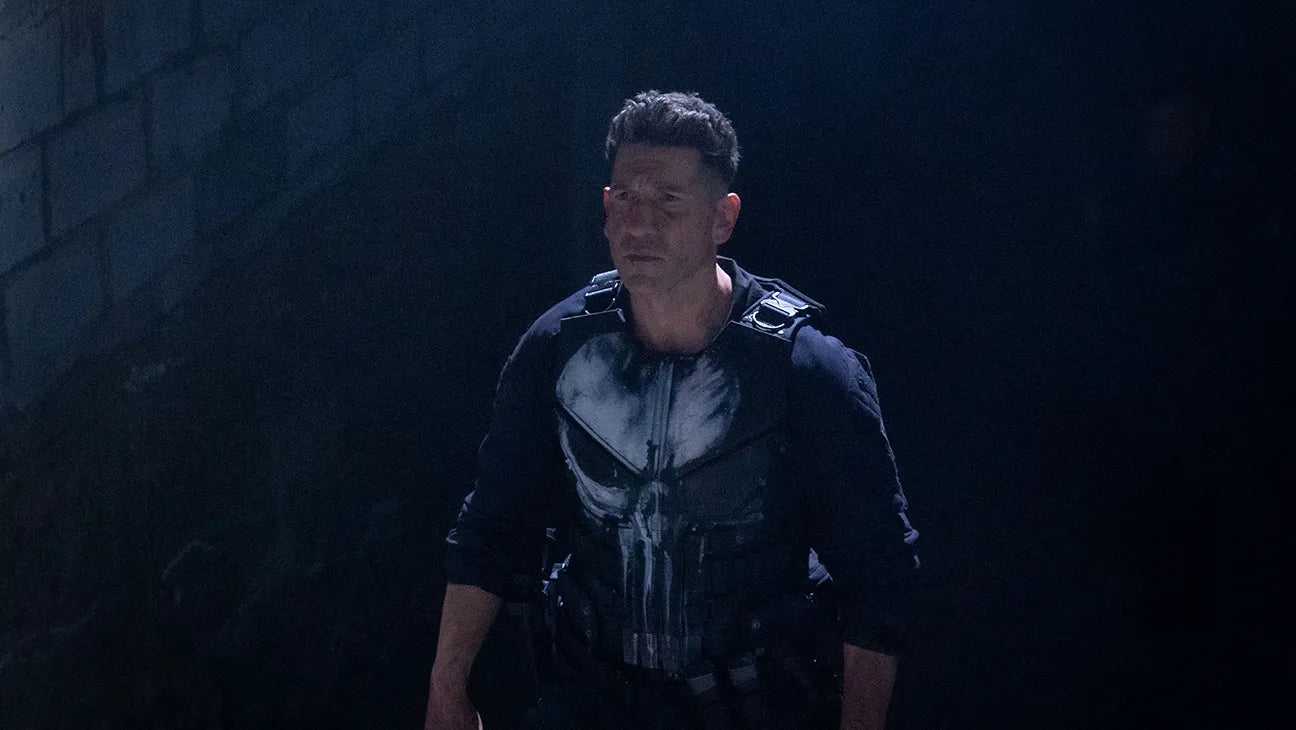
It is impossible to talk about the Punisher without mentioning his emblem: that large stylised white skull across his chest, with its elongated fangs and its distinctive jaw. This skull is arguably one of the most recognisable logos in all of comics, to the point that it has spilled far beyond the pages to become a cultural symbol in its own right, tattooed, printed and worn well outside the circle of Marvel fans.
But this symbol is not merely an aesthetic ornament: it has a tactical and psychological function. According to the best-known version of its origin, Frank Castle wears that skull to draw his enemies' fire onto an area protected by a bulletproof vest, the chest, rather than onto his head. The skull is therefore both a deliberate target and a tool of psychological warfare: it is designed to terrify. When a criminal catches sight of that spectral white in the dark, he knows death is coming. The symbol works for Frank before he even has to shoot.
Narratively, the skull perfectly embodies what Frank Castle has become: a man dead inside, a shell animated by vengeance alone. He no longer presents himself as an individual, but as a concept, punishment made flesh. This graphic power explains why the emblem has become a cult piece among fans, just like the most emblematic logos of the web-slinger's world that you find across the T-shirts and clothing in the Spider-Man collection.

DARK STYLE
Black Oversized Spider-Man T-Shirt - Symbiote
Adopt the nocturnal aesthetic of the vigilantes of the shadows: this black oversized T-shirt with its symbiote print has a dark, assertive presence, cut for everyday comfort and a look that does not go unnoticed.
View the product — 29,90 €Punisher versus Spider-Man: two irreconcilable visions of justice
The relationship between Frank Castle and Peter Parker is one of the richest and tensest in the Marvel universe, precisely because the two men defend opposing values while fighting the same enemies. Spider-Man embodies hope, the second chance and the sanctity of life; the Punisher embodies cold, definitive punishment. They sometimes respect each other, often fight each other, and work together reluctantly when the situation demands it.
We will not detail here every twist of their clashes and their alliances, because we have devoted a whole feature to them. For everything on how they went from enemies to unstable partners, we point you to our article Spider-Man and the Punisher: from enemy to unstable partner, which unpicks that unique dynamic in detail. What matters here is that their confrontation goes beyond a simple duel: it stages two possible answers to the same pain, because Peter Parker too lost someone he loved to a criminal he could have stopped. Two men, the same trauma, two opposite paths.
This ability of the Punisher's to invite himself into other people's stories, to play the moral catalyst, shows up in his many crossovers with other shadowy figures of New York. His world overlaps in particular with that of Daredevil, the city's other nocturnal vigilante, as shown by the analysis of the underrated alliance between Spider-Man and Daredevil, and with that of the New York crime lord in our portrait of Kingpin, the criminal who became king of New York.
Spider-Man
He embodies hope, the second chance and the sanctity of life.
The Punisher
He embodies cold, definitive punishment.
The same pain
Two men, the same trauma, two opposite paths.
Frank Castle on screen: Jon Bernthal and the One Last Kill special
For some years now, one actor has established himself as the definitive face of the Punisher: Jon Bernthal. Breaking out in the role within Marvel's television stable, he captured to perfection the character's intensity, pain and contained brutality. His performance won fans over unanimously, to the point that many now see him as the ultimate incarnation of Frank Castle, the one against whom every other interpretation will be measured from here on.
In May 2026, Jon Bernthal returned to the character in a television special titled The Punisher: One Last Kill, broadcast on Disney+ on 12/05/2026. This short format, co-written by the actor, shows a Frank Castle pushed to his very limits, holed up in a New York riddled with crime. The special acts as a narrative bridge: it links the character's recent appearances to his hotly anticipated arrival in Spider-Man: Brand New Day. In other words, this is not a standalone story but a piece of the puzzle that sets up the big event of summer 2026 directly. The subject is covered in more detail in Jon Bernthal's Punisher hits the big screen in Brand New Day.
One Last Kill, a narrative bridge
Broadcast on Disney+ on 12/05/2026 and co-written by Jon Bernthal, this special links the Punisher's recent appearances to his arrival in Spider-Man: Brand New Day.
The Punisher in Spider-Man: Brand New Day (2026)
Here is the event putting the Punisher back in the spotlight: Jon Bernthal reprises his role as Frank Castle in Spider-Man: Brand New Day, the fourth MCU solo film for the web-slinger, due on 29/07/2026 in French cinemas and on 31/07/2026 in the United States. It is the first time the Punisher has shared the screen with Tom Holland's Spider-Man, and for comics readers this crossover has a particular flavour, since it closes a loop more than fifty years old, going right back to that very first meeting in the pages of 1974.
A word of caution, though: as we write these lines, the exact scale of Frank Castle's role in the film and the precise nature of his interactions with Peter Parker are still largely speculation and rumour. Nothing has been officially confirmed as to whether he will be an occasional ally, an antagonist or a simple appearance. We invite you to treat every theory circulating online with caution, and to consider them rumours as long as Marvel has made nothing official. What is certain, on the other hand, is Bernthal's presence in the cast and the studio's determination to anchor the character in this new era.
The Punisher is not, in fact, the only striking face in this hotly anticipated film. For a complete overview of the announced and rumoured antagonists, we recommend our feature on the baddies of Spider-Man: Brand New Day and the villains of the 2026 film. And to understand the narrative upheaval this fresh start represents in Peter Parker's life, dive into our analysis of Brand New Day, the great reset that changed Peter Parker's life.
The table below sums up the key things to remember about the character's arrival on screen, clearly separating the confirmed facts from the areas that remain uncertain.
| Item | Status |
|---|---|
| Jon Bernthal reprises the role of Frank Castle | Confirmed |
| One Last Kill special broadcast on 12/05/2026 (Disney+) | Confirmed |
| Brand New Day released on 29/07/2026 (France) | Confirmed |
| Scale of the role and alliance with Spider-Man | Rumour, not confirmed |

COLLECTOR'S PIECE
Marvel Spider-Man Collector's Figure
Get ready for the release of Brand New Day with a centrepiece: this Marvel collector's figure captures the web-slinger in the finest detail, ideal for fans who want a display worthy of the event of the year.
View the product — 79,90 €Why the Punisher still fascinates
More than fifty years after his creation, the Punisher remains one of Marvel's most popular and most controversial characters. His strength lies in his tragic simplicity: no superpower, no flamboyant costume, no unresolved moral dilemma. He has a mission, a pain and a method, and he sticks to them to the very end. That purity of purpose makes him a perfect mirror for questioning our own reactions to injustice, to impunity and to the temptation of revenge.
Frank Castle makes us uncomfortable because he says out loud what many think quietly in moments of anger: the desire for the guilty to pay, really and finally. But Marvel's work never presents him as a model to follow. The Punisher is a warning as much as a fantasy, a man devoured by pain until nothing was left but war. It is this fundamental ambiguity, this impossibility of filing him clearly among the heroes or the monsters, that guarantees his longevity.
His arrival in Spider-Man: Brand New Day therefore promises far more than a simple muscular cameo: it is the confrontation, once again, of two philosophies of justice, carried by one of the actors most committed to the role and served by a red-hot cinematic context. Whether Frank Castle turns out to be an ally, an adversary or a free agent, one thing is certain: wherever the white skull passes, the web-slinger's world becomes a little darker, a little more dangerous, and a great deal more intense. To get ready for the occasion, discover as well our analysis of the cleverest baddies in the Spider-Man universe and our selection of the Spider-Man enemies who would deserve a solo film.
A warning, a fantasy
With no superpower and no flamboyant costume, the Punisher has a mission, a pain and a method. Marvel never presents him as a model to follow.

