
14-Day Money-Back Guarantee
0
The short answer
Amazing Fantasy #15 introduced Peter Parker to the public: one final issue granted to Stan Lee when the anthology title carrying it was already doomed. Martin Goodman opposed it, and Steve Ditko redrew the hero after a first attempt was rejected. The full origin story below.
Why Amazing Fantasy #15 remains the most important comic in Marvel's history
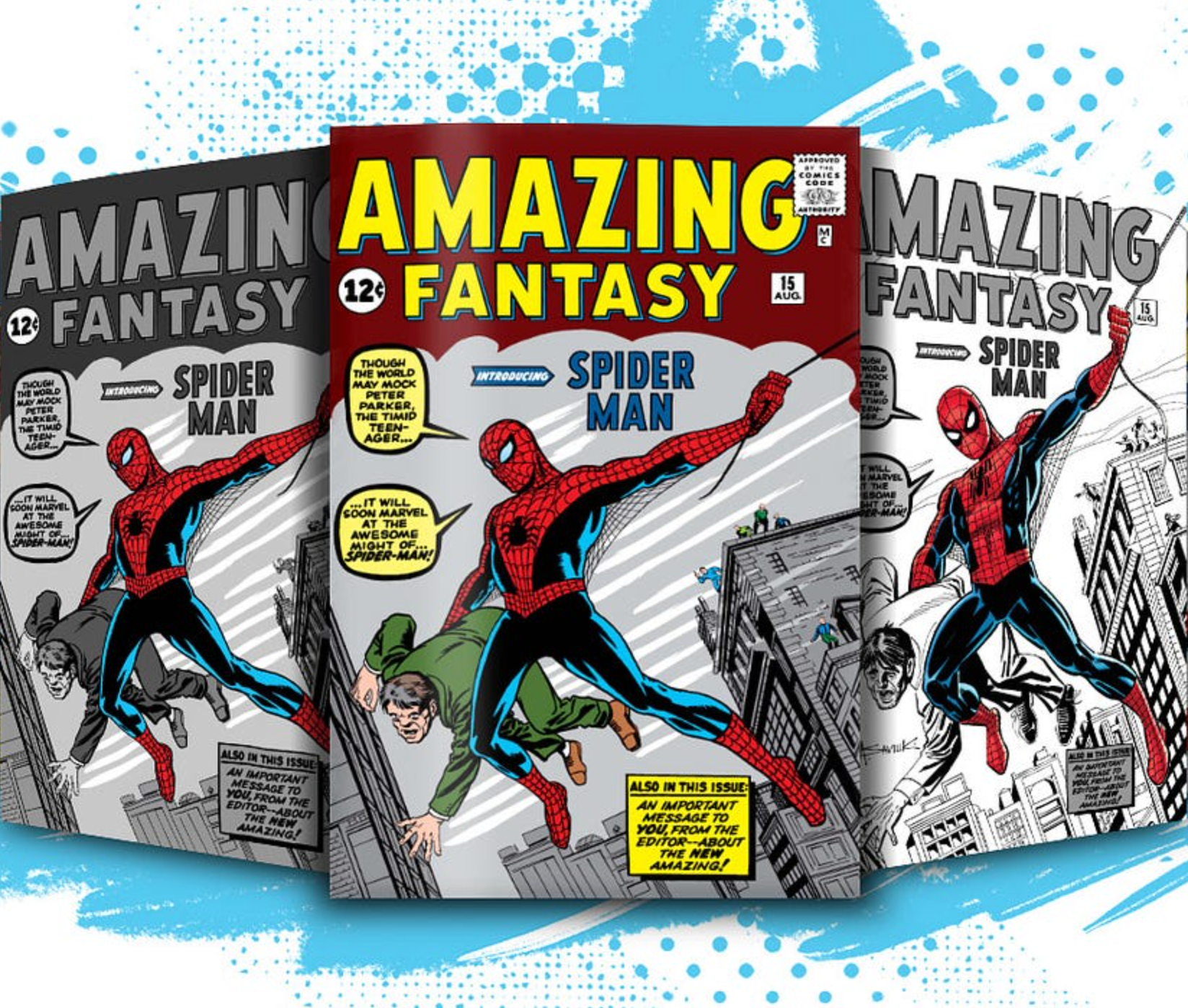
In September 1962, on the dusty American newsstands of an era when comic books still sold for twelve cents apiece, a slim thirty-six-page pamphlet went unnoticed on the racks. Its cover, drawn by Jack Kirby and inked by Steve Ditko, showed a masked man lifting a thug one-handed above a blurred New York neighbourhood. Nobody that day could have guessed that Amazing Fantasy #15 had just given birth to one of the most profitable fictional characters ever created. Sixty-four years later, that same issue sells at auction for $3.6 million and sits in the archives of the US Library of Congress as an official birth certificate for modern pop culture.
The fate of Amazing Fantasy #15 rests on a founding paradox. This issue should never have existed. The anthology title carrying it, originally called Amazing Adult Fantasy, had been in free fall for months. Publisher Martin Goodman, the boss of Marvel Comics, had already decided to shut it down. Stan Lee, then in his thirties and disillusioned with the industry, negotiated one last issue to try out an idea nobody in the office supported: turning a shy teenager into a superhero. That final stand would open the biggest franchise in the history of modern comics and write the name Peter Parker permanently into the collective imagination.
A final issue meant to close a dying title
In the early 1960s, Marvel Comics was still a modest publishing house. The contest with DC, then dominating the market with Superman, Batman and the Justice League, looked lost before it began. Amazing Adult Fantasy, launched in 1961, was a magazine of short science-fiction and fantasy stories, sold as 'the magazine that respects your intelligence'. But sales collapsed. Goodman, a businessman to his core, asked Stan Lee to shut up shop. The writer won one concession: a final issue, the fifteenth, in which he could try out a new character. It would be Amazing Fantasy #15, simply renamed for the occasion by dropping the word 'Adult', judged too restrictive. The gamble was strictly editorial. If the story did not work, the magazine would vanish and Lee would move on. If it did work, he would negotiate a solo title. It was in that grey area that the most profitable idea of Stan Lee's career was born.
Stan Lee's wild gamble against Martin Goodman
Martin Goodman's initial opposition to Spider-Man has become legendary in Marvel lore. The boss raised two blunt objections. First, he hated spiders and argued that readers would share his instinctive disgust. Second, he rejected the idea of a solo teenage hero, convinced that young people only read comics to identify with powerful adults. Stan Lee pushed back, pointing to the growing success of alternative stories and the demand for more relatable characters. The discussion ended in a tacit compromise: Goodman let the issue through but committed to nothing. Amazing Fantasy #15 would come out with no advertising, no promotion and no confidence behind it. Three months later, the sales figures reaching Marvel's head office would sweep away the last doubts. The Spider-Man wave could begin.

The secret origin of Amazing Fantasy #15: the birth of a legend
Everything about the making of Amazing Fantasy #15 tells a story of happy accidents and creative misunderstandings. The comic was drawn by Steve Ditko, written by Stan Lee, lettered by Artie Simek and coloured by Stan Goldberg. Its cover, however, is the work of Jack Kirby, inked by Ditko after a late change of plan. It is that tension between four major artists on a single low-circulation pamphlet that gives the issue its very particular texture, where you can still feel today the hesitations and the detours that saved the idea. Lee's original inspiration went back to a childhood memory, an old pulp story in which a hero named The Spider brought criminals down. The writer circled the idea of a man with spider powers for a long time before daring to propose it.
Stan Lee and the idea nobody wanted
The anecdote, recounted by Lee himself in his memoirs, is precise. He watched a fly climb a wall in his flat, wondered what a human capable of the same feat would be like, and mentally laid down the foundations of a teenage hero able to stick to surfaces, leap from roof to roof and spin a mechanical web. The concept is startling in its simplicity: a schoolboy who had lost his father, raised by an elderly aunt and a kindly uncle, who would gain superhuman powers while remaining trapped in the ordinary problems of adolescence. Money, bullying at school, loneliness in love, existential doubt. That humanist machinery, entirely new in the superhero landscape of 1962, is precisely what frightened Goodman and what would grip millions of readers.
Jack Kirby, Steve Ditko and the founding misunderstanding
Stan Lee first handed the artwork to Jack Kirby, his lifelong collaborator. But the result did not please him. The Spider-Man Kirby drew was too heroic, too muscular, too classical. Lee wanted a thin, anxious teenager, almost fragile beneath his costume. The writer then turned to Steve Ditko, a more introverted artist whose nervous line and taut anatomies fitted the idea of a tormented hero perfectly. Ditko started again from scratch. He invented the red and blue costume with its printed black webbing, drew Peter Parker's first acrobatics above New York and built the visual grammar that would define the character for the next sixty years. Kirby's cover, judged too precious to abandon, was kept and inked by Ditko as a gesture of reconciliation. It is that cover that hit the newsstands in September 1962.
The four stories in the anthology
It is often forgotten, but Amazing Fantasy #15 is not a comic devoted solely to Spider-Man. The anthology format required four short stories. The main one, titled simply Spider-Man!, runs eleven pages and tells the origin. Three secondary tales of five, three and five pages follow: The Bell Ringer, The Man in the Mummy Case and There are Martians Among Us. Those stories, though completely eclipsed by the birth of Peter Parker, are an integral part of the issue and contribute to its rarity today. Complete copies in good condition must contain all thirty-six original pages, or lose half their value on the collectors' market. That technical detail explains why reading guides for beginners always list Amazing Fantasy #15 as a recommended read, but one that is hard to find in its original entirety.
The story told in Amazing Fantasy #15: Peter Parker, the hero who changes everything
The eleven pages by Lee and Ditko compress a complete mythology. Everything fans know by heart today about Spider-Man's origin, from the science laboratory to the crucial crime that turns Peter Parker into a hero, fits into that tiny space. The narrative density of those pages remains a case study in comics schools around the world. No other founding superhero issue has managed to pack so much dramatic material into so few panels. It is that concentration that explains why decades of films, animated series, video games and later comic arcs have never stopped coming back to that point of origin, as if to a bottomless well.
The bite of the radioactive spider
It all begins in Forest Hills, in Queens, New York. Peter Parker, a schoolboy brilliant at science but socially isolated, goes to a public demonstration on radiation. During the experiment, a spider accidentally passes through the beam and drops onto the young man's hand. Its bite, which should have been fatal, passes on to Peter part of the arachnid's altered properties. Back home, the teenager discovers that he can stick to walls, lift considerable weights, sense danger before it arrives and move with inhuman agility. The bite sequence, drawn by Ditko in a handful of brutally efficient panels, has become one of the most reproduced images in comics history. It would return in every Spider-Man film, cartoon and reboot, almost always with near-religious fidelity to the original 1962 layout.
Easy success and young Peter Parker's blind spot
Where the story takes an unexpected moral turn is in what happens next. Peter Parker does not become a hero by vocation. He first monetises his powers by taking part in wrestling bouts, makes money, builds his costume to hide his face and lets himself be intoxicated by his new-found fame. That is exactly what makes what follows so devastating. When a thief runs out of the television studio after a robbery, Peter could have stopped him with a simple gesture. He does not. Not my problem, he thinks. That indifference is the key to all the drama that follows. Young Parker is not a hero yet. He is a self-absorbed teenager, exactly like his readers in 1962. That immediate identification, entirely new in the superhero genre, is what turns Amazing Fantasy #15 into a cultural bombshell. Peter Parker becomes the first fallible superhero, capable of ordinary bad decisions.
The death of Uncle Ben and the line that defines Spider-Man
A few days later, Peter comes home and learns that his Uncle Ben has been murdered by a burglar in their own house. The young man pulls on his costume, hunts the criminal down and discovers, in the warehouse where he corners him, that his uncle's killer is the same thief he let get away the night before at the television studio.

His face undone beneath the mask, Peter Parker understands in a split second that he could have prevented it all. That moral epiphany, drawn in just four panels by Steve Ditko, gives rise to the most quoted line in comics: 'With great power there must also come great responsibility.' That line, which Stan Lee originally placed as a simple closing caption, would become the mantra of the entire Spider-Man universe and a philosophical principle studied at university. The final panel of the comic shows Spider-Man walking away alone into the night, his back bent under the weight of his guilt. A posture that has never left the character since.

To carry on the spirit of the original comic
Spider-Man Retro Comic Book Poster
If reading Peter Parker's origin carried you into the graphic atmosphere of 1962, this poster reproduces the vintage look of the panels drawn by Steve Ditko. A direct tribute to the cult style of Amazing Fantasy #15, to hang in a bedroom, an office or a reading corner and breathe in the scent of the founding comics every day.
22,90 €
Discover the poster ›Why Amazing Fantasy #15 is worth millions of dollars today
For years, Amazing Fantasy #15 was just another comic in the second-hand boxes. Its original cover price was twelve cents in 1962. The copies kept in good condition through the decades have become, slowly and then very abruptly, the Holy Grail of the comic book market. No other publication embodies so perfectly the meeting of pop nostalgia, physical rarity and the symbolic value of a mythological origin. For collectors, owning a genuine copy of Amazing Fantasy #15, even a badly preserved one, means owning the birth certificate of a character whose merchandise now brings in billions of dollars a year to Disney and Sony.
The absolute record of $3.6 million
On 9 September 2021, at an auction held by Heritage Auctions in Dallas, a copy of Amazing Fantasy #15 graded CGC 9.6 on the conservation scale sold for $3.6 million. The result sent a tremor through the whole collectibles market. It beat the previous record by more than $350,000, held since April 2021 by an Action Comics #1 graded CGC 8.5, the very first Superman issue. For the first time in modern history, Spider-Man took the top spot from DC's hero. It is a major symbolic event in the small world of comics. Marvel officially dethrones DC not only in market share, but on the ground of pure symbolic value.
How to read the value of an Amazing Fantasy #15 by CGC grade
The value of a copy of Amazing Fantasy #15 depends entirely on its state of preservation, measured on the CGC scale running from 0.5 to 10. A copy graded 9.4 sold for $454,100 in 2016, then $795,000 in 2020, almost double in four years. The same grade changed hands again for $810,000 in 2023 at a new auction. The further down the scale you go, the more the value falls, but it stays impressive. A copy graded 8.5 reached $552,000 in 2022, and even mid-condition copies, graded between 6.0 and 7.0, regularly trade between $45,000 and $75,000. What is striking is the steadiness of the upward curve. No other comic book series shows such regular appreciation over six decades. To start a Marvel collection, owning a certified facsimile of this founding issue remains the dream target of just about every fan of the universe.
The 24 original pages given to the Library of Congress
In 2008, in a gesture that stayed discreet but carried considerable weight, an anonymous donor handed the twenty-four original pages drawn by Steve Ditko to the Library of Congress in the United States.

These pages, which still carry Stan Lee's blue pencil corrections and Ditko's layout notes, are now kept in a climate-controlled vault in Washington, catalogued alongside the manuscripts of Mark Twain and the scores of George Gershwin. That institutional recognition shifts Amazing Fantasy #15 from the status of a simple comic book to that of American cultural heritage in the strict sense. For fans who thought comics were merely a secondary entertainment, this official canonisation was a reminder of just how far the birth of Peter Parker is an event comparable, in its influence, to the great American novels of the twentieth century.

The centrepiece of your display case
Marvel Spider-Man Collector's Figurine
Owning an Amazing Fantasy #15 graded CGC 9.6 is out of reach for most fans. But the Marvel collector's spirit also runs through the pieces you can hold in your hand. This collector's figurine reproduces the web-slinger's iconic pose in a premium finish that comes into its own on a shelf, a desk or in a devoted fan's display case.
79,90 €
See the figurine ›The legacy of Amazing Fantasy #15: six decades that shaped pop culture
Sixty-four years after its publication, the shockwave from Amazing Fantasy #15 is still spreading in just about every direction imaginable. The issue transformed Marvel, revived the comic book industry, redefined the grammar of the superhero, opened the way for the modern Marvel blockbusters and anchored in global popular culture a moral figure that reaches far beyond entertainment. When a parent buys a child a first Spider-Man gift today, or when fans attend a convention devoted to the universe, they are taking part in an unbroken chain that runs straight back to the thirty-six pages published in 1962 by an anthology title on the brink.
From The Amazing Spider-Man #1 to today's Marvel empire
Just three months after the release of Amazing Fantasy #15, in December 1962, Marvel announced a new solo series titled The Amazing Spider-Man. The first issue, cover-dated March 1963, marks the official start of the character's regular publications. Very quickly, Spider-Man became Marvel's flagship title, outselling every other superhero in the house month after month, including the Fantastic Four then at their peak. It is in that series that the very first recurring enemy of Peter Parker appears, in issue one, opening the endless gallery of villains who would haunt the hero for decades to come. The success was such that other iconic figures quickly joined the ecosystem, including the Green Goblin, created in 1964, who would become the character's definitive antagonist.
Alongside the villains, a whole human universe unfolds around Peter. His biological family, his schoolmates, his future loves, his colleagues at the Daily Bugle, his allies and his rivals form a coherent social network that later major story arcs would never stop enriching. That human density, already sketched out in the eleven pages of Amazing Fantasy #15, is what sets Spider-Man apart from every other hero and what explains his exceptional commercial longevity.
How this comic saved Marvel from bankruptcy
What few people know is that without Amazing Fantasy #15, Marvel Comics would probably have disappeared in the 1990s. When the company came close to bankruptcy in 1996, it was precisely Spider-Man's lasting success that let its executives sell rights, sign partnerships with Sony for the first live-action films and restart an editorial momentum. The character's iconic logo, its merchandise, its toys, its soft toys, its collector's figurines and its posters became a revenue mine that kept Marvel alive through the turbulent years. Without Stan Lee's wild gamble in 1962, it is likely that neither Iron Man, nor Captain America, nor the Avengers as we know them today would ever have reached the screen.
Why fans still collect the myth
For Spider-Man devotees, owning a tangible trace of Amazing Fantasy #15 has become a form of modern pilgrimage. Those who cannot afford a certified original copy, which is the overwhelming majority of fans, fall back on posters reproducing the legendary cover, on facsimiles, on the Marvel Masterworks reissues or on decorative objects inspired by Ditko's original artwork. Vintage t-shirts reproducing the first cover, toys with retro designs and even masks inspired by the 1962 costume enjoy renewed interest with every big cinema release. The issue goes on living, indirectly, in millions of homes around the world.
What is striking, rereading the eleven pages by Lee and Ditko today, is that everything is already there. The costume, the psychology, the family drama, the famous line, the promise of a hero's life that will always be more painful than glorious. Amazing Fantasy #15 is not just a comic book from 1962. It is the embryo of a myth that redefined what it meant to be a superhero in the twentieth century, and which continues, six decades later, to shape the sensibility of every child who discovers Spider-Man for the first time. To go further into this founding mythology, fans can carry on reading with a complete portrait of Peter Parker or explore the official Spider-Man fancy dress costumes that keep the graphic legacy invented by Steve Ditko almost two thirds of a century ago visually alive at every carnival.

