
14-Day Money-Back Guarantee
0
The short answer
A botched spell from Doctor Strange pulls the villains and both previous Peter Parkers into the MCU, before Peter erases his own existence from everyone's memory. The film passed $1.9 billion at the box office. And since Brand New Day arrived, that sacrifice reads very differently. Here is the whole story.
This is the film that tipped the franchise over, and it is also the one everything that follows depends on. Released in late 2021, Spider-Man: No Way Home brought together three generations of actors, dug up villains everyone assumed were buried, then closed its story on a decision of a cruelty rarely seen in a blockbuster. Four years on, the release of Brand New Day has just shown that this choice was no end-of-film gimmick. A look back at the web-slinger's most consequential film.
The starting point: a spell that goes wrong
The film opens exactly where the previous one stopped: Spider-Man's identity has just been revealed to the entire world, and Peter Parker is discovering what that means in practice. His life falls apart, so do the lives of those close to him, and university doors close on the people around him.
His solution is a teenager's: ask a sorcerer to erase the problem. Doctor Strange agrees to cast a spell that would make the world forget Peter Parker is Spider-Man — but Peter interrupts the incantation halfway through, over and over, to spare the people he loves. The spell cracks, and it is that crack which opens the doors of the multiverse. The whole film flows from this clumsiness, and that is what makes it ring so true: the catastrophe is not caused by a Machiavellian plan, but by a boy who cannot bring himself to choose.
The villains from elsewhere
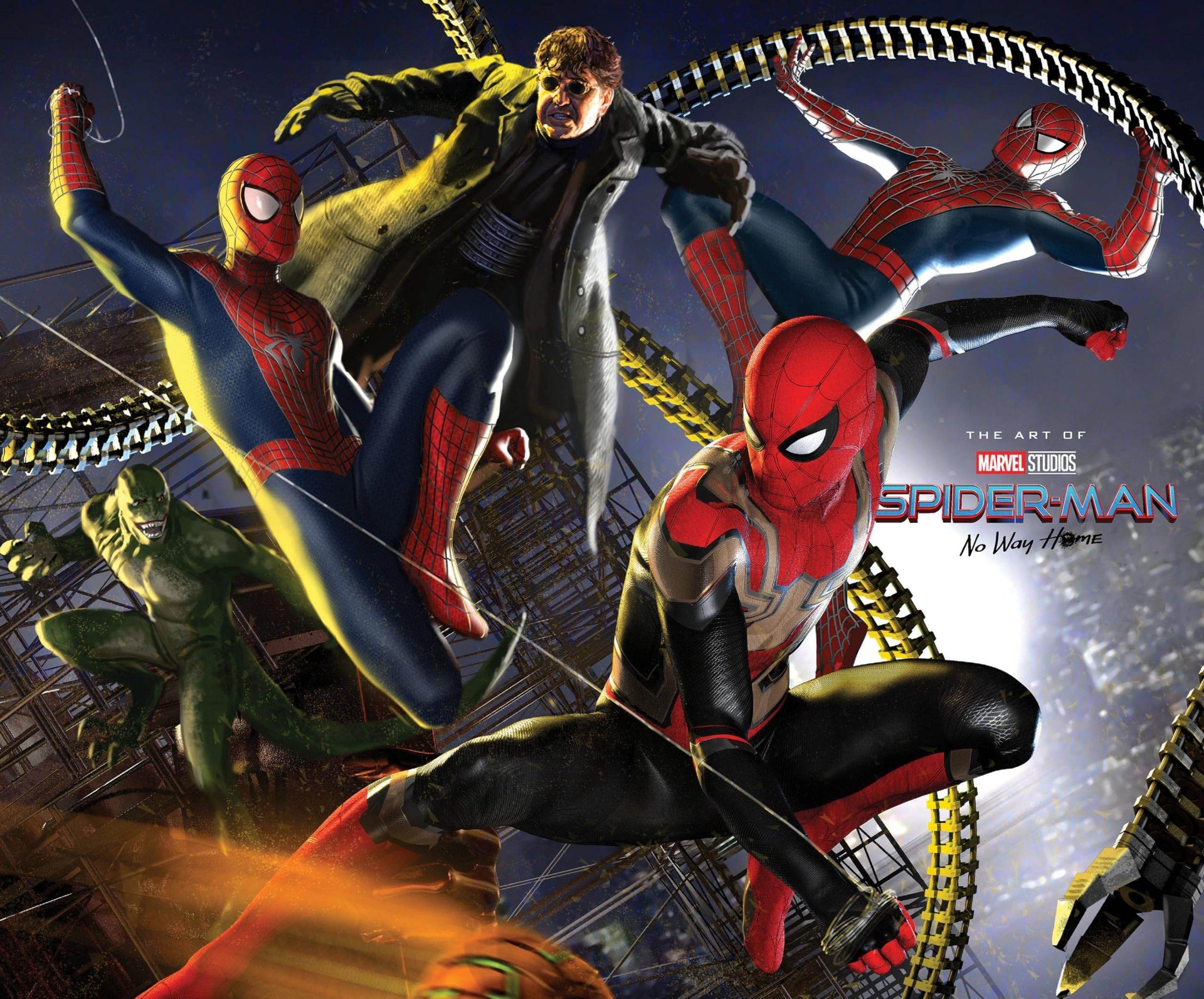
The breach draws in enemies from realities where Peter Parker wore a different face. Norman Osborn's Green Goblin, Otto Octavius's Doctor Octopus, Electro, Sandman and the Lizard each cross the screen with their story already written, and above all with their death already scheduled in their universe of origin.
This is where the film makes an unexpected decision. Rather than turning them into threats to be put down, it proposes curing them. Peter refuses to send them back to die and sets out to repair what broke them — a moral stance that will cost him dearly, but which defines the character better than any fight. Full portraits of these enemies are gathered in our guide to Spider-Man's enemies, and the most fearsome of them all in our analysis of the Green Goblin.
The return of Tobey Maguire and Andrew Garfield
This is the moment audiences were waiting for without daring to believe it, and the studio defended it right to the end, even having the actors themselves deny they were involved. The two previous Peter Parkers step in to support the youngest, and the sequence works for one simple reason: it does not just please, it repairs.
Each of the two carries a grief his own franchise never resolved. One lost his best friend, the other failed to catch Gwen Stacy — an episode whose weight we cover in our feature on the arc that changed Spider-Man forever. The film offers both of them a repair, and that is what turns a cameo into genuine writing.

The most anticipated return
Spider-Man Figure — Tobey Maguire in No Way Home
The silhouette of the oldest Peter Parker, back twenty years after his debut. The piece that brings to life the most talked-about sequence in the saga.
View the product — 99,90 €The final sacrifice: what Peter really chooses
The ending is the film's high point. The multiverse is on the verge of collapse, and the only way out is to make the entire world forget not Spider-Man's secret, but Peter Parker himself. His existence, his school years, his friendships, his love story: all of it has to vanish from memory for reality to hold.
Peter accepts. He warns the people close to him, takes the time to speak to them one last time, then lets the spell run its course. This is not a heroic death with music and slow motion — it is an administrative disappearance, silent, that nobody will ever know anything about. The final coffee shop scene, where he gives up on introducing himself to the woman who no longer recognises him, is one of the harshest endings a superhero film has ever dared.
What the spell erases exactly, and what it leaves behind
The detail matters, and plenty of summaries get it wrong. The spell does not erase Spider-Man: it erases Peter Parker. The masked hero remains perfectly well known, his exploits stay in people's memories, the city keeps talking about him. It is the man under the suit who is removed from everyone's awareness.
Another decisive nuance: the physical traces remain. Objects stay, so do documents, and nothing stops someone from relearning what they can no longer remember. This apparently minor flaw would become the engine of an entire film four years later. The question of the secret identity runs through the character's whole career, as shown by our roundup of every time he has been unmasked.
Four years on: what Brand New Day made of it
This is the real new development, and it changes the way you rewatch the film. Spider-Man: Brand New Day, released on 29 July 2026, takes place four years after these events, with its opening scene set nine months after the end of No Way Home. And it confirms what many hoped would be contradicted: the spell still holds.
Nobody has got their memory back. The world carried on without Peter Parker, the people close to him got on with their lives, and he spent four years in an isolation the new film takes its time to show. What the coffee shop scene left open — maybe one day, maybe a sign — has been closed. The portrait of this man forgotten by everyone is developed in our breakdown of his Peter Parker.
The new film does still make use of the flaw mentioned above. A letter written before the spell allows one character to relearn who Peter is — without ever remembering him. The distinction is a fine one and it sits at the heart of the story: we go into it in our article on what MJ remembers.

Wear the multiverse
Zip Hoodie — Gwen Stacy Multiverse
The film opened parallel realities up to a mass audience. A piece that picks up that multiverse look, wearable every day.
View the product — 69,90 €Should you rewatch it before Brand New Day?
Yes, and it is the only genuinely essential film. Every viewing guide published around the release of the fourth instalment agrees on this point: without No Way Home, the new film's starting situation makes no sense. You grasp neither why Peter is alone, nor why nobody recognises him, nor what the letter that sets the plot going represents.
The other films in the trilogy add comfort but are not compulsory, and some series that often get cited are of no real use. The full sorting is in our guide to what you need to have seen first. To place each film in order, our overview of the Spider-Man films retraces the whole chronology.
The moment that tips the film over
There is a before and an after in this story, and it is not the arrival of the other Peter Parkers. It is the death of Aunt May, killed by the Green Goblin at the precise moment Peter was trying to cure him rather than take him down. She dies as she says to him the line that has defined the character since 1962: with great power there must also come great responsibility.
The film takes a considerable risk here. It has that line spoken by the character who embodies it best, at the worst possible moment, and turns a formula that had become a slogan into a condemnation. Peter had just chosen compassion, and that compassion has just cost him the only family he had left. We look at the weight of this line in our feature on the web-slinger's most famous words, and at the way grief had already shaped the character in the story of how Uncle Ben died.
It is also what makes the ending coherent. A Peter who had lost nothing would have no reason to accept losing everything. The final sacrifice is not a noble gesture out of nowhere: it is the direct consequence of a man who has just understood, painfully, what his position really means.
Doctor Strange, the necessary counterpoint
The sorcerer is not a simple dispenser of spells. In the film he works as the voice of the pragmatic adult facing a young man who refuses trade-offs. When Peter wants to save the villains, Strange wants to send them home to die, on the grounds that it was their fate and that the stability of reality comes first.
The disagreement is more interesting than a standard confrontation, because neither of them is completely wrong. Peter defends a morality of the individual, Strange a morality of consequence, and the film never really settles it: Peter's position causes May's death, but it also saves five men. It is that ambiguity which gives the story its depth, and which sets up the disenchantment that the fourth film would put on screen four years later.
It is Strange, finally, who delivers the verdict: the spell can no longer be undone without risking collapse. In accepting, Peter is not choosing between two comfortable options, he is choosing the less destructive one. Nothing in the film suggests he will be able to go back, and the next one has confirmed it.
The numbers behind a phenomenon
The film passed $1.9 billion at the worldwide box office, at a time when cinema attendance was still recovering. In France, it drew 7,319,651 admissions, which to this day makes it the biggest superhero film of all time in the country.
To get a sense of the scale of that performance, its opening day in France drew 476,494 people across 882 prints. The fourth instalment did better out of the gate, with a quarter fewer screens, but remains a long way off the overall total: the detail of that comparison is in our tracking of the Brand New Day box office.
What the film changed for the whole MCU
Beyond Spider-Man, No Way Home installed the multiverse as the main narrative engine of the entire cinematic universe. What was only a science-fiction curiosity became the shared grammar of the films and series that followed, right up to the events announced for the coming years.
The film also proved that a studio could keep a secret on a global scale, a method used again since with a fair amount of success. Detailed assessments of that impact are gathered in our analysis of everything it overturned, and the multiverse echoes on the animation side in our feature on Across the Spider-Verse.

The Peter rehabilitated
Spider-Man Poster — Andrew Garfield
His version, long unloved, came out of the film a hero. A wall format for those who always defended it.
View the product — 22,90 €The film that rehabilitated Andrew Garfield
One side effect deserves a mention, because it is rare for a film to change another film's reputation retroactively. The version played by Andrew Garfield had been cut off mid-race, its franchise cancelled, his performance long reduced to a commercial failure. Two hours were enough to overturn that judgement.
Audiences rediscovered a Peter Parker who was more highly strung, more damaged, and above all carrying a guilt the film finally takes the time to address. Since then, calls for a sequel to this version come back regularly, and merchandise bearing his likeness sells far better than it did before 2021. It is probably the most spectacular rehabilitation in the genre's recent history.
Why it works so well
The explanation comes down to a balance that is hard to strike. The film hands out an unusual amount of immediate pleasure — reunions, nods, dialogue awaited for twenty years — without ever letting that pleasure replace the story. Every return serves a repair, every returning villain carries a moral question, and the whole thing converges on a real loss.
It is also the film that finally completes the character's coming of age. He starts out a teenager asking a sorcerer to erase his problems, he ends up a man who accepts paying the price alone. That trajectory is exactly the one the whole of Spider-Man mythology tells, as set out in our feature on the man behind the mask.
To carry it over into the shop, the figures and the posters cover all three actors in the role, the fancy dress costumes and masks recreate their respective suits, and the Brand New Day selection brings together the pieces from the film that follows it. The T-shirts complete the wardrobe.
Frequently asked questions
Do you need to have seen the older Spider-Man films?
No, the film stands alone and explains what you need to know. Having seen them does transform the experience, though: every return takes on its meaning, and the repairs offered to the two previous Peters only work fully if you know their wounds.
Is the spell permanent?
It still holds four years later, as the next film confirmed. Nobody has woken up, no counter-spell has been cast. What the mechanics do allow is relearning, through outside proof, what you can no longer remember.
How long is the film?
Two hours twenty-eight, which makes it the longest Spider-Man film to date. Its 2026 successor comes close with two hours twenty-five, without going past it.
Are there any post-credits scenes?
Two, and they do not serve the same purpose. The first extends a parallel plot from the studio, the second is a long trailer for the Doctor Strange film that followed. Neither of them changes Peter's fate or calls the spell into question.
Why do those particular villains come back?
Because the breach draws in those who, in their own reality, already knew Spider-Man's identity. That is the rule the film sets, and it explains the selection: each of them had discovered the face under the mask before dying. A simple logic that elegantly justifies a dream cast.
Should you rewatch it before Brand New Day?
It is strongly advised, and it is the only film for which that is really the case. The starting situation of the fourth instalment flows directly from its final scene: without it, you understand neither Peter's isolation nor the stakes of the letter that kicks everything off.
This great reset leaves Peter alone with himself — and, now, with his own body. Brand New Day pushes the logic one step further: we explain why Peter Parker's organic webs end up taking over on screen.

