
14-Day Money-Back Guarantee
0
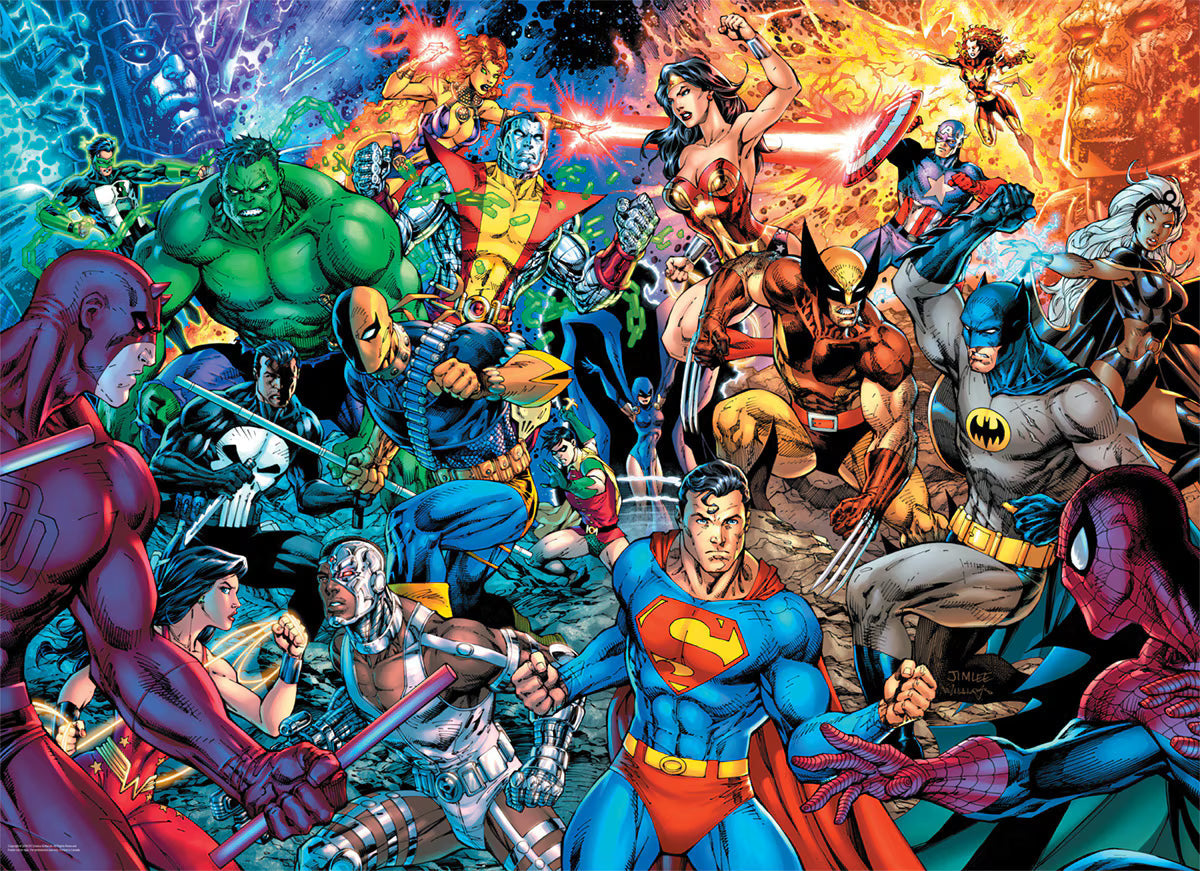
There's a question comic fans have been asking themselves for decades, over a coffee or a pint in a specialist shop: what would happen if Spider-Man met Batman? What if Peter Parker took on Superman? What if the Avengers and the Justice League had to join forces against a cosmic threat? For most fictional universes, that kind of scenario stays impossible — different brands, rival publishers, lawyers ready for a fight. But between Marvel and DC, the impossible has already happened. Not once, not twice — several times across three decades. And at the heart of almost every one of these historic crossovers you'll find one recurring character: Peter Parker.
This article traces all the Marvel vs DC crossovers involving Spider-Man — from the forgotten blockbuster events of the 1970s to the legendary bouts of the 1990s, by way of the merged Amalgam universe. Not a theoretical analysis of what might happen in some unlikely future, but a factual account of what really happened in the official comics. These crossovers are extremely rare editorial objects, now treasured by collectors, and most British fans only know them by name. Here is the complete story, in chronological order, of the day Spider-Man crossed the border between the two biggest superhero universes in the world.
1976: Superman vs Spider-Man — The First Historic Clash
It all begins in 1976 with a publication that seemed unthinkable at the time. Superman vs The Amazing Spider-Man, an oversized special co-published by Marvel and DC, is the first inter-publisher crossover in the history of American comics. Written by Gerry Conway (who had notably written the death of Gwen Stacy a few years earlier), with art by Ross Andru and John Romita Sr. The premise is simple: Lex Luthor and Doctor Octopus team up to conquer the world, which forces Superman and Spider-Man to meet in order to stop them.
What makes this comic historic isn't so much its plot (fairly conventional for the time) as its very existence. In 1976, Marvel and DC are fierce rivals. That the two publishers sat down at the same table to produce a comic together was an unprecedented industry event. The issue cost 2 dollars at the time (the equivalent of more than 10 dollars today) — an eye-watering price that turned it into a prestige object and a collector's investment. Copies in perfect condition now sell for several hundred euros on the specialist market.
The main fight between the two heroes — engineered by the villains to turn them against each other — is one of the most discussed moments in all of comics history. Spider-Man takes the blows of a manipulated Superman, unable to hit back in any real way against a near-divine being. But it's Peter, through cunning and tactical intelligence, who ends up breaking the mental illusion pushing Superman to attack him. The message is clear: in this crossover it's the web-slinger's brain that saves the day, not the raw power of the Man of Steel.
Superman vs Spider-Man, 1976
Price at the time2 dollars
Equivalent todayMore than 10 dollars
Copy in perfect conditionSeveral hundred euros
StatusFirst inter-publisher crossover
1995: Spider-Man and Batman — Disordered Minds
Nearly twenty years after the first crossover, Marvel and DC try the experiment again in 1995 with a more modest but artistically more ambitious project. Spider-Man and Batman: Disordered Minds, written by J. M. DeMatteis and drawn by Mark Bagley, stages a meeting between Peter Parker and Bruce Wayne around a dark subject: forced medical experimentation on psychopathic criminals. Carnage and the Joker — the two most emblematic psychopaths of the two universes — are at the heart of the plot.
What makes this crossover so fascinating is the juxtaposition of two heroes facing enemies who mirror them in sheer savagery. Carnage and the Joker are both incarnations of absolute chaos — but Spider-Man and Batman approach them in radically different ways. Peter wants to understand the psychology of Cletus Kasady; Bruce prefers tactical efficiency. This dynamic between two heroes with opposing philosophies but mirror-image enemies is the narrative heart of the comic.
Mark Bagley's artwork is especially successful — he had spent years drawing Spider-Man in the regular comics, and his nervous, dynamic style suited the world of Gotham just as well. The pages where Spider-Man swings through a rainy, shadowy Gotham have become iconic for the fans who collect this kind of crossover. The comic ends with a shared victory over the two villains, and a mutual respect between the heroes that hints they might cross paths again one day.
The team
Written by J. M. DeMatteis, drawn by Mark Bagley.
The villains
Carnage and the Joker, at the heart of the plot.
Two methods
Peter wants to understand Cletus Kasady; Bruce prefers tactical efficiency.
1996: Marvel vs DC — The Multiverse Mega-Event
1996 marks the high point of the Marvel vs DC crossovers with the publication of Marvel vs DC / DC vs Marvel — a four-issue mini-series co-written by Ron Marz and Peter David, drawn by Dan Jurgens and Claudio Castellini. The premise is cosmic: two near-divine entities (the Brothers, each one standing for a universe) challenge each other to decide which of the two realities will be destroyed. To settle the conflict, 11 fights pit the greatest heroes of the two houses against each other, and fans can vote to decide who wins.
Spider-Man fights Superboy in one of the most debated bouts of the whole mini-series. The fight takes place in a Manhattan that blends the two universes, and it's Spider-Man who comes out on top thanks to his agility and his knowledge of the terrain — one of the rare Marvel wins in a series where DC largely dominated the vote. The result infuriated DC fans at the time but remains one of the most iconic moments in the entire history of inter-publisher crossovers.
Beyond the Spider-Man vs Superboy fight, the mini-series also shows Peter Parker crossing paths with Lois Lane, Clark Kent meeting Mary Jane, and several other meetings between supporting characters that would have been unimaginable a few years earlier. It's a celebration of everything the two universes have built over fifty years, and the absolute peak of what the two publishers managed to achieve together.
Collector's Piece — Premium Edition

Spider-Man Collector's Resin Figurine
€299.90
The premium figurine that immortalises the web-slinger — for collectors who appreciate rare pieces, just like the Marvel vs DC crossovers.
Discover the Figurine →Marvel vs DC, 1996
Issues4
Fights11
Spider-Man's fightAgainst Superboy, in Manhattan
OutcomeSpider-Man wins
Amalgam Comics — When Spider-Man Merges with Superboy
The maddest moment of the Marvel vs DC crossovers comes just after the 1996 event with the creation ofAmalgam Comics — a temporary imprint that merges characters from the two universes outright. For a few months, fans discover a new universe where the heroes are combinations from both houses: Dark Claw (Batman + Wolverine), Super-Soldier (Captain America + Superman), Speed Demon (Flash + Ghost Rider), and above all — the centre of attention for Spider-Man fans — Spider-Boy.
Spider-Boy is the fusion of Peter Parker and Superboy. Pete Ross, a young man from Kansas, gains the powers of the spider and becomes a hero in a red and blue costume, but with a cape inspired by Superman. His origin combines the radioactive spider bite with Kryptonian roots — a narrative marriage fans still see today as one of the most creative concepts in the whole history of comics crossovers. Amalgam Comics published only a dozen issues in total, which makes it one of the rarest and most collectable imprints in the history of the medium.
What makes Amalgam especially fascinating for fans of the Spider-Man multiverse, it's that it foreshadows the modern Spider-Verse concept by more than fifteen years. Spider-Boy is technically an alternative version of Spider-Man, in a parallel universe where the borders between Marvel and DC don't exist. That's exactly the kind of concept Spider-Verse would exploit decades later with Miles Morales, Spider-Gwen, and all the other dimensional Spider-Heroes.
Dark Claw
Batman and Wolverine.
Super-Soldier
Captain America and Superman.
Speed Demon
Flash and Ghost Rider.
Spider-Boy
Peter Parker and Superboy, embodied by Pete Ross.
1997: Spider-Man and Batman 2 — New Age Dawning
A year after Amalgam Comics, Marvel and DC publish one last significant Spider-Man/Batman crossover with Spider-Man and Batman: New Age Dawning. This time the story pits the two heroes against a cosmic threat that goes beyond the limits of their respective universes — a narrative precursor to the multiverse events that would dominate comics in the 2010s.
What makes this crossover important is that it consolidates the narrative dynamic between Peter Parker and Bruce Wayne established two years earlier. The two heroes have become near-friends, they trust each other, they have developed a mutual understanding of their opposing methods. For fans who follow long-running comics arcs, this continuity between two crossovers two years apart is almost miraculous — it's the narrative equivalent of an inter-publisher extended universe that could have been born but never really came to anything.
A friendship consolidated
New Age Dawning pits the two heroes against a cosmic threat and consolidates the dynamic between Peter Parker and Bruce Wayne established two years earlier.
2003: JLA/Avengers — The Final Cosmic Crossover
The last great Marvel vs DC crossover to involve Spider-Man arrives in 2003 with JLA/Avengers, a four-issue mini-series written by Kurt Busiek and magnificently drawn by George Pérez (whose hyper-detailed style could fit hundreds of characters into a single panel). The cosmic premise sets the Justice League and the Avengers directly against each other, with Spider-Man in the Marvel ranks — including for the first time he really fought alongside the Avengers in an inter-publisher crossover.
The high point for Spider-Man fans is his meeting with the Flash (Wally West), where the two heroes discover they share a similar ethic — protecting the innocent above all, a sense of humour in the middle of a fight, the ability to improvise under pressure. Spider-Man and the Flash form one of the most unexpected yet most coherent pairings in the whole mini-series, and that dynamic remains one of the most discussed on collectors' forums.
JLA/Avengers is also remarkable for its narrative scale. Pérez literally draws hundreds of heroes across a single double-page spread — Spider-Man, the Fantastic Four, the X-Men, Iron Man and Thor on one side; Superman, Batman, Wonder Woman, Green Lantern and the Flash on the other. It's the absolute visual peak of the Marvel vs DC crossovers, and probably the never-equalled high point of the medium in terms of the density of iconic characters in a single work.
Collector's Edition — Watercolour Poster

Spider-Man Noir Watercolour Poster
€16.90
The web-slinger's grown-up iconography — to decorate a reading corner where the rarest comics take pride of place.
Discover the Poster →The team
A four-issue mini-series by Kurt Busiek, drawn by George Pérez.
The high point
Spider-Man meets the Flash (Wally West) and shares his ethic.
The scale
Hundreds of heroes on a single double-page spread.
Why These Crossovers No Longer Happen Today
Since JLA/Avengers in 2003, no major Marvel vs DC crossover has been published. The reasons are many and fascinating. First, Disney's acquisition of Marvel in 2009 changed everything — the new Disney management is far more protective of the Marvel rights and far less open to collaborations with other publishers. DC, for its part, now belongs to Warner Bros Discovery, a direct competitor of Disney in streaming and cinema. The two houses have become corporate rivals well beyond simple editorial competition in comics.
Next, the explosion of the Marvel Cinematic Universe from 2008 onwards and DC's strategy to compete created a climate where each publisher wants to maximise the value of its own characters rather than share them. The 2003 crossover was made at a time when superhero cinema barely existed — Marvel Studios had not yet launched Iron Man, and the DC films were marginal. Today, any potential crossover would immediately become a strategic question worth several billion dollars.
Finally, there's the question of narrative complexity. The Marvel and DC universes have become so sprawling and fragmented (the Spider-Verse multiverse on the Marvel side, New 52 and Rebirth on the DC side) that a coherent crossover would be an editorial nightmare. Which Spider-Man would meet which Superman? Which of the many Batmen would team up with which of the many Peter Parkers? The multiverse has paradoxically made inter-publisher crossovers almost impossible to plot cleanly.
Corporate rivalry
Marvel bought by Disney in 2009, DC at Warner Bros Discovery.
What cinema puts at stake
Since the MCU, any crossover would be worth several billion dollars.
Narrative complexity
Multiverses so fragmented that a crossover would be a nightmare.
The Hidden Legacy of the Marvel vs DC Crossovers
Even though they no longer happen, these crossovers left a deep mark on modern comics culture. The concept of the Spider-Verse multiverse is directly inspired by the idea of blending different universes — something Marvel and DC normalised during the crossovers of the 1990s. Miles Morales, Spider-Gwen and all the other dimensional Spider-Heroes exist narratively thanks to ground prepared by Spider-Boy and Amalgam Comics two decades earlier.
The other major legacy is the way Spider-Man was elevated as a character able to hold his own against the greatest DC heroes. In every crossover — Superman, Batman, the Flash, Wonder Woman — Spider-Man was never made to look ridiculous. On the contrary, his cunning, his tactical intelligence and his morality positioned him as a hero who deserves his place in the global superhero pantheon, not just the Marvel one. That cross-publisher validation strengthened the web-slinger's cultural standing in global pop culture.
For collectors, the Marvel vs DC crossover comics remain among the most precious objects in the medium. A mint-condition copy of Superman vs Spider-Man from 1976 now sells for more than €500 on the specialist market. The Amalgam Comics can reach similar prices for the rarest issues. And JLA/Avengers — published in just four issues but with hundreds of characters drawn by Pérez — is considered by many to be the finest comics crossover ever published, in any era.
The multiverse
Spider-Boy and Amalgam prepared the ground for the Spider-Verse.
The validation
Spider-Man was never made to look ridiculous against the DC heroes.
The market value
A mint-condition Superman vs Spider-Man from 1976 goes beyond €500.
And Tomorrow? The Hope of a Return
Will there ever be a new Marvel vs DC crossover involving Spider-Man? Probably not in the near future, given the corporate considerations above. But comics history shows us that things always change. In the 1970s, nobody would have imagined Marvel and DC publishing together. And yet 1976 happened. In the 1990s, the idea of a merged universe like Amalgam seemed absurd — but it existed.
Today, the success of the Spider-Verse on the animated film side and the growing popularity of multiverse concepts could eventually reopen the door. Picture a cinematic Spider-Verse where, for a moment, you glimpse a parallel dimension in which Spider-Man shares a coffee with Batman in a Gotham that looks like Manhattan. It isn't happening tomorrow — but it's no longer impossible. The fans who follow Beyond the Spider-Verse and Sony Pictures' multiverse strategy are secretly hoping for that kind of surprise.
In the meantime, the Marvel vs DC Spider-Man crossovers remain rare historic objects to discover or rediscover. To explore every dimension of the web-slinger — including his most extraordinary adventures, his most unexpected encounters and his most improbable alliances — the Spider-Man figurines collection and the Spider-Man posters collection offer pieces that pay tribute to every facet of the character, from the classic to the rarest. And to carry on exploring the Spider-Man universe, browse the complete Peter Parker page or the Spider-Verse pillar page. Because in the end, the dream of a Spider-Man meeting Batman has already come true — you just have to dig into the archives to rediscover it.
A return that isn't impossible
Not in the near future given the corporate considerations, but the success of the Spider-Verse and of multiverse concepts could eventually reopen the door.

