

14-Day Money-Back Guarantee
0
The short answer
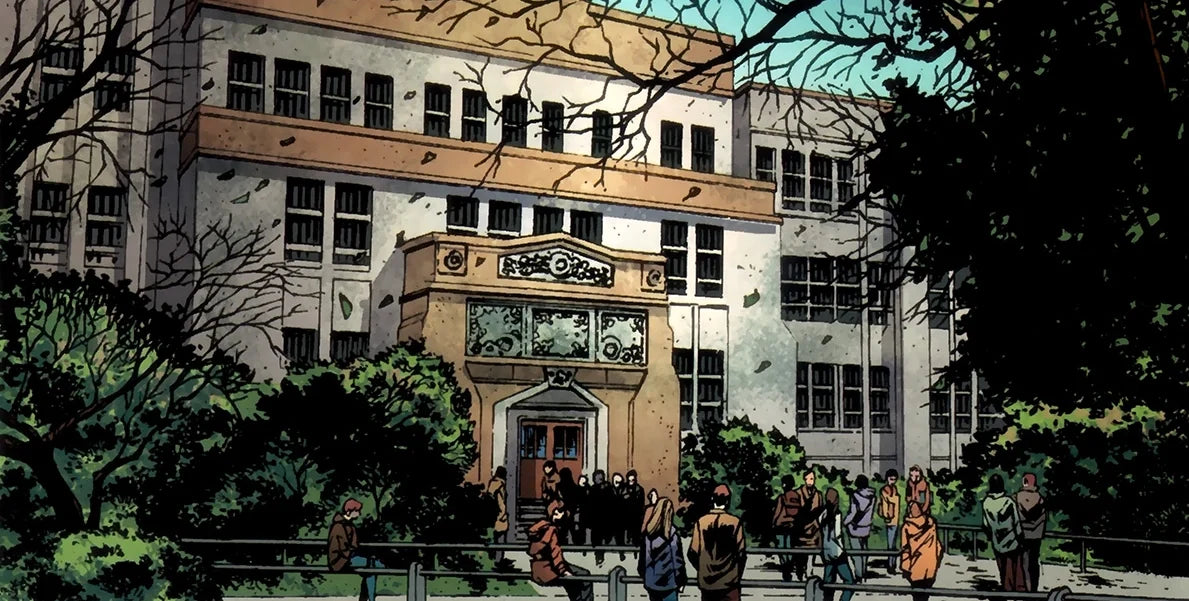
Empire State University is the New York university Peter Parker enrols at in 1965, after secondary school. It is where he meets Harry Osborn and Gwen Stacy, where he sits in the biology lectures of the professor who will become the Jackal, and where he later returns from the other side of the desk. It is the most drama-rich setting in the whole series.
Everyone knows Peter Parker’s secondary school. Far fewer people know that he left it, and that the next chapter of his life unfolds in a place just as formative: Empire State University, a fictional New York university he enters in the mid-1960s.
That shift is one of the most important ever made in the series. It moves the character from adolescence into adulthood, completely renews the people around him, and sets up the stage for his most memorable dramas. Here is why this campus matters as much as the house in Forest Hills or the Daily Bugle newsroom.
What Empire State University is
ESU is a fictional university in New York, presented as a large urban institution rather than a leafy campus tucked away from the city. It belongs to the same family of invented places as the Daily Bugle: plausible enough that you never question it, free enough that the writers can do whatever they like with it.
It first appeared at the end of 1965, in the issue where Peter Parker starts his first term. Choosing an urban university fits everything else in the set-up: Peter still lives at his aunt’s, takes public transport, and juggles lectures with a job. He does not have a campus student life, he has the life of a student who works.
Science is central to it. Peter pursues studies there that finally explain what readers had been seeing from the start: this boy makes his own web fluid in a bedroom. ESU gives institutional legitimacy to something school could only hint at.
That detail deserves a pause, because it cuts against the usual logic of the genre. For most superheroes, the kit comes from a fortune, from alien technology or from an inheritance. For Spider-Man, it comes from schoolwork. The web-shooters are not a gift: they are the homework of a gifted student with no money.
The university is therefore the institution that makes the character coherent. Without it, a schoolboy inventing an unheard-of polymer in his bedroom is pure fantasy. With it, you have a path: an early gift, a training, a laboratory, professors. The series gave itself the means to make its most improbable premise believable.
It also explains why so many of his adversaries come from the same world. When the hero is a scientist, his enemies are too — and the campus becomes the natural point of contact between the two camps.
1965: the day Spider-Man left school
Ageing a comics character is risky. Most heroes of the era stayed frozen at an undefined age, which allowed the same situations to be replayed indefinitely. Moving Peter Parker from school to university meant giving up that convenience.
The gamble paid off, and it explains a good part of the series’ longevity. By ageing alongside its readers, the character could tackle subjects impossible at school: financial independence, adult relationships, career choices, the death of friends. The school setting itself was handed down to the generations that followed.
The contrast with the earlier period is stark. Where Midtown High was a place of bullying and humiliation, ESU is a place of choices and responsibilities. Harassment gives way to adult dilemmas. It is the same character, in a completely different narrative register.
Harry and Gwen: the circle that replaces everything
University gives Peter what school never had: friends. He meets Harry Osborn there, with whom he ends up sharing a flat, and Gwen Stacy, who becomes the central love of this period.
Harry’s case is a particularly loaded one. The son of an industrialist, he embodies a social world Peter does not know, and their friendship is built in spite of that gap before falling apart under the weight of the secret and of his father’s legacy. We traced that arc in our portrait of Harry Osborn, friend, rival or enemy — and none of it would have been possible without a place where two young men from opposite backgrounds cross paths every day.
As for Gwen Stacy, she belongs entirely to this period. Her presence, her relationship with Peter and her death define the university era of the series, and its outcome remains one of the most discussed shocks in all of American comics, as we set out in our analysis of her death.

Spider-Man Poster – and the Green Goblin
The clash that begins with a university housemate friendship. Harry Osborn’s whole story is contained in that opposition.
See the product — €22.90The professor who becomes a monster
Here is the element few casual readers know about, and the one that makes ESU far more than a backdrop. One of Peter Parker’s biology professors is called Miles Warren. He is a respected scientist, an ordinary teacher, and a man who develops an obsession with one of his students.
His descent would give rise to one of the most disturbing antagonists in the catalogue, whose path we retraced in our article on the Jackal. The important point is this: this villain did not fall from the sky, he taught in the lecture theatre where Peter took notes.
The consequences unfold across decades. This professor’s work opens the way to one of the longest and most debated sagas in the series, and to characters such as Ben Reilly, who became Chasm. All of it comes out of a university laboratory.
A campus that manufactures monsters
Miles Warren is not an exception. ESU works in the series as an incubator: laboratories, funding, experiments, researchers under pressure. Many of the web-slinger’s adversaries are scientists, and they had to have worked somewhere.
The parallel with the private sector is instructive. Where Oscorp Industries produces disasters through greed and industrial negligence, the university produces them through personal ambition and intellectual drift. Two different mechanisms, the same result.
This symmetry is probably not premeditated, but it gives the universe a rare coherence. The threats do not come from another planet: they come from the institutions where Peter studies and works. For an overview of these figures, the complete guide to the iconic villains lets you measure how many of them wear a lab coat.

Retro Spider-Man Tie
The formal register, the one of campuses and lecture theatres. To be worn where nobody expects a nod to the web-slinger.
See the product — €22.90Money, the obstacle that never goes away
One point adaptations systematically skip: Peter Parker cannot afford to be a student. American tuition fees, the cost of textbooks, transport, and an aunt to support — university is a financial problem for him as much as an intellectual one.
That constraint runs through the whole period. It explains why he sells photographs to the paper that smears him, why he takes on one odd job after another, why he misses lectures and exams. Where other heroes have a fortune or a patron, he has to choose between a decent wardrobe and a semester.
The narrative payoff is precious. The stakes of an issue can be a threatened grant rather than an alien invasion, and the reader believes it just as much. Few superhero series can build tension out of a university enrolment; this one has been doing it for sixty years.
It is also what makes his path credible to a non-American audience, where the same trade-offs exist in other forms. The setting is fictional, the difficulty is not.
A place where social worlds meet
ESU brings together people who would never have crossed paths otherwise. A scholarship boy from Queens, an industrialist’s heir, a policeman’s daughter: the campus works as a meeting point between worlds that, in the real city, stay separate.

That set-up produces most of the tensions of the period. The friendship between Peter and Harry is constantly worked on by the gap in means, and the shadow of the elder Osborn hangs over scenes that would otherwise be simple student moments. The series never turns it into a speech, but the mismatch is present in almost every scene.
It is also what makes Harry’s trajectory so tragic. He has the money, the flat, the name — and he envies in Peter precisely what money does not buy. The campus is where that asymmetry becomes visible to both characters.
On the other side of the desk
Peter Parker’s relationship with the university does not stop at his studies. Over the decades he returns as a postgraduate, as an assistant, then as a teacher. Moving between these positions is one of the things that sets the character apart: few heroes have a professional path this well documented.
That back-and-forth also serves the storytelling. A teaching Peter is a Peter responsible for other young people, faced with situations he lived through himself from the other side. The series has used that mirror several times, often with some of the most moving results in the catalogue.
To follow all these shifts — from freelance photographer to researcher, from teacher to company boss — we traced every job he has held. The university comes back at almost every one of those stages.
The campus years, a graphic golden age
The university period is also a visual high point for the series. Civilian clothes, flat interiors, lecture theatres, cafeterias: all settings that force the artists to draw something other than façades and webs.
It is also the era of the boldest narrative experiments, such as the famous issue where Peter wakes up with four extra arms — a story we set out in our article on the six-armed Spider-Man. Such a plot only makes sense because it happens to a biochemistry student experimenting on himself.
Even the characters inherited from school evolve in this setting. The perennial rival follows a path of his own that takes him elsewhere, as shown by the evolution of Flash Thompson, from corridor bully to respected character.

Canvas Painting Poster – Modern Spider-Man Art
A canvas format for an office or a student bedroom. The character taken out of the children’s register.
See the product — €22.90The return of ESU on screen
Adaptations long ignored the university. The films of the 2000s brush past it, those of the 2010s take the character back to school, and the campus all but disappears from the cinematic story. There is a simple reason: a teenage hero sells better, and university implies an older character.
The latest film changes that, by installing a leading scientist as a professor at Empire State University. The nod is aimed at readers, but it does more than that: it brings back on screen a place that shapes decades of comics, and it gives the character an academic environment he had not had for a long time.
That fits the general movement of recent adaptations, which prefer to draw on the pages rather than on their own films. After the school of Homecoming, university logically closes the character’s education loop.
What the next stories will do with it remains to be seen. A campus offers possibilities a school does not: laboratories, adult researchers, funding, conflicts of interest. All levers the comics have used for decades and that cinema has barely touched.
One caution is worth keeping here: the presence of a professor in a film does not mean a university plot is planned. The nod may stay a nod. But the place is now established on screen, and that is the minimum condition for ever coming back to it.
For readers, the effect is immediate: a name they know from the pages suddenly turns up in a cinema, with no explanation. That is exactly the kind of detail that rewards comics knowledge without ever penalising those who lack it.
A fictional university in a real city
ESU poses a problem the rest of the universe does not. New York is real, its bridges are real, its boroughs too. Why invent a university when the city has several, prestigious and perfectly usable?
The answer is practical. A real institution imposes legal and editorial constraints: you do not blow up the laboratory of an existing university, you do not turn one of its professors into a serial criminal. Invention offers the freedom the scientific excesses of the story require.
It also allows the institution to evolve with the times, to gain departments, to have its architecture changed, without any reader being able to object. It is an elastic setting in a rigid city — exactly the same compromise that governs the Daily Bugle, an invented paper in a city where the press exists.
This hybrid of real and fictional places is one of the signatures of the Spider-Man universe. The character walks real streets, crosses real bridges, and works in imaginary institutions. The city provides the credibility, the institutions provide the freedom.
Why this place matters
Empire State University is not a transitional setting between school and adult life. It is the place where Peter Parker builds himself a substitute family, where he loses the woman he loves, where he crosses paths with the professor who will become his worst nightmare, and where he returns as an adult to teach others.
In other words: it is where the character stops being a teenager with a secret and becomes an adult with a history. School makes the hero, university makes the man. For the full picture, our complete page on Peter Parker puts these stages back in order.
And if the spirit of that period speaks to you, the Spider-Man posters and the decorations are a perfect fit for an office or a student bedroom, while the figurines, the t-shirts and the Spider-Man masks cover the rest of the collection. A university invented in 1965 is still feeding films sixty years later.

