
14-Day Money-Back Guarantee
0
The answer in brief
The first Avengers: Doomsday trailer landed on 20 July 2026 and broke Disney's record with more than 500 million views. It shows Xavier's school abandoned, the Fox X-Men back, a battle between Avengers and mutants, an army of Sentinels raised by Doom, and the return of Steve Rogers. Here is the breakdown.
On 20 July 2026, Marvel released the first full trailer for Avengers: Doomsday, unveiled in the wake of San Diego Comic-Con. Within a few days it had passed 500 million views and broken Disney's own in-house record for the format.
That isn't just a marketing figure. It's a sign that audiences are waiting for this film the way they haven't waited for one since Endgame, and the trailer explains why: it brings together three cinematic universes that had never shared a single shot. Here is what it shows, sequence by sequence, and what can reasonably be deduced without over-reaching.
The opening shot: Xavier's school left to ruin
The trailer opens on Charles Xavier's school for gifted youngsters - and the place is not in its usual state. The building looks poorly kept, almost deserted. The sign welcoming new mutant pupils has fallen down.
Then we find Patrick Stewart at a window, looking at what appears to be a tear in the sky. The shot says two things in a second: the mutant institution does exist in this story, and it has already taken a hit.
That choice of opening is telling. An Avengers film that begins in an X-Men location is announcing that the centre of gravity has shifted. We no longer start at the Tower or the Sanctum: we start at an empty school.
The composition of the shot is worth pausing on. A school built to welcome children, filmed deserted, creates an unease that ten explosion shots would never achieve. It's a visual grammar borrowed from horror cinema rather than from the superhero film, and it places the viewer straight away in a register different from the one the franchise had accustomed them to.
The Fox X-Men are back, for good
This is the film's main selling point and the trailer makes no secret of it. The actors from the Fox-era X-Men are reprising their roles: Patrick Stewart as Charles Xavier, Ian McKellen as Magneto, James Marsden as Cyclops, Kelsey Grammer as Beast, Rebecca Romijn as Mystique, Alan Cumming as Nightcrawler.
To put the event in context: these performers belong to a franchise that started in 2000, in a separate cinematic universe, with its own rules and its own continuity. Seeing them share the screen with the Avengers is what comics call a crossover - an exercise the printed page has practised for a very long time, as we showed in our round-up of the wildest crossovers.
The link between the web-slinger and the mutants has a long history on paper, one we traced in our article on their connections through the comics. What cinema is attempting here, the pages have been doing for decades.

Canvas Painting Poster - Spider-Man No Way Home
The film that opened the multiverse breach, the one Doomsday is about to close. Canvas format, ready to hang before December.
See the product - €22.90Avengers versus X-Men: the battle at the mansion
A large part of the trailer is taken up by a clash between the Avengers and the X-Men, inside the mansion grounds. This is no skirmish: the shots show a pitched battle, with heroes from both camps fighting one another.
Comics readers will recognise a classic motif. The conflict between the two teams is a recurring device on the page, usually triggered by outside manipulation or by a fundamental disagreement about the place of mutants. The film seems to be following that pattern rather than offering an immediate alliance.
One casting detail confirms the scale: Simu Liu takes on Channing Tatum in the role of Gambit. The duel brings together a character introduced recently on the Marvel side and an X-Men figure long awaited on screen.
The choice of that face-off is probably no accident. These are two hand-to-hand fighters, with no armour and no flight, whose powers run through an energy-charged object. Where most of the film's confrontations will pit powers that are hard to frame against one another, this one stays legible and choreographable - exactly the kind of sequence a first trailer puts forward to reassure people about the direction.
Thor, the axe, and Doom's hand
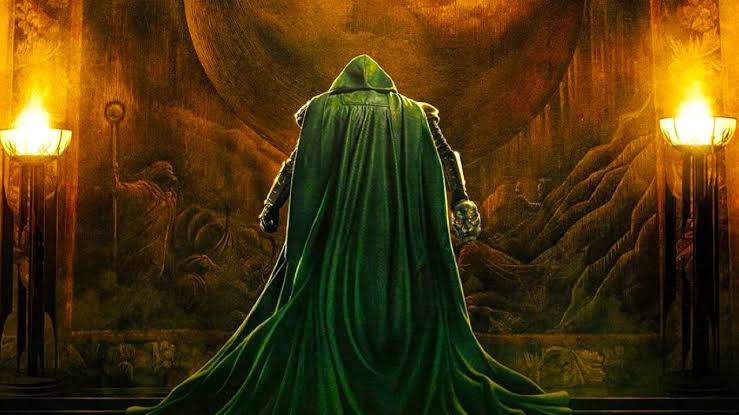
The most talked-about shot may be the simplest. Thor bears down on a hooded figure, his axe thrown at full force. The blade is stopped dead by Doctor Doom's raised hand, and the two forces stay locked in tension, motionless.
In a single shot, the film establishes the level of threat. Doom doesn't dodge, doesn't hide behind a visible force field: he catches it. It's a statement of intent about what this character represents against an entire team.
For anyone discovering the character through the films, it's worth knowing that he carries an old grudge with the Spider-Man side of the universe. We told that rivalry in our article on the duel between Spider-Man and Doctor Doom: two intellects, two methods, and a mutual contempt that has never faded.
'Hey pal': the return of Steve Rogers
The trailer saves its biggest moment for last. Thor hears a voice behind him - two words, 'hey pal'. He turns, disbelieving, and holds out his hand: Mjolnir leaves his palm and flies towards someone else. Steve Rogers steps into the light.
It's Chris Evans back in the role for the first time since 2019. The device is clever: rather than showing the character, the film shows the hammer that identifies him. Only someone worthy can lift it, and the image says so without a line of dialogue.
The reaction to that shot explains a good part of the 500 million views. After several years in which the universe was looking for a new centre, this return acts as a signal: the film openly sets out to replay the emotion of the great gatherings that came before.

Spider-Man Brooch - Avengers
The team logo in a discreet version. To wear through the four months of waiting still to come.
See the product - €14.90The Sentinels: Doom's army
The other major reveal came with the Comic-Con presentation: Doom raises an army of Sentinels to take on the Avengers, the Fantastic Four and the X-Men all at once.
In the comics, Sentinels are giant robots designed to hunt down and eliminate mutants. Handing them to Doom changes their nature: from a tool of targeted persecution, they become an instrument of general domination. The film takes an X-Men piece of iconography and widens it to the whole universe.
Spider-Man readers will see an immediate echo. The web-slinger has long faced his own hunting machines, a lineage we set out in our article on the Spider-Slayers. Anti-mutant robots on one side, anti-spider robots on the other: the same idea of an industrial manhunt, applied to two different minorities.
The Fantastic Four in the equation
The third group present is the Fantastic Four, with Pedro Pascal as Reed Richards, Vanessa Kirby as the Invisible Woman, Joseph Quinn as the Human Torch and Ebon Moss-Bachrach as the Thing.
Their presence is logical and even necessary: Doom is historically their adversary, not the Avengers'. The film therefore imports one team's antagonist to make him the threat to all the others, which implies that the relationship between Reed Richards and Victor Von Doom has a place in the story.
Here too, the pages are ahead of the screen. The ties between the web-slinger and this team go back a long way and are well documented, as the Civil War episode shows, where the alliances between groups were reshaped for good.

Building Block Set - Avengers Tower
The Tower, rebuilt brick by brick. A build of several evenings to pass the time until 18 December.
See the product - €299.90And where does Spider-Man fit into all this?
A fair question on this site, and an honest answer: the trailer doesn't show him. The detailed write-ups published after the screening list the heroes on view, and he isn't among them.
That means nothing definitive - a trailer never shows everything, and studios deliberately hold certain appearances back for the cinema. But as things stand, everything circulating about his involvement is deduction, not image.
We dealt with that question separately, with what is established and what isn't, in our article on Spider-Man's role against Doctor Doom. And on the recurring rumour about the three actors reuniting, we sorted out what is actually known from what is only assumed.
Why this crossover took twenty-five years to arrive
The detail many younger viewers don't know: if the X-Men and the Fantastic Four were absent from the Avengers for so long, it wasn't an artistic choice. It was a question of rights.
These characters have belonged to the same comics since the 1960s, but their film adaptation rights had been sold to another studio in the 1990s, at a time when Marvel was in poor financial shape. The result: two separate catalogues, two continuities, and no legal way to have them cross paths.
Disney's purchase of the studio that held them, completed in 2019, removed the obstacle. But buying rights isn't enough to write a film: the Fantastic Four had to be introduced, the mutants reintroduced, and a narrative mechanism found that could justify characters from incompatible continuities living side by side.
That is exactly what the multiverse is for. Rather than pretending the older films never existed, the device folds them in as neighbouring universes. The trailer draws its strongest argument from that: these actors aren't replaying their roles, they are continuing them.
A record that says something
More than 500 million views in a few days, and a record broken across the whole Disney group. The figure deserves to be read with caution - view counters add up very different platforms and very different watch times - but the order of magnitude is still significant.
Above all it says one thing: after several years in which the universe's productions met uneven receptions, a gathering on this scale still mobilises people in huge numbers. The curiosity isn't only about the plot, but about the very possibility of seeing these characters share a shot.
By way of comparison, the attention given to the franchise's releases remains far higher than that of most other licences, as we measured when looking at the journey of the cinematic universe since its origins. A promotional start like that mechanically places the film among the events of the end of the year.
What the trailer doesn't show
A serious breakdown also has to say what is missing. The trailer doesn't explain how the universes come into contact, doesn't spell out Doom's motives beyond his warning about the collapse of the multiverse, and gives nothing away about the ending.
Several major heroes announced in the cast don't appear in the edit, which is normal at this stage. Concluding that they are absent from the film would be a mistake of method: a trailer is a promotional object, not a contents page.
Caution as well on the multiverse mechanics. The vocabulary used refers to notions already established on screen, which we explained in simple terms in our guide to the Marvel multiverse and in our look back at No Way Home, the film that opened the breach.
How to watch a trailer without being taken in
A word on method, because the period ahead is going to produce a lot of noise. A trailer is cut to sell, not to inform. The shots are reordered, sometimes retouched, and some never appear in the finished film.
Three precautions apply to this one as to the ones that follow. First, the order of the shots is not the order of the story: two images side by side don't necessarily follow each other on screen. Next, a line heard over a shot may have been spoken in another scene, as the sound edit is free. Finally, a character's absence proves nothing, and their presence in a single image says nothing about how big their part is.
These reservations aren't theoretical: the franchise's previous gatherings used altered shots in their marketing, including digitally removing a character to preserve a surprise. It's therefore reasonable to treat the images as clues, not as established facts.
The simplest rule remains the best: separate what is shown from what is inferred. Everything this article states comes from the released edit or from the official Comic-Con presentation. The rest, we flag as uncertain.
Release date and what comes next
Avengers: Doomsday reaches cinemas on 18 December 2026, directed by the Russo brothers, already responsible for the franchise's two previous great gatherings.
The film isn't an end in itself: it opens onto a second part, whose implications we examined in our article on Secret Wars. The two-part structure recalls the one that worked before, with a first film setting things up and a second resolving them.
To get ready for the screening, the overview of the films and the universes helps put the continuities back in order - and the question of which Spider-Man belongs to which universe is, itself, still open.
What to take away
This trailer does exactly what you expect from a first trailer: it sets up the threat, shows the scale of the gathering, and keeps an emotional beat for the end. Xavier's empty school, Doom's hand stopping an axe, and two words spoken off camera.
Four and a half months still separate audiences from the cinema, and more trailers are to be expected between now and December. This one served above all to answer the only question that mattered: yes, the Fox X-Men really are there, and yes, Steve Rogers is back.
In the meantime, the Spider-Man figures and the posters cover the universe in question well, while the decorations, the T-shirts and the Spider-Man masks complete the waiting kit. For the character we're interested in here, the full portrait of Peter Parker remains the best way in.

