
14-Day Money-Back Guarantee
0
The short answer
Peter Parker isn't a mutant: his powers come from a radioactive spider bite, not from an inherited gene. That outsider status has fuelled six decades of exchanges with the X-Men, between scientific kinship with Beast and recurring friction with Wolverine. Shared arcs and enemies detailed below.
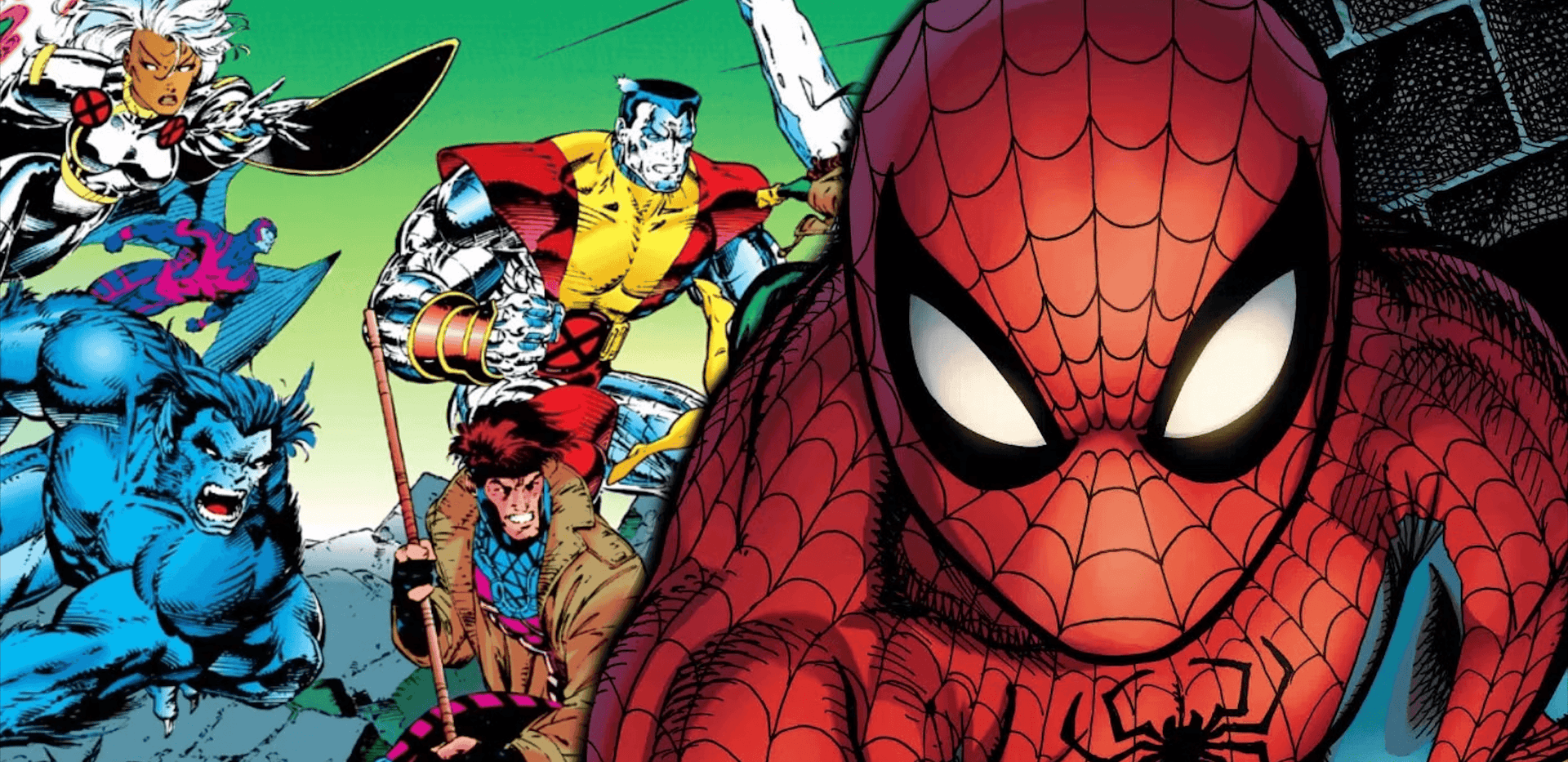
In the vast Marvel universe, few narrative relationships are as paradoxical as the one binding Spider-Man and the X-Men. On one side, two franchises that seem to belong to parallel universes, so different are their tones — the urban web-slinger, a loner clinging to his New York rooftops, versus the mutant team isolated in its Westchester school, perpetually at war with a humanity that rejects them. On the other, two franchises whose paths have never stopped crossing since the 1960s, in comic arcs, event crossovers and shared battles that have shaped fans' imaginations for six decades.
That duality is precisely what makes the Spider-Man / X-Men relationship so fascinating. No other Marvel franchise has produced as many moments of fertile narrative friction — Spider-Man is neither a mutant nor an official Avenger, which places him in an unprecedented narrative zone whenever he meets the X-Men. This article unpacks the full history of that turbulent relationship, the landmark comic arcs, the shared enemies, the surprising alliances, and the philosophical implications Marvel's writers have drawn from these unlikely encounters. For fans following the wider Spider-Man universe, understanding this relationship is essential to grasping exactly where the web-slinger sits in the global Marvel ecosystem.
Is Spider-Man A Mutant? The Question That Changed Everything
To understand the relationship between Spider-Man and the X-Men, you have to start with the fundamental question that separates the two franchises: is Spider-Man a mutant? The canonical answer from the Marvel comics is clear — no, Peter Parker is not genetically a mutant. His powers come from a radioactive spider bite, not from an inherited mutation switched on at puberty. That technical distinction is in fact fundamental, because it places Spider-Man in a category of his own within the Marvel universe — not a mutant like the X-Men, not ‘cosmic’ like the traditional Avengers, not magical like Doctor Strange. Spider-Man is a unique case, which immediately creates tension with the X-Men, whose collective identity rests precisely on belonging to the mutant community. That ambiguity has its visual counterpart: the spider logo has never joined mutant iconography, and the t-shirts rarely put the two side by side.
That ambiguity hasn't escaped Marvel's writers. Several comic arcs have deliberately played with the question, suggesting that Peter might carry a latent mutant gene that the bite ‘activated’ rather than created. That theory, never validated canonically, remains a subject of passionate debate among hardcore fans. But the point isn't the technical answer — it's what the question reveals about Spider-Man's place in the Marvel ecosystem. The web-slinger is deliberately kept in a zone of genetic uncertainty that lets him interact with every other franchise without belonging entirely to any of them.
This narrative stance creates interesting friction whenever he meets the X-Men. Wolverine sometimes accuses Spider-Man of not really understanding the mutant condition. The Venom symbiote, a recurring Spider-Man enemy, sneers at Peter's presumption in speaking for a community he doesn't belong to. Magneto, across several arcs, treats the web-slinger as an ordinary human to be protected rather than an equal. These tensions are never definitively resolved — they are part of the permanent narrative identity of the Spider-Man / X-Men relationship.
The First Crossings: Mistrust and Gradual Respect
The first encounters between Spider-Man and the X-Men go back to the 1960s, as early as X-Men #27 and Amazing Spider-Man #92. At the time, both Marvel franchises were still being built, and their creators (Stan Lee, Steve Ditko, Jack Kirby) were actively looking to connect every Marvel hero within one coherent shared universe. Spider-Man meets the X-Men from a position of mutual mistrust: the X-Men see him as a solitary troublemaker with no respect for team discipline, and Spider-Man sees them as a band of elitists cut off from the New Yorkers he defends every day.
That initial mistrust gradually turns into respect over the years. Beast (Hank McCoy), with his dual scientific training and an intellect comparable to Peter Parker's, probably becomes the X-Man who develops the warmest relationship with the web-slinger. The two scientists recognise each other instantly and collaborate regularly on technical problems. Iceman (Bobby Drake) also develops a functional friendship with Spider-Man, built on their similar age and shared sense of humour. These two friendships are the narrative anchors that make the many later crossovers between the franchises possible.
With Wolverine it's more complicated. Logan respects Spider-Man's fighting spirit and sense of duty, but hates his habit of cracking jokes mid-battle. Several comic arcs have explored that dynamic with a great sense of humour — Wolverine growling while Peter fires off one-liners, Spider-Man impressed by Logan's brutality while disapproving of his lethal methods. That clash of temperaments produces some of the most memorable dialogue in the whole Marvel franchise, and explains why fans regularly ask for more Spider-Man / Wolverine team-ups.
COSTUMES & COSPLAY

Spider-Man Costume - Spot Spider-Verse
The Spot, born of the multiverse: the figure that best embodies the crossing of universes this article is about.
119.90 €
Discover →The Landmark Crossovers: X-Men vs Spider-Man and the Great Sagas
Several major crossovers have defined the Spider-Man / X-Men relationship over the decades. The mini-series X-Men vs. Spider-Man (2008) remains one of the most complete references — it spans five decades of encounters between the two franchises and offers a unique narrative overview of how they evolved together. The Mutant Massacre saga (1986) had already introduced Spider-Man as an outside witness to the carnage inflicted on the Morlocks, creating a moment of realisation in which Peter grasps the true violence of the mutant condition. These crossovers produced some of the panels most often reprinted on posters and tapestries.
The Maximum Carnage arc (1993), although centred on the villain Carnage, brings several X-Men characters into the New York battle against the psychopaths coordinated by Cletus Kasady. That collaboration, forced by a shared existential threat, foreshadows later crossovers in which Spider-Man and the X-Men have to set aside their differences to face dangers that overflow the borders of their respective franchises. This narrative mechanism — union forced by a cosmic threat — would become particularly important in the Spider-Verse arcs and other multiverse events.
More recently, Avengers vs. X-Men (2012) created a narrative frame in which Spider-Man finds himself at the heart of a conflict between his former Avengers colleagues and the mutant community. The web-slinger's position in that conflict is particularly interesting: not fully an Avenger (he has left the team several times), not a mutant (so not entirely aligned with the X-Men), Peter Parker ends up as a mediating observer. That stance lets him ask the moral questions neither the Avengers nor the X-Men dare put to each other — who is genuinely in the right here? This enlightened neutrality makes Spider-Man one of the very few characters able to move between the two franchises without ever looking out of place.
The Shared Enemies: Green Goblin, Apocalypse, Magneto
One of the most interesting dimensions of the Spider-Man / X-Men relationship is their gallery of shared enemies. Magneto has faced Spider-Man several times, and every encounter is treated as a major narrative event — the master of magnetism outstrips in raw power anything Spider-Man can usually handle, creating an extreme tactical challenge for the web-slinger. Apocalypse, the ancient mutant, has also made his way into several Spider-Man arcs, particularly when his plans for genetic purification threaten the whole of humanity, mutants and non-mutants alike. The figures born of those confrontations turn up today as symbiote figures and across the collectible figures range.
More unexpectedly, some enemies traditionally associated with Spider-Man such as the Green Goblin or Doctor Octopus have occasionally crossed paths with the X-Men, usually in arcs where their scientific madness pushes them towards anti-mutant technology. Those meetings are rare but always memorable, because they force Spider-Man to explain to the X-Men why his personal enemies deserve particular attention. The Lizard, turned into a broader mutational threat in certain arcs, also becomes a point of narrative friction where the line between Spider-Man villain and anti-mutant menace blurs.
This gallery of shared enemies is exploited regularly in the modern Spider-Man video games, particularly in Marvel's Spider-Man 2 on PS5, where several side missions allude to mutational threats the web-slinger has to handle in the X-Men's absence. Insomniac's developers deliberately worked in those nods to lay the narrative groundwork for a future Marvel game bringing both franchises together — a project regularly floated in industry rumours without ever being officially confirmed.
The Alternate Universes: When Spider-Man Becomes An X-Man
In several alternate Marvel universes, particularly in the What If… series, Spider-Man ends up officially joining the X-Men. These alternate arcs offer fascinating narrative territory — what would Peter Parker have become had he grown up at Professor Xavier's school rather than in Queens? The answers Marvel's writers have imagined are many and often very different from the canonical timeline, creating versions of Peter that read like philosophical mirrors of the classic Spider-Man. That plurality of versions is the playground of the multiverse, and it feeds a whole iconography on the wall stickers side.
In some of those alternate realities, Peter joins the X-Men in his teens and becomes a full member of the mutant team. His habitual loneliness vanishes, replaced by the camaraderie of other teenagers with extraordinary powers. That version of Peter is generally happier but also less interesting narratively — Spider-Man's existential isolation is part of what defines the character, and placing him inside a mutant family softens that fundamental trait. It's probably why these alternate arcs stay fictional even within the canonical comics: they serve as windows for exploration, not replacements for the main timeline.
The reverse concept — an X-Man who becomes Spider-Man in a parallel reality — has also been explored, notably in certain branches of the multiverse where Logan is the one bitten by a radioactive spider. That fusion produces particularly fascinating narrative hybrids, in which Wolverine's mutant healing factor combined with Spider-Man's powers creates almost indestructible superheroes. Those variants regularly feed the Spider-Verse arcs and other multiverse events where dozens of hybrid versions coexist in one immense narrative fresco.
PHONE CASES & ACCESSORIES

Marvel Spider-Man DC Comics Phone Case
A design that embraces universes living side by side, for anyone who likes seeing the web-slinger rub shoulders with other heroes.
29.90 €
Discover →The Screen Adaptation: Towards An MCU Crossover?
On screen, the Spider-Man / X-Men relationship was never truly explored, because of the legal restrictions that long split the Marvel rights between Sony, Fox and Disney. For decades Spider-Man belonged to Sony and the X-Men to Fox, and the two franchises evolved in completely separate cinematic universes. That legal situation prevented any official crossover between them on screen until very recently.
With Disney's purchase of Fox in 2019, the legal barrier fell. And in July 2026 it stopped being a theoretical question: Spider-Man: Brand New Day gives Jean Grey her debut in the Marvel Cinematic Universe, opposite Tom Holland's web-slinger. The crossover readers had been waiting sixty years for is no longer a forum rumour.
FIGURES & COLLECTIBLES

LEGO Spider-Man Figure
The articulated piece that earns its place in a display cabinet alongside the other Marvel teams.
59.90 €
Discover →Jean Grey in Brand New Day: the MCU's first X-Man
The meeting happened in a way nobody had anticipated. Marvel kept the identity of the character played by Sadie Sink secret for almost a year, to the point that the actress went through the entire promotional tour without confirming it, and the face isn't revealed until around seventy minutes into the film. It is Jean Grey, the character's first appearance in the Marvel Cinematic Universe — and the first of the five original X-Men to debut there as a native of the main Earth.
Neither Famke Janssen nor Sophie Turner, who played her for Fox, had appeared in the MCU before: both denied being in the film that brought Deadpool and Wolverine together. This Jean Grey therefore starts from scratch, with no continuity with twenty years of Fox films.
A mutant who doesn't look like her comics counterpart
The film takes a notable liberty with the character. On screen, her dominant power is neither telepathy nor telekinesis but psychic possession: she takes control of the body of anyone within about ten metres, then leaps from one body to the next. Both canonical powers are indeed there — she is presented as an Omega-level mutant — but it is this possession ability that structures the action.
Another departure from the comics: she is not a member of the X-Men. She has never met Xavier, wears no team uniform, and moves through the film as an isolated teenager with no control over what is happening to her. It's a point many summaries skate over — calling Jean Grey ‘the film's X-Man’ is inaccurate, and the question of recruitment remains wide open. Our character panorama will place the team when it truly arrives.
Apparent antagonist, not a real villain
For much of the story she is treated as the threat: she possesses strangers and uses them to hit Damage Control facilities. The third-act twist points to someone else — the head of that agency, who had Sara Grey, Jean's older sister and a telepath herself, abducted and then experimented on. It is her death that sets the revenge in motion. The round-up of the film's villains details that gallery, and our article on Sara Grey looks at what the film invents compared with the comics, where she has no powers at all.
That pattern — a mutant presented as the threat, a human institution revealed as the real danger — is exactly the one the X-Men have carried since 1963. That the MCU imports it through a Spider-Man film rather than an X-Men film says a great deal about how closely the two franchises answer each other. A fresh iconography was born of this film, gathered in the range devoted to it, and the collectible figures are starting to roll out this version of the character.
Why This Relationship Keeps Fascinating
Beyond the narrative side, the Spider-Man / X-Men relationship keeps fascinating fans because it raises universal philosophical questions. What defines ‘difference’ — genetics or life choices? Who deserves protection — ordinary humans or persecuted minorities? Does power automatically create responsibilities towards those who share your condition, or only towards all human beings? Those questions, posed since the 1960s by the Marvel comics, remain painfully current in our contemporary debates about identity, community and collective responsibility. To take the reading further, our panorama of the narrative arcs places each crossover in its decade, and the gift selection brings together the collected editions.
Spider-Man brings a unique perspective to those debates: that of a hero who belongs to no established community yet fights all the same to protect every community. That solitary, individualist stance — almost liberal in the philosophical sense — contrasts sharply with the collectivist identity of the X-Men. The narrative dialogue between those two philosophies is probably the deepest and most durable dimension of their relationship. It also explains why so many fans invest emotionally in it — it mirrors questions they ask themselves in their own lives about the balance between the individual and the collective.
To go deeper into Spider-Man's relationships with the other Marvel franchises, dive into our pieces on the collaborations with the Fantastic Four, the underrated link with Daredevil, or explore the Spider-Man figures collection which includes several versions inspired by the great Marvel crossovers. The Spider-Man / X-Men relationship is only one doorway into the global Marvel ecosystem — but it's probably one of the richest narratively, and the one that best rewards the time invested by fans who genuinely want to understand the deep architecture of the Marvel Universe.

