

14-Day Money-Back Guarantee
0
The essentials before you choose
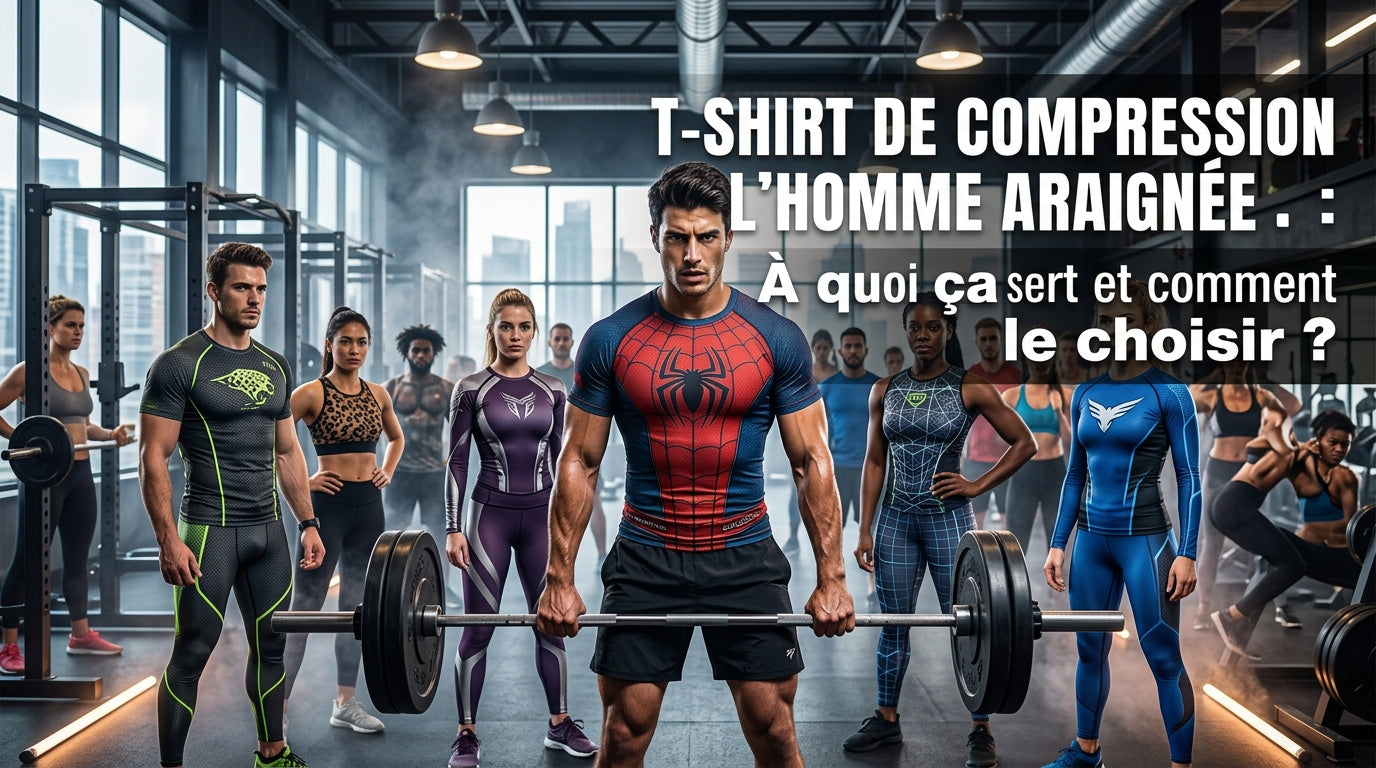
A compression top is not just a tight T-shirt. It is a technical second skin: polyester and elastane, flat seams, a cut that hugs the body to move sweat away and limit chafing. You take it in your usual size, never one below. Short sleeve for the gym, long sleeve for outdoors and ground-based sports.
It is the most misunderstood garment in the sports aisle. Plenty of people buy one for the look and discover that it does real work; others size down believing that ‘the tighter the better’, and then never wear it.
Here is what it actually does, what it does not do, and the five things to check before choosing a model.
What a compression top really does
The name promises a lot. The reality is simpler, and more useful.
Sweat management
This is the most immediate and least debatable benefit. Technical fabric does not soak up moisture the way cotton does: it carries it to the outer surface, where it evaporates.
In practice, you do not finish the session with a heavy, cold garment stuck to your back. It is the clearest difference from an ordinary T-shirt, and you feel it the very first time you wear one.
Support and chafing
Compression holds the muscles in place and reduces micro-vibration, which limits irritation on the friction points — armpits, chest, rucksack or harness straps.
In ground-based and contact sports this becomes central: a garment that does not ride up and cannot be grabbed changes the session.
Temperature regulation
Worn on its own in summer, the fabric stays cool. Worn as a base layer in winter, it keeps a thin layer of warm air against the skin without adding any bulk.
That is what makes it an all-year garment, where a cotton T-shirt is really only in its element in the mid-seasons.
What it does not do
It will not make you stronger. Research on the performance gains from compression garments is mixed and the measured effects remain modest. What there is consensus on is comfort during the effort and the feeling of recovery afterwards.
So do not buy one for a personal best. Buy it to finish the session comfortably, and for the fact that it does not lose its shape after ten washes.

Classic Spider-Man Compression Top
The iconic pattern in a short sleeve, in a second-skin cut. The full range is in our compression tops.
View the product — €39.90Fabric: here, synthetic is the right choice
This is the point that surprises people, especially after reading that cotton is the one to go for on every other garment.
Why not cotton
Cotton absorbs and holds moisture. On a sports garment that is exactly what you do not want: it gets heavy, goes cold the moment you stop, and takes hours to dry.
Polyester paired with elastane does the opposite: it wicks, dries fast and springs back into shape. The logic is reversed compared with an everyday garment, where cotton wins.
The right amount of elastane
Look for an elastane content of between ten and twenty per cent. Below that, the garment does not really compress and is simply close-fitting; above it, it becomes hard to pull on and loses its stretch faster.
A very cheap model often lists almost pure polyester: it clings, but it does not spring back after a few sessions.
The seams
Look for flat seams, ideally set towards the back of the arms rather than under the armpit. On a garment worn against the skin for an hour of effort, a thick seam in the wrong place causes irritation in a single session.
Short sleeve or long sleeve
This is not a question of looks but of use, and the two formats do not replace each other.
The short sleeve
A versatile format, designed for the gym and indoor training. It leaves the arms free, dries even faster and can be worn on its own in summer.
It is the logical first buy if you do not own one yet.
The long sleeve
It becomes essential in three cases. Outdoors in cool weather, as a base layer under a jacket. In ground-based sports — grappling, jiu-jitsu, wrestling — where it protects the forearms from mat burn. And in summer under full sun, where covering the arms is often more comfortable than exposing them.
The full set
Pairing top and bottom has a real benefit: continuous compression removes the friction zone at the waist, where a top on its own rides up when you bend forward.

Long Sleeve Spider-Man Black Symbiote Compression Top
The long sleeve in its symbiote version, for outdoors and ground-based sports. Pair it with our sports shorts.
View the product — €39.90Sizing: your usual size, not one below
This is the most common mistake, and it comes from a misunderstanding of the word ‘compression’.
The garment is already cut to compress. Going down a size does not double the effect: it restricts shoulder movement, digs into the ribcage and makes deep breathing unpleasant — precisely what you do not want during exercise.
Take your usual size. The garment should be firmly fitted at rest, without you having to fight to pull it on or tug it back down to breathe.
If you are between two sizes
Go by your chest measurement rather than by the size of the ordinary T-shirt you wear. Size equivalences vary a great deal from one model to the next, and the chest measurement in centimetres is the only comparable figure — the same reflex as for choosing a sweatshirt size.
The fitting-room test
Raise both arms above your head. If the bottom of the garment rides up above your navel and stays there, it is too short or too small. Then do a full shoulder rotation: nothing should pull across the back.
Printing: sublimation or screen printing
On a patterned garment, this is the criterion that decides how it will look in a year.
Sublimation
The pattern is built into the fibre, not laid on top of it. The result: no added thickness, no area that cannot breathe, and above all no cracking. The design cannot flake off because there is nothing there to flake.
It is the process used on almost every all-over design, the ones that carry the texture of the suit across the whole garment.
Screen printing
The pattern is laid down as a layer on the fabric. That is perfectly fine on a cotton T-shirt worn day to day, far less so on a technical garment: the printed area cannot breathe and eventually cracks under repeated stretching.
On a compression garment, then, always favour a pattern printed into the fabric itself.
Choosing your design
With the technical specifications equal, the pattern is the real deciding factor — and the range offers several clearly distinct families.
The classic suit
Red and blue, visible webbing, logo in the centre. It is the most recognisable and the most versatile. It works just as well at the gym as it does as a base for costumes and cosplay.
The darker versions
The black suit and its symbiote variants are the most understated to wear: the pattern stays readable but the whole thing almost passes for an ordinary technical garment. The story behind that suit is covered in our article on the relationship between Spider-Man and the symbiote.
The multiverse versions
Miles Morales, Spider-Gwen, Spider-Man 2099: these versions step away from red and blue and are often the most graphic. The 2099 one in particular, with its stylised skull on a dark background, owes a great deal to the character we introduce in our profile of Miguel O’Hara.
For Miles, the black and red suit has become a classic in its own right — see who Miles Morales is.
The film versions
The designs taken from the films — suits from the original trilogy, from the latest MCU instalment — speak above all to people attached to one particular version. It is also the safest choice for a gift, because it does not require knowing the comics. Our merchandise guide places each family within the wider universe.

Spider-Man Compression Shorts and Top Set
The top and bottom set, for continuous compression with no friction zone at the waist. Complete it with our trainers and our classic T-shirts.
View the product — €54.90Which sports it suits
The garment is not equally relevant everywhere.
Weight training and cross-training
This is the most common use. The support feels good on heavy movements, the cut restricts no range of motion, and the garment does not catch on the bar or on the machines.
Running
Excellent as a base layer in cold weather, very good on its own in summer. The thing to watch is the seam where the straps sit if you run with a pack or a belt.
Combat sports and ground-based sports
This is where the format is at its best. Long sleeve, flat seams, fabric that cannot be grabbed: the garment protects the skin from the mat and does not turn into a handle for your opponent.
Cycling and outdoor sports
As a base layer it is an excellent regulator. On its own, you have to accept the very close cut, which is its whole reason for being.
And outside sport
Plenty of wearers use it as a base for fancy dress or cosplay: the second-skin cut and the all-over pattern make it a credible starting point, to be completed with accessories. Our guide to the importance of the mask in a Spider-Man cosplay and the one on the dark-side costume explain how to build the whole look.
Compression top, sports top, rash guard: the differences
Three garments look alike on the rail and do not fill the same role. The confusion is common and it costs money.
The standard sports top
Loose cut, technical fabric too, but no support at all. It wicks sweat and stops there. It is the right choice for a sport where you want air between fabric and skin, and for anyone who simply does not like the close-fitting feel.
The compression top
Second-skin cut, significant elastane, real muscle support. It does everything the standard top does, plus the support, at the price of a cut you have to like.
The rash guard
Technically very close to a long-sleeve compression top, but designed for the water and for contact sports: denser fabric, reinforced seams, often a UV treatment. A compression model is perfectly fine for ground training, but a rash guard stays more robust for intensive use in competition.
In practice, for the gym, running and the occasional grappling session, a good compression top covers all three uses.
Spotting a good model on a product page
Four pieces of information settle it, and their absence is already a signal.
The stated composition first: a precise elastane percentage is the best indicator of the real level of compression. A page that only says ‘stretchy fabric’ tells you nothing.
The size guide in centimetres next, chest measurement and body length. Without it you are buying blind on a garment where two centimetres change how it feels.
The print type, or failing that some close-up photos: a pattern that runs across the seams and sleeves without a break is almost always sublimated.
And finally the length of the garment. A model cut short rides up as soon as you raise your arms, and that is the number one reason people give up on it after a month.
Care, which decides how long it lasts
A technical garment is cared for differently from a cotton one, and mistakes are punished quickly.
No fabric conditioner
That is rule number one. Fabric conditioner leaves a film on the fibres and cancels out the moisture-wicking property — the garment then starts behaving like cotton, which is exactly the opposite of the point.
Thirty degrees, no hotter
Heat relaxes elastane. Repeated hot washes turn a compressive cut into a merely close-fitting one, and there is no going back.
No tumble dryer
Same reason, only worse. The fabric dries in an hour or two in the open air anyway — that is one of its selling points.
Wash it promptly
A technical garment left damp in a ball for two days develops smells that washing no longer fully removes. Get it out of the bag the same evening, even if you are not washing it straight away.
The questions people ask
Is it worn against the skin?
Yes, and that is its whole reason for being: nothing between fabric and skin, otherwise the moisture-wicking stops working.
From what age?
There is no particular reason a teenager training regularly should not wear one. For a younger child the technical benefit is limited: an ordinary sports T-shirt is more than enough, and the comfort of a loose cut will suit them better.
Does it show under clothes?
As a base layer, no — that is the advantage of having no added thickness. The only visible pattern will be the collar, if the garment worn over it is open.
How many do you need?
Two are enough for two or three sessions a week, since drying is quick. Move to three or four beyond that, or if you also wear one as a base layer in winter.
How long does it last?
Two to three years for a model that is properly cared for and worn twice a week. The end-of-life sign is not a hole or fading, but the loss of snap-back: the garment slips on too easily and no longer returns to shape after stretching.
Does it make a good gift?
Yes, on one condition: knowing the size. It is a garment where the fit matters more than elsewhere, and a badly sized model will not get worn. For a gift where the size is uncertain, an accessory is safer — our gift ideas and our trainers guide give you the alternatives.
What to remember
Polyester and elastane between ten and twenty per cent, flat seams, a pattern printed into the fabric, your usual size. Short sleeve for indoors, long sleeve for outdoors and ground-based sports.
And for care: thirty degrees, never fabric conditioner, never a tumble dryer. Those three rules make the difference between a garment that lasts three years and one that is merely close-fitting after a single winter.

