

14-Day Money-Back Guarantee
0
The short answer
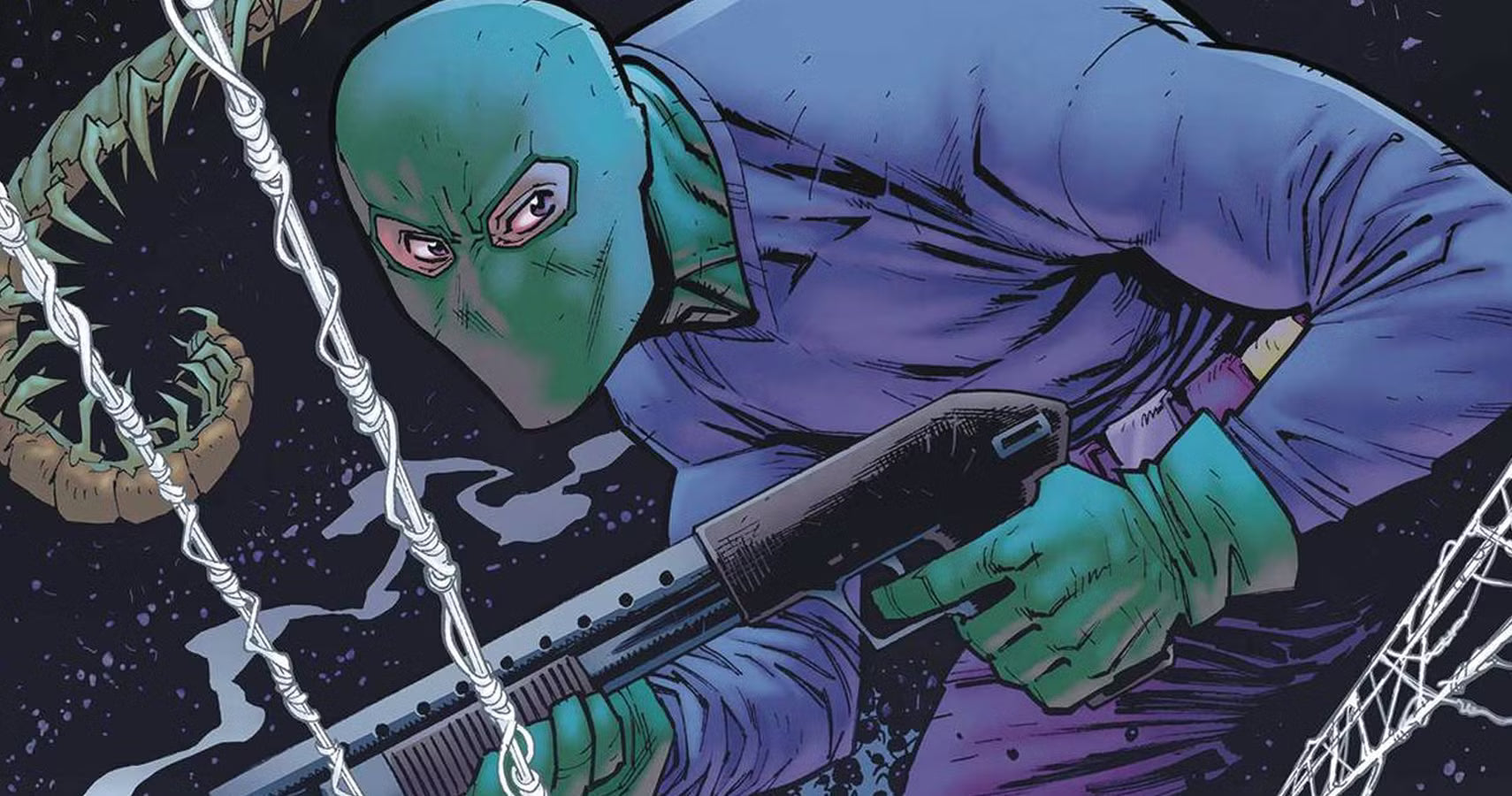
Behind the mask hides Stanley Carter, a former S.H.I.E.L.D. agent convinced he must purge the world of its sins; he is the one who guns down Jean DeWolff. Resurrected by Kindred in Sins Rising, he returns armed with a shotgun meant to absorb the sins of his victims. Full portrait below.
Sin-Eater: when justice turns into a deadly obsession
In Spider-Man's gallery of enemies, some stand out for their raw power, others for their madness or their intelligence. Sin-Eater, for his part, chills the blood with his warped ideology. This twisted vigilante believes he is working for the good, yet he leaves a trail of blood behind him. And facing him, Peter Parker confronts dilemmas far darker than any ordinary superhero fight.
Created by Peter David and Rich Buckler, Sin-Eater first appears in Peter Parker, the Spectacular Spider-Man #107, back in 1985. But this character would leave his mark far beyond that first arc. He sits at the heart of harrowing stories such as The Death of Jean DeWolff, and resurfaces years later with even more cruelty and complexity.
Stanley Carter: the face behind the mask
Behind Sin-Eater's shotgun and greenish mask hides Stanley Carter, a former S.H.I.E.L.D. agent driven mad by superhuman experiments. Convinced that society is rotten with sin, he launches a bloody crusade against figures of authority: judges, priests, police officers... everyone who, in his eyes, embodies moral hypocrisy.
But Sin-Eater is no ordinary serial killer. He sees himself as a purifier, a divine messenger, and that fanaticism makes him terribly dangerous. This ideology gives him an almost religious aura, deeply unsettling, that sets him radically apart from the other villains in Spider-Man's world.
A personal trauma for Spider-Man
The first confrontation between Spider-Man and Sin-Eater shakes Peter Parker to his core. When Jean DeWolff, one of Spidey's most precious allies, falls to the killer's bullets, the hero is overwhelmed by a sense of helplessness and rage. The case takes a dramatic turn and pushes Peter to question his own morality.
It is also one of the rare arcs where Spider-Man faces the psychological impact of a murder not on the masses, but on himself, intimately. A dimension few enemies ever manage to reach.
A sinister return in 'Sins Rising'
Years after his original crimes, Stanley Carter comes back from the dead in the modern storyline Sins Rising, published in 2020. But this time he is even more terrifying. Resurrected by Kindred, Sin-Eater now wields a mystical shotgun able to absorb sins... literally.
He no longer settles for eliminating his victims. He 'purifies' them, leaving them harmless, even repentant. That moral twist adds a fascinating layer to the character: is he still a monster, or an agent of change? Peter finds himself caught in a dilemma: should you stop someone who renders villains... harmless?


A disturbing ally... or a manipulator?
Throughout the Sins Rising arc, Spider-Man is pushed to his limits. The new Sin-Eater acts with an almost divine precision, targeting even figures like Norman Osborn. But are his motives really so pure? Is Carter genuinely guided by a desire for justice, or does he remain a puppet of Kindred, whose manipulations stretch across the whole of Spidey's modern narrative universe?
This return is a chance to explore deep questions about redemption, justice and guilt - themes that also sit at the heart of sagas such as Dying Wish or One More Day.
A violence that looks ever more justified
What makes Sin-Eater even more disturbing is that his violence seems 'justified' by the very people he 'heals'. Even notorious criminals appear transformed. Some civilians start to see him as a hero. That ideological drift opens a rift in public opinion... and in Spider-Man's conscience.
This moral grey area is rarely handled as well as it is in this arc. It also echoes other ambivalent figures, such as Kaine, Peter's shadowy clone, or Venom in his earliest incarnations.

An immense psychological weight for Peter Parker
Sin-Eater's reappearance in Sins Rising is not merely a physical challenge for Spider-Man. It is a psychological ordeal. Guilt, a recurring theme in Peter Parker's life ever since the death of his Uncle Ben, is pushed here to the extreme. Facing a killer who 'erases evil' without truly killing, Peter wavers between moral instinct and strategic helplessness.
Every clash with Sin-Eater stirs up the ghosts of the past: the mistakes, the losses, the promises never kept. The atmosphere is heavy, comparable to that of intense stories such as Kraven's Last Hunt or Back in Black, where Peter never has the luxury of winning without paying the psychological price.
Tense, symbolic confrontations
When Peter faces Stanley Carter, it is always a fight on two levels: the fight of fists, but also the fight of ideologies. In Sins Rising, Sin-Eater even manages to plant doubt in our hero's mind. Watching him disarm Norman Osborn and strip villains of their ability to do harm raises an uncomfortable question: what if Peter is the one who is wrong?
These confrontations call into question the line between justice and revenge. As in the story arc Identity Crisis, Peter has to ask himself whether he can go on embodying his values... even when the enemy seems to be getting better results.
Rising tension towards redemption... or damnation?
Sin-Eater's journey through modern comics is never linear. Even in his resurrected form, he remains a broken man, haunted by his own demons. As the arc unfolds, you sense that his crusade can only end in a dramatic fall or an ultimate sacrifice. He is at once Kindred's weapon and Kindred's victim.
That permanent tension makes him a striking character, comparable to those found in stories such as The Other: Evolve or Die, where the balance between survival, transformation and the abyss is so fragile.
Sin-Eater: a deep scar in Spider-Man's world
Whether in the 1980s or in more modern stories such as Sins Rising, Sin-Eater embodies a form of extreme justice, warped by pain and fanaticism. He does not seek to rule, nor to grow rich: he wants to purify, at the price of blood. And that is precisely what makes him so terrifying. Because he believes he is doing good. Because somewhere, a part of Peter fears he might be right.
As an antagonist, Sin-Eater marked a whole generation of readers. He also allowed Spider-Man to reveal his flaws, his resilience and his endless battle against himself as much as against his enemies. His narrative impact is such that he fully deserves his place among the worst enemies of Spider-Man.

A character barely used outside the comics
Unlike Venom or the Green Goblin, Sin-Eater has yet to receive a real film or animated adaptation. But his potential is immense. Picture a dark thriller in which Peter Parker faces a merciless vigilante, at the heart of a New York torn between fear and admiration. A perfect premise for a spin-off or a mature Marvel series...
In the meantime, fans can relive the intensity of these arcs through collector's pieces: realistic Spider-Man figures, dark, stylised posters or iconic LEGO sets built around the great story arcs.
Going further into the narrative universe
To dive into the richness of all these stories, head over to our page dedicated to the story arcs and explore our Spider-Man merchandise inspired by your favourite reads.

