

14-Day Money-Back Guarantee
0
The short answer
Wilson Fisk rules New York crime without a single superpower: he buys politicians, media outlets and shell companies, then hits the web-slinger’s reputation as hard as his jaw. Introduced as early as Amazing Spider-Man #50 in 1967, he embodies the enemy that agility alone is not enough to beat. Here is how he rose to the top.
In the Marvel universe, few antagonists inspire fear, respect and a troubling kind of fascination all at once. Wilson Fisk, better known as Kingpin, belongs to that category of his own. He doesn’t fly, he doesn’t teleport, he doesn’t bend matter. He has none of the things that usually define a supervillain, and that is precisely what makes him so hard to bring down. Where the web-slinger’s other enemies attack the body, he goes after the ground itself: the city, its institutions, its press, its judges.
Understanding Kingpin means understanding why certain opponents resist the usual formula of the genre. You can knock out Scorpion, see through the illusions of Mysterio, survive a hunt led by Kraven the Hunter. You cannot put an empire in prison with a single punch.
A crime boss born in the pages of Spider-Man
Kingpin first appears in Amazing Spider-Man #50, published in 1967, written by Stan Lee and drawn by John Romita Sr. The issue stayed famous for another reason: it is the one where Peter Parker dumps his costume in a bin. That accident of timing already says something. Fisk arrives at the exact moment the hero doubts himself, and he thrives in that vacuum.
At his creation, the character answered a simple narrative need: give Spider-Man an opponent that strength cannot settle. The 1960s had saturated the catalogue with mad scientists and chemical accidents. Fisk owes nothing to a gamma ray. His power is structural: he controls men, cash flows, building permits. The reader understands straight away that the problem will not be sorted out in three panels of action.
That origin also explains his longevity. A villain built around a gadget ages with his gadget. A villain built around economic power stays current for as long as economic power exists. That is what sets him apart in the pantheon of the web-slinger’s iconic enemies, where plenty of figures can be dated at a glance.
The Fisk method: money before fists
Kingpin’s signature comes down to one inversion. The ordinary criminal hides his business behind an honest front. Fisk does the opposite: he makes his business respectable, then uses that respectability as armour. He presents himself as a businessman, runs real companies, funds good causes, shows his face at the right dinners. When the police come knocking, they are not facing a thug but a taxpayer surrounded by lawyers.
The network is built in layers. Shell companies absorb the dirty money. Elected officials owe him their campaigns. Journalists receive the information he wants printed, and nothing else. On that last point, the connection with the Daily Bugle is instructive: Spider-Man knows better than anyone what a hostile press does to a reputation, and Fisk worked out the same mechanism long before him.
That is why his clashes with the web-slinger have a different rhythm. It is no longer about stopping a robbery but about dismantling an architecture. Every time Spider-Man breaks one link, Fisk rebuilds another with the money from the last one. The hero wins battles; the empire simply absorbs them.

Spider-Man Duvet Cover in New York
The city Fisk covets, seen from above: the web-slinger’s point of view, not the crime boss’s. Enough to turn a bedroom into a skyline.
View the product — 49,90 €A body that belies appearances
Kingpin’s silhouette is a joke the character turns back on whoever makes it. His bulk reads as fat; it is in fact muscle. The stories regularly insist on this point: Fisk trains, practises hand-to-hand disciplines, and takes hits that would floor a normal man. Several opponents have made the mistake of underestimating him exactly once.
That detail is not cosmetic. It destroys the easy solution. If Fisk were a fragile boss protected by guards, reaching the office would be enough. Because he holds up physically, a direct confrontation doesn’t even offer that shortcut. Spider-Man can beat him in a fight, and it has never been enough to bring him down, which is exactly the point.
The contrast with the other villains is stark. The Green Goblin draws his danger from unpredictable madness; Kingpin, from his composure. One explodes, the other calculates. They are two opposite ways of frightening people, and any analysis of the cleverest villains in the Spider-Man universe usually places Fisk in a category of his own for that reason.
Vanessa and Richard: family as his only flaw
If Kingpin had a weakness, it would be neither a weapon nor a rival. It would be his wife. Vanessa Fisk holds a place in his balance that nothing else holds: she is the only person in front of whom he lowers his guard, and the only one whose disapproval reaches him. Several major arcs rest entirely on that lever. Threaten the empire and he turns methodical; threaten Vanessa and he turns reckless.
Their son Richard complicates the equation further. Raised on lies about his father’s activities, he ends up choosing the criminal path in his turn, but against him. That journey gave birth to the identity of The Rose, Kingpin’s criminal heir, a figure who exists purely because Fisk wanted to protect his family from what he was.
There is a symmetry here that writers often exploit with Peter Parker. Both men lead a double life and lie to the people they love in order to spare them. That tension runs through the whole series, as shown by Peter’s constant struggle to reconcile private life and life as a hero. The difference lies in what they are protecting: one hides a burden, the other hides a crime.
From Spider-Man to Daredevil: the enemy who changed heroes
Born in Spider-Man’s pages, Kingpin found his full measure elsewhere. From the 1980s onwards he becomes Daredevil’s central opponent, and that migration changes the character for good. The story Born Again, written by Frank Miller in the mid-1980s, gives the most radical version of it: Fisk learns his enemy’s secret identity and, rather than kill him, sets out to destroy his life piece by piece.
That idea has become the very definition of the character. Kingpin is not after a physical victory. He is after collapse. Bank account emptied, home lost, reputation ruined, friends turned against you: the method works just as well on a Hell’s Kitchen lawyer as on a freelance photographer from Queens.
The move to Daredevil also explains why so many readers discover Fisk without knowing he came from the web-slinger’s corner. The two heroes share the same city and cross paths regularly, but the mental association has shifted. To trace those movements from one universe to another, the overview of the Spider-Man films and versions helps put the eras back in order.

Spider-Man Blanket – Spider-Gwen in New York
Two silhouettes above the rooftops, in the one place the Fisk empire never managed to get its hands on. Warm, washable, sofa-sized.
View the product — 42,90 €Kingpin on screen: several faces, the same coldness
In the cinema, Michael Clarke Duncan plays Wilson Fisk in Daredevil in 2003. The performance leans on physical presence and quiet authority, in a film that itself divided opinion. The character, on the other hand, finds a first credible translation there: the businessman nobody can trouble.
The version that left the deepest mark on audiences is still Vincent D’Onofrio’s, which appeared in the Daredevil series produced for Netflix from 2015 onwards. That Fisk is slow, ill at ease in company, capable of long silences before an explosion of violence. The contrast between the social awkwardness and the brutality made him a reference point, so much so that the actor has taken the role up again in several later Marvel productions.
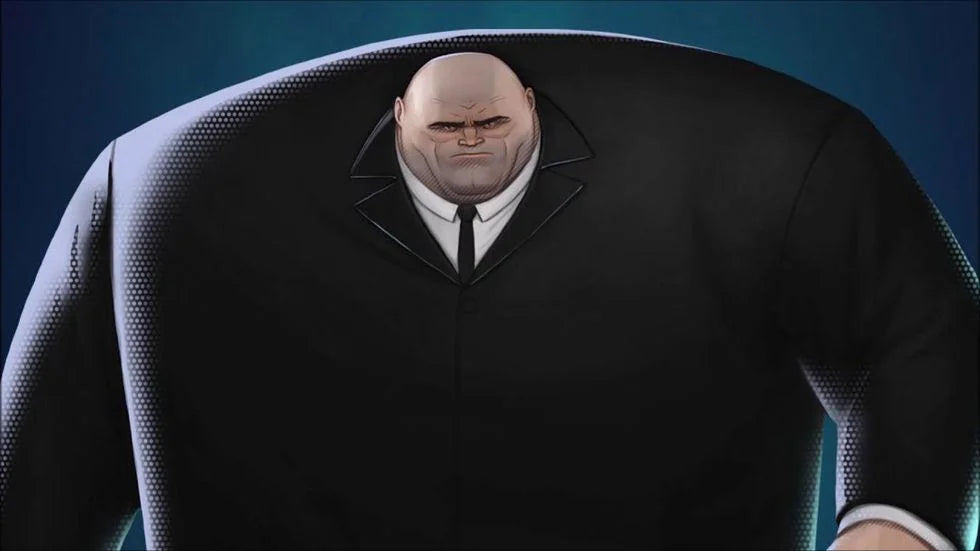
Animation offers a third reading. In Spider-Man: Into the Spider-Verse, released in 2018, Kingpin is the main antagonist, and his motive is not conquest but grief: he builds an accelerator capable of opening onto other dimensions, in the hope of finding again a family he has lost. The silhouette is pushed to the extreme there, almost architectural, and the result remains one of the truest adaptations of the character.
Video games have their own way of handling the New York underworld too, even when Fisk is not at the centre of the story. The question of controlling urban territory is structural there, as shown by the experience offered by Marvel’s Spider-Man 2 on PS5, where the city itself becomes the stake.
The day the criminal became mayor
The comics eventually pushed the character’s logic to its conclusion. Since Fisk has always bought elected officials, why not get elected himself? In the stories published from 2017 onwards, Wilson Fisk becomes mayor of New York. The criminal no longer hides behind power: he occupies it.
The reversal is brilliant because it disarms the heroes. Hitting an organised crime boss is an act of justice; hitting an elected mayor is an assault. Fisk turns democratic legitimacy into a shield, and Spider-Man ends up in a position where every intervention puts him, and not Fisk, in the wrong.
It is also a way of recalling what the character has stood for since 1967. Kingpin is not the threat that comes from outside, the one you spot by its mask or its costume. He is the threat that comes from inside the system, the one that uses the rules instead of breaking them. On that point, he has no equivalent in the web-slinger’s gallery.

Spider-Man Rug – Swinging Through New York
The movement Fisk will never be able to buy: a web, a building, and the city rushing past. To lay at the foot of the bed.
View the product — 37,56 €Why he remains the web-slinger’s hardest opponent
Spider-Man was designed as a neighbourhood hero. He protects a few streets, stops muggings, mends what breaks close to home. That scale is his strength and, against Kingpin, his limit. A web stops a robber, not a financial arrangement. The hero from the end of the road faces an opponent who operates at the scale of the entire city.
On top of that comes a moral asymmetry. Fisk can lose everything and start again; Peter Parker cannot. The empire is replaceable, Aunt May is not. Kingpin knows it, and that imbalance is exactly what he exploits. To grasp what that vulnerability costs the character, the full portrait of Peter Parker sheds light on the other side of the costume.
One last reason is put into words less often. The other villains want something from Spider-Man: his defeat, his recognition, his suffering. Kingpin, for his part, would mostly prefer that he did not exist. He doesn’t hate him, he treats him as an operational nuisance. That indifference is more chilling than any revenge, and it explains why the character crosses the decades without wearing out.
The white suit, the cane, the cigar: a silhouette built to dominate
Few Marvel villains are this instantly recognisable without a mask. Kingpin is marked out by a light suit, often white or cream, a cane he holds more like a sceptre than a support, and a cigar. Each of these elements says something precise, and none of them is decorative.
The white, first of all, is a deliberately counterintuitive choice. In fiction, the underworld dresses in dark colours to melt into the night. Fisk does the opposite: he dresses to be seen, in broad daylight, in places where nobody can touch him. The light suit is not a hiding place, it is a statement. It announces a man who has no need to conceal himself because he has already bought the people who could stop him.
The cane plays the same role. It suggests fragility, invites others to underestimate him, and regularly conceals something other than an accessory. As for the cigar, it sets a tempo: Fisk takes his time, including when the situation ought to panic him. That deliberate slowness is probably his most intimidating trait. Facing opponents whose identity rests on a mask, he offers an image that is perfectly legible, and that is precisely what makes it unsettling. The subject of visual identities runs through the whole saga, from Spider-Man masks to the villains’ outfits.
Where to start to discover the character
Three ways in are enough, and they cover three different eras. The first is obviously Amazing Spider-Man #50, in 1967: you find a Fisk who is still raw, almost theatrical, and the context that produced him, that of a Peter Parker ready to give it all up.
The second is Born Again, published over at Daredevil in the mid-1980s. It is the story that fixed the Fisk method for the decades that followed, and probably the best entry point for understanding what makes the character unique: patient destruction rather than elimination. Plenty of readers cite it as one of the high points of the genre, all publishers combined.
The third is the arc where he becomes mayor of New York, from 2017 onwards. More recent, more political, it shows what a criminal becomes when he no longer needs to get around the institutions because he runs them. Between those three milestones you have the essentials of half a century of character. And to place the other figures he meets along the way, the complete guide to the iconic villains remains the handiest map.
What to remember about Wilson Fisk
Kingpin is the exception that lights up the rule. In a universe built on powers, he shows that a fortune, a network and patience are enough to hold a city. He arrived in 1967 in an issue where Spider-Man was giving up, he changed heroes in the 1980s, he ended up mayor, and he has never needed a laboratory accident to be credible.
To take things further, Spider-Man figures let you bring together the great names of the saga, Spider-Man posters and Spider-Man decorations bring New York into your home, while Spider-Man T-shirts and Spider-Man masks remain the safe bets for showing which side you are on. Fisk would have chosen the city; the web-slinger still chooses the people who live in it.

