
14-Day Money-Back Guarantee
0
The short answer
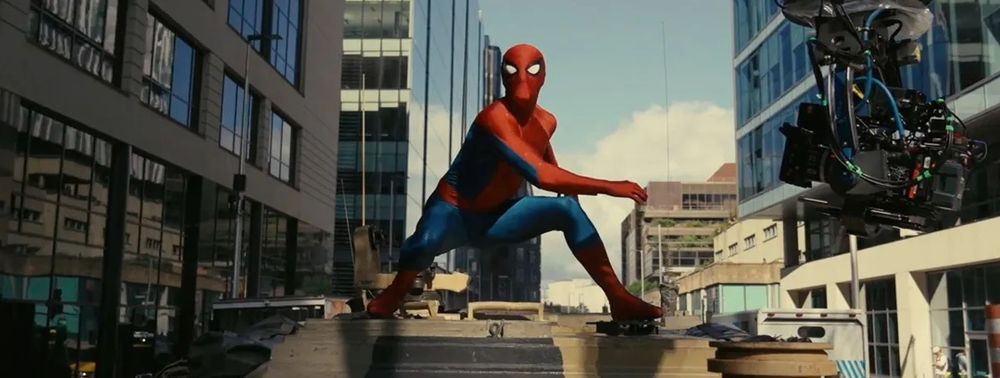
The stunt team, who play the Spider-Man video games, brought screenshots of moves into the writers’ room to try to recreate them for real. Jackie Chan’s team worked on the film, and some slow-motion shots were filmed at 420 frames per second — a frame rate at which, by the director’s own admission, it becomes almost impossible to act.
It’s the part of the film nobody talks about, and yet it explains why it feels different from the previous ones. The fight scenes in Brand New Day were built using an unusual method, borrowed from video games and Asian action cinema.
Here’s how those sequences were designed, and what difference it makes on screen.
When video games walk into the writers’ room
It’s the most revealing anecdote about how the film was made, and it comes from the stunt team itself.
Screenshots as a reference
The stunt performers play the character’s video game adaptations. While playing, they spotted moves — swinging combinations, landings, dodges — and took screenshots of them.
Those images were then brought into production meetings with one simple question: can we actually do this for real?
The lead actor has adopted that line himself. It’s an interesting reversal: for twenty years, games copied films. Here, the film copies the game.
Why it works
The character’s video game adaptations spent a decade solving a problem that cinema handled badly — how a body moves through a city while clinging to surfaces, with what momentum, what rhythm, what trajectories.
Borrowing their solutions therefore means inheriting years of research. The moves feel right because they have already been validated by millions of hours of play.
We devoted a whole article to these adaptations and what they brought to the character: all the Spider-Man video games.

Spider-Man Web Shooter
The accessory at the heart of all these moves. The web-shooter remains the character’s signature object, and you will find it in our Spider-Man web shooters.
View the product — €34.90Who actually choreographed these fights
Two names shape the film’s action work, and both come from Asian cinema.
A coordinator from another Marvel film
Stunt coordination and the second unit were handed to a professional who had already choreographed an earlier feature for the studio, known for its hand-to-hand combat.
That choice isn’t neutral: it steers the film towards a readable fighting style, filmed in longer takes, where you follow the bodies rather than endure choppy editing.

Jackie Chan’s team
The actor and director has publicly stated that his stunt team was working on the film, and that he was overseeing its action direction.
It’s a very recognisable school: precise choreography, the set used as a partner, physical gags built into the fight, and a refusal of the overly short shot. If some sequences struck you as more ’readable’ than in the previous films, that is where it comes from.
What that changes in practice
A fight choreographed in that school is filmed differently: camera further back, wider frames, fewer cuts. You see what is happening instead of guessing at it.
It fits with the rest of the film’s directing choices, which the critics broadly praised for their restraint.
420 frames per second: the constraint nobody imagines
Some of the film’s slow-motion shots were filmed at an extreme frame rate, and that creates a problem audiences never suspect.
What that frame rate means
A film is usually shot at twenty-four frames per second. At 420, you capture nearly eighteen times more frames — which means that, in projection, one second of action can be stretched to nearly twenty.
Technically, it demands a huge amount of light: the higher the frame rate, the less light each frame receives. So these shots are filmed under massive lighting.
The acting problem
The director put it bluntly: at that frame rate, it becomes almost impossible to act.
The reason is mechanical. Every movement, however tiny, is multiplied. A blink lasts an eternity; an expression forming takes seconds on screen. The actor therefore has to hold almost everything still while keeping a readable intention.
It is a constraint closer to mime than to acting, and it explains why these shots are rare and short.

Spider-Man Action Figure
An articulated figure for replaying the poses the film took weeks to choreograph. The whole range is in our Spider-Man figures, and the new arrivals from the film are in the Brand New Day merch collection.
View the product — €99.90What was done for real
The film consistently favours practical effects wherever possible, and it shows.
Thrown weapons
The projectiles used by the ninja clan were genuinely thrown, with no digital additions. It is a choice that requires trained throwers and heightened safety, for a real visual gain: an authentic trajectory cannot be simulated perfectly.
We cover this faction and its role in the film in our article on The Hand.
Sets you can actually use
The fight sequences rely on physically built sets — streets, underground platforms, interiors. The stunt performers therefore work on surfaces that react to impact, which changes the way a body falls and bounces.
We go into where all of this was built in our article on the final trailer breakdown.
The set as a fighting partner
It is the signature of the action school the team comes from: you do not fight in a set, you fight with it. A post, a railing, a car door become choreography elements rather than obstacles.
This approach requires solid, predictable sets, and therefore built ones — which explains the production’s investment in usable streets rather than digital backdrops.
What stays digital
Flight across the city, great heights, impossible scales. The film’s rule is consistent: what happens at street level is real, what happens above the rooftops is manufactured.
Filming a character who barely ever touches the ground
It is the central technical problem of every adaptation of this character, and each film answers it differently.
Wires, always and forever
Most of the aerial movement relies on computer-controlled wire systems, able to accelerate, brake and rotate a body along a programmed trajectory. The wire is then erased frame by frame.
The difficulty is not lifting someone, it is giving them weight. A suspended body with no momentum instantly looks fake, hence the importance of the choreography: the stunt performer has to act out the constraint the wire cancels.

The question of the gaze
The mask removes all facial expression. The actor can therefore only perform with the body — tilt of the head, tension in the shoulders, position of the hands.
It is a constraint the video game adaptations had already solved, and it is one of the reasons their movement served as a reference: they spent years making a faceless character readable.
Rhythm rather than speed
A common mistake is to speed things up to convey power. The film does the opposite: it slows key moments down, even if that means filming at extreme frame rates, to let you register what is happening.
A movement you understand is more impressive than a fast one. That is the founding principle of the action school the team comes from.
The recreated comic covers
A detail long-time readers spotted immediately.
The opening sequence recreates several famous covers of the character, shot for shot — poses, framing, compositions. It is a statement of intent placed before the story even begins.
The director has hinted at an even more ambitious goal across the whole film, with a list that does not entirely match the one people identify on screen. In other words: there are probably more references than audiences have picked up.
Recreating a cover is a technical exercise in its own right. An illustration allows impossible proportions, viewpoints no camera can take and bodies twisted beyond what a human can hold. Translating that into live action means choosing what you keep — the silhouette, the framing, the light — and what you let go.
That is also why these shots last a second or two: they work as still images slipped into the movement, not as sequences.
Our article listing the easter eggs and hidden references goes into these nods in detail.
What the stunts say about the character
Choreography is never neutral. The way a hero fights says what he is, and this film’s has changed compared with the previous ones.
A fighter who has become efficient
The earlier films showed a young man who improvised, took hits and won by luck as much as by talent. Here, the moves are clean, economical, without hesitation.
That fits the time gap the film sets up: four years of daily practice, alone, necessarily produce someone more skilled. The choreography tells that ellipsis without a line of dialogue.
A violence that unsettles
The flip side appears in the sequences where Peter loses control. That same precision becomes frightening once it is no longer held back, and the film uses that deliberately.
A clumsy hero who hits too hard causes an accident. A technically flawless hero who hits too hard causes something else — and that is what the direction wants you to feel. We go into that shift in our article on Peter’s mutation.
Solitude, right down to the fights
A rarely noted detail: Peter never fights as part of a team in this film. No backup, no coordination, no tactical exchange. Every confrontation is handled alone.
It is a choreography constraint that flows directly from the subject, and it makes some sequences longer and more laborious — deliberately.
The questions everyone asks
Does Tom Holland do his own stunts?
Partly, as on the previous films. Actors on this kind of production perform a significant share of the ground and wire work, but the most dangerous stunts are still left to specialist doubles.
Filming was in fact halted after an incident, which we document in our article on his injury on set — a useful reminder that these sequences carry a real risk.
Why do the fights look more readable?
Because they are choreographed in a school that favours the wide shot and duration. Fewer cuts, a steadier camera, whole bodies in frame: you follow the action instead of reconstructing it.
Does the film really borrow from the video games?
Yes, and the stunt team owns it. The screenshots served as movement references, not as storyboards: the idea was to physically reproduce gestures designed to be played.
How long does a fight sequence take?
Weeks of preparation for a few minutes on screen. The choreography is first rehearsed in a rehearsal room, roughly filmed, until it is signed off. It is then adapted to the real set, then filmed over several days from multiple angles.
The ratio is staggering: one minute of finished action can represent a month of combined work across all the teams involved.
Do stunt performers get injured often?
Serious incidents remain rare given the number of takes, precisely because the job consists of removing chance. But the risk never disappears, and this shoot was a reminder of that.
Are there a lot of digital effects?
As many as in any production of this scale, but distributed differently. The digital work happens mainly above the roofline and on urban backgrounds, less on the bodies and the immediate sets.

Spider-Man Mask
The web-slinger’s mask, worn through weeks of choreography. Discover it with our Spider-Man masks and our fancy dress and costumes.
View the product — €29.90The jobs the audience never sees in the credits
A two-minute action sequence mobilises trades you would never be able to name, and yet the whole result depends on them.
The stunt coordinator
He designs the choreography, picks the doubles, calculates the trajectories and signs off every take on safety grounds. He is the one who translates a directing intention into moves that can be executed without hurting anyone.
On this film, that role is combined with second unit director — the unit that shoots the action while the first films the dialogue scenes. That combination gives a rare consistency between what is designed and what is filmed.
The riggers
They are the ones who install and operate the wire systems. Their work is invisible by definition: if you can see it, it has failed. A believable aerial move depends as much on their calibration as on the stunt performer’s delivery.
The specialist doubles
Several different people can double the same actor depending on the type of stunt — falls, fights, aerial movement. Each brings a speciality, and the edit assembles those fragments into a single performance.
That is also why an actor can ’do his own stunts’ while also being doubled: both statements are true, applied to different shots.
What to take away
Stunt performers who play video games and bring back screenshots, an action team from Asian cinema, slow-motion shots at 420 frames per second where the actor can barely act, and thrown weapons genuinely thrown.
This is not making-of trivia. It is what explains the film’s particular feel: you see bodies moving according to consistent rules, in sets that exist, filmed wide enough for you to understand what is happening. Plenty of comparable productions do the opposite.
What remains is the funniest reversal in the whole story. For twenty years, the video game adaptations tried to look like the films. They put so much effort in that they ended up solving problems cinema had never handled well — how this body moves, with what momentum, along what trajectories. Today, it is the film taking screenshots of the game to work out what Spider-Man should look like in motion. The pupil has become the reference, and the result shows on screen.

