

14-Day Money-Back Guarantee
0
The short answer
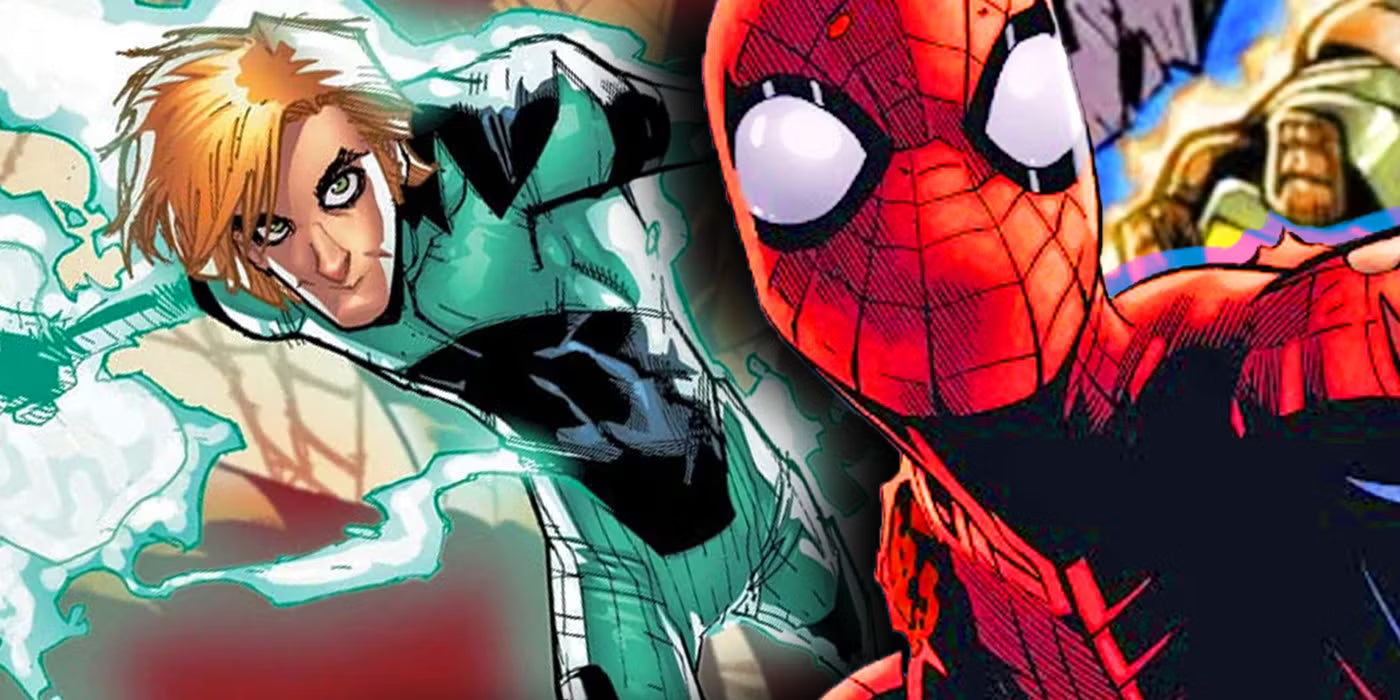
Andy Maguire is a secondary school pupil irradiated during a failed experiment at Horizon Labs, who inherits near-limitless power: flight, invulnerability, energy blasts. Hungry for fame rather than responsibility, he becomes the negative image of young Peter, before Peter strips away most of his gifts. We break down his origins below.
The accidental creation of a hero… and one of Peter Parker’s greatest failures
At the heart of the vast mythos built around Peter Parker, there is one fundamental truth: Spider-Man is a hero shaped by his mistakes. But among all the missteps that have marked his story, few are as symbolic, as unsettling and as revealing as the accidental creation of Alpha, alias Andy Maguire. An ordinary teenager who would become, through a chain of circumstance and scientific carelessness, one of the web-slinger’s most unexpected threats.
Introduced in the modern Marvel era, Andy Maguire is not a classic villain, an ancestral totem like Morlun or a structured criminal like the Hammerhead of organised crime’s heyday. He is the direct product of a scientific experiment supervised by Peter at Horizon Labs. An unforeseeable accident, certainly, but one whose consequences would deeply challenge his sense of responsibility — a principle often detailed in the pillar pages devoted to Spider-Man’s enemies and to the hero’s evolution.

When Andy acquires outsized powers — strength, invulnerability, colossal energy capabilities — he instantly becomes a kind of inverted Peter Parker. Where Peter has always carried the weight of remorse and duty, Alpha behaves impulsively, immaturely and dangerously. The contrast is striking: Spider-Man was forged by pain, Alpha was born of glory. And that contrast shows exactly how much a stable moral compass matters, something Peter himself long looked for in Uncle Ben.
The Alpha case is also fascinating from a narrative point of view: it is one of the rare moments when Peter realises he could be the origin of a future Morlun, Kraven or Shocker if the circumstances lined up. It is a rare bout of self-questioning, explored in darker stories such as Superior Spider-Man, where his scientific decisions have massive repercussions. Alpha is a modern variation on that theme.

Finally, Andy Maguire’s story also echoes through the pop culture built around Spider-Man. That ‘instant media hero’ quality clashes violently with Peter’s humility, and explains why Spider-Man merchandise — whether figurines or iconic masks — always celebrates the sense of sacrifice rather than raw power.
In this first part, we discover why Alpha is not simply a failed sidekick, but a distorted mirror of the web-slinger. What follows analyses his exact origins, the nature of his powers, and the reasons that pushed Peter to take back what he had given.
Alpha: the birth of outsized power and an uncontrollable ego
Alpha’s origin unfolds in a very particular setting: Horizon Labs, where Peter Parker works as a scientist. This high-tech environment, presented as one of the most advanced innovation centres in the Marvel universe, lets the hero reconcile his academic knowledge with his super-hero experience. But it is also a place where failure can have enormous consequences. Where a mistake in a New York alleyway can cost one life, a mistake in a laboratory can affect millions.

That is precisely what happens when the experiment codenamed ‘Zero-K’ goes wrong. Andy Maguire, a secondary school pupil on a visit, is struck by an unprecedented energy wave. And unlike the totemic transformations of creatures such as Shathra or the mystical evolution of the Spider-Totems, Alpha receives his abilities in a completely artificial, almost random way. It is a modern scientific accident, but one that mirrors the original bite Peter received — a painful reminder of what chance can create, and also of what it can destroy.
Where Peter gained proportionate powers (strength, agility, spider-sense), Andy receives something far more dangerous: unlimited potential. His internal energy, known as ‘Alpha energy’, gives him colossal strength, the ability to fly, to project destructive blasts, and near-total invulnerability. This is not a reasonable power, it is an absolute one — and that is where the problem begins.

From the moment Andy realises what he can do, his behaviour shifts. Where young Peter Parker had been terrified by his abilities, Alpha sees an opportunity for fame. He quickly adopts an arrogant stance, moving radically away from the moral model Spider-Man tries to pass on. That contrast highlights the saga’s central theme: power does not define a hero, it is the way that power is used.
In some stories, Peter tries to mentor Andy, hoping to spare him the mistakes he made in his own youth. But Alpha refuses the role of pupil. He wants glory, media attention and instant recognition — everything Peter himself had wanted before Uncle Ben’s death. That similarity reinforces the idea that Peter could have followed exactly the same path without the tragic impact of his past, a theme already explored in his confrontations with figures such as Doppelgänger or the corrupted Peter of Superior Spider-Man.

Alpha’s unpredictable attitude leads to increasingly dangerous incidents, where Spider-Man has to step in not only to protect New York, but also to stop Andy going too far. The public, meanwhile, is thrilled by this new super-hero with titanic powers. The media seize on him, brands take an interest, turning Alpha into a popular phenomenon — a striking contrast with the way pop culture has built, over several decades, the image of the web-slinger you find in the pyjamas, posters and Spider-Man t-shirts on sale today.
This second part sets the scene: Alpha is not a traditional villain, but a teenager too powerful to grasp what his own actions mean. In the next part, we will see how this tense dynamic between Peter and Andy builds to a major crisis… and how Spider-Man will once again choose to shoulder his responsibilities.
The turning point: when Alpha becomes more of a threat than a hope
The relationship between Peter Parker and Andy Maguire truly shifts when trust gives way to the brutal realisation that Alpha energy creates a moral and psychological imbalance in the young hero. Andy’s meteoric rise — media coverage, outsized ego, spectacular interventions — quickly turns into a dangerous spiral. For the first time in his life, Peter has to handle not an enemy, but a hero… one he created himself.
The first warning signs appear when Alpha joins rescue operations while ignoring Spider-Man’s instructions. His raw power endangers civilians instead of protecting them. Whole scenes show Andy acting without thinking, convinced his strength makes him infallible. This drift recalls the chaotic trajectories of characters covered in articles such as Big Wheel or The Spot, where arrogance turns incompetence into a major risk.


But what sets Alpha apart is his power. He is not a laughable criminal or a second-string villain: he is a teenager with enormous abilities and not the slightest moral structure to channel them. The Avengers themselves start to worry when his interventions damage entire buildings. And Spider-Man then grasps a painful truth: he has given birth to an unstable human bomb.
This situation highlights a deeply human side of Peter Parker: his fear of repeating the tragedy of Uncle Ben. Where he could not stop a burglar like the Burglar from doing the irreparable, he now refuses to let an innocent teenager become a danger to society. That moral tension sits at the heart of many stories, notably in the pillar page on Spider-Man’s enemies, where Peter’s mistakes sometimes create monsters he then has to fight.
The decisive moment comes when Alpha, during an international intervention alongside Marvel’s most powerful heroes, causes an unintentional disaster. That mistake brings massive damage and puts lives at risk. Peter faces a terrible dilemma: let Andy carry on and risk something even worse, or take away the power he has never learnt to master.
The scene that follows is one of the most memorable of this arc. Spider-Man, in the middle of an emotional storm, makes a decision he hoped he would never have to make: he switches off the Alpha energy. He does not remove Andy’s powers entirely, but reduces them to a tiny, almost symbolic scale. That choice echoes what he has always tried to embody: responsibility before power.
This brutal fall deeply affects Andy Maguire. Within days, he goes from globally publicised super-hero to a bitter, humiliated teenager looking for meaning in what is left. It is a trajectory that, in Spider-Man mythology, recalls many characters who fell from grace — from the Daily Bugle to more complex threats such as Dusk or Cloak & Dagger.
In this third part, the figure of Alpha changes: from uncontrollable prodigy, he becomes a scathing reminder of what Peter Parker has always feared. In the final part, we will analyse what this failed mentorship reveals about Spider-Man as a character… and why Alpha’s arc remains one of his most human failures.
What Alpha’s failure really reveals about Spider-Man
Andy Maguire’s story is not only that of a teenager unable to handle his new powers: above all it is a brutal mirror held up to Peter Parker. Alpha represents what Spider-Man could have become if, at the time of Uncle Ben’s murder, he had not drawn the right lessons from his own fault. And it is precisely that parallel that makes this arc so powerful.
Peter has always carried the weight of his guilt, explored in depth in the films, which you can see on our central page: Spider-Man Films: Order, Versions, Costumes and Universes.

In the final chapters of this arc, Marvel shows just how much Peter doubts himself. He wonders whether he has the right to take from Andy a gift that could have made him a symbol of hope. He wonders whether his choice is driven by fear or by wisdom. This moral dilemma recalls the emotional tension felt in arcs such as Kraven’s Last Hunt or during the Superior Spider-Man era, where Peter has no choice but to confront his own limits.

But what makes this episode strong is its conclusion. Alpha, stripped of most of his powers, has to rebuild his life. He remains a potential hero, but a modest one, forced to learn what being responsible really means. Spider-Man did not destroy a dream: he protected a teenager from a future in which his powers would have ended up destroying innocent people.
This theme of responsibility runs through the whole franchise. You find it right down to pop culture and merchandise — from the Spider-Man figurines that trace his moral evolution, to the costumes that embody his different psychological stages. Even the everyday accessories carry that simple idea: Spider-Man is not just a spectacular hero, he is a symbol of maturity, humility and growth.
Alpha: a warning, an echo, a scar
Andy Maguire still exists in the Marvel universe, but never with the same brilliance as at the start. And that is deliberate. Alpha is not there to outshine Spider-Man or to become an icon. He is there to remind the reader that power without wisdom leads straight to chaos. Where Peter grew through pain to become a hero, Andy grows through frustration to become… a young man like any other.
In the end, Alpha’s arc is not a story of failure: it is a story of realisation. It shows that Spider-Man does not define heroes by their powers, but by their ability to recognise their mistakes and draw the right lessons from them. It is a philosophy that structures the whole of the web-slinger’s universe and echoes right through to the products made for fans: whether posters, Spider-Man jumpers or pyjamas inspired by his early years.
Because Spider-Man is not just a hero. He is a moral guide. And Alpha is the most living proof that this guide is still needed — especially for those who, like Andy Maguire, receive too much power, too fast, without ever having known the weight of responsibility.

