
14-Day Money-Back Guarantee
0
The short answer
Marvel Zombies depicts a reality where the infected heroes keep their memories, their powers and their lucidity: Peter Parker remembers killing his own family. First seen in Ultimate Fantastic Four, then developed by Robert Kirkman, the saga was popularised by the What If series. Here are the keys to understanding it.
There are parallel Marvel universes where Peter Parker saved Aunt May. Others where he married Mary Jane and had a daughter. And then there is one where Peter Parker devours his friends, his wife and his aunt alive before howling his despair at the stars. Welcome to Marvel Zombies, the most disturbing parallel universe the House of Ideas has ever published - a parallel universe known as Earth-2149, where an alien virus turned every superhero on the planet into a conscious, cannibal zombie. And at the heart of this cosmic horror, one of the most tragic characters in the whole saga is Spider-Man himself, whose legendary morality becomes the instrument of his own eternal torture.
This article dives into the darkest version of Spider-Man ever imagined. Not a philosophical reflection on the saddest moments in the web-slinger's history, nor a classic comic arc analysis - here we step into a radical narrative nightmare where death, guilt and hunger share the same superhuman body. Marvel Zombies is probably the boldest editorial experiment ever attempted with Spider-Man, and most British fans have no idea how far this universe goes with the web-slinger. Here is the complete guide to understanding Zombie Spider-Man, his place in the Marvel multiverse, and why this horror version of the hero is coming back in a big way in 2026.
The Origin of the Nightmare: Earth-2149 and the Alien Virus
The story begins in 2005, when Mark Millar and Greg Land published Ultimate Fantastic Four #21-23 - an apparently standard arc in which Mr Fantastic discovers a parallel universe almost identical to his own, except that it is completely empty of superheroes. The reason for that absence is revealed little by little: on this Earth, known as Earth-2149, an alien virus passed on by direct contact has turned every superhero and supervillain into a conscious zombie. They keep their powers, their intelligence, their memories - but they are consumed by an insatiable hunger for living human flesh.
The macabre genius of the Marvel Zombies concept lies in that residual consciousness. Unlike classic Romero-style zombies, which are brainless corpses, Marvel's zombies think, speak and reason. Zombie Spider-Man knows he has just devoured his best friend. He knows he killed and ate Mary Jane. He knows he tore Aunt May apart. And he carries that knowledge with him for all eternity, in a body that can neither die nor rid itself of the hunger. It is Marvel's version of the punishment of Tantalus - knowing you are a monster, being aware of it every single moment, and being unable to stop.
Robert Kirkman - the writer who would later create The Walking Dead - took the concept back in 2006 for the five-volume Marvel Zombies mini-series. It is in this series that Spider-Man's fate in this universe is explored in depth, and it is probably one of the most traumatic arcs Marvel has ever published.
The Tragedy of Zombie Spider-Man: A Consciousness Imprisoned by Hunger
In Marvel Zombies, Peter Parker is infected at the very start of the apocalypse. Like every hero on Earth-2149, he first tries to fight the virus, to resist the hunger. But his resistance breaks when he comes face to face with his own human family - Mary Jane and Aunt May, terrified, begging him not to hurt them. In a horribly famous sequence, Peter loses control. He devours the two women he loves most in the world. And when the blood clears and he comes back to his senses, the residual consciousness returns - he realises what he has just done.
This scene is probably the most devastating in all of Spider-Man's alternative mythology. Where Peter's death in The Other is dramatic, where One More Day erases his marriage, where Back in Black explores his grief - Marvel Zombies does something worse: it turns Peter into the executioner of everything he loves. The guilt over Uncle Ben, multiplied a thousandfold. The pact of 'with great power comes great responsibility' turned into a weapon against Peter himself.
The worst part is that Peter carries the torn photograph of Mary Jane and Aunt May in a pocket of his suit for the rest of the series. He looks at it regularly, aware that he killed them. When the other zombie heroes mock his suffering, he simply answers: 'You don't get it. You never got it.' It is one of the most chilling lines in modern Marvel comics - Peter keeps his human morality in the middle of cosmic horror, which only amplifies his torture.
Zombie Hunter Edition - Official Variant

Spider-Man Zombie Hunter Pop Keyring
25,90 €
The official Zombie Hunter Spidey variant from What If - the collector's piece for fans of the darkest Spider-Man in the Marvel multiverse.
Adopt the Zombie Hunter →Marvel Zombies on Screen: What If…? and the Disney+ Revival
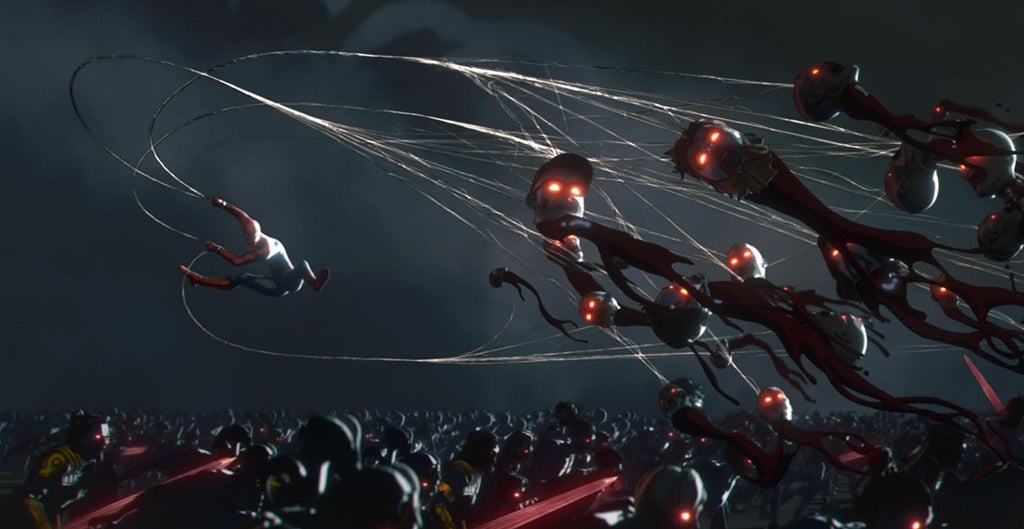
For years, Marvel Zombies remained a hidden treasure for horror comics fans, too dark to be adapted for mainstream cinema. Then in 2021, Disney+ launched the animated series What If…?, which devoted a whole episode to the Marvel Zombies concept - the episode What If… Zombies!?. It was the concept's first mainstream appearance, and it also introduced the character of Zombie Hunter Spidey, an alternative version of Peter Parker who survived the zombie apocalypse by staying human and who actively hunts infected heroes in order to 'finish them off' for good.
Zombie Hunter Spidey instantly became one of the fans' favourite What If characters, and he allowed Marvel to introduce a horror aesthetic without fully crossing the taboo of a cannibal Spider-Man. That is also the moment when figures and merchandise built around Zombie Hunter exploded in popularity - exactly what you find today across the Spider-Man figures range and the collector's edition Pop keyrings.
The natural extension of that approach arrives in 2025 with Marvel Zombies, the animated Disney+ mini-series that expands the whole universe around the What If episode. British fans who have been following Marvel Studios closely since No Way Home in 2021 know that the multiverse-as-horror strategy is now firmly established as a major creative direction. The Marvel zombies are part of this new extended universe and will keep appearing in the years to come - perhaps even in live action, if the creative call is made.
Marvel Zombies in the Spider-Man Multiverse: A Recognised Alternative Branch
What makes Marvel Zombies particularly fascinating for Spider-Man fans is its gradual recognition as an official branch of the Spider-Verse multiverse. For a long time, Marvel Zombies was seen as a completely independent side project - a creative playground with no narrative connection to the rest of the Marvel universe. But with the concept of the multiverse taking over mainstream comics from the 2010s onwards, the zombies have gradually been folded into the web-slinger's great cosmic mythology.
During the Spider-Verse event in 2014, explicit nods to a zombie universe appear - Morlun and the Inheritors mention that they actively avoid Earth-2149 because the 'meat' is spoiled. In End of the Spider-Verse in 2022, certain zombie variants of Spider-Man appear briefly in the multiverse gatherings. Marvel Zombies is no longer an isolated parallel universe - it is a recognised dimension, one that can be reached and is sometimes crossed by the main Spider-Heroes.
This narrative integration opens up enormous creative possibilities. Picture Miles Morales, in his modern Brooklyn universe, accidentally receiving a visit from a zombie Peter Parker desperately trying to warn him of a cosmic danger. Picture Spider-Gwen infiltrating Earth-2149 to rescue a human victim who is still alive. These narrative possibilities are exactly what Marvel is gradually exploiting in the extended multiverse - and Marvel Zombies has become one of the most creative branches in the whole Spider-Man mythology.
Collector's Piece - Premium Edition

Spider-Man Collector's Resin Figure
299,90 €
The premium figure that immortalises the web-slinger - for collectors who love every facet of the character, from the brightest to the darkest.
Discover the Premium Figure →Why Marvel Zombies Remains the Most Shocking Spider-Man Experience
Beyond the literal horror, Marvel Zombies works as a philosophical experiment on Peter Parker's identity. If Peter devours Mary Jane and Aunt May, is he still Peter Parker? If his consciousness persists but his actions become monstrous, what is it that defines humanity? There are no simple answers to these questions, and that is exactly what makes this parallel universe so disturbing for readers. Marvel Zombies asks questions the other Spider-Man universes do not dare to ask - questions about the nature of evil, about the loss of self, about holding on to morality in the face of uncontrollable urges.
This philosophical dimension explains why Marvel Zombies has been embraced by fans of horror comics and dark fiction. Traditional Spider-Man comics, even the most tragic ones such as Dying Wish or the death of Gwen Stacy, operate within a relatively stable moral framework where good and evil are identifiable. Marvel Zombies shatters that framework - Peter is victim and executioner at once, conscious and monstrous, human and inhuman. That radical ambiguity is what sets this parallel universe apart from every other branch of the multiverse.
For fans who enjoy that darker dimension, Marvel Zombies also forms a thematic trilogy with the Venom symbiote arc and the dark story of Carnage - three different explorations of what happens to Peter Parker when his morality is compromised by an outside force. The symbiote corrupts through seduction, Carnage through violent contamination, the zombies through viral infection. Three different metaphors for exploring the moral fragility of a hero who defined himself by his responsibility.
The Different Versions of Zombie Spider-Man Across the Comics
Since his first appearance in 2005, several variants of Zombie Spider-Man have been published across different comics and series. The original version in Marvel Zombies volume 1 is probably the most iconic - Peter Parker in the classic red and blue suit, but with chunks of flesh missing, empty yellow eyes and an oversized mouth revealing bloodstained fangs. That image became so striking that it inspired dozens of pieces of merchandise, posters, T-shirts and collector's figures.
In Marvel Zombies 2 and 3, Peter keeps his consciousness while gradually losing pieces of his body. Towards the end of the saga, he is nothing more than a torso with arms, hanging from cables - but his voice still reasons, his pain is still readable. That gradual degradation is one of Robert Kirkman's boldest narrative decisions, and it directly foreshadows the choices he would later make on The Walking Dead. The lesson is clear: you can lose almost everything of yourself physically and still remain the same person morally.
More recently, Zombie Hunter Spidey from What If introduces a new visual variant: an uninfected Peter Parker who survived the apocalypse, who wears a suit modified for zombie combat (darkened colours, added combat gear) and who actively hunts zombified heroes across a ruined Manhattan. It is probably the most accessible version of Zombie Spider-Man for the general public, and it is the one that generated the recent wave of Pop merchandise and collector's figures on the zombie theme.
Verdict: The Darkest Spider-Man Universe - and Why Missing It Would Be a Mistake
Marvel Zombies is not for everyone. If you are looking for an optimistic, bright Spider-Man who ends every arc with a reassuring moral, this parallel universe will traumatise you more than it will please you. But if you enjoy horror comics, dark fiction and radical explorations of identity - Marvel Zombies is probably the most powerful Spider-Man experience ever published. It is also one of Marvel's most influential editorial projects of the 2000-2010 decade, and its influence is still felt today in projects as varied as the Disney+ series and the new multiverse comics.
For fans who want to extend the zombie experience beyond reading the comics, the Spider-Man figures collection offers several Pop variants built around the alternative universes, including the Zombie Hunter version that pays tribute to the What If aesthetic. The Spider-Man posters in watercolour capture the character's darker dimension particularly well for anyone who wants to decorate their desk with mature iconography. And the Spider-Man gift collection covers every facet of the web-slinger - from the bright to the twilight - for fans who appreciate the character's full range. Because in the end, Spider-Man is not just a hero - he is a myth rich enough to sustain both the red and blue of Tobey Maguire and the rotting flesh of Earth-2149. And it is precisely that richness that makes Peter Parker, sixty years after his creation, the most fascinating superhero in the Marvel universe.

