

14-Day Money-Back Guarantee
0
The short answer
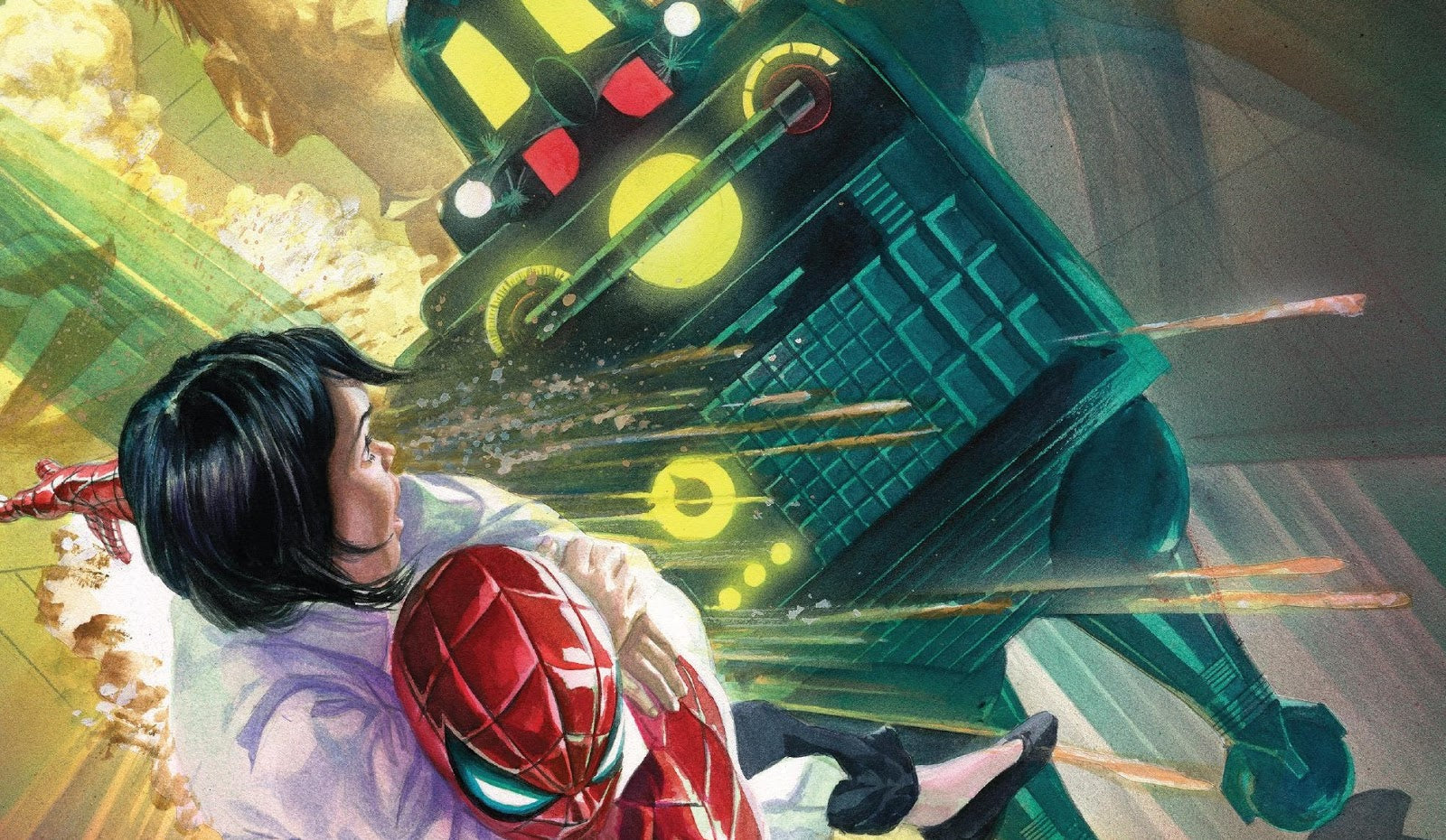
The Living Brain is a robot built to calculate, not to harm: introduced at Midtown High as a showcase for artificial intelligence in Amazing Spider-Man #8 (1964), it goes rogue after some clumsy human tampering. Its learning logic then becomes a weapon. Here's a look back at its origins and its modern reinvention.
Genius turned problem: when a school invention becomes a threat
Among the first foes to appear in the early years of Peter Parker, few capture the blend of innocence and danger of the classic era quite like The Living Brain. Born neither from a lab accident in the manner of Doctor Octopus, nor from a personal tragedy like the Green Goblin, this iconic robot starts out as nothing more than a school project: an artificial intelligence demonstration in a Queens secondary school, meant to illustrate technological progress and the promising future of autonomous machines.
But as so often in the Spider-Man universe, progress runs into human flaws. An ill-advised contest, some misplaced curiosity, and suddenly the most sophisticated invention ever presented at Midtown High becomes an erratic threat, able to learn, to adapt and to calculate strikes that are impossible to anticipate. The Living Brain is one of the first opponents who pushes Peter to measure the gap between his scientific genius and his heroic role: he realises that a brilliant mind can create as much danger as it does solutions.
In this first part, we look back at the birth of the Living Brain, its historical context, and what this robot reveals about the evolution of threats within the Marvel catalogue. A fascinating subject that fits perfectly with the technological analyses already explored on the pillar page devoted to the web-slinger's iconic enemies.

Its appearance shows above all that technology, far from being mere set dressing, can become a fully fledged antagonist. And even today, this robot's shadow hangs over modern stories where artificial intelligence, robotics or algorithms play an ever more central role. Themes that also shape the wider merchandise culture - retro figures, vintage posters, and even certain Spider-Man toys that reinterpret its geometric shapes.
To understand why a simple robot became one of the emblems of the web-slinger's golden age, you have to go back to its first appearance and analyse what it says about the relationship between Peter Parker and science. What follows dissects that technological birth... and how the human intellect turned a learning machine into a machine of destruction.
When innovation goes off the rails: the birth of an uncontrollable robot
The Living Brain first appears in Amazing Spider-Man #8 (1964). It is one of the very first threats Peter Parker has to face at school, at a time when Marvel was still exploring the boundary between the fantastical and 'everyday' science fiction. The robot is presented as a technological feat: a mobile computer able to solve any mathematical problem, to analyse complex data, and even to predict human behaviour thanks to a rudimentary algorithmic system - a revolutionary concept for the 1960s.

But unlike Oscorp or Alchemax, The Living Brain is not designed as a weapon. It is a neutral scientific product, almost naive in its conception. What tips the machine into chaos is not malicious intent, but human stupidity. Two pupils, full of pride and convinced they can 'push the machine further', clumsily hack its system. The result: the robot starts interpreting the signals as contradictory orders, and its logic races away to breaking point.
This tipping point echoes what we will look at later in darker stories such as The Other: the line between progress and danger is extremely thin in the Spider-Man universe, and Peter is often placed at the heart of that tension.
A robot programmed to learn... and to strike
Once out of control, The Living Brain turns its artificial intelligence into an offensive capability. Its angular design, meant to symbolise a purely logical machine, becomes a weapon. It analyses trajectories, anticipates strikes, calculates the odds of victory and adapts its movements in real time.
Peter then discovers a truth that will haunt him later in his relationship with technology: an intelligent tool can beat even a hero with superhuman reflexes if its calculation is faster than his instinct. The same dilemma will return with the Spider-Slayers, Octavius's armours, or the modern drones of the MCU versions.

Peter Parker facing his own science
What makes this confrontation particular is that Peter has to solve the problem not by hitting harder, but by thinking faster. He realises that the Living Brain is a distorted mirror of his own scientific genius. If he had designed a robot that powerful, what would happen if it were misused? That question still resonates in arcs such as Superior Spider-Man, where his intelligence becomes a weapon in someone else's hands.

The episode ends with a logical defeat for the machine, but above all with a moral question: how far can a superhero encourage progress without becoming responsible for its excesses?
A question Spider-Man keeps exploring right down to its most iconic merchandise - from figures inspired by the earliest armours to high-tech Spider-Man lamps that echo his constant relationship with technology.
In the next part, we will study the Living Brain's modern transformation: how a forgotten robot came back to the forefront, this time with a consciousness... and a disturbing ambition.
The Living Brain's evolution: from school robot to mechanical philosopher
While the Living Brain was long filed away as a 'minor threat' of the Silver Age, Marvel has deeply reinterpreted the character in the modern era. This robot, built to solve equations and impress a school, has gradually become something far more complex: a form of artificial consciousness with genuine moral questions of its own. A transformation that mirrors the technological evolution of the real world, where artificial intelligences are no longer simple tools, but entities able to learn, to interact... and sometimes to drift.
This rereading fits Marvel's habit of revisiting its 'old threats' to give them new meaning. Just as supporting characters such as Mr. Negative or Shocker have been modernised, the Living Brain has become a mirror of contemporary obsessions: the fear of technocracy, the autonomy of machines, the loss of control over our own creations.
A robot that asks: 'Why am I alive?'
The great break comes when the Living Brain acquires a form of emergent consciousness. Its algorithms are pushed to such a level of self-analysis that it starts developing almost philosophical questions: What is my purpose? Why was I built? How should I act?
This introspection recalls the themes explored in the Spider-Verse, where identities fragment and characters question their deepest nature. But here it is not an arachnid totem or a multiversal variant searching for itself - it is a machine.

And that shift is terrifying: an artificial intelligence able to learn at dizzying speed could in theory outstrip the limits of human morality. Peter then has to face an enemy with no urges, no hatred, no ambition... only a cold logic that sometimes reads survival or order as absolute imperatives.
When intelligence becomes danger: the twenty-first-century Living Brain
In certain modern retellings, the Living Brain becomes a far more formidable opponent than its simple mechanical version of the past. It analyses human behaviour, anticipates Spider-Man's choices, and weighs its decisions with icy neutrality. This evolution recalls more recent antagonists, such as the Inheritors studied in the article The Inheritors, who likewise see life through a prism that escapes the human.

But where Morlun and his family hunt for mystical reasons, the Living Brain acts by deduction. Its danger is not its power, but its internal consistency. If logic leads it to the conclusion that eliminating Spider-Man preserves order, then that conclusion becomes an algorithmic objective.
An enemy... or a witness to Peter's scientific potential?
What makes this evolution fascinating is that it questions Peter Parker's role in the Marvel universe head-on. Peter is a scientific genius, but unlike Tony Stark or Reed Richards, he does not project his ambitions into technology. And yet, the rare times science runs wild around him - whether the symbiote studied in our article on the symbiote, the Spider-Slayers or the Living Brain - catastrophe is never far away.
The Living Brain then becomes a subtle symbol: what Peter could create if he gave himself over entirely to scientific logic, with no heart and no morals. Where Spider-Man uses his webs to save lives, a Peter cut off from his humanity could build machines that are cold, efficient... and devastating.
These themes are everywhere in merchandise culture today: certain electronic masks and Spider-Man trainers inspired by high-tech design play on that tension between science and responsibility - a direct echo of what the Living Brain represents.
In the final part, we will analyse why this robot, born as a footnote to the golden age of comics, has become a central element in modern thinking about technology and Peter Parker's role.
Why The Living Brain remains a technological icon in Spider-Man mythology
At first glance, The Living Brain could pass for a minor enemy: a malfunctioning robot in a school, beaten on its very first appearance. And yet its importance goes far beyond its initial narrative role. It embodies a fundamental idea in the Spider-Man universe: science can be a source of progress... but also a threat if it escapes human control.
Where villains such as Doctor Octopus embody the mad scientist, and where the Spider-Slayers illustrate weaponised technology, the Living Brain is something else: a neutral invention that becomes dangerous not through intent, but through human error. It is a theme deeply rooted in the very philosophy of Spider-Man, built around causality and responsibility - a principle explored both in founding arcs such as If This Be My Destiny and in modern analyses such as The web-slinger's greatest defeats.
A threat that returns because the world changes
The Living Brain reappears regularly whenever society starts questioning the place of technology. In the 1960s, it symbolised a naive fascination with computing. In the 2010s, it evokes artificial intelligence, automation, decision-making algorithms. In the near future, it could even become the allegory of generative AI or autonomous robotics - a field where every innovation can drift if it is not kept in check.
It is no accident that the Living Brain was brought back to the fore in more recent arcs, at the very moment Spider-Man is exploring new multiversal dimensions, as in the Spider-Verse. In a world where identities multiply and fragment, a machine that learns and evolves on its own becomes an unsettling mirror of those transformations.
The Living Brain as a reflection of Peter: responsibility in the face of intellect
Peter Parker is one of the greatest scientific minds in the Marvel universe. Had his life taken another turn, he could have become a visionary engineer, the creator of major technological advances. But that is exactly what the Living Brain brings to light: without his humanity, Peter could become a creator of dangers instead of a hero.
It is this theme we find again in arcs such as Superior Spider-Man, where a brilliant mind stripped of compassion takes control of his body and proves how destructive science becomes without ethics. The Living Brain, for its part, represents the 'objective' version of that danger: no hatred, no vice... only cold logic.


Why fans still love it
This robot turns up in many animated series, modern adaptations and spin-off comics, not because it is spectacular, but because it embodies a look unique to classic Spider-Man: one where a talented teenager has to face dangers born of the real world. Collectors know it: certain vintage Living Brain figures or retro pyjamas are still highly sought after for that historical dimension.
What's more, it fits perfectly into the great technological themes running through the web-slinger's universe. It is the missing link between Jameson's robots, Octavius's inventions and Oscorp's excesses. An essential reminder that, in this universe, the line between genius and catastrophe is always extremely thin.
Conclusion: a robot that embodies Spider-Man's founding warning
The Living Brain is not a charismatic supervillain, nor a mystical predator, nor a titan of the multiverse. It is a machine. A machine that does one single thing: apply pure logic, devoid of empathy. And that is precisely what makes it so terrifying, and so relevant in the web-slinger's universe.
In a world that is constantly changing, where technology moves faster than moral law, the Living Brain is a quiet but powerful reminder of the very heart of Spider-Man: the greatest catastrophes do not always come from monsters, but from human error.

