

14-Day Money-Back Guarantee
0
The short answer
Of the three big-screen Spider-Men, only Sam Raimi's shoots organic webbing. Andrew Garfield builds his own mechanical wristbands, while Tom Holland moves from homemade shooters to Stark kit before going back to hand-made at the end of No Way Home. Each version reflects a different reading of the hero. We compare the models just below.
The web-shooter is far more than a simple gadget in the world of Peter Parker. It is the natural extension of the character, the outgrowth of his intelligence, his creativity and his determination to protect New York. From the web-shooter's very first appearance in Amazing Fantasy #15 in 1962 to the technological iterations of contemporary Spider-Man films, this accessory has gone through deep changes that mirror their eras, their narrative choices and the sensibilities of fans. This article traces the complete history of web-shooters across the comics, the three major screen incarnations and the variants of the Spider-Verse, and offers a practical guide to choosing the best Spider-Man web shooter for your needs, whether you are a child dreaming of becoming the web-slinger or an adult keen on cosplay.
How the web-shooter was invented in the comics: from Stan Lee and Steve Ditko to the great sagas
When Stan Lee and Steve Ditko brought Spider-Man to life in 1962, they made one fundamental decision that would set this hero apart from all the others: Peter Parker is not born with the ability to shoot webbing. The radioactive spider bite gives him superhuman strength, a sixth sense and the ability to stick to surfaces, but the web remains a purely mechanical invention. That narrative choice is revolutionary because it anchors Peter Parker in the reality of gifted teenagers. The web-shooter becomes tangible proof that this hero is not simply blessed by fate: he has to work, design, tinker and refine his own equipment. This detail reinforces the central message of the entire universe of Spider-Man characters: responsibility does not stop at raw power, it demands the intelligence to use it properly.

The original web-shooter design is elegant in its simplicity. Two metal wristbands worn under the gloves, fed by cartridges of synthetic fluid that Peter makes himself in the lab. A double tap of the ring and middle fingers on the palm fires the shot, a mechanism designed so it cannot go off by accident when Peter clenches his fist in a fight. Over the decades, writers have used that reliance on technology as a dramatic device. Cartridges that run dry at the worst possible moment, fluid that freezes in bitter cold, web-shooters wrecked by a particularly fearsome Spider-Man enemy: all of these are situations that humanise the hero and raise the narrative tension.
The major evolutions across the great story arcs
The great Spider-Man story arcs have often used web-shooters as markers of the character's evolution. During the Alien Costume Saga, the symbiote makes the web-shooters obsolete by producing unlimited organic webbing, a convenience that seduces Peter before revealing its true cost. Later, in the Big Time era, Peter Parker gains access to the resources of Horizon Labs and then Parker Industries, developing web-shooters with unheard-of capabilities: electrified webbing against Electro, acoustic webbing against sonic screams, fireproof webbing, magnetic webbing. This period marks a turning point where the web-shooter stops being a simple means of travel and becomes an adaptive arsenal that Peter tunes to each opponent. The most powerful version of Spider-Man in the comics is in fact often tied to the technological sophistication of his web-shooters rather than to any increase in his innate powers.
Tobey Maguire, Andrew Garfield, Tom Holland: three visions of the web-shooter on screen
Tobey Maguire and the radical choice of organic web-shooters
When Sam Raimi brought Spider-Man to the screen in 2002, he made a decision that still divides fans more than twenty years on: Peter Parker shoots webbing straight from his wrists, as a biological ability inherited from the bite. Raimi justified that choice with unanswerable narrative logic, arguing that a teenager from Queens with no money and no access to a laboratory could not reasonably invent a revolutionary synthetic polymer. The approach anchors the character in emotional rather than scientific realism. Organic web-shooters transform Peter's relationship with his powers: in Spider-Man 2, Peter's psychological block shows up physically as the loss of his ability to produce webbing, a bodily metaphor for depression and self-doubt that would not have worked with mechanical web-shooters. To go further on this, see also Organic webbing: why Peter's spider DNA takes over in Brand New Day.

Comics purists strongly objected to that change, however. For them, mechanical web-shooters are the very essence of the character: they prove Peter is a genius, not simply a lucky mutant. That debate is far from trivial, because it goes to the hero's philosophy. The Raimi trilogy nevertheless marked a whole generation and remains a pillar in the history of the best Spider-Man films, partly thanks to this visceral, emotional take on the web-slinger's powers. The special Spider-Man costumes in that trilogy build the organic wrist slits into the design as an iconic touch, one you find again on many collectible Spider-Man figures.
Andrew Garfield and the return to mechanical web-shooters
Marc Webb's The Amazing Spider-Man in 2012 is a deliberate return to source. Andrew Garfield plays a tinkering, skateboarding, quietly rebellious Peter Parker whose intelligence shows in the hand-built design of his web-shooters. The film devotes a whole sequence to making the devices by hand, showing Peter ordering parts online, assembling the mechanisms in his bedroom and testing the calibration in the school corridors. The choice is a direct nod to the comics and answers head-on the criticism aimed at Raimi's version. The wristband design is deliberately visible and mechanical, with exposed adjustment dials that recall the look of industrial watches. This Peter Parker is the closest to Lee and Ditko's original vision, a point often made by those who consider this adaptation the most comic-accurate Spider-Man film. Worth reading next: Spider-Man's forgotten gadgets: spider-tracer, spider-signal and the belt.


Garfield's web-shooters also bring a tactical dimension new to the films. The fluid is stored in small interchangeable red cartridges, and several scenes make the most of the tension of reloading mid-fight. In The Amazing Spider-Man 2, Gwen Stacy herself helps improve the formula, adding a relational layer to the technical object. These hidden details on the Spider-Man suit enrich the visual storytelling for attentive viewers.
Tom Holland and the double evolution: Stark Tech, then craftsmanship
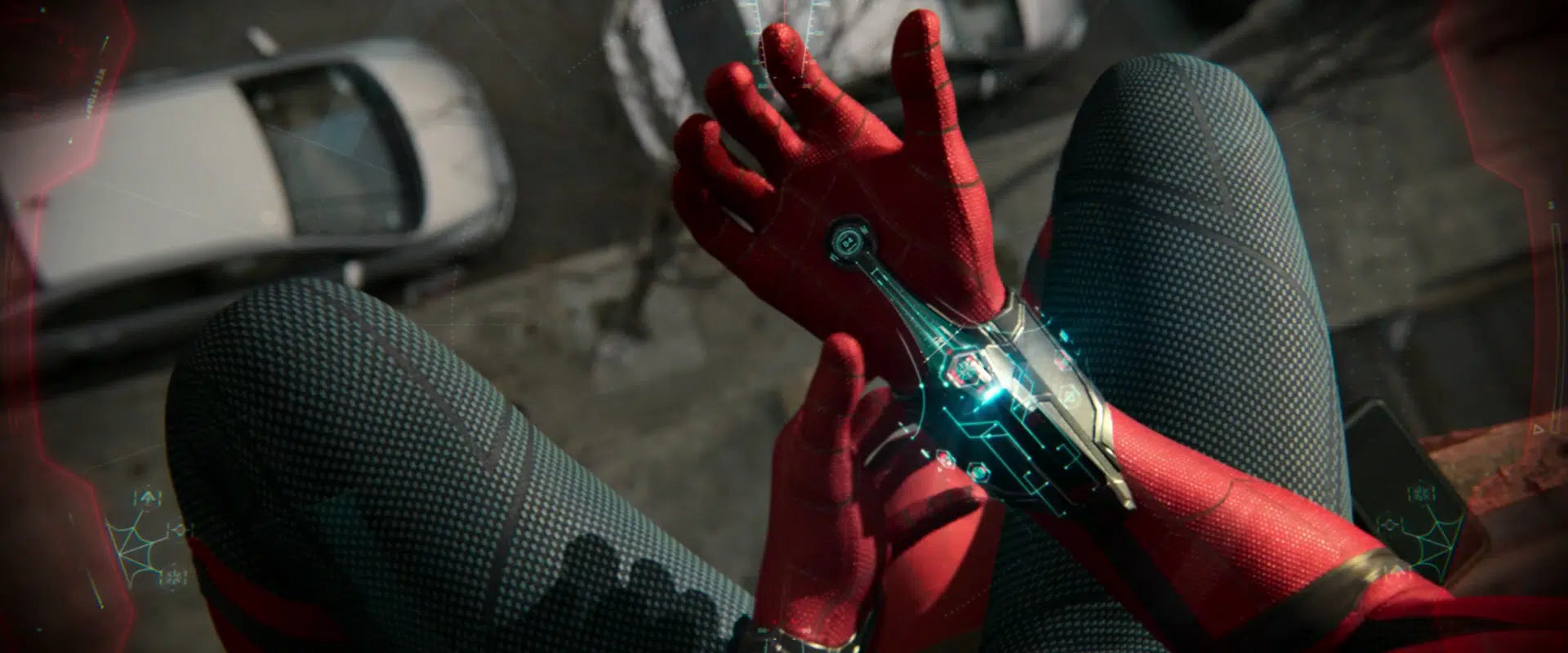
Tom Holland's incarnation in the Marvel Cinematic Universe offers the richest arc of all where web-shooters are concerned. In Captain America: Civil War and Spider-Man: Homecoming, Peter first uses basic homemade web-shooters before receiving Stark Tech equipment. Tony Stark gives him a suit with 576 different web combinations, controlled by the artificial intelligence Karen. These are web-shooters that are both mechanical and augmented by the most advanced technology in the Marvel universe: taser webs, reconnaissance webs, web nets, ricochet webs and rapid-fire mode. That technological abundance reflects the mentor-pupil relationship between Stark and Parker, but it also creates a narrative dependence that the films exploit brilliantly.

The real turning point comes in Spider-Man: No Way Home, when Peter loses everything Tony Stark had given him. The closing scene shows him sewing his own suit and building new web-shooters in a shabby New York flat. That return to fundamentals is a cathartic moment for long-time fans, who finally get back the Peter Parker of the origins, the one who has to rely on his own genius to survive. This trajectory, from high-tech to hand-made, is perhaps the cleverest use of the web-shooter as a narrative metaphor in the character's entire screen history. The narrative potential for Avengers: Secret Wars is immense, with a Peter Parker who is now self-reliant and potentially facing the most extreme multiversal threats.
Web-shooters of the Spider-Verse: Miles Morales and Spider-Man 2099
Miles Morales: when bio-electric powers reinvent web-shooting
Miles Morales represents a fascinating hybrid approach to the web-shooter. Like Peter Parker in the comics, Miles uses mechanical web-shooters, but he combines them with his unique bio-electric powers, the Venom Blast and his camouflage ability. In Across the Spider-Verse and in the video game Marvel's Spider-Man: Miles Morales, that combination produces visually spectacular effects: the webbing can be electrically charged to stun opponents at a distance, creating a fighting style distinct from Peter Parker's. Miles's web-shooters were originally designed by the Peter Parker of his own universe before his death, then modified by S.H.I.E.L.D., which gives them a strong symbolic dimension: they are at once an inheritance and a tool Miles makes his own by adding a personal touch. Video game fans will find these variants again among the Spider-Man suits on PS5, where each unlocked outfit changes the visual effects of the web-shooters.

Miguel O'Hara and the futuristic web-shooters of 2099
Spider-Man 2099, alias Miguel O'Hara, pushes the concept in a radically different direction. In the Nueva York of 2099, Miguel has no web-shooters in the classic sense. His genetic modification gave him retractable talons on his fingers and toes that let him cling to surfaces, along with the ability to produce organic webbing from his forearms, similar to the Raimi version but with a scientific justification tied to the rewriting of his DNA by a genetic manipulation programme. In the most recent iterations, notably in the film Across the Spider-Verse, Miguel also uses advanced holographic technology that projects web constructs in hard light, a fusion of the biological and the technological that perfectly matches the cyberpunk aesthetic of his universe. These multiversal variants show the endless richness of Lee and Ditko's original concept, with every version of the Spider-Verse reinterpreting the web-shooter through the codes of its own world.
Toy web-shooters for children: automatic, water or manual, the guide to choosing well
Beyond the fiction, web-shooters have become one of the most popular and most sought-after Spider-Man toys among children. Every generation of fans wants to reproduce the web-slinger's iconic gesture, that double tap on the palm followed by the jet of webbing, and the toy industry has developed remarkably varied models to meet the demand. The complete guide to automatic, water and manual web shooters goes through each technology, but here is a summary organised by age group to help parents make the right choice.
For ages 3 to 5: simplicity above all
The little ones discovering Spider-Man, often through animated series like Spidey and His Amazing Friends, need web-shooters that are simple, light and safe. Manual models with suction cups or foam darts are ideal for this age group. They work by simple mechanical pressure, with no batteries and no complicated mechanism, and the limited range guarantees safe use indoors and out. Spider-Man gloves with a small built-in shooter are also perfect for the youngest children because they stay put on small hands and need no fine dexterity to fire. Paired with a Spider-Man mask in the right size, these sets make a first complete role-play kit that fuels the imagination without technical frustration. To pick the best-suited model, the guide to web shooters by age and use gives precise recommendations tested by parents.
For ages 6 to 8: the immersion steps up
Between six and eight, children have better fine motor control and want more realism. Water shooters become a brilliant option for this age group, especially over the summer months. The principle is simple but effective: a water reservoir built into the wristband lets them fire a jet that mimics the webbing, with a range of two to four metres depending on the model. Water fights between friends take on a heroic dimension when every participant is wearing a full Spider-Man costume for children. Battery-powered automatic shooters also appear in this age group, with models that fire string or light adhesive tape, reproducing the visual effect of the webbing spectacularly. The guide to Spider-Man toys by age confirms that these intermediate models offer the best fun-to-safety ratio for this pivotal stage.

Picture your child's face the moment they stretch out an arm, press the palm and see the web shoot out for the first time. This Spider-Man web shooter turns every afternoon in the park into a rescue mission, every birthday into an epic adventure and every child's bedroom into the web-slinger's headquarters. This is not a toy, it is the precise moment your child becomes Spider-Man.
34,90 €
Give the power of the web-slingerFor ages 9 and up: chasing realism
From nine upwards, children get demanding about realism and performance. High-end automatic shooters dominate this category, with models able to fire real strands of synthetic web several metres. Some include sound effects lifted straight from the films, blue or red LEDs that light up on firing, and quick-reload mechanisms that reproduce the cartridge change seen on Andrew Garfield. For keen children who want to complete the outfit, a Spider-Man costume suited to their age paired with a high-performance shooter creates a totally immersive experience. This is the ideal age group for giving a complete set, and you can browse the best Spider-Man gift ideas for birthdays, Christmas or to reward a good school year.
Web-shooters for adults: cosplay, collector replicas and fancy-dress accessories
The web-shooter market is not just for children. The cosplay community has built a whole ecosystem around the faithful reproduction of web-shooters, running from the simple Spider-Man fancy dress and costume accessory to a functional device able to fire real strands. Conventions such as MCM Comic Con in London, Comic Con Birmingham and the regional cosplay events see ever more sophisticated creations every year, and the web-shooter is often the centrepiece that separates an amateur cosplay from a professional reconstruction.
Replicas faithful to the film versions
The most demanding cosplayers look for exact replicas of the web-shooters seen on screen. The Garfield version, with its exposed mechanical dials and red cartridges, remains the most popular in cosplay because it gives the best visual result once worn on the wrist. Tom Holland's Stark Tech version attracts cosplayers versed in embedded electronics, because it justifies fitting LEDs, small OLED screens and even servo-driven mechanisms into the wristband. Professional-quality Spider-Man cosplays now build these web-shooters in as functional parts of the costume rather than mere decorative accessories. Consistency between the shooter, the gloves and the rest of the costume is essential to get a convincing photographic result.

Halloween, carnival and costume events
For festive occasions like Halloween or carnival, web-shooters play a crucial part in the visual impact of a Spider-Man costume for carnival and Halloween. A Spider-Man outfit without web-shooters is just a costume; with a working shooter it becomes an interactive performance that captivates everyone around. Retractable string models are perfect in these settings because they let you reproduce the iconic gesture without messing up or damaging an indoor space. Long-time adult fans particularly appreciate shooters that reproduce the distinctive ‘thwip’, that unmistakable web sound that has become an audio signature of the Spider-Man universe just as much as the music of Danny Elfman or Michael Giacchino. To complete a truly immersive set, Spider-Man merchandise offers a full range of complementary accessories, from the Spider-Man T-shirt to the articulated mask and the collectible figures.
How to choose the right web-shooter: the decisive criteria and final recommendations
Faced with the range of models available, choosing the right web-shooter depends on three main factors: the age of the user, the context of use and the level of realism wanted. For a child of three to five, safety and ease of use come first, which points towards manual models with suction cups or foam darts. For a child of six to eight, water shooters offer the best compromise between fun and simplicity. For nine and up, automatic shooters that fire synthetic webbing give the most immersive experience. The shop's guides and advice hub goes through each category with precise comparisons.
For adults keen on cosplay or collecting, investing in a quality replica is justified by its durability and its fidelity. Shooters intended for cosplay need to be light for long wear at a convention, discreet under the costume gloves and robust enough to survive a full day of use. Collectors will favour officially licensed Marvel editions, which guarantee an exact reproduction of the proportions and finishes seen on screen. The whole Spider-Man web shooters collection available in the shop covers these different uses with carefully selected models.
The web-shooter ultimately embodies what is most universal about Spider-Man: the idea that with ingenuity, perseverance and a dash of nerve, anyone can become a hero. Whether you are a parent looking for the perfect Spider-Man gift for a birthday, a cosplayer preparing for the next convention or simply a fan who wants to understand how this legendary accessory evolved across the comics and the films, the web-shooter remains the most tangible symbol of Spider-Man's promise: with great power comes great responsibility, and sometimes all it takes is a well-designed wristband and a little fluid to change the world.

