

14-Day Money-Back Guarantee
0
The short answer
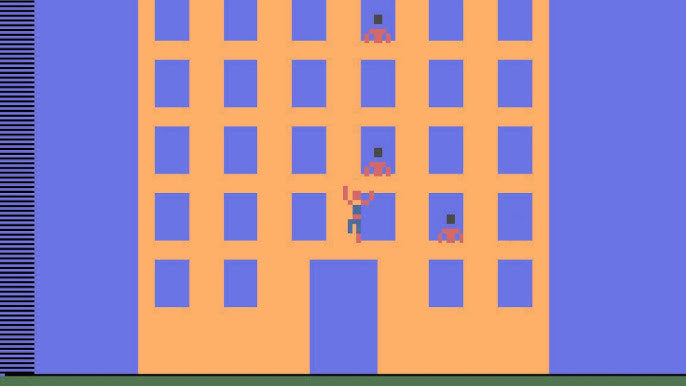
It was in 1982, on the Atari 2600, that Peter Parker became playable for the very first time, in a four-kilobyte programme written by Laura Nikolich for Parker Brothers. The idea: climb a tower block with your webs to defuse the Green Goblin's bombs. Full breakdown below.
Before Insomniac Games, before the PS5, before even the NES, there was a small grey plastic cartridge you slid into a console with kitsch wood panelling and plugged into the family television. It was 1982, and the video game industry had just seen the very first Spider-Man game in history. Released by Parker Brothers on the Atari 2600, this minimalist, strange title — four colours on screen, no music, graphics that today's children would mistake for a display error — nonetheless marked the beginning of a gaming saga that now tops ten billion dollars in cumulative revenue. Understanding the first Spider-Man game means understanding how Peter Parker went from the glossy pages of the comics to the screens of millions of players around the world. This article retraces the birth of this legendary game, its context, its gameplay, its fascinating technical limits, and the colossal legacy it left behind.
1982: The Unlikely Context of the First Spider-Man Game
To understand the importance of the first Spider-Man game, you have to picture the atmosphere of 1982. The video game industry was in full euphoria: the Atari 2600 ruled American living rooms, Pac-Man had just become a smash hit in the arcades, and everyone believed the market would keep growing for ever. That was the year Parker Brothers, the historic board game publisher (Monopoly, Risk, Cluedo), decided to move into video games. For its catalogue, the company negotiated a colossal licence: Spider-Man, then at the peak of his popularity in the comics. The story of Spider-Man was already a long one by then — twenty years of comics since Stan Lee drew on the myth of the spider to give birth to the web-slinger, thousands of pages, dozens of iconic villains — but the hero had never yet been embodied in a video game. It was a world first. To go further on this subject, see also Spider-Man: Shattered Dimensions — the cult game that brought together 4 universes of the web-slinger.
Development was entrusted to Laura Nikolich, one of the very few women developers of the era. She faced a dizzying technical constraint: the Atari 2600 cartridge could hold only four kilobytes of data. Four kilobytes for an entire game — roughly a million times less than the RAM of a modern smartphone. Under those conditions, it was impossible to tell an elaborate story, animate the character smoothly, or faithfully depict Spider-Man's urban world. Nikolich had to invent a gameplay concept that worked within those limits while staying true to the essence of the character. And the result was astonishingly ingenious.
The Gameplay: Climb, Web, Defuse
A radically simple concept
The game's plot fits in a single sentence: the Green Goblin has planted bombs at the top of a skyscraper and Spider-Man has to climb the facade to defuse them before they go off.

That is all. No cutscenes, no dialogue, not even an elaborate title screen. You play a pixelated blue and red silhouette climbing a building rendered as a few vertical lines. To climb, you fire a web upwards with the action button. The web latches onto an invisible point, Spider-Man rises along the thread, then you can fire another web to gain more height. Lateral movement is done by swinging like a pendulum, exactly like Spider-Man's real powers in the comics — a remarkable conceptual fidelity given the constraints.
At the top of the building sits a bomb that Spider-Man defuses simply by reaching it. During the climb, the Green Goblin appears periodically and tries to cut the webs with his pumpkin bombs, sending the hero falling. If Spider-Man drops too far, he dies. As the levels go by, the building grows taller, the Goblin more aggressive, and the countdown shorter. The difficulty curve is brutal, but the satisfaction of nailing a perfect ascent is strangely addictive. Decades before Marvel's Spider-Man 2 on PS5, this little 1982 game had already grasped the essential: the sensation of vertical movement and swinging is what makes Spider-Man unique.
Why the Green Goblin and not Doctor Octopus?
Pitting Spider-Man against the Green Goblin rather than another villain was no accident. In 1982, the Green Goblin was unquestionably the web-slinger's most iconic enemy in the comics — he had killed Gwen Stacy in 1973, an event that marked the end of the Silver Age of American comics. Doctor Octopus would have been just as relevant a choice, but his mechanical tentacles posed a technical challenge that was impossible to meet on the Atari 2600.

The Green Goblin, by contrast, flies on his glider and throws bombs — two actions perfectly representable with a handful of pixels. It is also worth noting that the web-slinger's classic red and blue costume, perfectly suited to the Atari's four-colour format, posed no representation problem at all, unlike some of Spider-Man's more complex special suits which would have been technically impossible to code. Parker Brothers' logic was therefore to pick the villain who was both the most iconic AND the simplest to animate. That decision helped cement in the collective imagination the idea that the Green Goblin is Spider-Man's number one arch-enemy, long before the films enshrined that status.

Critical Reception: A UFO Ahead of Its Time
On its release in September 1982, the game received mixed but respectful reviews. The specialist magazines of the day — Electronic Games, Video Games Player — praised the ingenuity of the concept while pointing out the graphical limits. Many noted that the game captured the sensation of height and vertigo surprisingly well, quite a feat for the console. Sales were decent without being exceptional, partly because the general public was starting to tire of the Atari 2600 and the legendary video game crash of 1983 was already looming on the horizon. But the game found its audience among comics-loving children, who discovered for the first time that they could themselves control the hero who tells them that with great power comes great responsibility.
In hindsight, this first Spider-Man game is now regarded as a cult title by video game historians. It regularly appears in rankings of the best Atari 2600 games, and several academic studies have examined how Laura Nikolich managed to translate the essence of a superhero into four kilobytes. The concept of vertical ascent as the main gameplay mechanic was taken up years later in modern games such as Shadow of the Colossus and Assassin's Creed. And of course, the idea that Spider-Man's enemies must be fought at rooftop height has become an omnipresent narrative convention in every Spider-Man game that followed.
Since we are talking about a 1982 classic whose pixelated aesthetic evokes a whole era, the Spider-Man retro comics poster is exactly what you need to celebrate that nostalgia. Vintage panels, primary colours, period print screens — it is the soul of 1970s and 1980s comics reproduced with a fidelity that would thrill any collector. Hung on the wall of an office or a teenage fan's bedroom, it turns the space into a permanent tribute to the era when Spider-Man became a cultural icon. See the Retro Comics poster →
The Legacy: How 1982 Shaped Every Game That Followed
The direct lessons of the first game
If you look objectively at every Spider-Man video game that followed, you find in each of them elements that were already present in the 1982 title.


Vertical traversal by swinging has become the absolute signature of the franchise. The final boss fought high above the ground, usually in a spectacular aerial duel. The presence of the Green Goblin as a recurring antagonist. Managing the fall as a permanent threat. All these elements, which Laura Nikolich coded for want of anything better, have become narrative conventions set in stone in the Spider-Man game. Even the Insomniac Games blockbusters, with their hundreds of motion-capture animations and their open-world cities, remain fundamentally built on the same founding idea: Spider-Man is above all the sensation of moving freely up and down in a vertical environment.
The dazzling graphical evolution
The contrast between the 1982 Spider-Man and modern games is one of the most striking examples of technological progress in video games. In forty-three years, we have gone from four colours to billions, from a few static pixels to photorealistic 3D models, from a non-existent soundtrack to orchestral compositions. The evolution of special effects in the Spider-Man films followed a parallel path, but video games have probably progressed even faster, because they had both to catch up with cinema visually and to invent new ways of embodying the hero. Today, games such as Spider-Man on PS5 offer whole sequences where you wonder whether you are watching an animated film or actually controlling the character — a fluidity Laura Nikolich could never have imagined in 1982.
The arrival of Miles Morales and the opening of the multiverse
Another fascinating dimension of this evolution is the diversification of the protagonists. In 1982, there was only one playable Spider-Man: Peter Parker. Today, players can take on the role of Miles Morales, Spider-Gwen, Spider-Man 2099, Spider-Man Noir, the 1930s detective, and many other versions from the Spider-Verse.

That openness would have been inconceivable in 1982, when Spider-Man came down to a single character and a single costume. The very concept of the multiverse would only be popularised in games decades later, alongside its explosion in the comics and in cinema. What makes the legacy of the first game even more impressive is that it managed to lay the foundations of a genre that would go on to gain so many new narrative layers without ever disowning its mechanical origins.
Why This Game Deserves to Be Rediscovered Today
At a time when modern Spider-Man games offer ultra-cinematic experiences and hours of gameplay, you might think there is no point going back to the 1982 title. That would be a mistake. The first Spider-Man game offers something no modern blockbuster can reproduce: the absolute purity of a single mechanic pushed to its extreme. No map, no inventory, no side quests, no skill trees. Just you, a building, and the need to climb. That purity has become rare in contemporary video games, and rediscovering this title helps you understand why gaming became a major art form — because right from the start it was able to capture the essence of a character in a few moving pixels.
What is more, playing the Atari Spider-Man today puts you back in the shoes of the first fans who discovered the web-slinger on screen. It is feeling the wonder the children of 1982 must have felt as they realised for the first time that they were controlling their favourite hero. That emotional dimension is precious, especially for fans who grew up with the comics and have watched Spider-Man travel through every possible media form. Stan Lee's cameos in the modern films constantly remind us that this universe has a history, and the first game is one of its founding pillars, just as much as the first comic or the first cartoon.
For those who want to wear this Spider-Man heritage every day, the The Amazing Spider-Man and Venom T-Shirt brings the comics spirit to life with a design that would have made 1982 fans dream. The web-slinger facing his symbiote enemy, in a visual that recalls the best Marvel covers of the 80s and 90s. Comfortable cut, crisp print, and that unique satisfaction of wearing a piece of the history of a hero who crosses the generations without ever ageing. Perfect for retro-gaming nights, comic conventions, or simply for showing off a passion that never goes out of style. Discover the Amazing Spider-Man T-Shirt →
Spider-Man and Video Games: A Saga That Keeps Evolving
Forty-three years after the founding title of 1982, the Spider-Man saga in video games has never been more alive. Insomniac Games has turned the franchise into the absolute benchmark of the PS5, with titles that break sales records with every release. Every new game adds its stone to the edifice: new costumes, new powers, new villains, new facets of the character. And yet, every time a player swings between two New York skyscrapers with a controller in hand, they are unconsciously repeating the founding gesture of the 1982 Spider-Man — fire a web, climb, fall, start again. That mechanical continuity across the decades is one of the finest examples of cultural transmission in the history of video games.
The current success of the Spider-Man games also has an effect on merchandise and fan culture. Spider-Man figures now reproduce the costumes seen in the PS5 games, Spider-Man t-shirts feature designs inspired by the cutscenes, and Spider-Man posters take up the publishers' official artwork — the evolution of the Spider-Man logo through the decades reads, incidentally, like a visual summary of the gaming franchise itself. For Spider-Man gifts aimed at retro-gaming fans, the choice is now vast. For children discovering the web-slinger today through video games,


the ecosystem of merchandise becomes a gateway to the character's entire world. It is through Spider-Man toys that they extend the play experience, through Spider-Man pyjamas that they identify with the hero, and through Spider-Man backpacks that they take him to school.
This continuity also extends to LEGO products, which have in fact developed their own franchise of Spider-Man games, creating a surprising bridge between the physical world of bricks and the digital world of video games. LEGO Spider-Man sets let fans rebuild the most iconic scenes, from the fight against the Green Goblin to the rooftop chases across New York. For themed dressing up at conventions or parties, Spider-Man fancy dress and Spider-Man masks let you embody the character in the flesh — a return to the roots of role-play, in the end, but with no controller and no pixels. And for those who want an emblematic collector's item, the Spider-Man figure remains the centrepiece of any self-respecting fan's collection.
Conclusion: Honouring the Origins to Better Understand the Present
The first Spider-Man game of 1982 was no technical masterpiece. With its four colours, its minimalist gameplay and its extreme hardware constraints, it could easily be swept aside with a flick of a controller by modern standards. And yet this little Atari game laid the foundations of one of the most prolific and best-loved gaming franchises in history. Understanding its legacy means better appreciating every new Spider-Man that comes out today — and it also means doing justice to Laura Nikolich, that unjustly forgotten pioneer who managed to capture the essence of a superhero in four kilobytes. To go further in exploring this vast universe, our complete universe of Spider-Man characters as well as the official collection of merchandise offer every resource for fans who want to continue the journey that began in 1982 on a cathode-ray television. For the full editorial ecosystem, our guides and advice cover every facet of the web-slinger, from video games to comics by way of the films and the merchandise.

