

14-Day Money-Back Guarantee
0
The short answer
The breakthrough comes down to one technical rule the team laid down: the web can only attach to a building genuinely present above the player, never to an invisible point in the sky. That constraint forces you to read the skyline and turns movement into a discipline in its own right. We cover the origins and the legacy below.
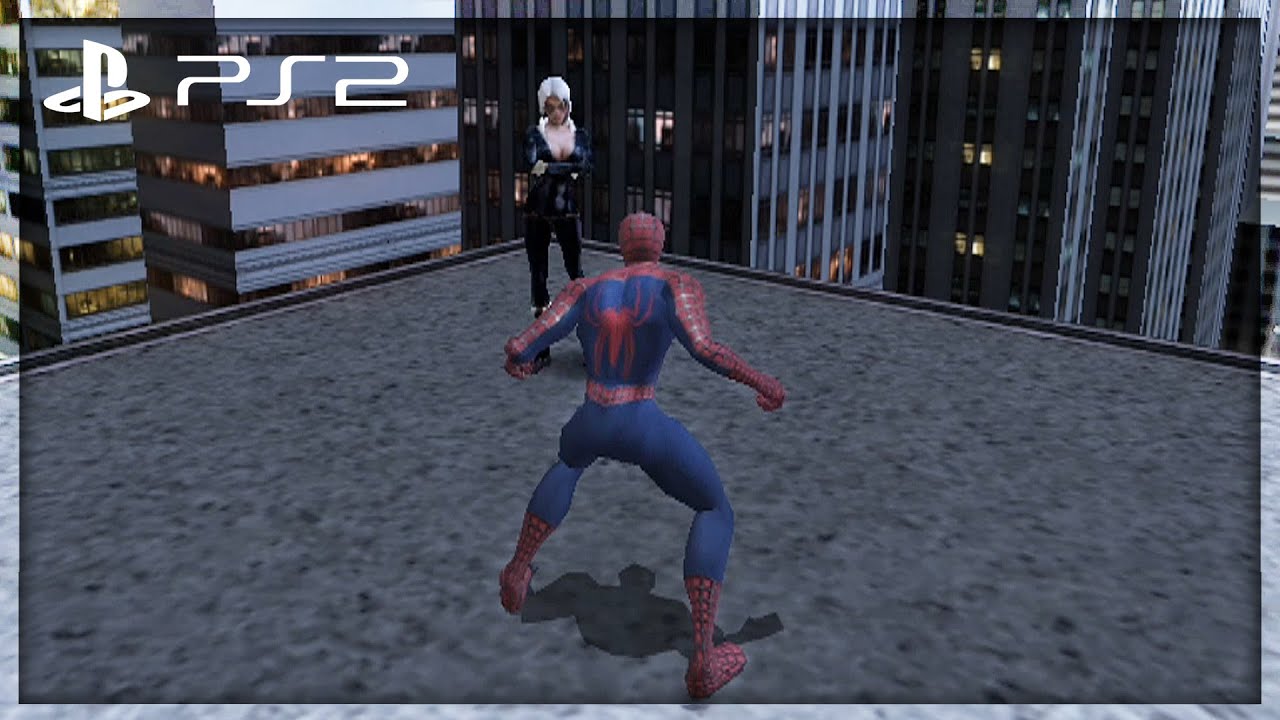
There are a handful of titles in video game history we talk about as earthquakes: Super Mario 64 for 3D, Half-Life for storytelling, and Spider-Man 2, released in 2004 on PlayStation 2, for the sheer sensation of freedom. Twenty-two years on, this Treyarch-developed game is still, for many fans, the best Spider-Man game ever made — ahead even of the recent Insomniac Games blockbusters. Why? Because it was the first to really make you feel what it means to be Peter Parker swinging between the skyscrapers of Manhattan. Before it, Spider-Man games offered walled-off levels and pre-programmed jumps. After it, no web-slinger game could afford to ignore the real physics of web-swinging. This article traces the origins, the technical revolution and the monumental legacy of a title that redefined what it meant to play a superhero.
2004: The Mad Promise of an Open Manhattan
To understand the shock of Spider-Man 2, you have to put yourself back in the context of the time. In 2004, Grand Theft Auto Vice City had proved that an urban open world could be addictive, but nobody had yet imagined combining that freedom with a hero blessed with superhuman powers. Activision, buoyed by its adaptation of the first Raimi film in 2002, handed Treyarch the job of producing the tie-in game for the film Spider-Man 2. The studio could have settled for a classic action corridor. Instead it chose to take a colossal risk: recreate the whole island of Manhattan, to scale, and let the player move around it freely using Spider-Man's powers. At that point, no other superhero game had attempted anything so ambitious. The promise was dizzying: for the first time, you wouldn't be playing Spider-Man on rails, but really being Spider-Man, with the whole urban geography at your disposal.

The development team, led by Jamie Fristrom as technical director, focused on one precise point: the web. In the earlier games, web-swinging was scripted; Spider-Man latched onto invisible points in the sky, even with no building anywhere nearby. Fristrom refused that cheat. His rule was clear: if nothing is visible above the player's head, the web must not be able to attach. That physical constraint, which could have made the game frustrating, instead became its central stroke of genius. Spider-Man's powers are no longer a visual gimmick, they are a geographical constraint. To get around, you have to read the skyline, work out trajectories, anticipate angles. The city itself becomes an instrument of play.
Web-Swinging: A Revolution in Physics
The mechanic that changed everything
Spider-Man 2's real tour de force lies in the way it models swinging. Every web the player fires attaches to a real building, with a length calculated in real time. You control the tension of the line with the trigger, can release at any moment to build momentum, and chain arcs together by transferring kinetic energy from one swing to the next. This system, which the developers called 'catenary physics', demands a learning curve but delivers incomparable satisfaction once mastered. You are no longer playing as Spider-Man, you are piloting a body that defies the laws of gravity. The result was such that some players spent dozens of hours simply swinging between the buildings, without even triggering a mission. It was the first time a video game managed to turn plain movement into an activity more addictive than the story itself.
This real-physics system is the exact opposite of what was offered by every previous Spider-Man video game. In 1982 on the Atari 2600, Spider-Man climbed a single building with pre-scripted webs. In 2000 on PlayStation 1, the web-slinger moved through an artistic haze that hid the absence of real buildings above him. Spider-Man 2 on PS2 dared to show a complete, sunlit Manhattan in broad daylight, and to let the player take full possession of it. That leap in quality wasn't incremental — it was a paradigm shift that redefined every expectation of the genre.
Doc Ock and the rogues' gallery
The game's other strength is its cast of antagonists. Based on Sam Raimi's film, the title puts Doctor Octopus front and centre as the main threat, faithful to the film's storyline. But Treyarch, aware that a single villain isn't enough to hold up an open world, decided to scatter fights against other iconic enemies across the city: Mysterio, Rhino, Shocker, the Headhunter — a line-up that almost foreshadowed the ambition of the Sinister Six, the cult villain team. These surprise fights turn every stroll through Manhattan into a potential epic confrontation. The player is never safe, always liable to be called on by a radio SOS, a robbery alert or the sudden appearance of a villain. That density of random events was revolutionary for the time and served as the model for every superhero open world that followed.

The Shock on Release: Ecstatic Reviews and Record Sales
When Spider-Man 2 came out in June 2004, the specialist press was unanimous: this was the best superhero game ever produced. IGN gave it 9 out of 10, Game Informer 9.25, and Electronic Gaming Monthly ranked it among the best games of the year across all categories. The sales followed: more than six million copies shifted worldwide, making it one of the biggest commercial successes of the PS2 era. For Activision, it was total vindication of the bet Treyarch had placed. For players, it was a new absolute benchmark. And for the industry, it was the signal that a superhero game could compete artistically and commercially with any AAA, provided it respected its source material instead of botching it.


Part of the reason for the success also lies in the voice acting and the art direction. Tobey Maguire lends his voice to Spider-Man in the original version, Alfred Molina plays Doc Ock, and Bruce Campbell, Sam Raimi's long-standing collaborator, handles the game's comic voice-overs — a cast that carried straight on from what many consider the best Spider-Man film of all time. You will also find one of the Stan Lee cameos as a radio nod inside the game. This continuity with the film universe creates total immersion. You really do feel as though you are playing an alternative sequel to the film, with its own narrative arcs and its own side missions. The game thus became one of the first cases where a film tie-in is treated as canon by fans, on the same footing as the film itself. Years later, while designing Marvel's Spider-Man 2 on PS5, Insomniac would openly admit to drawing on the 2004 Spider-Man 2 for the feel of fluid swinging — a tribute that says a great deal about the title's historical importance.
If the sensation of firing a web and swinging through Manhattan has always fascinated you, the Automatic Spider-Man Web-Shooter turns that gaming fantasy into a real object. Strapped to your wrist, it reproduces the web-slinger's iconic gesture, with a trigger mechanism that really does send a line shooting out. For fans of the PS2 game who spent hours mastering the art of web-swinging, it is the ultimate accessory for carrying the experience off-screen — cosplay nights, conventions, or simply to relive the magic of 2004. See the Automatic Web-Shooter →
A Lasting Legacy: How Spider-Man 2 Shaped a Generation
The direct influence on modern games
Twenty years after its release, Spider-Man 2's DNA can be found in every modern superhero game. Batman Arkham City, released in 2011, borrowed the concept of an urban open world with random activities. Marvel's Avengers tried to recreate the fluidity of movement. But it is above all the Insomniac trilogy (Marvel's Spider-Man 2018, Miles Morales 2020, Spider-Man 2 PS5) that stands in the direct lineage of the Treyarch game. Insomniac improved the graphics, the storytelling, the cutscenes, but the physical basis of web-swinging remains conceptually identical: attach a web to a real building, use gravitational momentum, chain the arcs together. Miles Morales, the hero of the PS5 generation, swings exactly according to the principles laid down by Spider-Man 2 in 2004. The difference is purely technical, not conceptual.


That lineage is openly acknowledged by the creators. Bryan Intihar, creative director at Insomniac, has said in interviews several times how closely the team studied Spider-Man 2 as an absolute reference during pre-production. 'We wanted players to find again that magic of web-swinging they felt in 2004,' he said. Few games can claim to have inspired two decades of later productions at that level. In the history of the medium, Spider-Man 2 holds the same place as Ocarina of Time does for adventure or Half-Life for the FPS: a founding title whose shockwave keeps travelling through every new generation of hardware.
The impact on fan culture
Beyond the industry, Spider-Man 2 marked a whole generation of players. For many teenagers in 2004, it was the first game that genuinely made them feel like a superhero, embodying that founding lesson that with great power comes great responsibility. That emotional dimension has fed two decades of a particularly loyal fan culture, which still turns out mods, speedruns, retrospective YouTube videos and unofficial remasters today. The PC community in particular has developed patches to run the game on emulators at 4K resolution, extending the title's life well beyond its official commercial run. This active preservation phenomenon, typical of cult games, places Spider-Man 2 alongside timeless classics such as Ocarina of Time or Shenmue in the imagination of those in the know. The most powerful enemies of Spider-Man present in this game — Doc Ock, Mysterio, Rhino — were, for that matter, rediscovered by a whole generation thanks to this gaming experience.
A game that came before the multiverse
Another remarkable dimension: as early as 2004, Spider-Man 2 offered a side mission where the player could dress up in different alternative suits, in a way foreshadowing what would become central to the concept of the Spider-Verse and the multiverse. You could unlock the black symbiote suit, the 1970s suit, or even the Spider-Man Noir suit in certain versions — a wardrobe that today comes close to what the write-ups on the most legendary special Spider-Man suits. These variations weren't yet narrativised as a multiverse in the strict sense, but they laid its play-based foundations. This system of progressively unlocking suits has become an absolute convention of the Spider-Man games that followed, so much so that we often forget it was Spider-Man 2 that popularised it first.
Why Spider-Man 2 Remains Irreplaceable in 2026
At a time when modern Spider-Man games reach photorealistic graphical levels with budgets of several hundred million dollars, you might think there is no longer any point going back to Spider-Man 2. That would be a misjudgement. The 2004 game has a mechanical purity that its successors, obliged to adapt to heavier narrative expectations, have gradually lost. In Spider-Man 2 there are no interminable cutscenes, no complex skill trees, no invasive crafting systems. Just a hero, a city, and the freedom to move around it with a fluidity that remains, two decades later, one of the most satisfying ever programmed into a video game. That purity is precious and explains why so many players still regard this title as their personal benchmark, whatever the technical progress made since.

Playing Spider-Man 2 again today is also an act of cultural memory. It means rediscovering an era when superhero games had to win over a sometimes sceptical audience, when creative ambition came before the tried-and-tested commercial formula. It also means measuring the distance travelled since the story of Spider-Man in film and in the comics, seeing just how much video games have helped make the web-slinger a cultural icon in his own right, and not merely a comics character adapted for the big screen. The evolution of special effects in the Spider-Man films has in turn benefited from advances in video games, creating a creative dialogue between the two media that wouldn't have existed without the milestones Treyarch laid down in 2004.
For collectors who want to honour this founding era, the Spider-Man Figurine captures the hero in his iconic swinging pose — exactly the one you spent hours watching in Spider-Man 2 on PS2. Precise articulation, careful finishing, suit details faithful to the comics: it is a centrepiece for any fan's shelf, an object that reminds you there was a legendary character behind every pixel of the game, now immortalised in three dimensions. Ideal for fans who want to make their gaming passion tangible in their everyday space. Discover the Spider-Man Figurine →
The Spider-Man Ecosystem: From Video Game to Pop Culture
The success of Spider-Man 2 in 2004 did a great deal to feed the whole ecosystem of merchandise that surrounds the web-slinger today. When a child discovers Spider-Man through an immersive game, they build a strong emotional relationship with the character, which then translates into buying across the board. Spider-Man figurines reproduce the iconic poses seen in the cutscenes. Spider-Man T-shirts sport the logos and suits made famous by the games. Spider-Man posters often reuse the official artwork from the games' marketing campaigns.

This convergence of video games and merchandising extends to every facet of fan spending. Spider-Man LEGO lets you physically rebuild the game's iconic scenes, from the Daily Bugle to the tops of the skyscrapers. Spider-Man pyjamas and Spider-Man soft toys become bedtime companions for the children who discovered the hero through the games. Spider-Man backpacks go with them to school, extending the pride of being a fan beyond the bedroom. For fans on the move, the classic Spider-Man MagSafe case lets you show your love of the web-slinger every day, on a smartphone that has itself become a gaming platform. And for the more expressive fans, Spider-Man fancy dress and costumes combined with Spider-Man masks or Spider-Man web-shooters turn themed nights and conventions into genuine experiences of becoming the character.
For families looking to organise a birthday or a themed surprise around the web-slinger, the guide to a successful Spider-Man birthday party has all the ideas for turning an ordinary day into a superhero adventure. It is a way of extending that gaming magic into the real world, giving children the chance to live out physically what they adore virtually.
Conclusion: Doing Justice to the Founding Game of the Modern Era
Spider-Man 2 on PlayStation 2 isn't just a good superhero game — it is the title that demonstrated what the genre could be. By daring to go open world, with real swinging physics, a density of urban events and absolute respect for the source material, Treyarch laid the foundations on which the whole superhero game industry still rests today. Twenty-two years later, replaying this title remains an experience that is both nostalgic and revealing: you understand better why the Insomniac games look the way they do, why Batman Arkham adopted its structure, and why so many players regard 2004 as year zero for the superhero in video games. To keep exploring this rich universe, our complete universe of Spider-Man characters and the full collection of merchandise offer the ideal resources for extending the experience. And for those who want to go further still, our guides and advice cover the web-slinger's entire ecosystem, from video games to comics by way of the films and the merchandise — an ecosystem of which Spider-Man 2 remains one of the founding pillars, and whose influence keeps making itself felt with every new release in the franchise.

