
14-Day Money-Back Guarantee
0
The short answer
Phil Urich starts his career as a well-meaning Green Goblin before he tips over: he becomes the new Hobgoblin after betraying and then killing Roderick Kingsley. In the meantime, Alchemax technology and the Goblin gas have eaten away at his sanity. We retrace that fall below.
Contents
A heavy family legacy to carryA hero without direction in a city without mercyFrom failed hero to tragic figure: the fall of Phil UrichThe Goblin of modern times: between manipulation and chaosPhil Urich against Spider-Man: the inevitable confrontationMadness as a final refugeA legacy of pain and reflectionThe symbol of modern tragedy at Marvel
A heavy family legacy to carry
In the teeming universe of Spider-Man, few characters have embodied the duality between light and darkness as well as Phil Urich. Nephew of the famous journalist Ben Urich of the Daily Bugle, Phil grows up in the shadow of the heroes and villains of New York. Ambitious, curious and eager to do the right thing, he is nonetheless swept up by the unpredictable consequences of a simple twist of fate.
His journey begins when he accidentally discovers a hideout containing the equipment of the Green Goblin. Rather than give in to the temptation of crime, Phil decides to use it for heroic ends. He becomes the new Green Goblin, but an unusual sort of hero — clumsy, enthusiastic, and terribly human.

The Green Goblin… the heroic version
Unlike Norman Osborn, his diabolical role model, Phil Urich tries to use his equipment to do good. He fights crime, saves innocent people, and eventually crosses paths with Spider-Man, with whom he keeps an ambiguous relationship — somewhere between admiration and rivalry. His inexperience and impulsiveness, though, make him an unstable hero, often prey to doubt.
Phil embodies something rare at Marvel: a second-tier hero who fails not out of malice, but through a lack of mastery. He perfectly illustrates what the world of the web-slinger so often puts forward: humanity above all. Like Peter Parker, he wants to do good, but he runs into the harsh reality of power and responsibility.
A heroic Green Goblin
Ben Urich's nephew, Phil stumbles on the Green Goblin's equipment by chance and chooses to use it for good, as a clumsy, enthusiastic hero.
A hero without direction in a city without mercy
As his adventures go on, Phil Urich realises that the world of superheroes is not made for him. Mocked by some, ignored by others, he starts to sink into a sense of failure. His heroic deeds go unnoticed, and his attempt to make a name for himself in a universe dominated by figures such as Daredevil or Peter Parker fails miserably.
That disillusionment marks the start of his descent: loss of confidence, frustration and jealousy settle in. Little by little, Phil drifts away from his heroic calling towards a far darker path… the one that will make him a dangerous anti-hero, and later a genuine villain of the Spider-Man universe.
If you love this period caught between heroism and madness, have a look at our Spider-Man figures and our Marvel posters featuring the saga's most striking outsider heroes and anti-heroes.
The start of the descent
Mocked or ignored, Phil Urich watches his heroic deeds go unnoticed: loss of confidence, frustration and jealousy slowly pull him away from his calling.
From failed hero to tragic figure: the fall of Phil Urich
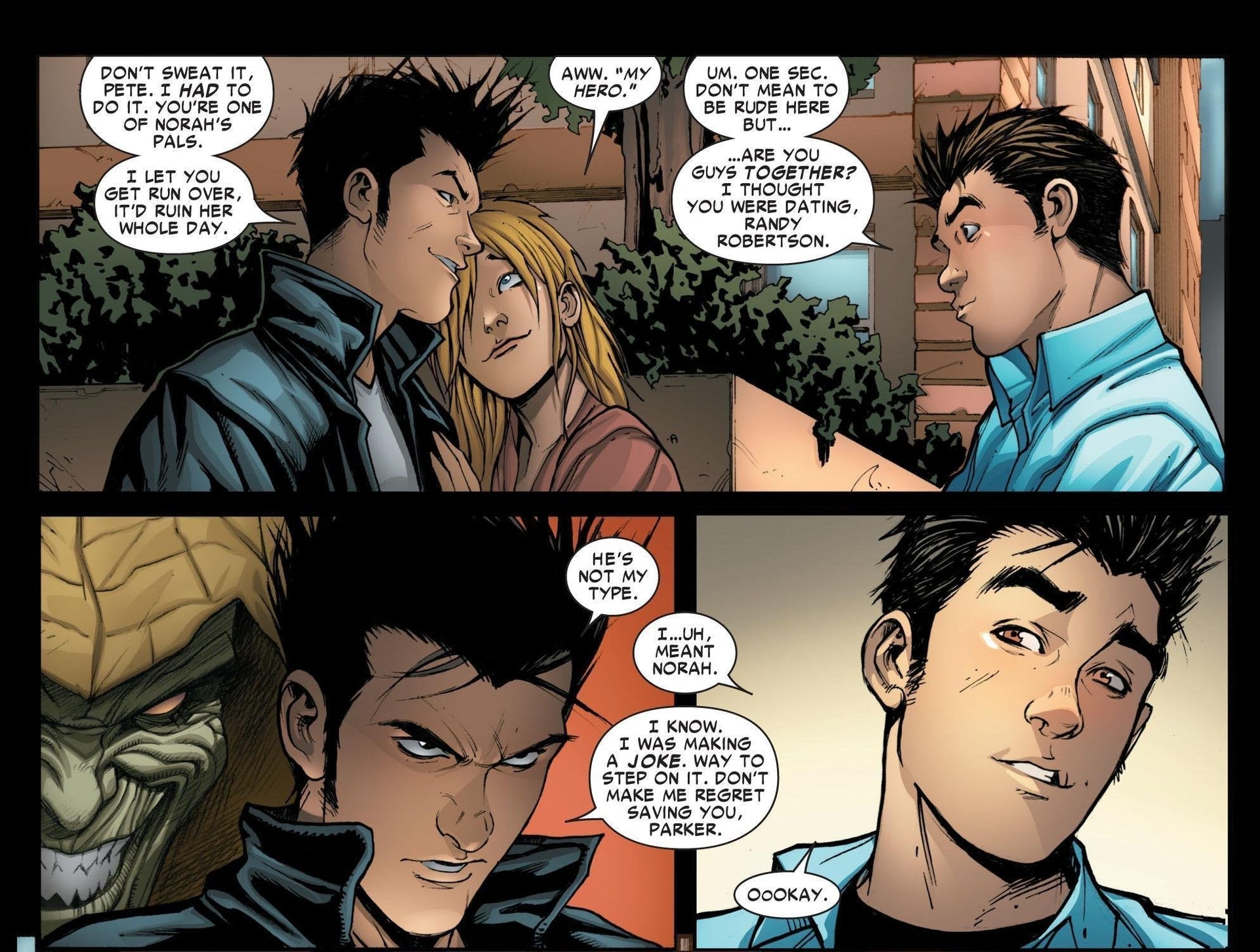
The transformation of Phil Urich did not happen in a day. At first, he simply wanted to honour the name of the heroes he admired, such as Peter Parker or Daredevil. But as his attempts failed one after another, he began to feel a deep frustration. Every lost fight, every humiliation suffered at the hands of his peers fed an anger in him that even his uncle Ben Urich could no longer soothe.
His already fragile mind wavers between guilt and resentment. Phil starts to see the world of superheroes no longer as a source of inspiration, but as a closed, unfair system where only the most powerful find a place. That bitterness will gradually lead him to cross the line he had sworn never to cross.
The temptation of power and the birth of a new Goblin
The real descent into hell begins when he comes across a new version of the Green Goblin's gear. The technology and chemicals of Alchemax let him upgrade his equipment… but they also damage his sanity. The Goblin gas works on him like a drug: it heightens his emotions and brings out the darkest part of him.

Phil gradually becomes the new Hobgoblin, succeeding Roderick Kingsley after betraying and murdering him. That killing marks the point of no return. The former idealistic hero gives way to a charismatic but unstable criminal, obsessed with power and recognition.

The Goblin of modern times: between manipulation and chaos
Behind his mask, Phil Urich no longer merely imitates Norman Osborn: he parodies him. He laughs, he taunts, but there is nothing amused about that laugh any more. It is a nervous laugh, the laugh of a broken man trying to prove to himself that he still controls something. His shift from hero to villain becomes a metaphor for the corruption of an ideal — a dark vision of the American dream, Marvel style.
This transformation is all the more striking because it belongs to an era when Spider-Man faces threats that are more psychological than physical. Phil Urich is not the strongest, but he is profoundly human, and that is what makes him dangerous. His actions sometimes recall the madness of characters such as Mysterio or the Jackal: men broken by their own ambition.
To find the look of that era and the modern versions of the Goblin, explore our Spider-Man mask collection, where the various incarnations of the Green Goblin and the Hobgoblin take pride of place, along with the most iconic Spider-Man costumes.
A parody of Norman Osborn
Phil Urich no longer merely imitates Norman Osborn: he parodies him, with the nervous laugh of a broken man still trying to control something.
Phil Urich against Spider-Man: the inevitable confrontation
The confrontation between Phil Urich and Peter Parker was inevitable. On one side, a broken hero trying to prove he still exists; on the other, a web-slinger who is exhausted but true to his values. Their duel, more psychological than physical, perfectly illustrates the moral complexity of the Spider-Man universe: a world where the line between good and evil is often blurred.

By putting on the Hobgoblin costume, Phil rejects everything he once was. He sees Spider-Man not as a role model but as an oppressive figure — the image of what he could have been had he not failed. That resentment feeds his hatred and pushes him to extremes, recalling the toxic rivalry between Peter and Harry Osborn.
A hatred born of admiration
Phil Urich never truly wanted to kill Spider-Man. He wanted to be recognised, understood, loved by the same public that worships the web-slinger. But unreturned love turns to frustration, and frustration turns to rage. In fighting Spider-Man, Phil is not only fighting a hero — he is fighting the symbol of everything he failed to become.
That tragic dimension brings him close to the hero's other 'mirror' enemies: Venom, for instance, embodies rejection; Morlun, fate; and the Hobgoblin, the drift. Phil Urich brings all three together: he is the fate of a failure, the drift of an ambition, and the rejection of morality.
Madness as a final refuge
As his mind cracks, Phil ends up losing his grip on reality. His shrill laugh — once a heroic gimmick — becomes a cry of pain. Marvel's writers deliberately showed that this 'Goblin laugh' stood for the mental fracture between his former self and the creature he has become.
The chapters of his fall recall those of Norman Osborn, but with a shade of tragedy: where Norman seeks control, Phil seeks meaning. And in that hollow quest, he loses himself completely. The Hobgoblin he embodies is eventually defeated by Spider-Man, but his eyes, just before the defeat, betray neither hatred nor fear — only the weariness of a man who wanted to be someone and lost everything.
That confrontation marks an important stage in the web-slinger's mythology. It reminds us that even in a world of masked heroes, the greatest dramas come from human flaws. It is a theme that also runs through Sam Raimi's films, where every enemy — from Doctor Octopus to the Green Goblin — is above all a victim of himself.
If you are drawn to this symbolism of light and madness, explore our Spider-Man slippers inspired by the films and comics, along with our multiverse pyjamas featuring his most fearsome adversaries.
Seeking meaning, not control
Where Norman Osborn seeks control, Phil seeks meaning; defeated by Spider-Man, he shows neither hatred nor fear, only weariness.
A legacy of pain and reflection
While Phil Urich is a less prominent character in Marvel comics today, his time there left a lasting mark on the mythology of Spider-Man. His arc, from clumsy hero to tortured Goblin, perfectly embodies the duality of this universe: one where even good intentions can turn monstrous once despair gets involved.
Phil never had Norman Osborn's presence or Roderick Kingsley's cunning, but he remains one of the most human Goblins. His tragedy echoes that of many of the web-slinger's supporting characters, such as George Stacy or Ned Leeds: figures who, for all their mistakes, tried to give their existence meaning in a world where heroes fall as fast as they rise.
A new generation shaped by his example
Modern Marvel stories sometimes echo Phil Urich, especially in arcs where the line between good and evil disappears completely. Writers use him to remind us that Goblins are not only a symbol of madness: they are a mirror of human despair. And Phil, more than any other, showed that one failure, one humiliation or one bad choice is enough to tip you into the shadows.
His legacy lives on in the young heroes searching for an identity, but also in anti-heroes such as Venom or Mister Negative. They all have one thing in common: they are products of society, of loneliness and of lost meaning. These are themes that run through the greatest Spider-Man works, from its iconic films to the cult comics of the Spider-Verse.

One of the most human Goblins
Without Norman Osborn's presence or Roderick Kingsley's cunning, Phil shows that one failure, one humiliation or one bad choice is enough to tip you into the shadows.
The symbol of modern tragedy at Marvel
Phil Urich is, in the end, the story of a young man who wanted to be someone. And that is no doubt what makes him so universal: his fall comes not from hatred or revenge, but from failure and the fear of being forgotten. In a world saturated with perfect heroes, he reminds us that the real tragedy is trying to do good in a system that does not reward fragility.
Spider-Man himself, in fighting him, always saw that humanity in him. Phil is not a monster, but a warning. A reminder that even heroes can fail, and that the line between light and darkness sometimes hangs by a thread — or by a web.
To take this theme of duality and madness further, have a look at our Spider-Man lamps featuring the most memorable Goblins, our supervillain masks for full immersion, and our Marvel blanket collection paying tribute to these tortured characters.
A character worth (re)discovering
Phil Urich deserves his place in Spider-Man's history not as just another Goblin, but as the most sincere reflection of what the web-slinger's universe stands for: a world where every failure can become a rebirth, and where even those who fall remain essential to the legend.
A warning, not a monster
His fall comes neither from hatred nor from revenge, but from failure and the fear of being forgotten: even heroes can fail.

