
14-Day Money-Back Guarantee
0
The short answer
Neither traitor nor criminal: Ned Leeds was brainwashed by Roderick Kingsley, the real Hobgoblin, who made him carry the blame for his crimes. Murdered in Berlin, he was only cleared long after his death. The full story of his downfall is below.
In the mythology of Spider-Man, few characters embody the blurred line between friendship and betrayal quite like Ned Leeds. Known to the wider public as Peter Parker's best friend in the films of the Marvel Cinematic Universe, Ned has a far darker story in the comics - that of a man manipulated, broken, and accused of a crime he may never have committed.
A reporter at the Daily Bugle and engaged to Betty Brant, Ned Leeds is above all an ordinary man, caught up in the secrets and lies of the Marvel universe. But behind that unremarkable facade lies a tragic riddle: was he really the fearsome **Hobgoblin**, or simply a victim of manipulation?
Quiet beginnings at the Daily Bugle
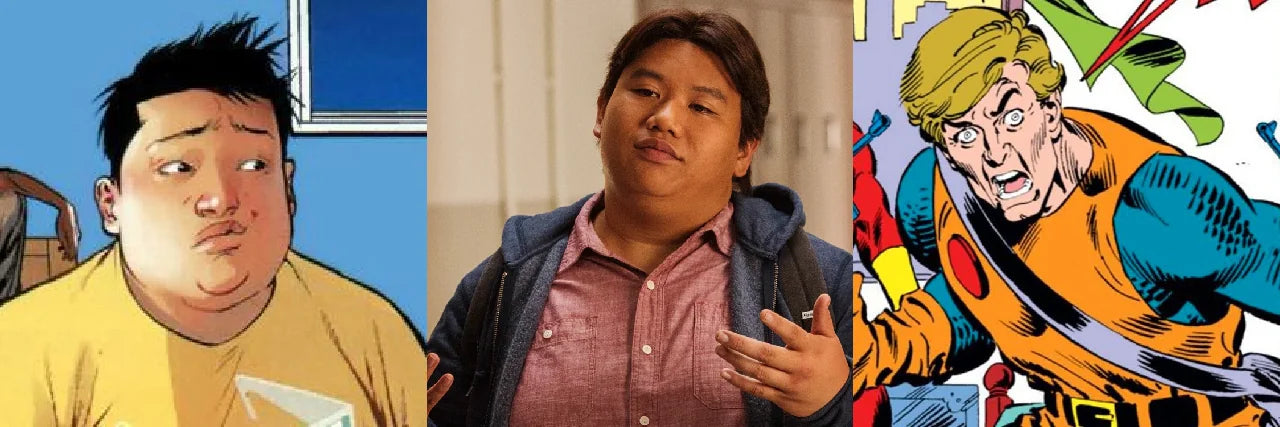
Ned Leeds first appeared in The Amazing Spider-Man #18 in 1964, created by Stan Lee and Steve Ditko. Originally he was nothing more than a reporter working for the famous J. Jonah Jameson, often caught in the crossfire between the newsroom and Spider-Man's exploits.
His role grows in importance when he becomes the **romantic rival** of Peter Parker: both men are in love with Betty Brant, the Bugle's secretary. But unlike Peter, Ned stands for stability and maturity, and that is what eventually wins Betty over. Their relationship quickly turns serious, and even leads to marriage. Peter, for his part, tries to be happy for his friends, but the situation adds a note of melancholy to the web-slinger's life, already marked by loneliness and guilt.
The shadow of the Hobgoblin hangs over him
As Ned's career develops, his fate takes a turn. While investigating a series of crimes linked to a mysterious masked vigilante, he falls into the clutches of the real **Hobgoblin**, an enemy as cunning as he is dangerous. Captured and mentally manipulated, Ned becomes a **puppet of evil** in spite of himself - wrongly accused of being the very criminal he was hunting.
This storyline is one of the most ambiguous of the 1980s. For several issues, readers genuinely believe that Ned Leeds is the Hobgoblin, only to discover much later that he was merely the scapegoat. That deliberate confusion, kept alive by Marvel, is what made the character legendary.
If you want to relive the cult comics era that gave birth to this storyline, browse our vintage Spider-Man figurines and our retro Spider-Man posters inspired by those legendary stories from the 70s and 80s.
A victim of the Hobgoblin: the manipulation of Ned Leeds
In the 1980s, Ned Leeds finds himself at the heart of one of the darkest storylines in the history of Spider-Man. While reporting for the Daily Bugle on a series of attacks attributed to the mysterious **Hobgoblin**, he ends up in the hands of the real criminal: **Roderick Kingsley**. An expert in manipulation and brainwashing, Kingsley uses chemicals and mental conditioning to turn Ned into his stand-in, his perfect double. To go further on this subject, see also Ned Leeds in the MCU: from guy in the chair to MIT - the journey of Peter's friend (Jacob Batalon).
Under hypnosis, Ned commits crimes he has no memory of. In the eyes of the world - and even of Peter Parker - he gradually becomes **the official Hobgoblin**, public enemy number one. That tragic situation turns him into a Shakespearean figure: an innocent man destroyed by power and manipulation.
A tragic death in Europe
Ned's downfall reaches its peak in The Amazing Spider-Man #289 (1987). While covering a story in Berlin, he is murdered by mercenaries working for the Kingpin. His death shocks the Bugle newsroom, devastates Betty Brant and plunges Peter into deep guilt.
The public believes the **Hobgoblin** is gone for good, but the truth would come out much later: Ned was only a **manipulated victim**, used by Kingsley to throw suspicion off himself. That revelation gives Ned back his full humanity and turns his death into a symbolic tragedy - that of a man crushed by the lies of the superhero world.
This duality between truth and lies, identity and manipulation, echoes other landmark storylines from the Spider-Verse, notably those surrounding the clone Ben Reilly or Spidercide.

A man trapped by fear and doubt
What makes Ned Leeds' fate so striking is how human it is. Unlike most of Spider-Man's enemies, he is not after power or glory. He is not driven by revenge, but simply by the truth. And yet that very quest is what destroys him.
Peter Parker sees in Ned a tragic mirror of his own life: an ordinary man, the victim of a system far beyond his understanding. Like Peter, Ned wanted to do good, but was swallowed up by a world where the line between hero and villain fades away. His death reminds Peter how fragile the people he loves really are - a recurring theme running through the whole mythology of the web-slinger, from Gwen Stacy to Aunt May.
This psychological drama stands in contrast to the lighter tone of the recent MCU films, where Ned Leeds, played by Jacob Batalon, is portrayed as a funny, warm-hearted friend. But that difference is exactly what shows the richness of the Spider-Man universe: one name can carry several destinies, from the most tragic to the brightest.

To dive into that darker era of the comics, browse our Spider-Man pyjamas or our web-slinger slippers paying tribute to those cult stories from the 80s.
The unexpected return of Ned Leeds: a late vindication
For years, Spider-Man fans believed Ned Leeds was dead, condemned to be nothing more than a pawn in the Hobgoblin storyline. But in 2017, Marvel rekindled the flame: Ned comes back to life in the pages of The Amazing Spider-Man. This time he is no longer a victim, but a **man marked by his past**, determined to understand what happened to him.

Ned's resurrection is no accident. It reflects Marvel's wish to **set the historical record straight** around a character who was unfairly sacrificed. The writers give him depth again, presenting him as a survivor of the mental manipulation he suffered under Kingsley's control. This new version of Ned digs deeper into his **trauma**, his search for redemption and his broken relationship with Betty Brant.
This storyline, more psychological than spectacular, is a perfect illustration of how mature the modern world of the web-slinger has become, able to blend drama, emotion and genuine human realism.
An unexpected parallel: Ned Leeds in the MCU
In the Marvel Cinematic Universe, Ned Leeds changes identity completely. Played by Jacob Batalon, he becomes a likeable, loyal and often comic character - Peter Parker's best friend in the trilogy starring Tom Holland.
This Ned has nothing of the tortured reporter from the comics. He is the ideal sidekick, the one who brings humour and humanity to films that are sometimes dominated by action and tension. However, in Spider-Man: No Way Home, one line intrigued fans: when Ned learns that alternative versions of Peter exist, he worries about becoming, in another universe, an enemy of the hero - a direct nod to his **Hobgoblin destiny** in the comics.
This modern reinterpretation reinforces the richness of the Spider-Man multiverse: every version of Ned, tragic or kind-hearted, reflects a facet of the human soul. It shows that even supporting characters can carry powerful stories, worthy of the greatest superhero tragedies.
You can also find these different incarnations in our Spider-Man mask collection inspired by the multiverse, including versions of Peter, MJ, Ned and many other heroes from the Spider-Verse.
Between tragedy and humour: two faces of the same character
The contrast between the Ned of the comics and the Ned of the MCU shows how the tone of Marvel adaptations has evolved. Where the early stories set out to explore **guilt and suffering**, today's films prefer **lightness and friendship**. But in both cases, Ned keeps an essential role: the friend, the confidant, the human voice that brings Peter Parker back to reality.
This duality recalls other ambivalent characters such as Harry Osborn or Mary Jane Watson: all of them show that in Spider-Man's world, emotional ties are both a strength and a weakness.
For fans who want to celebrate this iconic friendship, our Spider-Man poster collection captures the finest scenes between Peter, Ned and MJ, a reminder of how deeply human this saga is.
Ned Leeds' legacy in the Spider-Man universe
What makes Ned Leeds so memorable is not only his tragic story, but the way it illustrates the core themes of the Spider-Man universe: guilt, responsibility, loss and redemption. Through him, the writers showed that even the most ordinary characters could be swept up in the turmoil of the superhero world - and come out of it destroyed.
His fate reminds Peter Parker that the collateral damage of his double life goes far beyond the fights themselves. Every lie, every mission, every enemy faced leaves invisible scars on the people around him. And Ned Leeds, through his sheer humanity, embodies that silent pain better than anyone.

A figure of manipulation and forgiveness
In truth, Ned Leeds is neither a hero nor a villain. He is the symbol of the moral grey area so central to Spider-Man. Manipulated, betrayed and finally forgotten, he stands for the innocents sacrificed in a world where superpowers guarantee neither justice nor truth. But his rehabilitation in modern comics proves that no one is condemned to remain a victim forever.
Ned Leeds today: between nostalgia and modernity
With the success of the multiverse introduced by Spider-Man: No Way Home, Ned Leeds' future remains wide open. The nod to his 'Hobgoblin' version suggests that a darker rewrite could one day see the light of day. But for now, he remains the **symbol of friendship** and **loyalty**, an emotional anchor for Peter Parker in the modern adaptations.
Fans drawn to this duality between light and darkness can find that essence in our Spider-Man masks and our Spider-Man costumes, perfect for embodying both the hero and his darkest doubles.
A supporting character who became essential
In the end, Ned Leeds perfectly embodies what makes the Spider-Man universe so strong: human characters, fallible and disarmingly sincere. His story spans the decades, from the pages of the Daily Bugle to the screens of the MCU, without ever losing what makes him who he is: a deep humanity.
Whether he is the victim of a conspiracy or a companion on the web-slinger's road, Ned Leeds will forever remain a **mirror of Peter Parker** - the reflection of a man caught between duty and the heart.

