
14-Day Money-Back Guarantee
0
The short answer
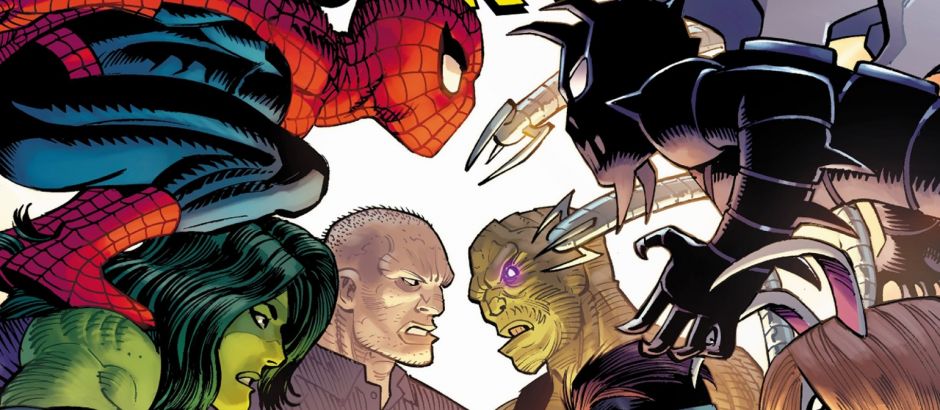
Gang War is a Marvel event created by Zeb Wells and John Romita Jr., published from November 2023 to March 2024. After Tombstone is gunned down, New York's crime families fight over control of the underworld. The main story runs through Amazing Spider-Man #39 to #44, preceded by the prologue Gang War: First Strike, and continues across five tie-in series, twenty-nine issues in total.
Marvel's big events usually pit gods, cosmic armies or entire universes against one another. This one plays out at pavement level: New York crime families fighting over neighbourhoods, and a handful of street-level heroes forced to choose between standing aside and taking sides. That change of scale is what makes Gang War interesting - and it is also what makes it the most useful event for working out who controls what in this universe's underworld, a subject usually scattered across dozens of series.
Gang War: the editorial facts
The event was created by writer Zeb Wells and artist John Romita Jr., and published between November 2023 and March 2024. Marvel had announced it a few months earlier as its next big crossover, which tells you all about the ambition: this was not a simple series arc but an operation coordinated across several titles.
The structure is classic and easy to follow. A prologue, Amazing Spider-Man: Gang War First Strike #1, sets up the situation. The main story unfolds in Amazing Spider-Man #39 to #44. Five tie-in series cover the other protagonists: Daredevil, Luke Cage, Deadly Hands of Kung Fu, Miles Morales and Spider-Woman, plus an issue devoted to Jackpot. Counting the prologue, the whole thing comes to twenty-nine issues.
John Romita Jr.'s name is worth noting, given how closely his family is bound up with this character: his father fixed the features we all know, as the article devoted to John Romita Sr. recounts. To place this event among the other great storylines, the page listing Spider-Man's story arcs gives the complete reading order.
The starting point: Tombstone gunned down
It all begins with an attack. Tombstone, an established figure in the New York underworld, is gunned down. He is not just one criminal among many: he held a balancing position, the one that stopped the other families from declaring war on each other. Remove him and you open up a succession.
What follows is mechanical, and that is what makes the story believable. Every organisation sees an opportunity in the vacuum, nobody wants to be served last, and the city tips over within days. The logic is that of a turf war, not a supervillain's plan: there is no single mastermind to defeat, which deprives the heroes of their usual method.
That shift puts Spider-Man in an uncomfortable position. His rule of conduct - no killing, no siding with one criminal camp against another - becomes hard to hold when doing nothing means letting whole neighbourhoods change hands. That is the real subject of the event, and it runs through every tie-in series. The silhouettes of this urban period feed a good part of the Spider-Man posters with their darker graphic treatment.
COLLECTABLE FIGURES

Detective Spider-Man Figure
This event tells the story of a Spider-Man who investigates more than he punches, in a city he no longer quite understands. This piece captures exactly that stance, in a display format that sits well on a shelf with a darker palette.
79.90 €
Discover →Who is fighting whom: the map of the families
This is the real value of the event for a reader: it gathers into a single story figures who are usually scattered. You come across Hammerhead, the mobster with the reinforced skull, a direct heir to gangster-film imagery; Mr. Negative, whose split personality makes him an unstable gang boss; and the Beetle, whose armour has passed from hand to hand down the generations.
Above the melee looms the shadow of Kingpin, still the benchmark for criminal control of the city, and that of his heir, The Rose. Other, less prominent figures have their say too, such as The Hood, who unites the superhuman underworld, or Silvermane, the Maggia's cybernetic veteran.
You also have to add the second-stringers, who often provide the flavour in this kind of story: Crime Master, forever a pretender to the title, or White Rabbit, whose eccentricity cuts against the seriousness of everything else. The page listing Spider-Man's villains lets you place each of them before you start, and the Spider-Man figures cover a good part of that gallery.
The heroes called up, and why those ones
The choice of tie-in series is not arbitrary: they are all street-level hero titles, working at ground level. Daredevil is the natural partner for this kind of plot, since organised crime is precisely his territory. Luke Cage brings a different point of view, that of a man with official responsibilities to defend on top of a neighbourhood.
Miles Morales has his own series involved, which makes sense: Brooklyn is directly affected by any redistribution of territory. Jackpot gets an issue to herself, and a Spider-Woman series takes part as well. Together they give a fairly complete picture of who protects what in this city at that moment.
One notable absence: the cosmic teams. No planetary outfit turns up to sort the problem out, and that is a choice. Gang War works because it refuses the easy solution - an event where the Avengers land in the third issue would only have told a story about mismatch. That human scale runs through the imagery of the period, widely picked up on the Spider-Man t-shirts and Spider-Man stickers with a comics feel.
PRINTS AND POSTERS

Spider-Man Daily Bugle Article Poster
A turf war is told in the newspapers as much as in the alleyways. This poster takes the layout of a New York front page, a motif that sits particularly well with the character's urban stories.
22.90 €
Discover →What the event actually changes
It is worth being honest about the scope. Gang War does not redraw the Marvel universe: no major character dies for good, no law of physics is altered, and the city stays the city. What the event moves are positions - who runs what, who owes whom a favour, which alliances of convenience will survive.
That modesty is also its quality. Underworld stories age better than cosmic crises, precisely because they do not claim to change everything. A reader picking the event up today does not need three years of continuity to understand what is at stake: a seat is empty and several people want it.
The other contribution is structural. By gathering all these criminals into a single plot, the event creates relationships between characters who never used to meet, and hands later writers a usable map. It is the same service performed, in a tighter format, by bringing the villains together in the Sinister Six.
Why a street-level event rather than a cosmic crisis
The editorial decision deserves explaining, because it runs against what most big crossovers do. For the past twenty years or so the trend has been to raise the stakes: one universe threatened, then several, then the whole multiverse. The arithmetic problem is well known - once everything has been threatened, there is nothing left to put in danger, and the reader stops believing.
Gang War takes the opposite route. The stakes are streets, businesses, families. Nobody risks the end of the world, but everybody risks something concrete. That is what lets the story hold up over twenty-nine issues without escalation, where a cosmic confrontation has to keep going up a gear to hold your attention.
This choice has a direct precedent in the character's history. The series' best periods are often the ones where the hero has rent, work and neighbour problems at the same time as fights. The stories that take him away from New York are rarely the ones anyone remembers. The urban imagery that comes out of it runs through the Spider-Man backpacks as much as the Spider-Man caps in the catalogue.
Where to start if you want to read it
The shortest route is also the most satisfying: the prologue, then the six issues of the main series. That is enough to follow the plot from end to end. The tie-in series add points of view but are not needed to understand it - which is good news, twenty-nine issues being a considerable investment.
For anyone who wants the full journey, the most readable order is to read each tie-in block in one go rather than alternating issue by issue: the four-issue Daredevil and Luke Cage arcs read better in a single sitting. The reading guides gathered on the guides and advice page set out other approaches depending on the time you have.
One useful prerequisite, though: knowing Tombstone. The whole story rests on the gap he leaves, and a reader who does not know who he is loses the central mechanism from the first page. Half an hour spent on his background changes the experience completely - the same advice applies to most New York underworld stories. The everyday items that go with these re-reads, from Spider-Man mugs to Spider-Man blankets, are sorted by theme in the shop.
T-SHIRTS

The Amazing Spider-Man Comics T-Shirt
The main series logo is still the best marker for showing your attachment to the comics rather than the films. This cut takes the historic lettering on a knit that survives the wash without the print cracking.
29.90 €
Discover →Gang War and the rest of Spider-Man's career
The character has always had a particular relationship with organised crime, more distant than Daredevil's and more involved than that of the cosmic heroes. He lives in this city, he works in it, he knows people in it: the New York underworld is not a backdrop for him but a neighbourhood. That is what makes this kind of plot natural for him.
That closeness also produces his best dark stories. The Death of Jean DeWolff remains the benchmark of the genre, and its kinship with Gang War is obvious: in both cases, the hero discovers that the city is slipping away from him. The difference is one of scale - an investigation on one side, a war on the other.
To go further, each of the figures met in this event has a story of their own, listed on the page devoted to the characters of the Spider-Man universe. And for those who prefer stories where the city itself becomes the subject, Spider-Island offers the most spectacular variation on that theme. The Spider-Man phone cases with urban patterns carry on the same graphic vein.
What the event says about the Spider-Man of this period
The character goes through this story constantly outmatched. He does not have the means to stop a turf war, he does not have the authority to impose a truce, and by his own rules he does not have the right to side with the least bad camp either. That powerlessness drives the story, and it is faithful to what the character has always been: someone who arrives too late and limits the damage.
It is also what sets him apart from the other heroes involved. Where the crime bosses think in market share and the official characters think in jurisdictions, Spider-Man thinks in residents. The typical scene in this event is not a fight won, it is someone brought out of a building before the fire.
This reading sheds light on something often misunderstood: the stories where he loses are generally his best. The character does not work as an invincible hero but as a witness who keeps going, and a gang war is the ideal setting for that register. You find the same mechanism in the complicated relationship he has with Black Cat, herself straddling the two worlds the event sets at war.
One question the event leaves open, and probably on purpose: can a city be defended by individuals? Gang War does not settle it. The heroes save people, none of them saves New York, and the underworld reorganises around the empty seats. Stories that claim otherwise age badly; this one has the clear-sightedness to stop where the character stops. That is also what makes the event worth re-reading, where many crossovers from the same period are already dated by their own stakes. The motifs of this urban vein turn up on the Spider-Man toys as much as on the Spider-Man soft toys in the recent ranges.
Frequently asked questions
Which issues should I read for Gang War?
The prologue Amazing Spider-Man: Gang War First Strike #1, then Amazing Spider-Man #39 to #44. The tie-in series - Daredevil, Luke Cage, Deadly Hands of Kung Fu, Miles Morales, Spider-Woman and a Jackpot issue - complete the set, for twenty-nine issues published between November 2023 and March 2024.
Do you have to read all the tie-in series?
No. The main series is enough to follow the whole plot. The tie-ins add extra points of view on neighbourhoods and supporting characters, but none is essential to understanding how it unfolds or how it ends.
Who started the gang war?
The trigger is the attack on Tombstone, whose removal leaves a balancing position vacant in the New York underworld. The crime families then race for control of the territory, with no single mastermind organising it all.
Does Gang War have anything to do with the films?
None so far. It is a comics event, published between late 2023 and early 2024, with no adaptation announced. Several of the characters it puts on stage have, however, been seen in the films or in video games, which makes the whole thing more familiar than it looks to a reader coming from the adaptations. The overview of the filmed versions is set out on the page devoted to the films.
What happens to Tombstone after the event?
His fate and his position in the underworld shift across the series that follow, without any definitive status emerging - that is the normal state of organised crime characters at Marvel, who rise and fall according to what writers need. His overall journey, from his origins to his current place, is traced in the article devoted to him.
Is it a good entry point into recent comics?
Yes, on one condition: knowing who Tombstone is. The event is self-contained, reads without knowing the previous years of continuity, and presents the essentials of the New York underworld in a single story. It is one of the few recent crossovers you can recommend without reservation to a returning reader.

