
14-Day Money-Back Guarantee
0
The short answer
Otto Gunther Octavius first appears in Amazing Spider-Man #3 in July 1963: a nuclear physicist whose four mechanical tentacles are fused to his spine during a laboratory accident. Founder of the Sinister Six, he goes as far as stealing Peter's body in Superior Spider-Man. Full breakdown below.
In the vast gallery of enemies who have crossed Spider-Man's path since 1962, few characters have marked the collective imagination as deeply as Doctor Octopus. Otto Octavius, to give him his real name, is not a supervillain like the others. No mystical powers. No dark inheritance. No family tragedy. Just a brilliant scientist whom scientific pride turned into one of the most dangerous minds in New York. That singularity makes Doc Ock the antagonist who challenges Spider-Man not physically (even if he often outmatches him in raw strength) but intellectually — a duel of brains that goes far beyond the usual fist fights of superhero comics.
This article explores the character of Otto Octavius in depth — his scientific origins, his tragic transformation, his philosophical rivalry with Peter Parker, his creation of the Sinister Six, and his most surprising arc in Superior Spider-Man where he literally takes control of Peter's body. To understand why Doc Ock remains one of the most complex and most beloved supervillains in the Marvel universe after six decades of existence, you have to unpick every dimension of the character: scientific, psychological, narrative, ethical. Here is the complete analysis of an evil genius who amply deserves his place in the pantheon of the great Marvel antagonists. To go further on this subject, see also Stunner: the virtual supervillain Doctor Octopus created to exist more fully.

The Origins of Otto Octavius: A Broken Scientific Genius
Otto Gunther Octavius first appears in Amazing Spider-Man #3 in July 1963, created by Stan Lee and Steve Ditko barely a year after the birth of Spider-Man himself. That timing is no accident — it places Doc Ock in the very first circle of the web-slinger's great enemies, alongside the Green Goblin and the Vulture. At the time he was created, Otto is presented as one of the most brilliant nuclear physicists of his generation, a scientist recognised internationally for his work on radiation and atomic manipulation. His academic career is exemplary, his scientific publications are authoritative, his intelligence is praised by all his peers.
The central element of his transformation is the four mechanical arms he designed himself to handle radioactive materials at a safe distance. These artificial tentacles, controlled by a direct brain interface, represent a revolutionary feat of engineering for the comics era. Otto wears them proudly as a natural extension of his body, artificially boosting his scientific capabilities beyond normal human limits. But during one fateful experiment, a laboratory accident permanently fuses the mechanical arms to his spine, short-circuiting his nervous system and profoundly altering his psychology.
That transformation is not just an incidental physical change. The electric shock literally reorganises Otto's neural connections, releasing narcissistic impulses that his scientific training had kept in check until then. The rational man gradually becomes a megalomaniac convinced of his absolute superiority over humanity. This gradual psychological drift is what makes the character so tragic in narrative terms — Octavius did not choose his madness, it was imposed on him by a scientific accident. That tragic dimension brings him close to other figures such as Norman Osborn, who became the Green Goblin, also transformed by a scientific experiment that went wrong.
The Legendary Rivalry With Spider-Man: A Duel of Minds
From their very first encounter in Amazing Spider-Man #3, the fight between Doctor Octopus and Spider-Man is radically different from the web-slinger's usual confrontations. Where most supervillains bet on brute force or exotic physical abilities, Doc Ock plays mainly on the strategic level. Every one of his attacks is planned weeks in advance. Every trap takes into account Spider-Man's precise capabilities (the speed, the spider-sense, the flexibility). Every fight becomes a game of chess in which Otto anticipates Peter's moves before Peter has even thought of them.

That intellectual dimension of the fight is probably what makes the rivalry so fascinating in narrative terms. Stan Lee often said in interviews that Doc Ock was his favourite of the web-slinger's enemies, precisely because he forced Peter Parker to use his scientific intelligence as much as his physical powers. Spider-Man can move faster than Otto, but Otto can anticipate Peter's movements. Spider-Man can lift more than the classic mechanical arms, but Otto designed his tentacles to withstand exactly the pressure the web-slinger can apply. Every fight thus becomes a demonstration of both characters' intelligence rather than a simple physical battle.
The other fascinating dimension of their rivalry is that it goes far beyond physical confrontations. Doc Ock systematically tries to reach Peter Parker in his civilian life — by threatening Aunt May, by infiltrating the Oscorp laboratories, by manipulating the New York media. This psychological strategy turns every Doc Ock arc into an elaborate thriller rather than a simple superhero battle. That is probably what explains why Doc Ock arcs are regularly cited by fans as the best in the whole Spider-Man franchise — they combine spectacular action and narrative depth at a level few other antagonists reach.
Direct Match — Iconic Spider-Man 2 Scene

LEGO Spider-Man — Fight on the Train
169,90 €
Rebuild in bricks the legendary showdown between Spider-Man and Doctor Octopus on the roof of the train — the most memorable scene in the whole Sam Raimi trilogy.
Discover the Train Fight Set →The Sinister Six: When Doc Ock Becomes the Architect of the Evil Coalition
One of Doctor Octopus's most lasting contributions to the Spider-Man universe is the creation of the Sinister Six — the coalition of supervillains first formed in Amazing Spider-Man Annual #1 in 1964. It is Otto who personally gathers the web-slinger's six great enemies (himself, the Vulture, Mysterio, Electro, Kraven and Sandman) into a coordinated team capable of overwhelming Spider-Man through their combined action. This brilliantly simple idea — why attack one by one a hero you cannot defeat individually? — is so obvious in hindsight that it is almost surprising no other villain had thought of it before.
That creation places Doc Ock in a unique narrative position within the gallery of Marvel antagonists. He is not just one enemy among many — he is the organiser, the strategist, the brain who structures the whole opposition to Spider-Man. Over time the Sinister Six become a recurring team that re-forms in different iterations across the comics, the films, the video games and the animated series. Every new version reaffirms Otto's central role as the architect of that coalition, reinforcing his status as the most strategic supervillain in the Spider-Man universe.
The narrative success of the Sinister Six also influenced the very structure of Marvel superhero writing. The idea of a coordinated coalition of villains against an isolated hero became a major narrative trope, taken up in almost every big modern superhero franchise. The Avengers have their Masters of Evil, the X-Men have their Brotherhood, but it really is Doc Ock who invented the modern concept of the 'villain team' structured around a central brain. That narrative innovation alone justifies his place in the pantheon of the greatest supervillains ever created.
Superior Spider-Man: The Arc That Changed Everything
The most radical arc in the whole Doc Ock mythology is Superior Spider-Man, launched by Dan Slott in 2012. In that revolutionary saga, Otto Octavius manages to transfer his consciousness into Peter Parker's body, condemning Peter to die in Otto's dying body while Otto lives Spider-Man's life with all its resources. This major narrative twist opens one of the deepest explorations ever made of what it really means to be a hero — and what it would take for a great villain to become a great hero.
The twenty-five issues of Superior Spider-Man follow Otto as he gradually learns the role of Spider-Man. At first he keeps to his antagonist methods — brutally eliminating criminals, intimidating civilians, acting with narcissistic contempt for other people's feelings. But gradually, by living Peter Parker's life, by interacting with his loved ones, by feeling the same moral responsibilities, Otto discovers something he had never understood before: the emotional complexity that defines the web-slinger. That gradual epiphany profoundly transforms the character and reveals that Otto, beneath his shell of narcissistic scientist, in fact possesses a genuine capacity for forgiveness and self-improvement.
The arc ends with Otto voluntarily sacrificing himself to give his body back to Peter Parker, acknowledging that the web-slinger is a better Spider-Man than he himself will ever be. That emotionally rich conclusion retroactively elevates the whole character of Doc Ock — he is no longer simply a narcissistic supervillain, he is a wounded man capable of moral growth in the right circumstances. That psychological nuance echoes the full analysis of Superior Spider-Man, which details why that arc is probably the most important of the 2010s in modern Spider-Man writing.
Fighting Energy — Strategy in Action
Marvel Spider-Man Mug
24,90 €
The mug that celebrates the wider Marvel universe — for fans who love Spider-Man facing his greatest scientific antagonists such as Doc Ock.
Grab the Marvel Mug →Doc Ock On Screen: Alfred Molina's Definitive Performance
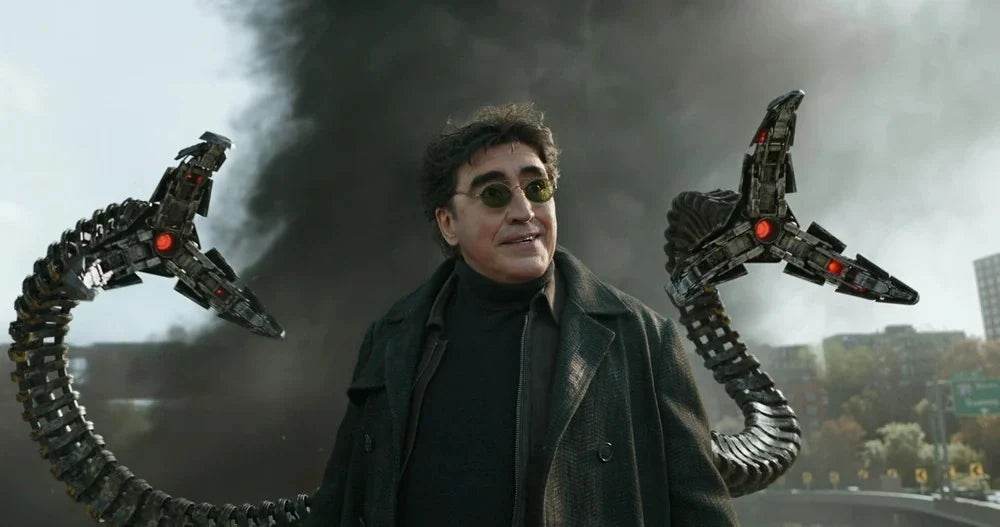
On screen, Doctor Octopus reached his absolute peak thanks to Alfred Molina's performance in Spider-Man 2 by Sam Raimi in 2004. Twenty years on, that performance is still considered one of the best portrayals of a Marvel supervillain ever brought to the screen — often cited alongside Heath Ledger's Joker and Tom Hiddleston's Loki in rankings of the greatest screen villain performances. Molina captures the whole psychological complexity of Otto: his initial scientific brilliance, his personal tragedy after the death of his wife, his growing madness under the influence of the mechanical arms, and finally his sacrificial redemption in the closing scene.
What makes Molina's performance so exceptional is that it balances physical menace and emotional depth perfectly. When Otto's mechanical arms stretch out and attack, you feel genuine terror. When Otto mourns Rosie's death, you authentically share his grief. When Otto finally chooses to sacrifice his life to save New York by plunging his fusion reactor into the Hudson River, you understand that this is not just a supervillain dying — it is a man who finally recovers his true identity at the very last moment. That final scene remains one of the most emotionally charged moments in the whole Sam Raimi trilogy.
Molina's return in Spider-Man No Way Home in 2021 confirmed the public's lasting attachment to that interpretation. Seventeen years after his first appearance, Molina picks the role back up with disarming ease, proving that some acting performances travel through the eras without losing any of their impact. The scene where he is offered the 'cure' for his mechanical arms in No Way Home is probably the most emotionally satisfying moment of the film for fans of the 2000s — a genuine narrative conclusion for a character who amply deserved to get his redemption on screen.
Why Doc Ock Is So Dangerous: The Complete Arsenal
Beyond his psychological dimension, Doctor Octopus combines several physical and strategic assets that make him one of Spider-Man's most formidable opponents. His four mechanical arms can each lift several tonnes, are capable of synchronised independent movements, can extend over several metres to attack at a distance, and are fitted with sensory receptors that complement his own human senses. This artificial bodily extension amply compensates for the absence of traditional biological powers and places Otto in the category of supervillains able to physically stand up to Spider-Man through prolonged confrontations.
Otto's scientific genius multiplies that physical danger further. Where other antagonists are content to use their powers instinctively, Doc Ock designs his own weapons, his own traps, his own secret laboratories. Several comics arcs see him build scientific devices of such complexity that they threaten the whole of humanity — unstable nuclear reactors, large-scale mind-control satellites, climate machines capable of altering the planetary environment. That outsized technological ambition brings him close to fiction's great scientific criminals such as Lex Luthor or an evil Mr Fantastic.
The other element that makes Doc Ock so dangerous is his deep knowledge of Peter Parker. Over the decades of comics, Otto ended up discovering the secret identity of Spider-Man (before it was wiped several times by various narrative manipulations). That knowledge gives him a massive strategic advantage — he can attack Peter in his civilian life, threaten his loved ones, exploit his emotional weaknesses. No other supervillain has ever had this psychological intimacy with the web-slinger, and it is that narrative singularity that makes every Doc Ock return in the comics particularly intense emotionally.
The Alternative Versions In The Multiverse
With the advent of the Spider-Man multiverse, Doc Ock has had dozens of alternative versions that explore different facets of the character. The 1930s Spider-Man Noir version offers a more primitive, more brutal Otto, without the intellectual finesse of his canonical comics version. The Ultimate Marvel version rejuvenates the character by anchoring him in a more credible contemporary science. The animated version in the children's series softens the menacing side to make him acceptable to a young audience.
One of the most surprising variants is the female Otto who appeared in certain branches of the multiverse — a version in which Olivia Octavius (sometimes called 'Liv' Octavius) takes over the scientific role with a completely different psychology. That version appears briefly in Into the Spider-Verse in 2018, where she is voiced by Kathryn Hahn in a comic register that contrasts sharply with the gravity of the Molina version. That diversity of multiverse interpretations proves the lasting richness of the concept — the scientist broken by his own tools can take almost any form while keeping his narrative essence.
Modern video games, particularly Marvel's Spider-Man on PS5, offer their own particularly interesting version of Otto Octavius. Insomniac Games develops a longer and more emotional version of Otto's transformation — you meet him as Peter's scientific mentor before he becomes Doc Ock, you gradually witness his psychological drift, you feel his pain grow ever more intense. That approach turns the final fight into a genuine emotional tragedy rather than a simple boss fight, and it is probably the best adaptation of the character ever achieved in an interactive medium.
The Narrative Legacy: Why Doc Ock Will Remain Iconic
Beyond all his incarnations, Doctor Octopus remains fundamentally a character who poses an essential philosophical question: what separates heroic genius from evil genius? Before his accident, Otto Octavius could have been another Tony Stark — a brilliant scientist using his intelligence for the common good. After his accident, he becomes another Green Goblin — a man turned by his own technology into an uncontrollable monster. That fragile border between the two destinies is probably what makes the character so universally fascinating. Doc Ock embodies the dark mirror of all scientific ambition — the possibility that our own tools corrupt us until they turn us into something we would never have wanted to be.
That philosophical dimension raises Doc Ock above most Marvel supervillains. He is not a villain who wants to destroy the world out of pure sadism. He is a man who wanted to improve the world through his science and who ended up becoming the embodiment of the excesses he initially fought. That tragedy is universal, it speaks to anyone who has ever seen their good intentions corrupted by circumstances or by their own weaknesses. That is probably why so many fans identify deeply with the character despite his antagonistic nature — they recognise in Otto a possible version of themselves in different circumstances.
Collector's Piece — Articulated Web-Slinger

LEGO Spider-Man Figure
59,90 €
The articulated web-slinger in bricks — the ideal collector's piece to pay tribute to every epic showdown between Spider-Man and Doc Ock across the decades.
Discover the Figure →The questions people really ask about Doc Ock
Knowing who Otto Octavius is takes ten seconds. The questions that follow have no one-line answer, and they are the ones readers ask us most often.
Is Doctor Octopus dead?
Several times, and never permanently. His most striking death comes at the end of the arc in which he swaps minds with Peter Parker: Otto's body dies, but his consciousness survives in the web-slinger's. He then came back in various forms.
It is a constant of the character: unlike most villains, his survival does not rest on his physical resilience but on his ability to transfer, back up or duplicate his mind. The detail is developed in our article on the Dying Wish arc and in the one devoted to Superior Spider-Man.
Who would win between Spider-Man and Doctor Octopus?
The question has no single answer, because the balance of power depends entirely on the terrain. In brute strength and reach, the mechanical arms outclass the web-slinger. In speed, in agility and thanks to the spider-sense, Spider-Man keeps the advantage in open space.
The confrontations Otto wins are almost always the ones he has prepared: a chosen location, suitable equipment, Peter lured to where his reflexes are not enough. He is an opponent who wins through planning, not through power.
How many arms does he have, and what are they made of?
Four mechanical appendages, attached to a harness worn on his back, on top of his two human arms. Originally designed to handle radioactive materials at a distance, they have been controlled directly by thought since the accident that fused them to his nervous system.
It is that neural connection that makes the difference with a simple exoskeleton: the arms react as fast as his own limbs, and they keep acting even when he is unconscious. We set out his full arsenal higher up in this article.
Which films does he appear in?
Alfred Molina plays him in the second instalment of Sam Raimi's trilogy, then takes the role back up decades later in the film that reopens the multiverse. It is one of the rare villain interpretations to have crossed two eras of superhero cinema with the same actor.
To place those films in relation to one another, our reference page on the order of the Spider-Man films gives the complete chronology.
Where can you find products featuring him?
The character is widely represented in figures and building sets, often paired with the web-slinger. Our Spider-Man figures bring together the collector's pieces, our Spider-Man toys cover the formats aimed at children, and our posters feature several of his best-known confrontations. Villain lovers will also find plenty to enjoy in our Venom and symbiote figures and our Spider-Man masks.
Conclusion: Marvel's Most Complete Evil Genius
Doctor Octopus remains one of the most brilliantly designed characters in the whole Spider-Man mythology. From his comics origins in 1963 through to his modern adaptations in film and video games, by way of the revolutionary arc Superior Spider-Man, Otto Octavius embodies narrative complexity at a level few other supervillains reach. He combines the physical menace of the great traditional antagonists with the psychological depth of tragic characters, all carried by a philosophical dimension that questions the border between science and hubris.
For fans who want to deepen their knowledge of the character, several entry points exist. The classic comics arcs by Stan Lee and Steve Ditko from the 1960s offer the narrative foundations. The saga Superior Spider-Man by Dan Slott explores the deepest psychological dimension. The film Spider-Man 2 by Sam Raimi offers the best cinematic adaptation. And the PS5 games by Insomniac Games develop a particularly moving video game version. Whatever your entry point, Doc Ock amply rewards the time invested. To go further into the world of Spider-Man's great antagonists, dive into our analyses of the web-slinger's seven most powerful enemies or explore the Spider-Man figures collection which includes several versions of Doc Ock across the eras. Otto Octavius definitely deserves his place in any serious Spider-Man collection — he is probably the most complete evil genius Marvel has ever created.

